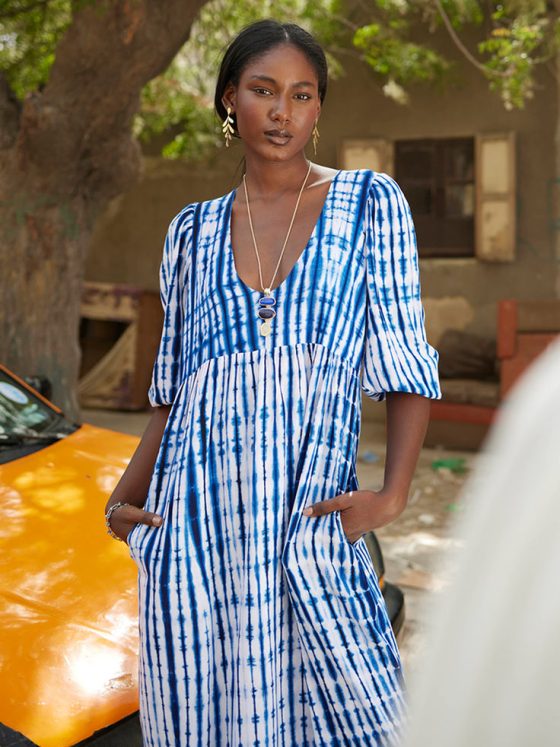
In Abeokuta, Ogun State, some women know how to fold and tie resist patterns on cotton cloth before submerging it in indigo pits maintained by their families for generations. The resulting adire is not decorative. The patterns encode meaning specific to the Egba Yoruba community: social position, ceremonial context, and the vocabulary of a dye tradition whose grammar took decades to learn. In 2025, those women will be teaching their daughters. Not because the Nigerian government has funded a craft preservation programme. Not because a luxury house has endowed an artisan fellowship. Because the knowledge would otherwise disappear, and they understand what disappearance costs.
This is the condition of African craft in 2025. Alive, practised, transmitted, and almost entirely unsupported by the institutional infrastructure that comparable European craft traditions take for granted. LVMH’s Métiers d’Art programme funds the preservation of French craft traditions across nineteen specialist houses. Its equivalent for African craft traditions does not exist. The African Development Bank identifies creative and cultural industries as a strategic priority. The investment pipeline that would make that identification meaningful has not materialised. What has materialised, instead, is a generation of African fashion designers who have decided not to wait.
Artisans did not abandon African craft traditions. They were abandoned by policy. A generation of designers is doing the institutional work that governments have not.
What State Disinvestment Actually Looks Like
The pattern of state disinvestment in African craft is not uniform across the continent, but its consequences are consistent. In Nigeria, the textile sector that once directly employed over 600,000 workers has contracted to a fraction of that figure following decades of import liberalisation, competition from cheap Chinese fabric, and the collapse of government support for the cotton supply chains that domestic mills required. As Omiren Styles has documented in its analysis of the Ankara economy, the cultural premium embedded in Ankara fabric is African in origin. The financial capture of that premium has largely moved offshore. The artisans who produce the source traditions for one of the continent’s most commercially significant textile aesthetics have not been the primary beneficiaries of that aesthetic’s global commercial success.
In Ghana, kente weaving communities in Bonwire and the Volta Region have maintained strip-loom traditions for centuries. The 2025 Geographical Indication registration of kente was a significant institutional step. What preceded it was decades of unprotected cultural appropriation during which kente-inspired patterns were manufactured in China and sold in global markets without credit or compensation to the communities that developed them. The GI registration came after the commercial damage was already extensive. As Omiren Styles has documented in its analysis of authentic kente sourcing, every purchase of counterfeit kente is a financial transaction with a specific consequence: income that should reach Asante and Ewe weavers is redirected to factories that contribute nothing to the tradition being sold.
The Designers Who Stepped Into the Gap
The response from African fashion designers to this institutional failure has not been primarily rhetorical. It has been practical. Emmanuel Okoro of Emmy Kasbit arrived in Abeokuta’s Akwete weaving communities and found the looms nearly idle because demand had collapsed. His response was to commission directly from the weavers, integrate Akwete cloth into collections shown at Lagos Fashion Week, and build a supply relationship that gave the artisans a reason to continue. The looms did not return to full production because of a government programme. They returned because a designer made a commercial decision that treated the craft as worth preserving. This is the model that is quietly rebuilding African craft infrastructure, one designer-artisan relationship at a time.
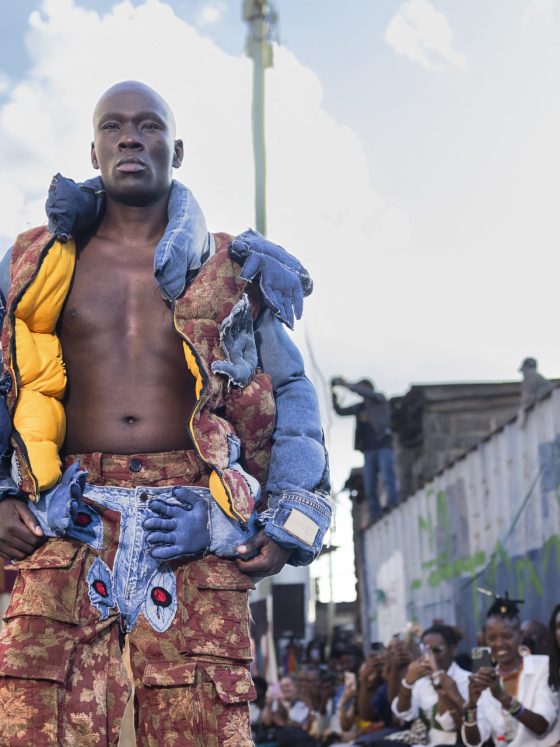
Nkwo Onwuka’s label NKWO has operated on the same principle since 2007, building luxury from deadstock, denim offcuts, and post-consumer textile waste in a practice that Omiren Styles has documented as predating the Western sustainable fashion conversation by nearly a decade. Her Dakala cloth process, which transforms denim waste into a new textile through cutting and reconstruction, is both a craft practice and an argument: that the raw material for African luxury is already present in what the system has discarded, and that the knowledge to transform it belongs to African makers.
Adèle Dejak in Nairobi builds her jewellery practice from recycled brass, bone, and found East African materials, drawing on the geometry of Maasai beadwork as a design grammar while producing entirely contemporary objects. Her practice demonstrates what Omiren Styles has documented in its analysis of African craft and handmade fashion: that craft in many African contexts was never abandoned. It adapted, sometimes quietly, sometimes under pressure. What is changing now is visibility and control.
Why This Is Industrial Policy, Not Nostalgia
The argument these designers make is not sentimental. It is economic. African craft traditions represent intellectual property developed over centuries and embedded in the specific technical knowledge of specific communities. That intellectual property has been systematically extracted without compensation by global fashion markets. The designers who are rebuilding relationships with artisan communities are not preserving the past for its own sake. They are building the supply chains, the quality standards, and the commercial relationships that would allow African craft to compete in the global luxury market on its own terms.
The scale of what is not happening makes the significance of what is clear. LVMH’s Métiers d’Art programme supports nineteen specialist craft houses across France. Its equivalent for Africa, a continent whose textile and craft traditions represent some of the most technically sophisticated production in the world, does not exist. The Hermès Manufactures invest in artisanal infrastructure in France. An equivalent commitment to the African textile sector has not materialised. As Omiren Styles has argued, the capability to build this is not the barrier. The will is. In its absence, individual designers are doing institutional work with individual-scale resources. That is not sustainable as a long-term model. For now, it is what keeps the knowledge alive.
The most significant institutional development in 2025 is the Lagos Fashion Week Earthshot Prize win, which brought £1 million to a circular fashion hub whose model is explicitly designed to be replicated in Kigali, Dakar, and Accra by 2030. That prize was awarded not for a runway show but for fifteen years of infrastructure-building: designer development programmes, artisan supply chain relationships, and the documented evidence that fashion can function as industrial policy when the institutions commit to it. It is the first time a major international prize has treated African fashion infrastructure as the point rather than the aesthetic output. It is a beginning.
The Omiren Argument
Artisans did not abandon African craft traditions. They were abandoned by policy. The women in Abeokuta’s adire pits did not stop because the tradition lost its meaning. They continued under conditions of institutional neglect that would have ended European craft traditions of equivalent age and complexity within a generation. The fact that the knowledge survived is not evidence that the neglect was acceptable. It is evidence that the communities carrying the knowledge were more committed to its survival than the governments and institutions nominally responsible for cultural preservation were.
The designers doing this work now, building direct artisan relationships, commissioning from craft communities, integrating handcraft into commercial collections with full attribution, are performing a function that should be institutional. They are doing it at the scale available to individual creative businesses rather than at the scale that the problem requires. As Omiren Styles has documented in its analysis of what hand-weaving lost to mass production, when craft knowledge disappears, what disappears is not simply a technique. It is a system of meaning that the technique was the vehicle for. The looms in Abeokuta are not just looms. They are the physical infrastructure of a knowledge system that has survived colonialism, import liberalisation, and global competition. They deserve more than the continued good intentions of individual designers.
The state abandoned African craft. Designers are doing the work anyway. The question now is whether the institutions will arrive before the knowledge does.
ALSO READ
- From Handmade to High Fashion: Why Craft Feels Radical Again
- What the World Lost When Hand-Weaving Gave Way to Mass Production
- Why European Luxury Houses Invest in Afrobeats Stars but Not African Fashion Infrastructure
- African Textile Museums: Preserving Memory in an Age of Fast Fashion
Frequently Asked Questions
Why have governments and institutions underinvested in African craft?
The pattern differs by country, but the underlying causes are consistent: decades of import liberalisation that exposed domestic craft-based textile production to competition from cheaper industrially produced alternatives, the collapse of government support for the raw material supply chains (particularly cotton) that domestic craft production requires, and the absence of an institutional infrastructure equivalent to what European governments have built for their craft traditions. LVMH’s Métiers d’Art programme supports nineteen specialist French craft houses. No equivalent exists for African craft traditions of comparable age and technical complexity.
Which African designers are most actively rebuilding craft relationships?
Emmanuel Okoro of Emmy Kasbit has rebuilt the Akwete weaving supply chain in Abia State through direct commissioning of designers and artisans. Nkwo Onwuka’s NKWO label has built a luxury practice from post-consumer textile waste, transforming deadstock into new cloth through the Dakala process. Adèle Dejak in Nairobi builds jewellery from recycled East African materials, drawing on Maasai beadwork geometry. All three demonstrate that the commercial and the artisan-supportive are not in tension. As Omiren Styles has documented, what is changing is visibility and control: artisans are no longer anonymous producers but authors of work whose cultural origin is documented and credited.
What is the difference between craft preservation and craft commercialisation?
The distinction is less important than it appears. Craft that is not commercially viable does not survive. The women in Abeokuta’s adire tradition are not maintaining their knowledge for archival reasons. They are maintaining it because it is their practice and, when it has buyers, their livelihood. Commercialisation that credits the source community, pays fairly, and builds a long-term relationship is preservation. Commercialisation that extracts the visual output without a relationship or compensation is not. The designers documented in this article are doing the former.
What did the Lagos Fashion Week Earthshot Prize mean for African craft?
The 2025 Earthshot Prize win in the “A Waste-Free World” category, with £1 million for a circular fashion hub designed to be replicated in Kigali, Dakar, and Accra by 2030, was significant because it was awarded for infrastructure rather than aesthetic output. It recognised fifteen years of designer development programmes, artisan supply chain relationships, and documented commercial outcomes as a model worth funding at scale. It is the first time a major international prize has treated African fashion infrastructure as the central achievement rather than runway work.
Why is this an argument about industrial policy rather than cultural preservation?
The craft knowledge that African fashion designers are working to preserve represents intellectual property with significant commercial value that has been systematically extracted without compensation. The 2025 Kente Geographical Indication registration in Ghana is one documented step toward correcting that. The designer-artisan relationships being built across the continent are another. As Omiren Styles has argued, the question is not whether African craft traditions are worth preserving for cultural reasons. It is whether the economic value they generate can be structured to flow back to the communities that developed them. That is an industrial policy question, and it requires institutional answers at the institutional scale.