On 15 March 2026, the members of the Association des Créateurs de Mode du Bénin gathered for an elective general assembly at their building in Cotonou’s Agontinkon district. The agenda was specific: revisit the association’s governing texts, adopt amendments to clarify and modernise governance, and elect a new executive bureau. When the vote was counted, Jerry Sinclair Aguénoukoun had been elected president. In his address, he acknowledged that the association had traversed what he called “une période délicate,” a delicate period, and called on members to unite to rebuild an organisation that was “forte, crédible et utile” — strong, credible, and useful.
Those three words are a precise diagnosis of what a designers’ association needs to be. Strong enough to represent the sector with institutional authority. Credible enough that its members and partners treat it as a legitimate voice. Useful enough that individual designers and brands find membership worth maintaining. The election of a new bureau in March 2026 is a reset moment: a sector that has been building its creative infrastructure across the decade since the association’s founding is now rebuilding the institutional infrastructure that should support it.
The Association des Créateurs de Mode du Bénin (ACMB) is the professional backbone of Beninese fashion. Here is what it does, who leads it, and why it matters in 2026.
The Omiren Argument:
ACMB is not a fashion industry accessory. It is the governance structure that determines whether Beninese fashion is a collection of individual practices or a sector with collective bargaining power, shared standards, and institutional presence. The quality of that governance structure shapes what the entire ecosystem can become.
What ACMB Is and When It Was Built
The Association des Créateurs de Mode du Bénin was formally constituted in September 2016. Its first leadership elections were held on 28 September 2016, the date confirmed in the Wikipedia article on Lolo Andoche, who was elected vice-president that day. The association describes its primary mission as the valorisation of the fashion sector at both national and international levels, providing a consolidated and credible view of the sector to government, partners, and the public. Its registered address is at Agontinkon, Cotonou, in the building that has also served as the meeting place for the Réseau des Agences et Instituts de Mannequinat du Bénin (RAIM BENIN).
The association’s founding coincided with a specific moment in Beninese fashion’s institutional development. President Patrice Talon took office in April 2016 and launched the Benin Revealed (Bénin révélé) economic development programme, which would eventually include GDIZ, Sème City, and Benin Fashion Month. The designers who formed ACMB in September 2016 were creating their representative body at the same moment that the government was creating the infrastructure that would shape the sector. The timing was not accidental.
Lolo Andoche, who served as both vice-president and later president of ACMB, was running an enterprise in 2019 with six boutiques, five sales points, and 130 employees. His presence in the leadership of a designers’ association reflects the kind of practitioner the association was built to represent: not emerging designers at the beginning of their practices but established creators with commercial operations who needed a collective voice in conversations with government agencies, international partners, and institutional funders.
What ACMB Does: Services, Events, and Social Role
ACMB’s activities fall across four documented categories. The first is commercial facilitation: the association organises expo-ventes and boutiques éphémères, sales exhibitions and pop-up shops, that provide member designers with access to retail opportunities beyond their own studios and boutiques. These events function as collective market access: a single designer cannot easily fill an expo-vente venue; a group of designers representing the full range of Beninese fashion can.
The second is training and professional development. The association’s stated approach is to provide a solid base for creativity and to standardise service offerings across members through training sessions and orientation visits. In a sector where formal design education is limited, the association’s training function serves a capacity-building role that no individual brand can perform for the sector as a whole.
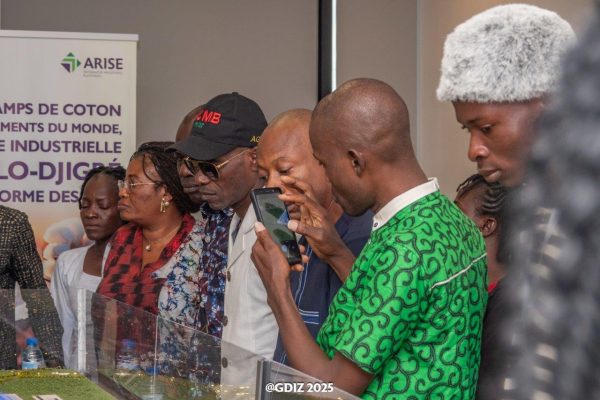
The third is institutional representation. ACMB has represented the fashion sector in meetings with the Ministry of Tourism, Culture and Arts and the Ministry of Small and Medium Enterprises. It co-delivers activities at Benin Fashion Month alongside ADAC, providing the designers’ perspective on the event’s programme and contributing to its expo-vente and boutique éphémère components. When ACMB designers visited GDIZ during Benin Fashion Month’s seventh edition in July 2025, that visit was organised through the association’s institutional relationship with the event rather than through individual designer access.
The fourth is social contribution. During the COVID-19 pandemic in 2020, ACMB members produced and donated more than 7,000 protective masks to vulnerable communities and ministries across Benin. The mask donation is documented on the ACMB website as an example of the association assisting its members and populations beyond strictly commercial interests. An association whose members’ production capacity can be mobilised for social purposes in an emergency has built sufficient internal cohesion to act collectively. The 7,000 masks are evidence of that cohesion.
The Delicate Period: What It Means and Why It Matters
Jerry Sinclair’s reference to “une période délicate” in his inaugural address is the most important phrase in the 15 March 2026 assembly coverage. Associational crises are common in emerging creative industries: founding enthusiasm gives way to disagreements over direction, resources, and representation; members drift away; governance structures that worked for a small group become inadequate as the membership grows; and the association loses the institutional credibility it was built to provide.
The specific nature of ACMB’s delicate period is not fully documented in public sources. What is documented is its resolution: the assembly adopted governance amendments for “clearer and more modern” governance, elected a new bureau, and charged it with rebuilding under Jerry Sinclair’s leadership. The presence of a bureau des sages and an équipe transitoire, both acknowledged in Sinclair’s address as having “played a determining role” in navigating the difficult period, suggests that the association had developed the internal dispute-resolution mechanisms of a mature institution. The crisis was managed from within.
The timing of the reset is significant. ACMB is rebuilding its internal governance at the same moment that Beninese fashion’s external infrastructure is at its most developed: Benin Fashion Month has completed seven editions, GDIZ is exporting to international brands, the FLY incubator has graduated its first cohort, and the FinAB competition has introduced a new generation of designers to a national platform. The association is resetting from a position where the external ecosystem is stronger than it has ever been. The question is whether the institutional reset will be fast enough to exploit that moment fully.
Jerry Sinclair Aguénoukoun: The President and What He Represents

Jerry Sinclair Aguénoukoun brings a specific institutional profile to the ACMB presidency. He is the artistic director of La Nuit de la Mode at Benin Fashion Month, the closing runway show of the government’s annual fashion event. In that role, he described FARE publicly as “a brand with spirit” after their Tailoring Ring collection at the 2025 edition, demonstrating both curatorial judgment and a public platform. He now holds the ACMB presidency, making him the only person with the most direct institutional connection between the government’s fashion event and the designers’ professional association.
This dual position is a structural asset for the ecosystem. When the artistic director of the government’s flagship fashion event is also the president of the designers’ association, the coordination between those two institutions does not require a formal partnership agreement or an interagency memorandum. It can happen through the judgment and priorities of one person who holds both roles. The risk is the same as any single-person institutional connection: if Sinclair leaves either role, the coordination advantage disappears with him. The benefit is the efficiency of aligned leadership during the period when he holds both.
His five stated priorities for the ACMB presidency are a programme for the sector’s next phase: reunifying members who may have drifted during the delicate period; strengthening associational life so members find active membership valuable; developing training programmes for the sector’s professional development; structuring member enterprises so they operate with proper commercial infrastructure; and creating international partnerships that give Beninese designers access to markets and collaborators beyond the domestic ecosystem. These five priorities map directly onto the gaps identified across this series: talent development, commercial structure, and international reach.
ALSO READ
- Benin Fashion Month: The Government-Backed Festival Quietly Reshaping West African Fashion
- Made in Benin: Designers and Brands to Watch in 2026
- GDIZ and the Made in Benin Dream: Inside Africa’s Most Ambitious Fashion Supply Chain
ACMB and the Broader Ecosystem: How the Pieces Fit
ACMB does not operate in isolation. It is one piece of an institutional architecture that includes ADAC (which organises Benin Fashion Month), Sème City (which runs the FLY incubator), GDIZ (which provides industrial supply chain infrastructure), the Ministry of Tourism, Culture and Arts (which holds the policy mandate), and the Empire Group (which organises FInAB). Each of these institutions serves a different function in the ecosystem, and the quality of coordination between them determines whether the ecosystem operates as a coherent national fashion strategy or as a collection of parallel institutional activities with limited mutual reinforcement.
ACMB’s specific role in this architecture is representation and collective action. It is the body through which designers speak to the government as a sector rather than as individuals. It is the body that can negotiate minimum conditions for Made in Benin labelling, advocate for reduced production costs through collective purchasing, and represent the creative community’s interests in conversations about GDIZ’s relationship with artisan-scale production. Individual designers can perform none of these functions, however successful they may be. They require an association.
The Beninese fashion ecosystem in 2026 is stronger than it has ever been at the level of individual practice: LOAN-H has 40+ country clients, FARE showed at La Nuit de la Mode, NEFER Couture operates between Paris and Cotonou, Président Djangoun has France 24 coverage, and the FinAB competition has produced a documented generation of emerging designers. The ecosystem’s next phase of development requires that these individual practices be supported by institutional infrastructure that can create the conditions for a sector rather than a collection of talented individuals. ACMB’s March 2026 reset is the moment when that institutional infrastructure is being rebuilt to meet the demand that the individual practices have already created.
What a Strong ACMB Would Make Possible
A designers’ association that is strong, credible, and useful, in Sinclair’s own terms, creates specific capabilities that the current ecosystem does not yet fully have. Collective bargaining with fabric suppliers reduces production costs for all members. Shared quality standards make Made in Benin a credible consumer signal rather than simply a geographic label. A training programme that is independent of individual brands creates a pool of skilled workers that the entire sector can draw on. International partnerships that the association negotiates on behalf of its members give individual designers access to markets they could not reach on their own.
None of these capabilities requires GDIZ to change its minimum order quantities or the government to increase its fashion budget. They require an association that has resolved its internal governance challenges and rebuilt its members’ trust. The March 2026 assembly’s adoption of clearer, more modern governance and its election of a new bureau with a specific mandate are the preconditions for those capabilities to develop. Whether they develop in the 18-24 months following the assembly will determine whether ACMB becomes the institutional backbone that Beninese fashion’s next phase requires.
“ACMB is not a fashion industry accessory. It is the governance structure that determines whether Beninese fashion is a collection of individual practices or a sector with collective bargaining power, shared standards, and institutional presence. The quality of that governance structure shapes what the entire ecosystem can become.”
Frequently Asked Questions
What is ACMB, and what does it do?
ACMB (Association des Créateurs de Mode du Bénin) is the professional association of Beninese fashion designers and creators, based in Cotonou. Founded in September 2016, it has a primary mission to valorise the fashion sector nationally and internationally, providing a consolidated institutional voice for designers in conversations with government, international partners, and the public. Its activities include organising expo-ventes (sales exhibitions), boutiques éphémères (pop-up shops), training programmes, and institutional representation. It also co-delivers activities at Benin Fashion Month alongside ADAC.
Who is the current president of ACMB?
Jerry Sinclair Aguénoukoun was elected president of ACMB at the association’s elective general assembly on 15 March 2026. He is simultaneously the artistic director of La Nuit de la Mode, the closing runway show of Benin Fashion Month. In his inaugural address, he called on members to unite to rebuild an organisation that is ‘strong, credible, and useful.’ He set five priorities: reunifying members, strengthening associational life, developing training, structuring member enterprises, and creating international partnerships.
When was ACMB founded, and who were its early leaders?
ACMB was constituted in September 2016, with its first leadership elections held on 28 September 2016. Lolo Andoche (Charlemagne Amoussou), Benin’s most established ready-to-wear designer and a kanvô specialist, served in both vice-president and president roles at different stages of the association’s history. During his presidency, he represented the association at the AGOA Forum in Abidjan in 2019, showcasing kanvô-based collections to an international business audience. His enterprise had six boutiques, five sales points, and 130 employees at that time.
What were the five priorities announced by the new ACMB president?
Jerry Sinclair Aguénoukoun announced five strategic priorities for his ACMB presidency: first, reunifying members who may have drifted during the association’s recent difficult period; second, strengthening associational life so active membership is valuable; third, developing training programmes for professional development across the sector; fourth, structuring member enterprises with proper commercial infrastructure; and fifth, creating international partnerships that give Beninese designers access to markets beyond the domestic ecosystem.
How does ACMB relate to Benin Fashion Month and GDIZ?
ACMB co-delivers activities at Benin Fashion Month alongside ADAC, the government’s arts and culture agency. Its contributions include expo-ventes, boutiques éphémères, and participation in the event’s training and professional development components. During the seventh edition of Benin Fashion Month in July 2025, ACMB designers visited GDIZ, the Glo-Djigbé Industrial Zone, which connects the artisan and designer sectors directly to Benin’s industrial cotton-to-garment infrastructure. ACMB also advocates for Made in Benin labelling and for creating conditions that would allow Beninese designers to access GDIZ’s production capacity.
How does ACMB fit into the broader Beninese fashion ecosystem?
ACMB is one of several institutions shaping Beninese fashion’s development. The ecosystem includes ADAC (Benin Fashion Month organiser), Sème City (FLY incubator host), GDIZ (industrial supply chain), the Ministry of Tourism, Culture and Arts (policy mandate), and the Empire Group (FInAB organiser). ACMB’s specific role is the one none of the others can fill: representing the designers’ sector as a collective voice in conversations with all the others. Its effectiveness at this function, particularly after the March 2026 governance reset, will significantly influence whether Made in Benin becomes a coherent national fashion sector or remains a collection of talented individual practices.
Explore more from our Industry section, where Benin’s fashion infrastructure is documented with the institutional precision the sector deserves.