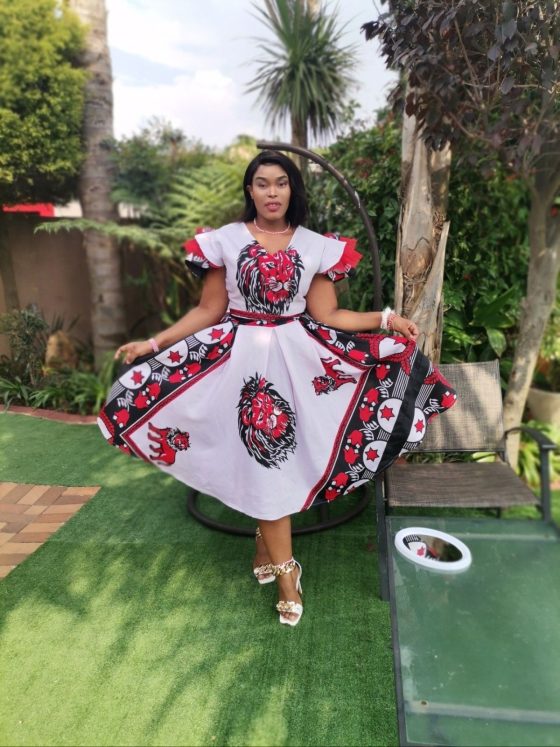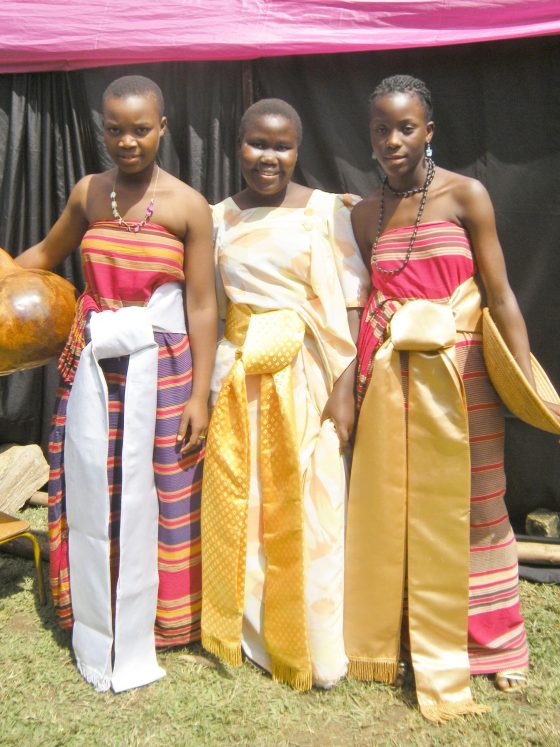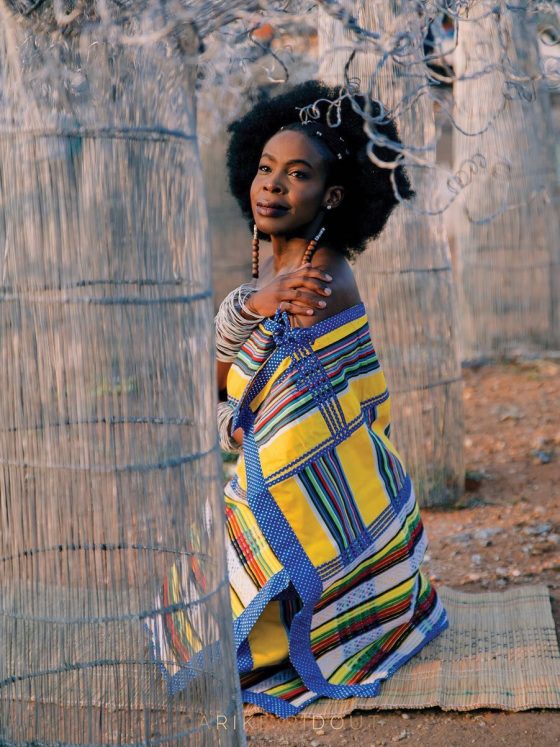
There is a photograph of Hendrik Witbooi that the German colonial administration produced before it tried to kill him. He is a slight man in a dark coat and wide-brimmed hat, with an expression that conveys something between resignation and absolute determination. The photograph was intended to document a subject of colonial administration. It ended up documenting a man who understood that dress communicates political authority, and who dressed accordingly.
Witbooi was the Kaptein of the Witbooi Nama clan. On 3 October 1904, he revolted against German rule in what is now Namibia, rallying his people to fight for their freedom. He died in battle in 1905, aged approximately 75, fighting a colonial military force equipped with the most advanced weapons of the early twentieth century. His face is now on the Namibian dollar note. His people’s dress has never appeared in a fashion publication.
The Herero and the Nama both suffered the German colonial genocide of 1904 to 1908. Both adopted the Victorian missionary dress introduced during the colonial era. Both transformed that dress into a cultural identity. The Herero Ohorokova is photographed in every travel editorial about Namibia. The Nama Kaplyn and long dress have never appeared in a fashion publication. This article is the account that corrects that absence.
The Herero and the Nama both survived the German colonial genocide of 1904-1908. Both adopted the same missionary dress. Only one of them gets photographed in travel editorials. This is the account that corrects that.
The People That History Keeps Forgetting

The Nama, also known historically as Namaqua and belonging to the larger Khoikhoi group of the Khoisan peoples, are the largest Khoisan ethnic group in Namibia, comprising approximately 5% of the country’s population. They are primarily concentrated in central and southern Namibia, with smaller communities in Namaqualand straddling the Namibia-South Africa border and additional groups in Botswana. Their language, Khoekhoegowab, is one of Namibia’s official languages and is also spoken by the Damara people, reflecting a deep historical relationship between the two communities that navigated similar colonial pressures within the same geographic territory.
Between 1904 and 1908, the German Empire waged a war of extermination against both the Herero and the Nama peoples of German South West Africa. Approximately 10,000 Nama died, half their pre-war population, in what is now formally recognised as genocide. The Herero losses were proportionally even greater, and the Herero community’s post-genocide cultural expression, including the ohorokova dress, has become the more internationally recognisable story. But the Nama suffered the same campaign, lost the same proportion of their people, and have been maintaining their own post-genocide cultural identity in their own dress tradition ever since.
That dress tradition is the subject of this article. One distinction needs to be established clearly before it can be discussed: the Nama are not the Herero. Their adoption of Victorian dress is not the Herero adoption. Their relationship to the garment is different, their pre-colonial material culture is different, and the specific form their dress has taken is different enough to constitute a distinct fashion tradition that deserves its own account.
Before the Missionaries: What the Nama Wore
The pre-colonial Nama material culture is documented in ethnographic sources and in the surviving practices of the Richtersveld community, the last Nama group to maintain elements of their nomadic pastoral tradition in the context in which it was originally developed.
The early Nama dressed entirely in animal skin. To stay warm, they wore skin-covered robes in the winter and turned their clothing inside out in the summer, a practical reversal that used the leather’s insulating properties in either direction. The kaross, a large skin robe worn by both men and women, was the foundational garment of Nama dress, made from the skins of animals the community herded and hunted. It was waterproof, warm, and entirely suited to the semi-arid environment of Namaqualand and the southern Namibian interior.
The Nama also produced hand-stitched leather patchwork long before trade cloth arrived. Maria Caley, a lecturer at the University of Namibia specialising in textiles and fashion design, whose keynote on Namibian textile traditions is documented at twyg.co.za, documented this directly from archival research: ‘For a long time, we were taught that the Nama people made patchwork because they came across lappies or off-cuts and started making patchwork dresses. This changed the story for me: the Nama people already knew how to make leather patchwork by hand. When trade cloth was introduced, it was just a matter of transitioning to a different material.’ The implication is significant. The Nama’s adoption of trade cloth was not a change in skill or aesthetic logic. It was a change of material. The visual grammar, the patchwork sensibility, the attention to coordinated pattern: all of these pre-existed the missionary encounter. As Omiren Styles has argued in the documentation of how African communities transform colonial cloth into indigenous cultural identity, the Nama case is the most precisely documented example of a community that already had the craft language and simply applied it to a new material.
Beyond the kaross, Nama material culture included leatherwork, skin mats, musical instruments made from reeds, tortoiseshell powder containers, clay pots, and jewellery. The traditional Nama dwelling, the |haru oms, a portable rush-mat covered domed hut, was designed for mobility, for a people who moved with their livestock through an arid landscape whose seasonal rhythms dictated where they could be and for how long. The entire material culture, clothing, shelter, containers, and tools were designed for movement. The dress understood the land it was made for.
The Victorian Adoption: Same Missionaries, Different Meaning

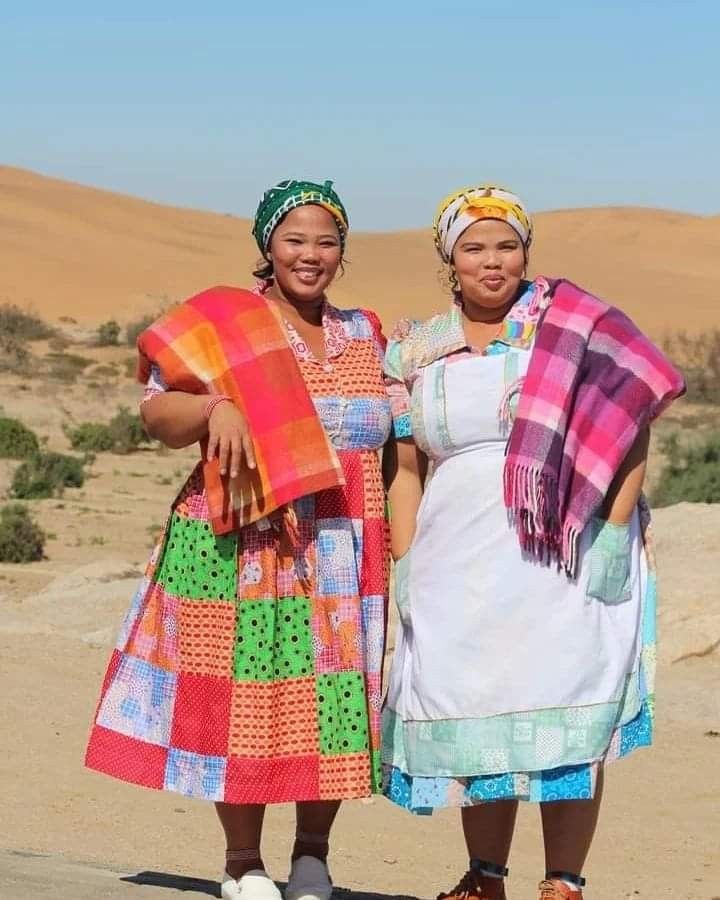
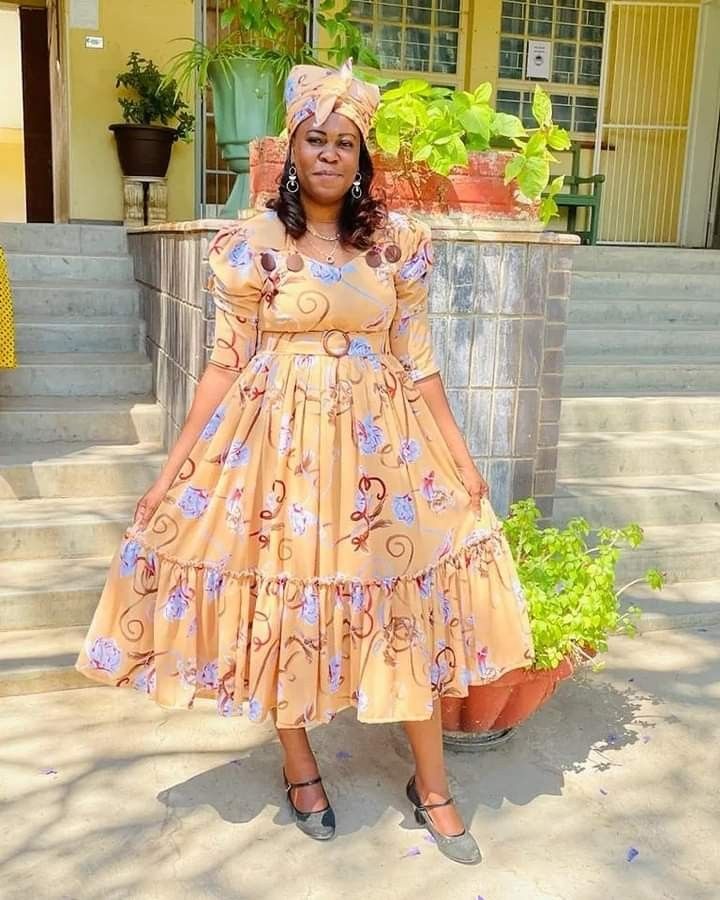
The traditional dress of Nama women consists of long, formal dresses resembling Victorian fashion, derived from the style of Finnish missionaries in the 1800s. Maria Caley’s keynote documents the mechanism precisely: ‘Most school-going children were asked to sew specific dresses. Finnish missionaries introduced these after finding children wearing traditional-style clothes and aprons. They didn’t like that; they wanted them to wear Eurocentric-style dresses.’ The dress began as a school uniform imposed by missionaries who found the existing Nama style insufficiently European. It became, through the same process documented in the case of the Herero ohorokova, something entirely different from what was imposed: a community’s own cultural expression, worn with the specific aesthetic choices that make it recognisably Nama rather than recognisably Finnish or recognisably colonial.
Women wear the long dress with a matching headwrap, the kaplyn, covering their hair. Men wear shirts made of the same fabric as women’s dresses. Both men and women wear veldskoene, the leather shoes whose name comes from Afrikaans for field shoes, another layer of colonial material culture absorbed and repurposed. The Nama and the Damara share the Victorian dress tradition and are often discussed together, though their communities are distinct. Within this shared tradition, colour communicates geography and identity: women north of the Swakop River conventionally wear blue; green indicates women from the southern parts of the river. The headwrap communicates more still: married women and young girls tie the kaplyn differently, and only specific fabrics are permitted for scarves in specific contexts. As Maria Caley documented from community practice: ‘The scarf can also indicate political and social standing; for instance, if you are related to a deceased person, you may print a photo of them on your scarf.’
The adoption of the Nama dress has a specific character that distinguishes it from the Herero transformation. Where the Herero ohorokova is characterised by extraordinary volume, up to ten metres of fabric and multiple petticoats, the Nama dress is more restrained in its silhouette while being specific and deliberate in its colour and fabric coordination. The patchwork sensibility that predates the missionary encounter is present in the contemporary Nama dress: the matching of dress and kaplyn, the construction of a complete visual unity from a single textile choice, reflects a people who already knew how to build meaning through material coordination before European cloth arrived.
The Nama and the Herero wear the same colonial-era dress tradition. They wear it differently. The difference is the story, and the story has only ever been told for one of them.
ALSO READ
- The Dress That Survived a Genocide: How Herero Women Turned Colonial Cloth Into Cultural Defiance
- The Geometry of Heritage: Why Shweshwe Still Defines South African Fashion
- The Diaspora Fashion Paradox: Who Gets to Wear What, and Who Gets to Decide
- Kanga Cloth: The Fabric That Speaks
Hendrik Witbooi and the Dress That Fought a War
The Nama resistance to German colonial rule was led by Hendrik Witbooi, one of southern African history’s most remarkable figures, whose dress has a specific cultural significance that has never been examined in a fashion context. Witbooi was the Kaptein of the Witbooi Nama clan: a devout Christian, a skilled military strategist, and an extraordinary political communicator whose letters to other Nama and Herero leaders constitute some of the most compelling political prose in southern African history.
Witbooi initially cooperated with the German colonial administration before the scale of German violence made continued cooperation impossible. On 3 October 1904, he revolted against German rule, rallying his people to fight for their freedom. He died in battle in 1905, aged approximately 75, fighting a colonial military force equipped with the most advanced weapons of the early twentieth century.
The photograph of Witbooi in his coat is not a photograph of a man in costume. It is a photograph of a man who understood that dress communicates political authority in the colonial context, and who dressed accordingly for the documentation that he knew the German administration was producing. The dark coat and wide-brimmed hat are the Nama adoption of Victorian dress used as deliberate political positioning: not submission to the coloniser’s aesthetic, but the strategic use of the coloniser’s visual language against the coloniser’s own assumptions about who could command authority and in what garments. That face, on the Namibian dollar note, is the Nama dress tradition’s most powerful argument. It has simply never been named as such.
The Money That Is Not Reparations
On 28 May 2021, German Foreign Minister Heiko Maas announced that Germany formally recognised the atrocities committed against the Herero and Nama peoples as genocide, following five years of negotiations. Germany agreed to contribute €1.1 billion in development aid to the communities impacted by the genocide. As Smithsonian Magazine documented at the time, the two governments explicitly agreed not to use the term ‘reparations’ to describe the financial package, instead calling it ‘ex gratia development aid’ to avoid opening a legal avenue for other countries to claim reparations. Victim communities rejected the deal. Vekuii Rukoro, Paramount Chief of the Herero, stated plainly: ‘Is this the kind of reparation that we are supposed to be excited about?’ The Namibian Genocide Association’s chairman, Laidlaw Peringanda, insisted that Germany should purchase the ancestral lands back. A UN report published in February 2023 concluded that the joint declaration lacked ‘meaningful participation’ from descendants of genocide victims.
The reparations question is directly relevant to the dress tradition because the land that was taken from the Nama, the grazing territories on which their pastoral culture was built, the landscape that their pre-colonial kaross and mobile architecture were designed for, has not been returned. White Namibians make up 6% of the country’s population but own more than 70% of prime farmland. The communities that wear the Victorian dress today are wearing it on land that their grandparents lost to a colonial state that killed half their population to acquire it. As Omiren Styles has argued in the documentation of how African communities use dress as cultural resistance against forces specifically designed to make cultural maintenance difficult, the Nama wear their Victorian dress in exactly these conditions: maintaining the specificity of a matched headwrap and a carefully chosen fabric as the insistence that they are still here and still themselves, on land that the political economy has not returned to them.
The Richtersveld: The Last Place
Today, the Richtersveld National Park, which returned to community ownership in December 2002, is one of the few places where the original Nama traditions survive in the context in which they were developed. A UNESCO World Heritage Site recognised not for stone ruins or architectural achievement. Still, for the living cultural landscape of a pastoral people, the Richtersveld holds something that global fashion media has yet to find: the coexistence of the kaross and the Victorian dress within a single living community. An older woman might wear the kaross in certain ceremonial contexts while wearing Victorian dress for church. A younger woman might wear only the Victorian dress, the kaross having passed beyond the range of her daily experience. The Richtersveld holds both traditions simultaneously, in the last landscape where both are practised. As Omiren Styles has argued in the analysis of how African textile museums and community archives function as counter-records for traditions that institutional coverage has failed to document, the Richtersveld is precisely this kind of counter-record in living form: a landscape and community that has maintained the full range of Nama material culture. At the same time, the rest of Namaqualand has moved on from the kaross.
The Richtersveld gets occasional environmental coverage. It does not get fashion coverage. The coexistence of kaross and Victorian dress within a single living community, in the last landscape where both traditions are still practised, is one of the most significant dress stories in southern Africa. Nobody has told me until now.
ALSO READ
- African Textile Museums: Preserving Memory in an Age of Fast Fashion
- How African Dress Is Worn as Cultural Resistance Across the Continent
- How African Identity Is Styled Differently Across Continents
- The Invisible Thread: How African Oral Tradition Shapes Fashion and Heritage Textiles
What the Matching Headwrap Says

The kaplyn, the Nama headwrap that matches the dress, is the element that most immediately distinguishes Nama women’s dress from superficially similar Victorian-era adoptions in the region. The Herero headwrap is architecturally constructed into the otjikalva horn shape, communicating specific cultural information about cattle and ancestry. The Nama kaplyn is a flat, wrapped, matched covering: less architecturally dramatic, more quietly coordinated. The coordination is the statement.
Where the Herero dress announces itself through volume and the otjikalva through architectural ambition, the Nama ensemble announces itself through coherence: the deliberate matching of fabric between dress and headwrap, the construction of a complete visual unity from a single textile choice. A Nama woman who has chosen a deep green floral fabric wears it from hem to head. The dress and the covering are one decision, one material, one statement about the care and intention she has brought to her appearance. The missionaries gave the long dress. The Nama gave it the kaplyn, the coordination, the colour deliberateness, and the patchwork sensibility that make it theirs.
Two Peoples, One Genocide, Two Dresses
The Herero and the Nama suffered the same genocide. They adopted the same missionary dress tradition. They transformed it into different cultural expressions: the Herero through extraordinary volume and the symbolic architecture of the otjikalva, the Nama through colour coordination, geographical colour coding, and the quiet completeness of the matched ensemble.
Global fashion media have found the Herero version visually compelling and have photographed it extensively. The Nama version, less architecturally dramatic, quieter in its statement, and worn by a smaller, less internationally visible community, has received almost no coverage. This is not a reflection of relative cultural significance. It is a reflection of fashion media’s tendency to reach for the most visually spectacular expression of any tradition while ignoring the traditions that communicate in a more restrained register.
The Nama dress communicates just as much as the Herero dress. It communicates in a different key: the key of coordination rather than volume, of ensemble rather than individual statement, of quiet persistence rather than dramatic declaration. It is the dress of a people who have survived genocide, land dispossession, colonial administration, and post-independence marginalisation by maintaining, in the specificity of a matched headwrap and a carefully chosen fabric, the insistence that they are still here and still themselves.
That is not a small statement. It does not require a spectacular silhouette. It requires only attention to notice it.
THE OMIREN ARGUMENT
Omiren Styles notes that this article is the first fashion editorial documentation of the Nama dress tradition. Named voices include Maria Caley, lecturer at the University of Namibia specialising in textiles and fashion design, whose keynote at Africa Textile Talks 2025 provides the most comprehensive available documentation of Namibian dress traditions from a Namibian academic perspective. Named historical figure: Hendrik Witbooi, Kaptein of the Witbooi Nama clan, whose image is on the Namibian dollar note. Reparations facts sourced to Smithsonian Magazine’s contemporaneous reporting on the 28 May 2021 announcement by German Foreign Minister Heiko Maas. Omiren Styles is committed to adding named voices from the Richtersveld community and from active Nama cultural associations in a future update. The Richtersveld observation, the coexistence of kaross and Victorian dress in a single living community, requires community authentication to be fully documented to the standard this tradition deserves.
FAQs
Who are the Nama people and where do they live?
The Nama, also known historically as Namaqua and belonging to the larger Khoikhoi group of the Khoisan peoples, are the largest Khoisan ethnic group in Namibia, comprising approximately 5% of the country’s population. They are concentrated in central and southern Namibia, with smaller communities in Namaqualand straddling the Namibia-South Africa border and additional groups in Botswana. Their language, Khoekhoegowab, is shared with the Damara people and is one of Namibia’s official languages. Their pre-colonial material culture was designed entirely for pastoral nomadism: the kaross garment, the portable |haru oms dwelling, and the full range of leather and natural material craft were built for movement through the semi-arid southern Namibian landscape.
What is traditional Nama women’s dress, and how does it differ from Herero dress?
Nama women’s traditional dress consists of long, formal Victorian-style dresses worn with a matching headwrap called the kaplyn, coordinated from a single fabric choice from the hem to the head. Men wear shirts of the same material. Both men and women wear veldskoene leather shoes. Colour communicates geography and identity within the tradition: women north of the Swakop River conventionally wear blue; green indicates women from the southern parts of the river. The Herero ohorokova uses up to 10 metres of fabric and multiple petticoats to create extraordinary volume. The Nama dress uses a more restrained silhouette, with the matched ensemble, not the individual garment, as the aesthetic statement. Both were adopted from the same Victorian missionary tradition. Both communities transformed that adoption into a distinct cultural identity.
What is the Kaplyn headwrap, and what does it mean?
The kaplyn is the matched headwrap worn by Nama women as part of their Victorian dress ensemble. It is made from the same fabric as the dress, creating a completely coordinated ensemble from a single textile choice. Married women and young girls tie the kaplyn differently, communicating marital status through the manner of wrapping. Specific fabrics are permitted only in specific social contexts. The scarf can also indicate political and social standing: in mourning, it is conventional to print a photograph of the deceased on the kaffiyeh fabric. The kaplyn is the element that most immediately distinguishes Nama dress from superficially similar Victorian-era adoptions in the region.
What happened to the Nama during the German colonial genocide?
Between 1904 and 1908, the German Empire waged a war of extermination against both the Herero and the Nama peoples of what was then German South West Africa, now Namibia. Approximately 10,000 Nama died, half their pre-war population, in campaigns involving mass executions, concentration camps, and deliberate starvation. The Nama were led in resistance by Hendrik Witbooi, Kaptein of the Witbooi Nama clan, who revolted against German rule on 3 October 1904 and died in battle in 1905. On 28 May 2021, German Foreign Minister Heiko Maas formally recognised the atrocities as genocide and announced €1.1 billion in development aid, though this was explicitly not called ‘reparations’ by either government. Victim communities rejected the deal as insufficient and objected to their exclusion from negotiations.
Who was Hendrik Witbooi, and why is he on Namibian currency?
Hendrik Witbooi was the Kaptein of the Witbooi Nama clan, a devout Christian, skilled military strategist, and extraordinary political communicator whose letters to other Nama and Herero leaders are among the most compelling political prose in southern African history. He led the Nama resistance against German colonial rule from 3 October 1904 until he died in battle in 1905, aged approximately 75. He is represented on the Namibian dollar note as Namibia’s most recognisable historical figure. The colonial photograph of Witbooi in his dark coat and wide-brimmed hat, produced by the German administration, is now read as a document of political dress: a man using the coloniser’s visual language as deliberate political positioning, communicating authority in the terms the colonial administration understood while maintaining the dignity of a Khoikhoi leader.
What is the Richtersveld, and why is it significant to Nama culture?
The Richtersveld is a UNESCO World Heritage Site in the far northwestern corner of South Africa, where the Orange River reaches the Atlantic Ocean. It was returned to community ownership in December 2002. It is one of the few places where the original Nama nomadic pastoral traditions survive in their original context, including the |haru oms portable dwelling and seasonal movement patterns. The Richtersveld is also the last site where the kaross and the Victorian dress coexist within a single living community: an elder woman might wear the kaross for certain ceremonial contexts while wearing the Victorian dress for church. This coexistence of pre-colonial and colonial dress traditions within one community, in one landscape, is the most significant dress observation available in the Nama world and has not previously been documented in any fashion publication.
Did Germany pay reparations to the Nama people?
Germany formally recognised the genocide of the Herero and Nama peoples on 28 May 2021, when Foreign Minister Heiko Maas announced €1.1 billion in development aid to be disbursed over 30 years. Germany and Namibia explicitly agreed not to call this payment ‘reparations,’ describing it instead as ex gratia development aid, to avoid opening legal avenues for other countries to claim reparations. Victim communities, including the Herero and Nama groups themselves, rejected the deal as insufficient and objected to being excluded from negotiations. A UN report published in February 2023 concluded that the joint declaration lacked meaningful participation from descendants of genocide victims. Land, the most significant dispossession, has not been restituted.