The Kalanga built Mapungubwe. They built Great Zimbabwe. They built Khami. Their ancestors established the Leopard’s Kopje culture, Sub-Saharan Africa’s first mixed farming society, and traded gold with Arabia, China, and Portugal. Their ceremonial dress is black and white: the colours of a sky about to break open. Nobody in global fashion has written this story.
There is a question that Zimbabwean cultural history has debated for over a century, and the colonial administration that ran Rhodesia spent considerable energy trying to suppress the answer. Who built Great Zimbabwe?
The eight-century-old dry-stone structures of the Zimbabwe plateau, walls built without mortar across a mountain-sized complex, were dismissed by early European settlers as the work of Phoenicians, Arabians, or some other external civilisation too distant to threaten white supremacist narratives of African incapacity. The evidence pointed, then and now, to the ancestors of the Shona and, critically, the Kalanga: a people whose civilisational record connects Mapungubwe to Great Zimbabwe to Khami in an arc of political and architectural authority spanning more than eight centuries.
The Kalanga built some of the greatest kingdoms in pre-colonial southern Africa, traded with the Indian Ocean world, produced the first Iron Age culture south of the Sahara, and, as the living custodians of the Njelele Shrine in the Matobo Hills, maintained the most important religious institution in what is now Zimbabwe. Their ceremonial dress is the most precisely coded weather-prayer garment in the region. And global fashion has never once looked at them. That stops here.
The Kalanga built Mapungubwe, Great Zimbabwe, and Khami. Their ceremonial dress is black and white: the colours of a sky about to break open. Nobody in global fashion has written this story until now.
Who the BaKalanga Are
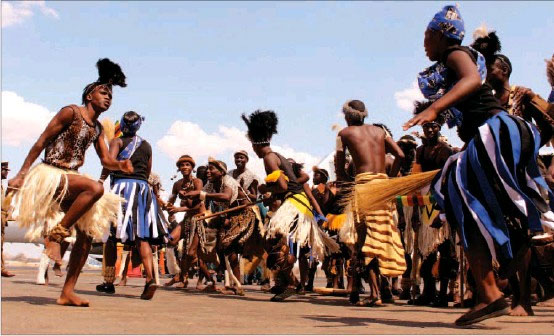
The Kalanga, properly the BaKalanga, are a southern Bantu people primarily inhabiting Matabeleland in western Zimbabwe, northern Botswana, and parts of Limpopo in South Africa. In Zimbabwe, TjiKalanga is the country’s third-most-spoken language; in Botswana, the BaKalanga are the second-largest ethnic group. Their cultural and political reach, at the height of the kingdoms they built, extended across much of what is now the southern African interior.
By approximately 500 AD, the Kalanga’s ancestors had established the Leopard’s Kopje Culture, Sub-Saharan Africa’s first mixed-farming society, practising iron smelting, copperwork, and gold trading at a scale and sophistication that predates most of what the world’s history curricula associate with African civilisational development. The Leopard’s Kopje culture flourished from approximately 420 CE to 1050 CE. By approximately AD 1220, the Kalanga-ancestor Leopard’s Kopje people had established Mapungubwe at the confluence of the Limpopo and Shashe Rivers as a major kingdom, Sub-Saharan Africa’s first city-state, whose royal hill produced a golden rhinoceros that today represents South Africa’s highest national honour. From Mapungubwe, the Zimbabwe culture expressed itself at Great Zimbabwe (approximately CE 1300 to 1450) and eventually Khami (approximately CE 1450 to 1820).
Three UNESCO World Heritage Sites. One cultural continuum. The same dress tradition carried through it all.
The colonial Rhodesian government did not merely suppress the Kalanga’s claim to Great Zimbabwe in the historical record. It suppressed the Kalanga themselves: a people whose language, political traditions, and ceremonial life were absorbed and marginalised under Ndebele rule in the 19th century and then again under British colonial administration in the 20th. By the time Zimbabwe achieved independence in 1980, the BaKalanga had spent more than a century negotiating cultural survival between two dominant political orders, neither of which had an incentive to acknowledge the depth of what the Kalanga had built. The dress tradition survived anyway.
The Ceremonial Palette: Black for Clouds, White for Rain
The most immediately striking feature of BaKalanga ceremonial dress is its colour system, and it is a system, not an aesthetic choice.
When BaKalanga pilgrims travel to the Njelele Shrine in the Matobo Hills to petition Mwali, the supreme deity of the Kalanga and related peoples, they dress in black. The meaning is as explicit as a weather forecast written in cloth. Black represents the dark, heavy clouds, elimnyama, the dark moon period, that carry rain. White represents the rain droplets themselves, the falling water that the pilgrims are travelling to request. Gogo MaNyathi, a pilgrim who described the ceremony in a 2022 account documented by the Herald of Zimbabwe, was direct: “We dance the night away dressed in these black clothes, and in the morning, we return to our villages, and the ceremony continues.”
Red is specifically prohibited during rain-making ceremonies at Njelele. The symbolism is direct: red is the colour of blood, of war, of the termination of life. Njelele ceremonies are about the renewal of life, rain for crops, fertility for livestock, and continuity for the community. The colour of death has no place in a garment worn to ask for abundance. This prohibition is not merely traditional; it is actively enforced in ceremonial protocol. Solifa Ncube, also known as Khulu Thobela, the custodian of Njelele, has confirmed that during elimnyama, the dark moon period, even visits to the shrine itself are forbidden.
Male dancers at the Njelele ceremonies wear kilts alongside headdresses of ostrich feathers and black-and-white feathers, maintaining the colour palette even in the most elevated elements of the ensemble. The two longest ostrich feathers are arranged to resemble horn formations above the head. Each dancer holds a gourd rattle in one hand. The full ceremonial ensemble, kilt, feather headdress, rattle, and the black-and-white palette maintained from hem to crown, is one of the most coherent colour-coded ceremonial dress systems in southern Africa, and it has been documented almost exclusively in academic anthropology rather than in any fashion or cultural media of meaningful reach.
The BaKalanga do not dress for rain as other cultures do for a ceremony. They dress as the sky itself: black above, white below, the moment of the break between drought and water rendered in cloth and feather.
Njelele: The Shrine the Dress Is Made For
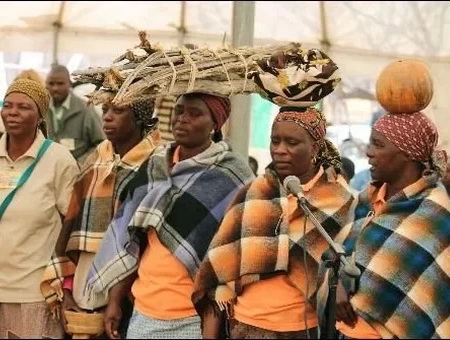
The Njelele Shrine in the Matobo Hills, approximately 100 kilometres south of Bulawayo, is the holiest site of the Mwali religion, a spiritual institution whose reach extends across Zimbabwe, Botswana, and South Africa. Njelele is a TjiKalanga term, referring to a certain type of bird; in Shona, the shrine is known as Mabweadziva, meaning the place of spring waters. It has been a Kalanga religious institution since at least the 14th century. However, oral traditions variously trace their origins to the era of Great Zimbabwe and to the migration of Rozvi priests from that site to the Matobo Hills.
It is not a Ndebele shrine, though the Ndebele have worshipped there since Mzilikazi found it already established when his forces settled in Matabeleland in the 1830s. Mzilikazi was careful to treat the shrine with respect and was buried in the Matopo Hills. The shrine opens between August and September each year, ahead of the rainy season. Delegations of pilgrims arrive from across the region carrying offerings: cloth, beads, spears, hoes, and a black bull. The colour of these offerings maintains the ceremonial palette. The bull is sacrificed. A voice, the oracle of Mwali, is said to respond from within the cave. The amawosana, the rain priests, dance until the early hours of the morning for multiple nights. After the ceremony, the rains are said to fall to erase the omathobela’s footprints.
This is an extraordinary living religious institution. Liberation fighters consulted it during Zimbabwe’s independence struggle. Solifa Ncube, Khulu Thobela, has stated plainly: “Abantu abasakwazi ukuqakatheka kwendawo le” (People do not know the importance of this place). They think it is just like any other place for prayer, forgetting that this is a sacred and holy shrine.
The dress worn to Njelele is the dress that has survived the survival of a people through centuries of invasion, absorption, and suppression. It is the most politically charged garment in Zimbabwe that no one in global fashion has ever discussed.
ALSO READ
- Top 5 Traditional Styles for Ndebele Women in 2026: History, Beadwork, and Ceremony
- The Geometry of Heritage: Why Shweshwe Still Defines South African Fashion
- The Zulu Reed Dance and the Dress That Carries a Nation’s Dignity
- Maasai Beadwork: Meaning, Symbolism, and the Language of Identity
The Dances and What They Wear
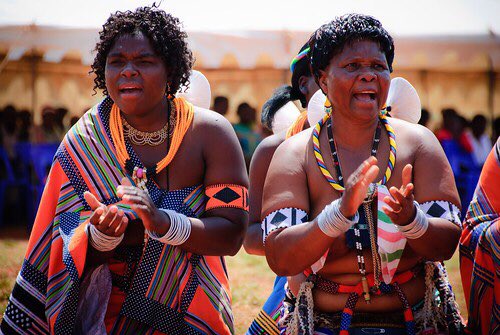
Beyond the Njelele pilgrimage dress, BaKalanga ceremonial attire is also found in several important dance traditions. The hoso and hosana dances precede and accompany the Njelele ceremonies. Both are drum-based and maintain the black-and-white ceremonial palette. The mazenge dance is performed by women for ancestral healing ceremonies: the dress follows the community’s colour conventions while incorporating specific adornments that communicate the wearer’s role in the healing process. The ndazula dance, performed to celebrate a great harvest, expands the palette slightly as the context shifts from supplication to celebration, but the ceremonial foundation remains consistent.
What links all of these is the Kalanga understanding that ceremonial dress is not decoration. It is communication addressed not to other people in the room but to the ancestral world and to Mwali directly. The colour you choose, the garments you bring, the offerings you carry, all of it is read by forces whose attention the community is attempting to secure. Dressing wrong for Njelele is not a fashion mistake. It is a theological error with potential consequences for the entire community’s rainfall.
This is a seriousness about dress that fashion media, with its tendency to treat traditional African attire as visual material rather than functional language, has consistently failed to convey.
The Suppression and the Survival
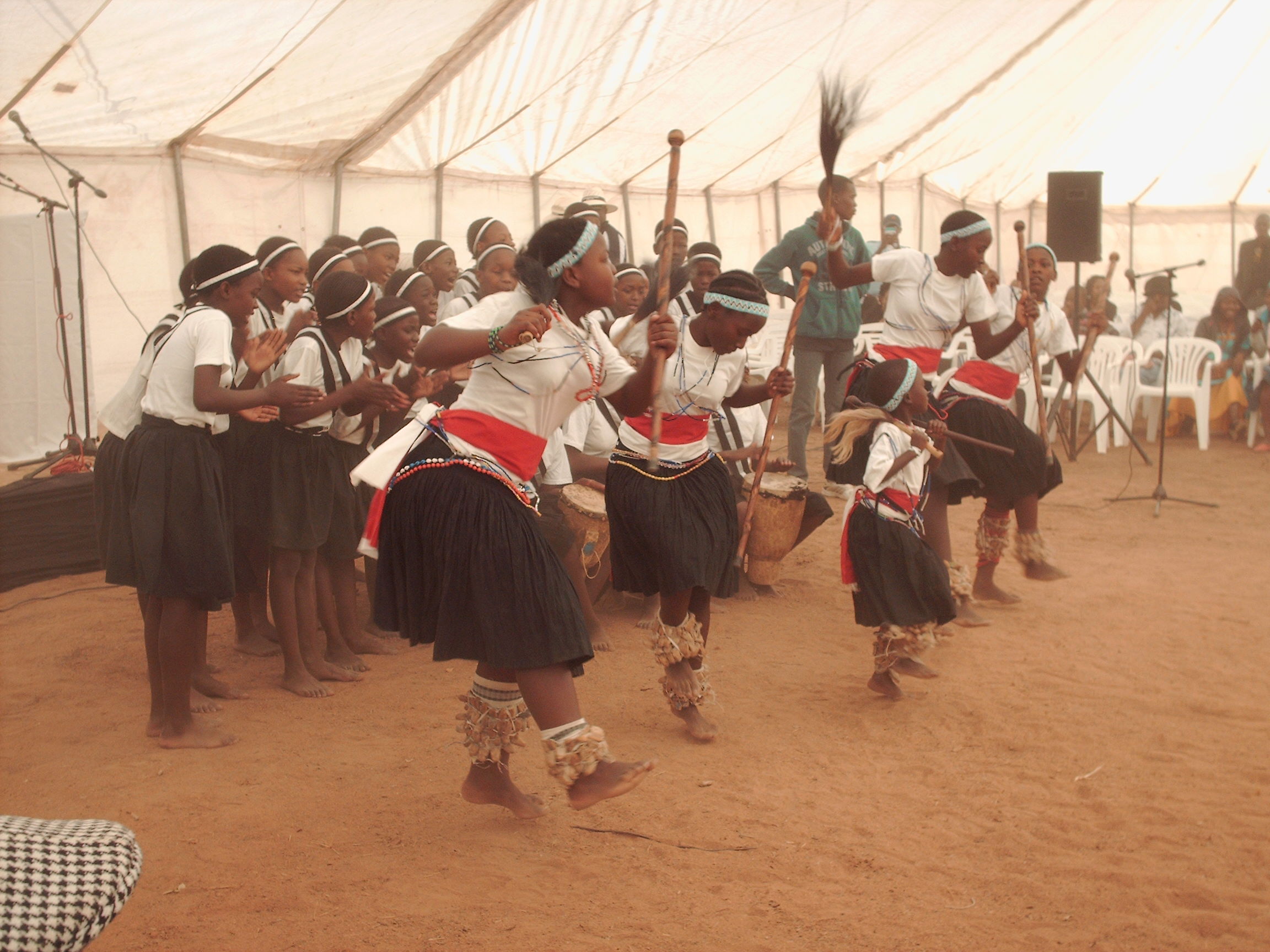
The BaKalanga’s cultural marginalisation has been systematic and layered. In the 19th century, Mzilikazi’s Ndebele state absorbed Kalanga territories in Matabeleland, and many Kalanga speakers shifted to isiNdebele as a survival language, embedding their identity inside a dominant political culture that did not acknowledge the sophistication of what it was absorbing. As Omiren Styles has documented in the case of the Ndebele themselves, communities that have faced forced absorption have used dress as the most persistent form of identity declaration available. What cannot be seized, taxed, or reassigned is how you dress. For the BaKalanga, the ceremonial dress performed the same function: a system of meaning that survived political absorption precisely because it required cultural knowledge to read, not political permission to wear.
Under British colonial rule, the Kalanga’s connection to Great Zimbabwe was actively suppressed. The Rhodesian government preferred theories of external civilisational origin to the acknowledgement that African people had built one of the most architecturally remarkable pre-colonial cities on earth. Post-independence Zimbabwe has been more complex. TjiKalanga is now recognised as one of Zimbabwe’s 16 official languages, and Kalanga cultural institutions have worked steadily to document and revive elements of the tradition that decades of marginalisation placed under pressure. The TG Silundika Cultural Community Centre and the Domboshaba Cultural Festival in Botswana both represent active efforts to maintain and celebrate BaKalanga material culture, including ceremonial dress.
In the global fashion conversation, the BaKalanga remain invisible. Their ceremonial dress system is undocumented, their rain-prayer palette unanalysed, and their thousand-year dress tradition unmarked. As Omiren Styles has documented in the analysis of how African textile museums function as counter-archives for communities whose official records have been systematically erased, documentation is not a neutral act. For communities like the BaKalanga, it is a political choice: to preserve the record on their own terms rather than wait for institutional recognition that may not come.
What Black and White Carries
The BaKalanga ceremonial dress is the most historically grounded garment in this series. It is worn by people who built Sub-Saharan Africa’s first city-state, who traded gold with the medieval Arab world and with China, who established and have maintained for at least seven centuries the most significant religious shrine in the Zimbabwean interior, and who encoded their cosmological relationship to rain directly into the colours of their ceremonial cloth.
Black for the clouds. White for the rain. The sky, worn on the body, is carried to the shrine where a voice answers from inside the mountain.
That is not a fashion story in the conventional sense. It is the kind of story that fashion, at its most serious, exists to tell.
THE CREDIT THAT WAS WITHHELD
The Kalanga connection to Mapungubwe, Great Zimbabwe, and Khami is now academically established, supported by the archaeology of the Leopard’s Kopje cultural tradition and documented by scholars including T.N. Huffman. Three UNESCO World Heritage Sites mark the civilisational arc of a people who have been, in the Zimbabwean national imagination and in global cultural media, consistently under-credited for what they built. The black-and-white ceremonial dress worn to Njelele is not a regional curiosity. It is the living ceremonial tradition of the people who produced approximately 80% of all the gold traded from sub-Saharan Africa to the medieval Islamic world and to China. Their dress encodes their most urgent practical theology: the relationship between their community’s survival and the rainfall that sustains it.
Omiren Styles documents the BaKalanga here because they represent the clearest available case of a fashion story that global fashion media has not told, since the communities excluded from that media are also excluded from the credit structures of academic and popular history. The ceremony at Njelele is attended every August and September by people who travel from across Zimbabwe and Botswana, wearing black. They are asking the sky for rain on behalf of their community. The sky that answers is the same sky their ancestors read when they built Mapungubwe. The cloth that carries the prayer is the same cloth it has always been.
ALSO READ
- African Textile Museums: Preserving Memory in an Age of Fast Fashion
- The Reed Dance and What Eswatini’s Umhlanga Ceremony Tells the Fashion World About Collective Dress
- How African Identity Is Styled Differently Across Continents
- What Accra Street Style Is Actually Arguing in 2026
FREQUENTLY ASKED QUESTIONS (FAQs)
Who are the BaKalanga people?
The BaKalanga are a southern Bantu people primarily inhabiting Matabeleland in western Zimbabwe, northern Botswana, and parts of Limpopo in South Africa. TjiKalanga is Zimbabwe’s third-most-spoken language. The BaKalanga are the second-largest ethnic group in Botswana. Their civilisational history links the Leopard’s Kopje culture (approximately 420 to 1050 CE) to the kingdoms of Mapungubwe, Great Zimbabwe, and Khami, three UNESCO World Heritage Sites that represent a continuous arc of political and architectural authority spanning more than eight centuries.
What is the connection between the BaKalanga and Great Zimbabwe?
The academic consensus, supported by archaeological analysis of the Leopard’s Kopje cultural tradition by scholars including T.N. Huffman, connects the BaKalanga’s ancestors to the civilisational sequence that produced Mapungubwe (approximately CE 1220 to 1290), Great Zimbabwe (approximately CE 1300 to 1450), and Khami (approximately CE 1450 to 1820). The Rhodesian colonial government actively suppressed this connection in the historical record, preferring theories of external civilisational origin. Post-independence scholarship has re-established the connection, though it has not yet translated into popular cultural credit.
What is the Njelele Shrine, and why is it significant?
The Njelele Shrine is a sacred cave in the Matobo Hills, approximately 100 kilometres south of Bulawayo, Zimbabwe. It is the holiest site of the Mwali religion, a pre-colonial spiritual institution that has attracted pilgrims from across Zimbabwe, Botswana, and South Africa for at least seven centuries. The shrine opens between August and September, before the rainy season, for rain-petitioning ceremonies. A voice, the oracle of Mwali, is said to respond from within the cave to pilgrim petitions. Liberation fighters consulted the shrine during Zimbabwe’s independence struggle,e and it remains an active ceremonial institution today.
What do BaKalanga pilgrims wear to the Njelele Shrine?
Pilgrims attending the Njelele rain-making ceremonies dress in black, the colour that represents the dark, heavy clouds that carry rain. Male dancers wear kilts and headdresses of black and white ostrich feathers, with the two longest feathers arranged to resemble horn formations above the head. Each dancer holds a gourd rattle. Red is strictly prohibited: it represents blood, war, and the termination of life, and has no place in a ceremony asking for the renewal of rain. The colour system is theological, not aesthetic. Gogo MaNyathi, a Njelele pilgrim, described the ceremony: “We dance the night away dressed in these black clothes, and in the morning, we return to our villages, and the ceremony continues.”
What is Mwali, and how does it relate to BaKalanga dress?
Mwali (also known as Mwari in Shona) is the supreme deity of the Kalanga and related peoples, whose primary oracle is the Njelele Shrine. Mwali governs fertility, rainfall, and the ecological and moral order of the community. The BaKalanga’s black-and-white ceremonial dress is worn specifically to communicate with Mwali: black for the clouds that carry rain, white for the rain droplets themselves. The dress is not symbolic in a decorative sense. It is functional: it is what you wear when you ask the deity to intervene in the weather to ensure your community’s survival.
How has BaKalanga culture been suppressed, and how does it survive today?
BaKalanga culture was marginalised under 19th-century Ndebele political dominance, which absorbed Kalanga territories in Matabeleland and led many Kalanga speakers to adopt isiNdebele as a survival language. British colonial rule compounded this by suppressing the Kalanga’s historical connection to Great Zimbabwe. Post-independence Zimbabwe has recognised TjiKalanga as one of its 16 official languages. Active cultural preservation efforts include the TG Silundika Cultural Community Centre in Zimbabwe and the Domboshaba Cultural Festival in Botswana. The Njelele Shrine continues to attract annual pilgrimages, and the black-and-white rain-petition dress system has been maintained through ceremonial practice despite a century and a half of political pressure.