There is a rule at Wimbledon that has survived for more than a century. Players must wear white. Almost entirely, precisely, verifiably white: colour trims capped at one centimetre, shoelaces included, even undergarments visible during play. The rule began in the 1880s when tennis was a pastime for the wealthy and visible perspiration was considered socially unacceptable. White fabric hid sweat. Over time, it became something else: a shorthand for a very specific idea of tradition, class, and belonging. Wimbledon did not invent that idea. It inherited it. It has been enforcing it ever since.
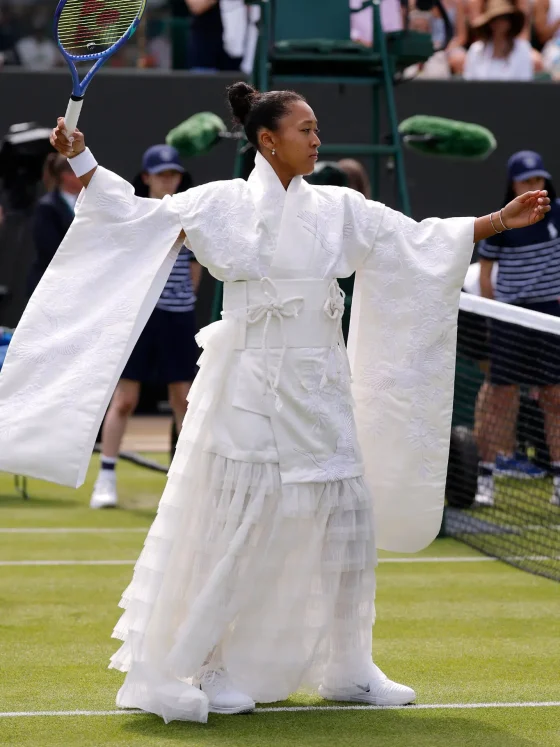
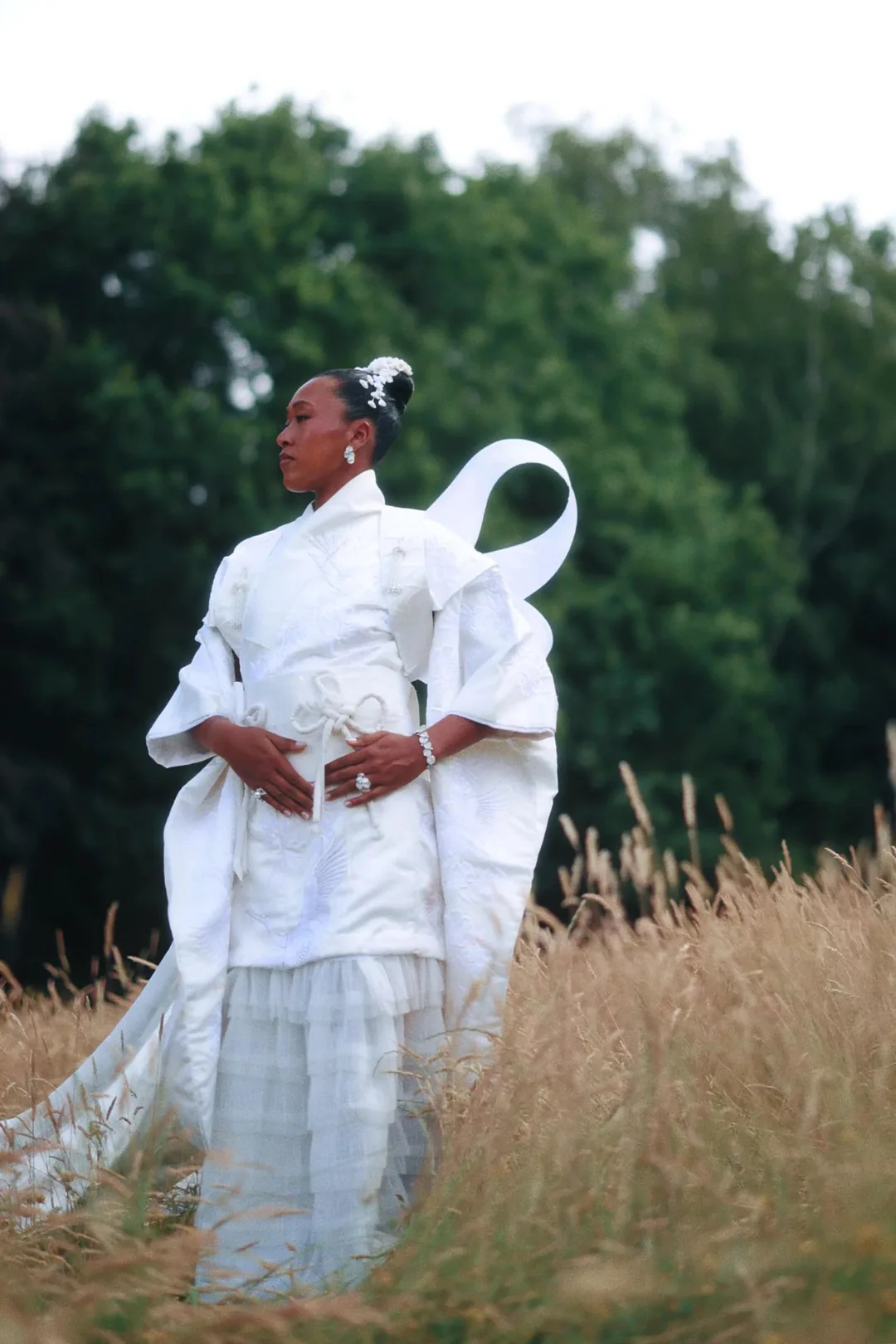
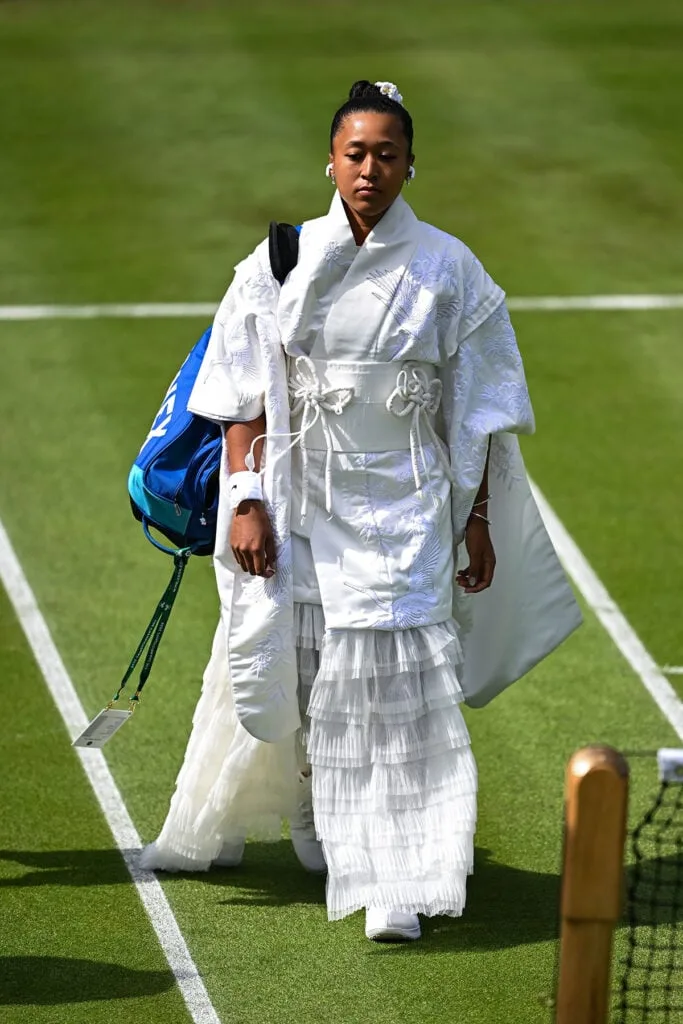
On 29 June 2026, Naomi Osaka walked onto Centre Court in a floor-length, all-white gown titled “Evolving Ceremony,” built by Tokyo-based designer Hana Yagi from seven different textiles upcycled from vintage Japanese kimonos, a shiromuku bridal kimono, and a deconstructed Western wedding dress. She wore kanzashi-style floral ornaments in her hair. She wore Mikimoto diamonds and pearls at her neck. The silhouette referenced the junihitoe, the multilayered court dress of Heian-era Japanese noblewomen, with elongated sleeves, an obi-style belt, and layered tulle that belonged to couture, not sportswear. Across the robe, cranes and cherry blossoms were hand-embroidered in white-on-white thread: longevity, luck, renewal. She removed it before play. She then won her opening round. But by then, the argument had already been made.
The rule said white only. Osaka made white carry her entire heritage. That is the argument this piece is about.
Naomi Osaka walked onto Centre Court in an all-white kimono built from upcycled shiromuku silk and Heian court references. The rule said white only. She made white carry her entire heritage. This is what that decision reveals.
What the White Rule Actually Is

It is worth being precise about what Wimbledon’s dress code does and does not prohibit. The All England Club mandates that players be “almost entirely in white.” It does not prohibit specific silhouettes. It does not prohibit specific cultural garment traditions. It prohibits colour. Osaka and Hana Yagi used that gap to their advantage. Every visible element of “Evolving Ceremony” is white. The design is not. The references are not. The cultural grammar being spoken on Centre Court is not the grammar Wimbledon’s rulebook was written to accommodate. Tournament spokespeople confirmed no formal concerns were raised. The rule was followed. The rule was also subverted. Both things are true, and that is precisely the point.
This is a move diaspora communities have been practising for generations. You learn the rule. You understand its history. You understand what it was designed to protect and who it was designed to protect it from. Then you work inside it until it holds more of you than its authors intended. Caribbean nurses arrived in Britain in pressed NHS uniforms and saved their boldest fabrics for Sunday. African diaspora professionals in London wear corporate suits with Ankara linings that nobody sees until they take off their jackets. Latin American athletes slip indigenous-coded jewellery beneath sponsor kits. Strategic compliance is not a compromise. It is the longer game.
The rule said white only. Osaka made white carry her entire heritage.
What White Means When You Come from Somewhere Else
The mainstream fashion conversation about Osaka’s kimono has focused almost entirely on its visual impact: the volume, the embroidery, the Heian references. What it has mostly missed is the colour. In Yoruba and Afro-diasporic spiritual traditions, white garments are worn for initiation, spiritual labour, and festivals honouring deities associated with purity, wisdom, and transition. In Japanese tradition, the white shiromuku bridal kimono marks a bride’s transformation, her willingness to be remade. In parts of the Caribbean and Latin America, all-white church services, funerals, and celebrations carry histories of survival, liberation, and communal memory that have nothing to do with Wimbledon’s ideas about sweat and class. As Omiren Styles has documented in the analysis of how Caribbean ceremonial dress carries histories that fashion media consistently under-read, white in the diaspora is one of the most freighted colours in the dress vocabulary. It is not neutral. It was never neutral. Wimbledon made it a rule. Diaspora communities were already using it as a language.
Osaka named her gown “Evolving Ceremony.” That title is doing precise work. A ceremony is a structured act that carries cultural memory. Evolving signals that the memory is not fixed, not preserved behind glass, but active and adapting. The garment is not a costume, and it is not nostalgia. It is a ceremony that has evolved across borders, across generations, across dress codes, and still arrives on time.
ALSO READ
- The Cultural Codes of Dressing Well: What Every Society Understands About Style and Respect
- Two Generations, One Fabric, Two Different Meanings
- Caribbean Carnival Fashion: How Costume Traditions Shape Global Couture
Heritage as Method, Not Theme
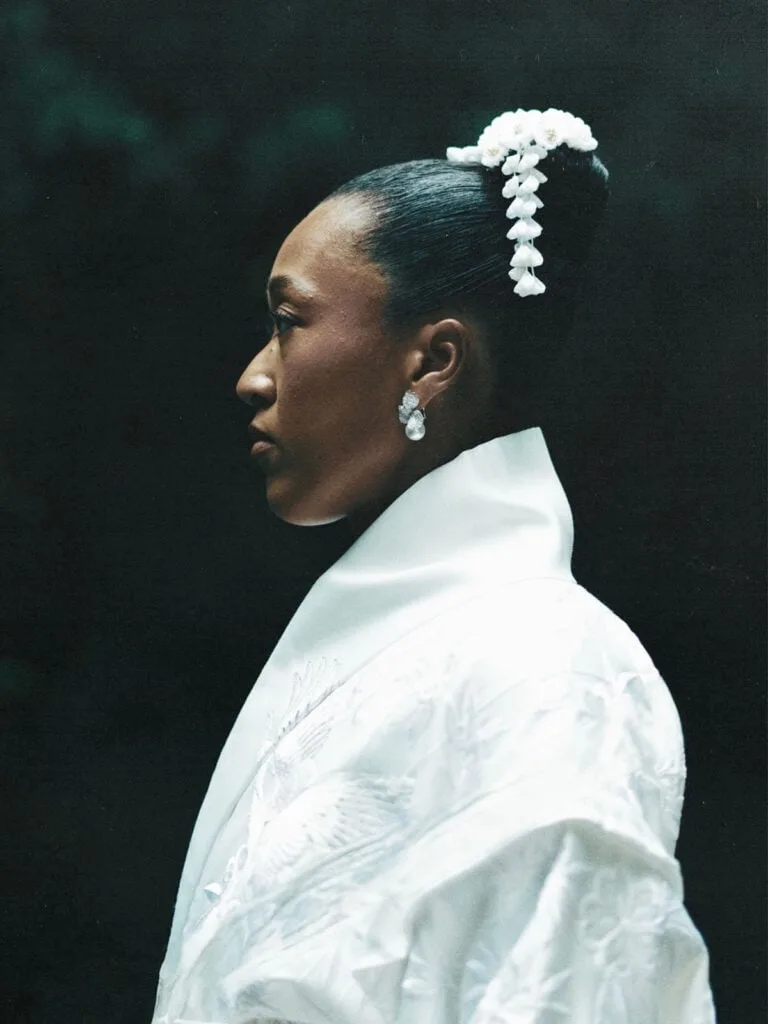
Fashion media described the look as “stunning, “show-stopping, and “kimono-inspired.” That word, inspired, is where the reading goes wrong. “Inspired by” places heritage at a safe aesthetic distance: drawn from, influenced by, referenced. What Yagi built and what Osaka wore are not inspired by Japanese ceremonial dress. It is built from it: upcycled shiromuku silk, junihitoe structure, kanzashi ornaments, Mikimoto pearl heritage, Heian court volume. The distinction matters because it is the same distinction African, Caribbean, and Latin American designers have been fighting to establish for years. As Omiren Styles has argued in the analysis of how diaspora designers refuse to be positioned as ‘inspired by’ their own cultures, the question of whether a designer is inspired by a tradition or working from inside it is not a semantic distinction. It is a question of authorship, authority, and credit.
Kente does not inspire Ghanaian tailors to re-engineer suits with Kente linings. They are building on Kente knowledge. Caribbean designers translating mas construction into resort wear are not drawing on Carnival energy. They are extending a craft tradition. Afro-Brazilian labels working from Candomble dress codes are not taking African influence. They are the continuation of that influence, after everything that tried to stop it. Osaka’s gown does not resolve those arguments. But it makes it harder for the institutions that manage global fashion visibility to keep treating non-Western ceremonial dress as a theme available for periodic editorial deployment. As Omiren Styles has documented in the study of how African and diaspora dress traditions constitute a luxury of craft and history that does not require external validation, the argument is not about inspiration. It is about who gets to say what counts as serious design.
The Athlete as Creative Director

Osaka did not put this look together the way an athlete accepts a sponsor’s kit. She and creative director Marty Harper built a deliberate cultural argument: Hana Yagi’s specialism in retired ceremonial garments, Mikimoto’s Japanese pearl heritage, the Kill Bill reference that places Japanese feminine power inside pop culture history, the Nike dress beneath that echoes the robe’s motifs, so the narrative survives once play begins. Every element is chosen. Every element is connected. This is not styling. This is the direction.
Osaka said in post-match interviews that she wanted to come out in a kimono precisely because Wimbledon insisted on white. She said: “You don’t have to have the colour of a kimono to know it is a kimono.” That line is in the article. Silhouette, structure, and cultural context carry the meaning. Colour is just the medium. The institution told her what medium to use. She decided what meaning to put in it.
This is the model Omiren Styles has been documenting across the African, Caribbean, and Latin American creative landscape. The athlete, the designer, the creative from a diaspora background who arrives at an elite institution and understands its rules well enough to make those rules carry what the rules were never written to carry. As Omiren Styles has argued in the analysis of how African ceremonial dress constitutes a living archive rather than a historical record, the archive is only dead if nobody insists on carrying it. Osaka insists. The All England Club nods along. Both believe the rule has been followed. They are correct on compliance; they are wrong if they think compliance means the rule still belongs entirely to them.
For younger athletes and creatives watching from Lagos, Kingston, Sao Paulo, and Hackney, the look is a technical demonstration. This is how you enter a space that was not built for you. You read the rulebook more carefully than the people who wrote it. You find the gap. You fill the gap with everything they said you had to leave outside. You walk in dressed for the occasion they specified. You walk in dressed for the occasion you intended. You win the round. The ceremony continues.
ALSO READ
- Peckham, Brixton, and Hackney Built What Central London Wouldn’t
- African Diaspora Fashion: The Dress Code in London, Paris, and New York
- African Royal Dress Is Not Decoration. It Is Governance.
Frequently Asked Questions (FAQs)
What was Naomi Osaka’s Wimbledon 2026 kimono outfit?
Naomi Osaka wore a custom all-white gown titled “Evolving Ceremony,” designed by Tokyo-based Hana Yagi and built from seven textiles upcycled from vintage kimonos, a shiromuku bridal kimono, and a deconstructed Western wedding dress. The silhouette referenced the junihitoe, the multilayered court dress of Heian-era Japanese noblewomen. She wore kanzashi-style floral hair ornaments and Mikimoto diamonds and pearls. She removed the gown before play to reveal a Nike tennis dress, and won her opening round.
How did Naomi Osaka comply with Wimbledon’s all-white rule while wearing a kimono?
Wimbledon’s dress code requires players to be almost entirely in white, including visible undergarments and trim, but does not prohibit specific garment silhouettes or cultural forms. Osaka and designer Hana Yagi kept every visible element of the gown white while using kimono- and junihitoe-inspired construction, thereby fully complying with the rule while placing Japanese ceremonial dress on Centre Court. Tournament spokespeople confirmed no formal concerns were raised.
What does Naomi Osaka’s Wimbledon kimono mean?
Osaka described the gown as a way of paying love and respect to Japan while working within Wimbledon’s white-only rule. She described the look as a deliberate interpretation of that rule through her own heritage and cited Lucy Liu’s O-Ren Ishii in Kill Bill as a cultural reference. Her own clearest statement: “You don’t have to have the colour of a kimono to know it is a kimono.” The gown demonstrates that silhouette, structure, and cultural context carry meaning independently of colour, and that a rule about medium does not determine the meaning the medium carries.
Who is Hana Yagi?
Hana Yagi is a Tokyo-based designer who specialises in reworking bridal and ceremonial garments into contemporary pieces using upcycled vintage textiles. For Osaka’s Wimbledon gown, she combined seven different textiles from vintage Japanese kimonos, a white shiromuku bridal kimono, and a deconstructed Western wedding dress into a single one-of-a-kind garment. The gown was hand-embroidered with cranes and cherry blossoms in white-on-white thread. The look represents the kind of upcycled ceremonial craft that Omiren Styles documents as a form of luxury that does not require validation from European houses.
Why does Naomi Osaka’s Wimbledon kimono matter for diaspora fashion?
Because it is a technical demonstration of strategic compliance: entering an elite institution on its own stated terms while insisting that those terms carry your own cultural history. Diaspora communities have practised this for generations, from Caribbean nurses in NHS uniforms saving their boldest fabrics for Sunda, Diasporacan diaspora professionals in London wearing Ankara linings beneath corporate suits. Osaka does it on a global broadcast, in front of millions, and the institution confirms that the rule has been followed. For younger athletes and creatives watching from Lagos, Kingston, Sao Paulo, and Hackney, the demonstration is the point: you can arrive dressed for the occasion they specified and the occasion you intended simultaneously. The ceremony continues.