There is a ceremony practised in the Ketu region of the Benin Republic, in parts of southwestern Nigeria. In Yoruba diaspora communities across the Atlantic, men dress in women’s clothing, strap carved wooden masks to the tops of their heads, and perform elaborate dances that can last through an entire night and into the following day. The ceremony is not a carnival, a ritual cross-dressing performance in the theatrical sense, or a festival of inversion for its own sake. It is an act of tribute to female spiritual power that Yoruba communities have been performing for more than a century, which UNESCO recognised as a Masterpiece of Oral and Intangible Heritage in 2001, and whose oral histories in Ketu trace back to a founder named Oga Abiodun in a place called Ilobi.
This is Gelede. The UNESCO description is unambiguous: the ceremony has been performed to pay tribute to the primordial mother, Iyà Nlà, and to the role women play in the process of social organisation and the development of Yoruba society. The men wearing women’s clothes are not mocking female identity. They are honouring it. The costume is the argument. The dance is the evidence. And the spiritual framework being enacted is one in which female power is understood as foundational to the community’s survival.
The Omiren Argument: Gelede is not a masquerade in which men dress as women. It is a ceremony in which men demonstrate, by borrowing women’s cloth, that female spiritual authority is the source from which community well-being flows. The costume is not a disguise. It is a declaration.
Gelede is a Yoruba ceremony in which men wear women’s clothing and carved masks to honour female spiritual power. UNESCO-listed. Here is how fashion becomes ritual.
Where Gelede Comes From: Ketu, Benin Republic
The Gelede masking tradition is believed to have originated among the Yoruba people of the Ketu region in what is now the Republic of Benin, sometime in the late 18th century. Ketu is both a historical Yoruba kingdom and a Yoruba subgroup. The kingdom’s chief town, Kétou, straddles the border between southeastern Benin and southwestern Nigeria and is considered one of the oldest capitals of the Yoruba-speaking world, with its founding traced to a descendant of the Yoruba progenitor, Oduduwa.
The oral history of Ketu attributes the founding of the Gelede tradition specifically to Oga Abiodun, in a locality called Ilobi within Ketu territory. From Ketu, the tradition spread across the wider western Yoruba world: to the Egbado, Ohori, and Anago communities of the border zone between the Benin Republic and Nigeria, and eventually to Yoruba communities across southwestern Nigeria. It crossed the Atlantic with enslaved Yoruba people and has been maintained in diaspora communities in Brazil, Cuba, and the wider African diaspora for centuries.
The Gelede tradition is therefore not a Nigerian masquerade that spread to the Republic of Benin. It originated in what is now the Benin Republic and spread from there. This geographic origin matters for how the tradition is situated within Beninese cultural heritage: Gelede is not a borrowing from a neighbouring country but one of the oldest masking traditions native to this specific territory.
The Spiritual Architecture: Why Female Power Requires Male Tribute
The spiritual framework of Gelede is built on a specific understanding of female power in Yoruba cosmology. Elderly women, collectively referred to as awon iya wa, meaning “our mothers,” are understood to hold powers over agricultural bounty, wealth, and human health, and are believed to be akin to those of the gods. The primordial mother Iyà Nlà is the supreme expression of this power. She is described in Yoruba tradition as the source of life, fertility, and social order.
The implication is precise: if female spiritual power can be directed positively, the community prospers. If it is not appropriately honoured, the community suffers. Gelede is the formal mechanism through which this honour is expressed. The annual ceremony, held at the onset of the farming season, is as much an act of communal supplication as it is a celebration: the community is asking its most powerful spiritual force to direct its power toward abundance and well-being rather than destruction.
This is why the men wearing women’s clothes are not performing inversion for its own sake. They are performing a tribute. The act of borrowing women’s clothing is a material acknowledgement: the man wearing the garment is physically placing himself within the category of female identity to demonstrate that female authority encompasses all community members, including him. The costume is the tribute made visible.
UNESCO’s documentation notes that while Gelede has adapted to a more patriarchal social order over time, its oral heritage and dances “can be considered as a testimony of the former matriarchal order.” The ceremony preserves, in its structure and its material practice, a memory of social organisation in which female spiritual authority was primary. The costume, the dance, and the songs carry that memory forward.
The Ceremony: Efe Night and Gelede Day
The Gelede ceremony unfolds across two phases. It opens with the Efe masquerade, performed at night on a public square. Efe performs from late evening through to dawn, appearing before the main Gelede performances the following day. The two phases use different masks. The Efe mask has its own character: it sings traditional prayer songs that invoke divine blessings and tell of the hierarchical order of the world through allegory and riddle. It addresses the moral weaknesses of individuals, groups, and the community with a satirical directness that the nighttime setting amplifies.
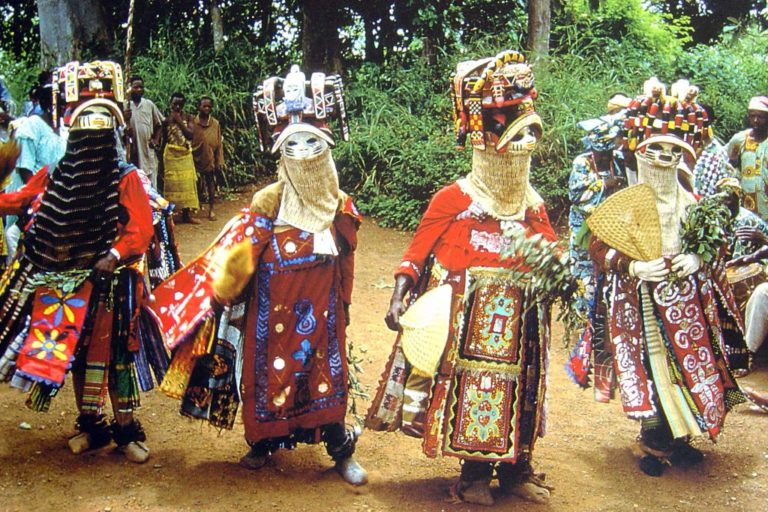
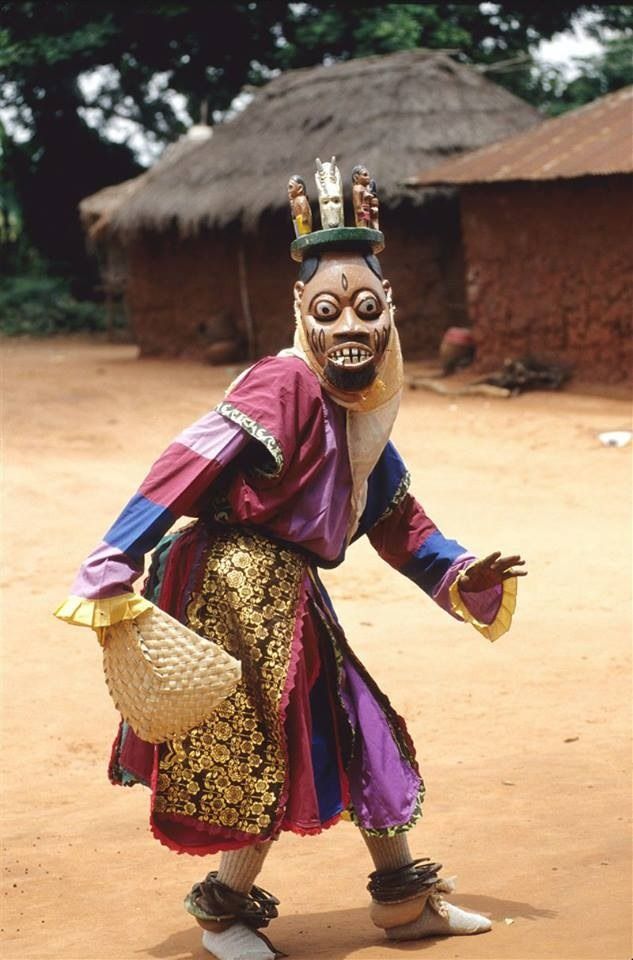
The afternoon after Efe night is reserved for the main Gelede masquerade. The maskers, all male, appear in sequence over an extended period. They wear sculpted wooden helmet masks on their heads and, in some cases, carved wooden breasts and abdomens. The textiles used for their costumes are borrowed clothes of local women: head ties, baby wrappers, and skirts tied in various ways, producing multi-coloured ensembles that emphasise the breasts and buttocks of the women they represent.
The maskers impersonate both men and women. The youngest dancers appear first, encouraged by friends and relatives as they attempt their first steps to the intricate, changing rhythms of the drummers. Their instructors in the Gelede society follow closely, giving advice and encouragement during the performance. The ceremony is educational as well as spiritual: the younger generation learns both the dance and the values it encodes.
The annual ceremony is held at the onset of the farming season. Gelede also appears after harvests, during droughts or epidemics, and at other moments of community need. The festival is not confined to a single occasion. The community calls Gelede when it needs it, and the Gelede society is the institution that maintains the capacity to respond.
The Costume: What Women’s Clothing Carries in This Context
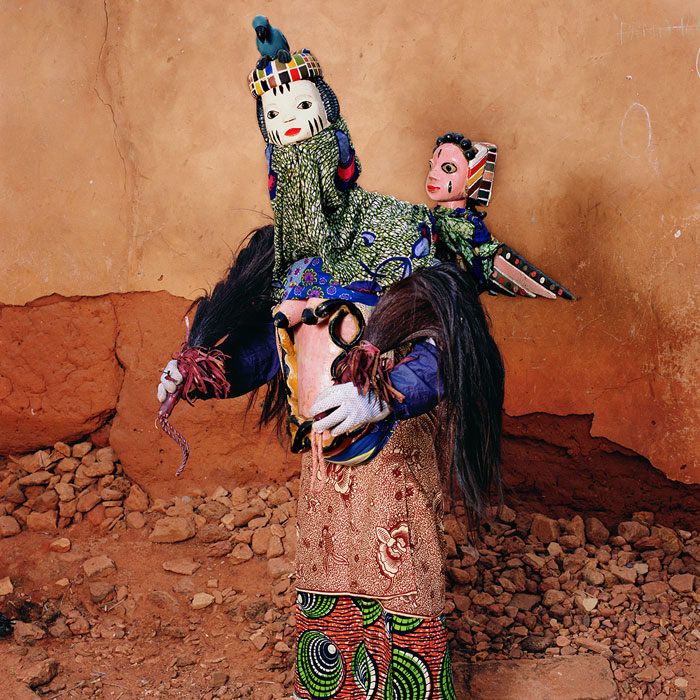
The specific textiles used in Gelede costumes are borrowed rather than made. The maskers wear the actual clothing of local women: head ties, wrappers, and baby carriers. These are garments that carry specific social meaning in everyday Yoruba dress. A head tie communicates formality and respect. A baby wrapper communicates maternal care. A wrapper tied around the hips communicates female dignity and social standing. When a male masker wears these garments, he is not wearing costume fabric. He is wearing the social meaning the fabric carries in daily life, transferring it from its everyday context into a ceremonial one.
The wooden mask worn on top of the head is equally specific in its visual language. The base of a Gelede mask is typically a calm human face: patience and self-control, values understood as defining female role models in Yoruba culture. The sculptural elements above the face, which can depict animals, objects, or human figures, reference social situations, proverbs, and songs known to the community. The serpent signifies power. The bird is the messenger of the mothers. Each element of the mask is a legible symbol within a shared visual vocabulary.
The costume in Gelede is therefore operating on multiple registers simultaneously. The borrowed women’s clothing is a material act of tribute. The carved wooden mask is a vehicle for spiritual communication. The carved breasts and stomachs, present in some costumes, are an explicit representation of female generative power worn on a male body. All three registers operate together to produce a performance in which the boundary between male and female, between the living and the spiritual, and between everyday dress and sacred material is deliberately and carefully suspended.
ALSO READ
- Egungun Masquerade Costume: When Fabric Becomes a Portal to the Ancestors
- Beninese Bridal Fashion: Fabric, Ceremony, Identity
- Benin Textiles and Symbolism
The Gelede Society: Who Governs the Tradition
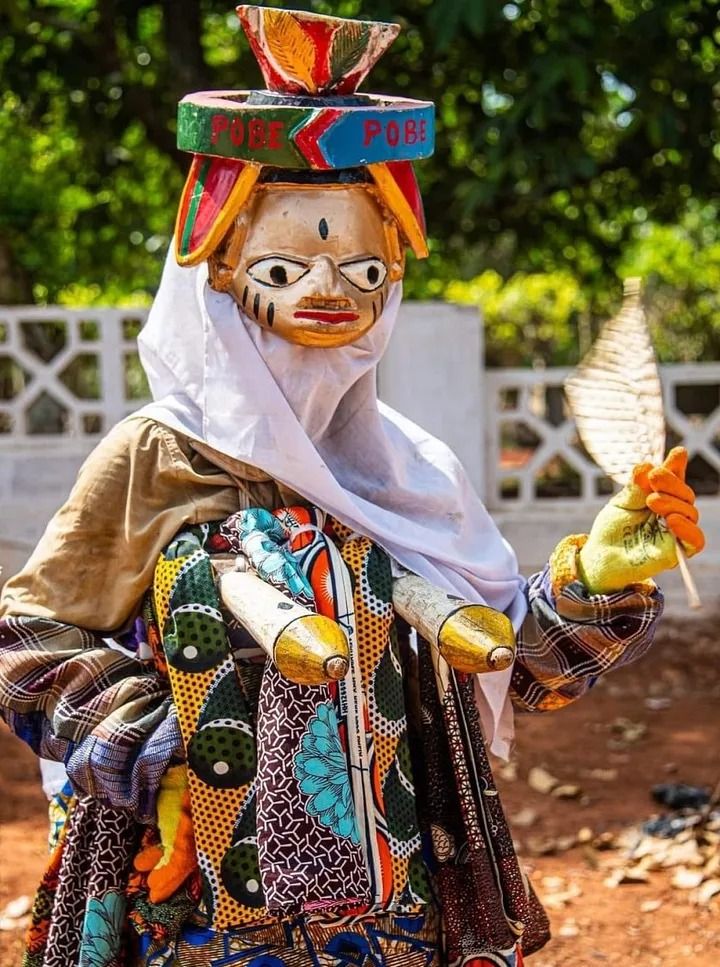
The Gelede society, made up of initiated male and female titled elders, is the institutional structure that organises each year’s performances. As Smarthistory documents, each year at the beginning of a new agricultural cycle, the Gelede performances are organised by the male and female titled elders of the Gelede society. The society is not a performance troupe. It is the institution that holds the tradition’s knowledge, maintains the masks and costumes, trains the younger generation, and determines when the ceremony will be called.
The priests of the Gelede society are also responsible for the ritual sacrifices that precede the ceremony. The festival commences with rituals to appease the deities for peace, prosperity, and orderliness in the community. These are not preparatory formalities. They are the ceremony’s foundation. The public performance that follows, with its borrowed clothing, carved masks, and elaborate dances, is the visible surface of a ritual structure whose deeper elements are conducted within the society.
UNESCO has identified the loss of traditional specialists in some communities as a threat to the tradition’s continuity. Where the Gelede society loses its most experienced members without adequate succession, the knowledge of which masks belong to which occasions, which songs address which spiritual needs, and how the borrowed clothing should be assembled diminishes. The physical objects, the masks and the borrowed clothing, are not the tradition. The society that knows how to use them is.
Gelede as Fashion Argument
The international fashion industry has, over the past decade, developed a vocabulary for gender fluidity in dress: men’s fashion houses presenting womenswear codes, runway shows in which gender boundaries are deliberately crossed, and editorial content that celebrates the aesthetic possibilities of clothing that refuses a single gender category. This vocabulary is presented, in most fashion media, as contemporary and progressive.
Gelede has been doing this, with specificity, intention, and a precise spiritual and social framework, for more than two centuries. The men who wear women’s clothing in the Gelede ceremony are not making an aesthetic statement about gender fluidity. They are performing a specific spiritual obligation within a tradition that understands female power as the source of community well-being. The borrowed clothing is not an artistic choice. It is a ritual requirement. And the ritual requirement is grounded in a cosmological understanding of gender, power, and social order that predates the contemporary fashion conversation by centuries.
This does not mean the two conversations are the same. They are not. What it does mean is that the fashion industry’s current engagement with gender and dress is not a new development in human material culture. It is a new chapter in a very long story, and the Gelede tradition is one of the earlier and more precisely theorised chapters in that story. Understanding Gelede on its own terms, rather than as a cultural parallel to a contemporary trend, is the more useful and more honest approach.
“Gelede is not a masquerade in which men dress as women. It is a ceremony in which men demonstrate, by borrowing women’s cloth, that female spiritual authority is the source from which community well-being flows. The costume is not a disguise. It is a declaration.”
Frequently Asked Questions
What is Gelede?
Gelede is a Yoruba masquerade ceremony in which male dancers wear women’s clothing and carved wooden helmet masks to honour the spiritual power of elderly women, known as awon iya wa, or “our mothers.” It originated in the Ketu region of what is now the Republic of Benin in the late 18th century and is practised across the Yoruba communities of Benin Republic, Nigeria, and Togo, as well as in diaspora communities in Brazil, Cuba, and elsewhere. UNESCO inscribed it on the Representative List of Intangible Cultural Heritage in 2008.
Why do men dress as women in Gelede?
The borrowed clothing is an act of tribute, not performance. In Yoruba cosmology, older women hold powers akin to those of the gods, extending to agricultural bounty, wealth, and human health. The ceremony honours the primordial mother Iyà Nlà and asks that female spiritual power be directed toward community well-being. Men wearing women’s clothing are placing themselves inside the category of female identity as a material acknowledgement that female spiritual authority encompasses all community members. The costume is the tribute made visible.
What do Gelede costumes consist of?
Gelede maskers wear sculpted wooden helmet masks on their heads and, in some cases, carved wooden breasts and abdomens. The textile costumes are made from borrowed clothes of local women: head ties, baby wrappers, and skirts tied in various ways, producing multi-coloured ensembles that emphasise the breasts and buttocks of the women they represent. The base of the wooden mask typically shows a calm human face representing patience and self-control. Above the face, carved imagery depicts animals, objects, and human figures referencing proverbs, social situations, and songs known to the community.
When does the Gelede ceremony take place?
The main annual Gelede ceremony is held at the onset of the farming season. It opens with the Efe masquerade, which performs at night from late evening through to dawn, followed by the main Gelede performances the following day. Gelede also appears after harvests, during droughts, epidemics, or other significant community events. The Gelede society determines when the ceremony will be called in response to community needs.
What is the Gelede society?
The Gelede society is the institution of male and female titled elders that organises each year’s performances, maintains the masks and costumes, trains younger generations, and conducts the ritual preparations that precede the public ceremony. It is not a performance group but a governance structure for the tradition. UNESCO has identified the loss of traditional specialists within Gelede societies as one of the primary threats to the tradition’s continuity.
Is Gelede from the Benin Republic or Nigeria?
Gelede originated in the Ketu region of what is now the Republic of Benin in the late 18th century. Ketu is a historical Yoruba kingdom and subgroup whose territory straddles the border between southeastern Benin Republic and southwestern Nigeria. From Ketu, the tradition spread across western Yoruba communities in both countries and eventually across the Atlantic. Gelede is therefore native to the Benin Republic, not a borrowing from Nigeria. It is practised today across Benin, Nigeria, and Togo and is classified by UNESCO as the shared heritage of all three countries.
Explore more from our Culture section, where Africa’s ceremonial traditions are documented with the precision and depth they have always deserved.