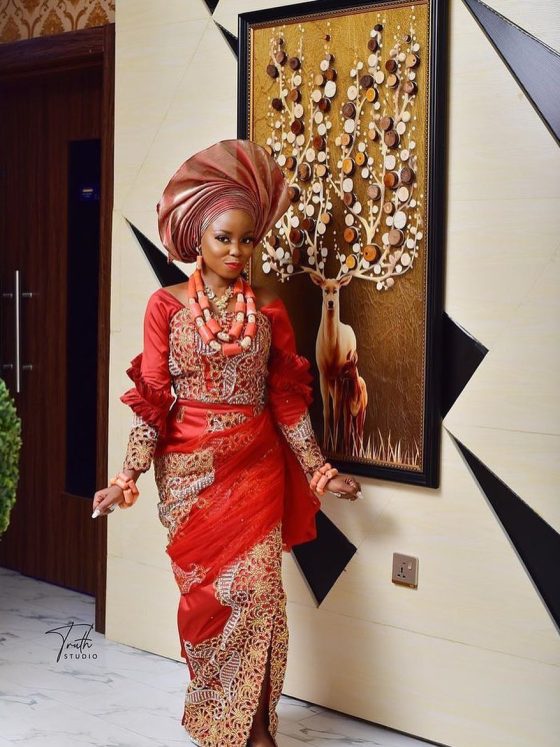
Two women wear matching aṣọ-òkè at a wedding in Nigeria during the 1980s. Their cloth connects them, but their accessories and the ways they have tied their gèlè distinguish their outfits. The V&A’s caption identifies Alice Beckley and a friend; Beckley’s granddaughter, Tosin Adeosun, identifies the occasion as her aunt’s wedding. “They’re unique but together,” Adeosun says. She understands their coordinated dress as an expression of support for the bride. Her words make a particular relationship visible. The photograph shows shared cloth and different styling. A family member supplies the occasion, the kinship and an interpretation of the women’s choices.
That is what testimony can contribute to dress history. It does not need to decode every outfit in a region. It can explain why one person chose a garment, how a mother’s sewing supported a household or why a carefully posed photograph began as an ordinary afternoon decision. The historical value lies in preserving those explanations with the people who give them.
Named memories connected with Ghana, Nigeria and Britain reveal the personal decisions behind sewing, studio portraits and everyday family dressing.
What Kind of Testimony Are We Reading?
The principal examples here come from the V&A’s web feature on family photographs and memories, titled “Family, Photography, Memories: Africa Fashion”. The museum gathered photographs, home movies and related accounts through a public call-out for its Africa Fashion exhibition, which ran at V&A South Kensington from 2 July 2022 to 16 April 2023. The page publishes named memories, but it does not describe every contribution as a recorded oral-history interview. Cindy Deeds’s accounts are credited “as told to Esinam Jordan”; other statements appear under contributors’ names without equivalent information about their collection method. Individual recording dates are not supplied throughout.
These sources are therefore described here as published testimony. A photograph’s date is kept separate from the later recollection, and the webpage’s July 2026 update is not treated as an interview date. Their geographical scope is equally specific. The accounts concern people connected with Ghana, Nigeria and Britain. Together, they offer several ways to approach dress through memory, not a representative survey of West Africa.
Shared Cloth Could Accommodate Personal Style
Adeosun’s reading of the wedding photograph resists a simple choice between collective belonging and individuality. Her grandmother and the other woman wear the same aṣọ-òkè, yet neither is presented as an interchangeable participant. Adeosun draws attention to their accessories and different approaches to the gèlè. Their coordination leaves room for personal decisions. “Unique but together” is a family interpretation of this image. It should remain attached to its speaker rather than becoming a fixed explanation for every instance of matching cloth. That attribution makes the account more useful. It tells us not only what the women wore, but how a granddaughter understands their appearance within a family celebration.
For another photograph, the relevant questions might produce different answers. Who selected the cloth? Did the wearers agree on accessories? Was the coordination expected, requested or improvised? The image may prompt those questions, but it cannot answer all of them alone. Testimony adds value when it supplies a situated explanation rather than confirming a meaning the researcher has already assumed.
Sewing Connected a Household with Paid Work
A 1968 photograph taken at a family home in Awudome, Accra, shows Mary Kufuor, née Abrokwah, and Rose Owusu-Boateng, née Abrokwah. Michael Owusu-Boateng contributed the image and recalled his mother’s sewing. The published passage does not explicitly identify which woman he means, so that relationship should remain unassigned until confirmed. His account describes an extensive practice. His mother made her own clothing and sewed for his sister, cousins and aunts. Later, when the family lived in Tooting, sewing became her principal source of income. He remembered an industrial Singer machine and accompanying her to Petticoat Lane to buy fabric.
The recollection connects making for oneself, making for relatives and making for payment. It also links the family’s Ghanaian photograph with a later working life in Britain. His description includes a remembered design preference:
“When designing garments, simplicity was her thing. There was always a story behind the style of her dresses.”
The statement preserves more than technical competence. It records how a son understood his mother’s taste and the attention she gave to clothing. It does not establish that she made every outfit in the 1968 photograph. Her broader sewing practice and the authorship of a particular garment remain separate questions. His memories of fabric shopping also preserve a change in feeling. The trips were unappealing to him as a child; later, London’s East End prompted nostalgia. The activity stayed the same in memory, but its emotional significance changed.
A Studio Portrait Did Not Require a Special Occasion
Kofi Owusu’s account offers a useful correction to the apparent formality of a studio image. He dates his Accra portrait to around 1970 or 1971, when he was approximately 14 or 15. He remembers the studio on the Ring Road, near the place then called Circle and beside Bea’s Beauty Parlour. “This wasn’t a special occasion,” he explains. He and a friend were passing and decided to have their pictures taken. That recollection changes the picture’s circumstances. A composed pose and professional setting do not necessarily indicate a ceremony or milestone.
Owusu places the visit within his experience of family photograph albums and young people using professional studios. He supplies a participant’s context, not a comprehensive history of photography in Accra. His clothing description is similarly individual. He calls the top a Jeromi, explaining the term through the stitching around its neck and chest. He also remembers it as “not particularly fashionable,” despite its popularity. That distinction deserves to survive publication. A writer might otherwise use the photograph to illustrate fashionable youth without considering what the sitter thought of the garment.
Here, the person photographed can challenge the story that appearance alone encourages.
A Wearer Distinguished Cloth from Garment
Cindy Deeds’s account of a photograph taken in Yola, Nigeria, around 1978 separates two stages in the life of her lace top:
“The lace top was sewn in Nigeria. The fabric was from Ghana.”
She identifies Nigeria as the place of sewing. Her reference to Ghana links the fabric, but not necessarily its place of manufacture. “From” could refer to where the cloth was bought, obtained, or brought from. The published statement does not resolve that question. The distinction is important because a finished outfit may involve several movements and different kinds of work. Fabric manufacture, purchase, transport and garment construction should not be collapsed into one place of origin. Deeds says she was dressed to visit a friend. Her testimony, credited as told to Esinam Jordan, gives the image an everyday social setting and preserves knowledge that cannot securely be read from its surface.
The maker is not named. That absence invites further enquiry; it does not justify attributing the sewing to Deeds or assigning it to an unidentified workshop.
One Dress Could Carry Several Memories
A second photograph shows Deeds in a studio in Cape Coast, Ghana, around 1970. She remembers having a seamstress make the dress and describes it as beautiful and special. The image prompts a story about another occasion: wearing the dress when she and her friend Maggy were invited to a hotel ball. Deeds watched the ballroom dancing rather than joining it, and remembered laughing at her friend’s dancing. The studio sitting and the ball are not the same event. The photograph records the dress in one setting; its wearer connects it with another episode.
That connection is part of the garment’s biography. A photographed outfit need not be confined to the occasion when the image was taken. The memory also makes room for pleasure. Historical writing can become so concerned with symbolism and status that it neglects enjoyment. Deed’s account preserves affection for a dress, companionship and the humour of an evening. Those are not distractions from dress history. They are among the reasons clothing becomes memorable.
A Daughter Recognised a Longer Pattern of Dressing
Akua Appiah contributed a 1960s photograph of her mother, Dinah Osei, with a friend in Kumasi. She identifies the period as her mother’s time at teaching college and describes a white shirt worn with an African-print wrapper. Appiah recognises the combination as a style her mother carried from youth into later life. This is a daughter’s interpretation, informed by knowing the person beyond the image. It is not Osei’s own recorded explanation of what she wore that day. The distinction locates the account’s authority. A relative can recognise continuity across decades even when they were not present at the moment of the photograph.
Appiah also donated two of her mother’s tailor-made outfits to the V&A. Photographs, garments and family knowledge could therefore enter the collection together. The example challenges any automatic opposition between institutional records and personal memory. A museum can preserve testimony, while testimony can help identify and interpret a garment. Omiren’s guide to what a museum record can and cannot tell us about dress explores why we must examine each entry before deciding what social history it contains.
Makers’ Recollections Answer Different Questions
A maker’s testimony may explain reasoning rather than a wearing occasion. In a statement dated 2021, Shade Thomas-Fahm recalls comparing a European skirt with a Yoruba ìró. Both clothed the lower body, but their differences offered possibilities: “Both styles had something to learn from the other.” The statement explains her approach to comparison. It should not be used to assign a particular adaptation to every garment she made. Placed beside the family accounts, it demonstrates the different knowledge speakers contribute. A wearer may identify an occasion. A relative may recognise a recurring preference. A maker may explain a decision.
None needs to substitute for the others.
Preserve the Circumstances of the Account
Careful publication retains those relationships. Identify the speaker, their connection to the garment or photograph, and whether the account is first-hand or inherited. Record when and how it was collected, and where that information is available. Preserve approximate dates and uncertainty rather than supplying precision for a smoother narrative. Permissions require separate attention. Lending an image to an exhibition does not automatically authorise republication elsewhere. Permission to reproduce a family photograph and permission to quote a published statement should not be treated as the same agreement. The final caption matters as much as the body. It should not strip away a qualification, turn a recollection into an independently confirmed fact or assign an unnamed maker.
These decisions protect the detail that makes testimony valuable.
The Omiren Argument
Testimony changes dress history when it makes a particular choice intelligible: why someone entered a studio, how a garment was commissioned or what coordinated cloth meant within a family event.
The accounts discussed here preserve sewing as work, style as remembered preference and clothing as part of ordinary pleasure. Their significance does not depend on representing everyone.
The task is to keep speaker, photograph, garment and recollection connected. That precision allows personal knowledge to enter a wider historical record without losing the person who gives it meaning.
Also Read:
- Ola Ebiti Stylist: Nigerian Heritage, Tailoring and Editorial Fashion
- Ghana’s Premium Fashion Tier Is Building What Fast Fashion Can’t Buy
- Fashion and Ritual: How Celebrations Shape African Style Practices
- What Black British Women Wear to Work and Why It Is a Political Statement
Frequently Asked Questions
What can testimony add to a photograph?
It can identify an occasion, relationship, decision or remembered association. In the V&A accounts, testimony explains a family wedding, an unplanned studio visit and where a lace top was sewn. The photograph supplies the image; the speaker supplies circumstances that cannot securely be read from its surface.
Is every family memory an oral-history interview?
No. The V&A publishes named contributions but does not describe a uniform interview method for all of them. Cindy Deeds’s accounts are credited “as told to Esinam Jordan”, while other statements appear under contributors’ names without equivalent detail. The source form should be stated accurately as published testimony where the method is unclear.
Can someone contribute evidence without having been present?
Yes, but their relationship to the knowledge must remain clear. Akua Appiah recognises her mother’s white shirt and African-print wrapper as part of a style continued from youth into later life. That is a daughter’s interpretation, not Dinah Osei’s own recorded explanation of what she wore that day.
Can one account represent West African dress?
It should not be made to explain more than its evidence supports. The accounts concern people connected with Ghana, Nigeria and Britain, and they are not a representative survey of West Africa. They matter because they preserve particular people and choices, not because they offer a universal regional code.