An archive is a record. A record is a claim about the past. A claim about the past can be wrong. In textile heritage collections held by museums, universities, fashion institutions, and private foundations worldwide, the wrong claims are not marginal annotation errors. They are foundational attribution problems: garments collected, catalogued, and stored under descriptions supplied by the collectors, in the collectors’ languages, using the collectors’ categories, with the communities of origin neither consulted nor credited. The archives were built by people who did not know what they were looking at and did not ask the people who did.
The correctable archive is the archive that still exists, still holds the objects, still maintains the records and still has staff who can process an incoming claim for correction. Most of the major textile heritage collections in Western museums and universities meet this description. The objects are there. The records are there. The records are wrong in specific ways that specific communities could correct. The question is not whether the archive can be corrected. It is whether the institution accepts the community’s standing to request that correction, and whether the correction process is accessible to communities whose resources do not match those of the holding institution.
This article examines that question through the specific lens of textile heritage: the garments, fabrics, adornments and clothing objects that constitute a significant proportion of non-Western material culture collections in Western institutions. It argues that the archival correction question is structurally different from the physical repatriation question and that the distinction matters for what communities can request and what institutions can grant without the political and legal complexity of returning physical objects.
A textile archive can be corrected. Who has the standing to request that correction, who holds the knowledge to make it, and what happens when the institution does not acknowledge the community the error erases? This analysis examines archival correction in heritage textile collections.
The Nature of the Archive Error in Textile Collections
What the error typically looks like
Attribution errors in textile heritage collections follow a consistent pattern rooted in the collecting practices of the nineteenth and early twentieth centuries. A collector, typically European, encounters a textile object in the field. The collector records what they observe: the approximate region of origin, the visible technique, the function as they understand it and the date of collection. The collector’s record is the archive’s founding document. The community that produced the object is not consulted about the technique name, the garment name, its account of the object’s ceremonial or social function, or its identification of the specific community within the broader regional designation the collector used.
The result is a catalogue entry that carries the weight of institutional authority while containing significant errors and omissions. ‘West African, unidentified community, woven cotton, ceremonial use, circa 1900’ is a description that is accurate about the material and approximate about the date while being wrong about the community identification (or declining to supply it) and reductive about the function. The word ‘ceremonial’ flattens what may be a highly specific social role whose vocabulary belongs to the community that developed it. The phrase ‘unidentified community’ performs the absence of knowledge as a neutral fact rather than acknowledging that the knowledge exists in the community that was not asked.
In African textile collections specifically, the misattribution problem is compounded by the colonial framework within which most collecting occurred: objects were described using geographic and administrative categories imposed by colonial structures rather than the community names and ethnic or cultural identifications that the producing communities use for themselves. A garment described as ‘Northern Nigerian’ may belong to any of several dozen distinct ethnic communities, each with its own dress traditions, technique vocabularies, and ceremonial contexts. The regional attribution is the archive acknowledging the limit of the collector’s knowledge without acknowledging that the knowledge has a holder; the archive failed to consult.
Why does the error persist?
The archival error persists for two distinct reasons. The first is institutional inertia: an error in a founding record becomes embedded in subsequent records that cite it, is repeated in exhibition labels, catalogue entries, academic publications and secondary databases, and accumulates a citation history that gives it the appearance of confirmed fact. A correct attribution submitted to one record may not propagate to all the records that have cited the incorrect one. The archive’s correction infrastructure is not designed for the scale of the correction task.
The second reason is more structural: many holding institutions do not acknowledge the epistemic authority of source communities over the objects in their collections. The institution considers itself the legitimate interpreter of its holdings. A community requesting an archival correction is asking the institution to defer to a knowledge source outside its own staff and scholarly network. Institutions with a robust community partnership model will process this request through a collaborative methodology. Institutions without such a model may not have a mechanism for processing it at all.
The Standing Question
Who has the right to request a correction?
A 2025 paper in Museum Anthropology reconceptualises repatriation as the power to decide, arguing that the central issue in heritage disputes is not only the return of physical objects but the reaffirmation of source communities’ rights to make decisions about their own cultural heritage. The standing question in archival correction draws directly from this framework: the community whose cultural knowledge is misrepresented in the archive has an inherent right to request correction, because the archive’s error misrepresents that community’s identity, practice, and knowledge.
However, the community asserting it does not resolve the standing question. The institution holding the archive must also recognise it. In jurisdictions with legal frameworks for Indigenous cultural heritage, such as NAGPRA in the United States, law provides for recognising a community’s standing to make claims about objects in institutional collections. Under NAGPRA, an institution must consult with a lineal descendant, Native American tribe or Native Hawaiian organisation that establishes a cultural affiliation with an object. Standing is legally defined, and consultation is mandatory. Outside Indigenous contexts and outside NAGPRA’s jurisdiction, the standing question has no equivalent legal answer: a community requesting an archival correction in a British, French or German institution is making a claim whose recognition depends on the institution’s own policies rather than a legal requirement.
This asymmetry is significant. It means that archival correction rights are not uniformly available across the global textile heritage collection landscape. A West African community requesting an archival correction from a Lagos museum operates in a different legal context from the same community requesting a correction from a Berlin museum. A foreign institution may not recognise the community’s standing in its own institutional context, and the resources required to pursue a correction across international institutional boundaries may be prohibitive for communities without dedicated cultural heritage staff.
Who holds the knowledge required to correct?
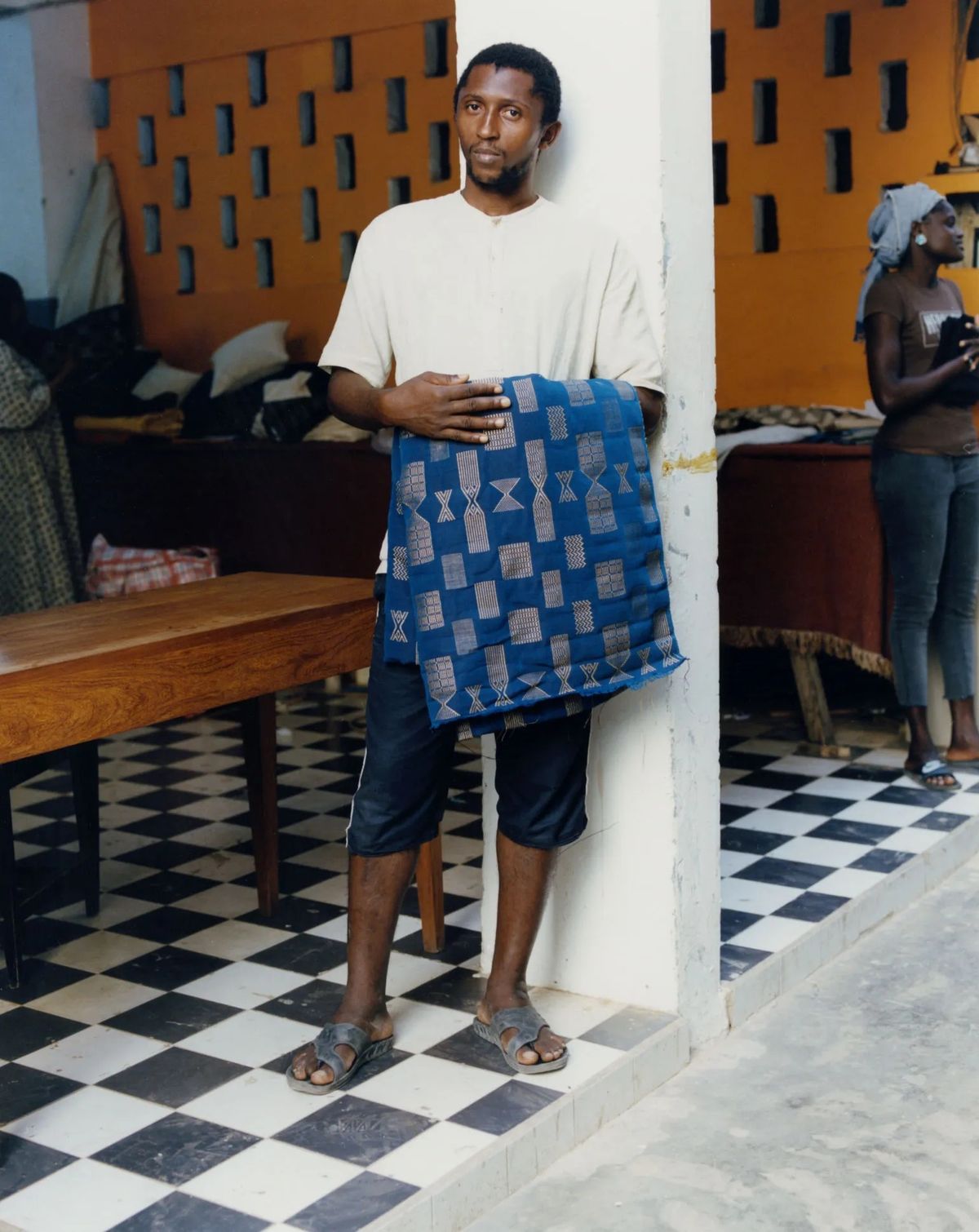
The standing question has a companion: the knowledge question. Archival correction requires knowledge that the original collector did not have and that the holding institution does not possess. The name of the specific community that produced the object, the Urhobo or Hausa or Ewe or Kente weaving tradition to which it belongs, the ceremonial or social context in which it was used, the technique name in the producing community’s language, the social position of the person who would have worn it – this knowledge is held by the community, not by the institution.
The knowledge question is also the community’s strongest argument for archival standing: they are not simply asserting a right to correct the record. They are offering to supply what the record lacks, from a knowledge source that the archive cannot replicate through its own scholarly resources. A community elder who can identify a garment’s technique, its regional and social context and its correct community attribution is offering the archive an upgrade in accuracy, not merely a political claim. The institution that refuses this offer is choosing an error over a correction because the correction comes from a knowledge authority the institution has not previously recognised.
How Institutions Have Responded
The collaborative model: telling the story their way
When the Tŝilhqot’in Nation engaged with the Museum of Vancouver over the return of their cultural belongings, cultural staff from the Nation met routinely with the museum over the course of a year to ensure, in the words of one Nation representative, that they told the story their way. The subsequent exhibition was built from the Nation’s own account of its objects and their significance rather than from the museum’s inherited interpretive framework. The archive’s founding description gave way to the community’s own testimony.
This model, in which the holding institution actively invites the source community into the interpretive process, is the strongest available response to the archival correction question. It does not simply amend a catalogue entry. It rebuilds the interpretive framework around which the objects are understood and presented, making the community’s knowledge the primary source rather than an external supplement to the institution’s own record. The correction is not a footnote; it is the new text.
The collaborative model’s limitation is that it requires the institution to initiate it or to have a policy framework through which communities can initiate it. An institution without a community partnership model, without dedicated Indigenous or source community liaison staff and without a budget for the travel, translation and relationship-building the collaboration requires, will not produce this outcome even when the community has the knowledge and the will to engage. The gap between institutions that have built this infrastructure and those that have not is a gap where corrections wait.
The digital archive and the correction problem at scale
The digitisation of textile heritage collections has created a new dimension of the archival correction problem. A garment’s incorrect attribution, once confined to a physical card in a museum’s storeroom, is now accessible through a digital database that researchers, designers, and the fashion industry worldwide can query. The incorrect attribution circulates at a scale and speed that the physical archive never achieved. When a fashion brand researches a textile tradition and encounters the digitised archive’s erroneous description, the error shapes the brand’s understanding of the tradition before the community has had any opportunity to correct it.
Digital archives also create a new possibility for correction at scale. A community that successfully secures an archival correction in one institution’s digital record has a model it can present to institutions holding similar objects. The Tłı̨chǫ Nation’s development of its own digital archive in Behchokǫ̀ represents an alternative approach: building a parallel record whose accuracy and community authority are built in from the start, rather than correcting a sequence of external records built without community input.
The community that builds its own archive creates the correction by making the authoritative record first, rather than disputing the secondary record built without its knowledge. The external archive’s error becomes visible against the community’s own account, rather than remaining invisible within a system with no authoritative alternative.
The Archival Correction and Fashion’s Use of Heritage
The archival correction question is not only a museum policy question. It is a fashion industry question, because fashion designers, brands and media organisations use textile heritage archives as creative and commercial reference sources. A designer who researches a weaving tradition through an institution’s digital archive and encounters an incorrect attribution will draw incorrect conclusions about the tradition’s origins, its community context and its correct name. Those incorrect conclusions may then appear in the brand’s marketing, in press coverage and in the public record that becomes the next designer’s reference source.
As Omiren Styles has established in its analysis of fashion as a cultural archive, it holds cultural memory in its materials, techniques, and forms, and the accuracy of that memory depends on the accuracy of the records from which the fashion industry draws its understanding of the traditions it references. An archive that misattributes a weaving technique to the wrong community, uses the wrong community name, or omits the community name entirely can feed the fashion industry reference that carries the same errors into commercial contexts.
The fashion industry’s use of cultural archives makes the archival correction question a commercial equity question as well as a cultural accuracy question. When a fashion brand correctly attributes a textile technique to its producing community, and that attribution appears in its marketing and editorial coverage, the community receives the visibility that the brand’s platform provides. When the brand’s source archive carries an error, the credit goes to no one: the technique is described as regional or anonymous, and the community that developed it is invisible in the commercial record built from the archive’s wrong description.
As Omiren Styles has argued throughout its coverage of heritage textiles and the Global South, the textile traditions of the Global South carry meanings that scale and market adoption can obscure rather than distribute. Archive error is one mechanism of obscuration: when the archive does not know the community’s name for its own technique, the technique enters the market without the knowledge system that produced it. Correcting the archive record corrects this mechanism.
What Archival Correction Requires

A community seeking archival correction in a holding institution needs four things: recognition of its standing to make the claim, access to the institution’s records and correction process, the ability to provide documented knowledge that satisfies the institution’s evidentiary standards, and a mechanism for propagating the correction across the network of records that have cited the erroneous original.
The first, standing recognition, is the hardest to secure in institutions without a community partnership policy. The second, process access, depends on the institution having a correction process that is accessible to external parties rather than confined to internal curatorial staff. The third, documented knowledge, is a resource question: a community elder who holds the corrective knowledge may not produce it in the written, cited form the institution’s standards require, and translating oral knowledge into archival documentation is itself a process that requires institutional partnership and support. The fourth, propagation, requires coordination between institutions that may not have a shared correction mechanism.
Of these four requirements, the most tractable in the short term is the second: institutions can open their correction processes to external parties by establishing community liaison functions, partnership protocols and submission mechanisms for archival corrections. The Smithsonian’s ethical returns policy and the Canadian Museums Association’s work toward a national repatriation framework both represent this kind of institutional opening. They do not resolve the standing question for communities outside their geographic and legal jurisdictions. Still, they demonstrate that the opening is possible and that institutions can choose it without legislative compulsion.
The Omiren Argument
A textile archive that cannot be corrected by the communities whose textiles it holds is an archive whose authority rests on its own founding errors. The institution that built the archive from external observation, without community input, has claimed the right to hold and interpret objects whose meaning it did not possess when it catalogued them and still does not possess without the community’s participation. The correction is not an external imposition on the archive. It is the archive becoming what it claims to be: an accurate record.
Who gets to request the change is both the wrong and the right question. It is the wrong question because the answer is obvious: the community whose cultural knowledge the archive misrepresents is the party whose correction makes the archive accurate. It is the right question because the obvious answer is not the institutionally operative answer in most holding contexts, and naming the gap between the obvious answer and the operative one is the work that produces the pressure for institutional change.
As Omiren Styles has argued throughout its coverage of fashion, culture and the Global South, the Global South made fashion and never got credit. The textile archive that describes Urhobo beadwork as ‘Niger Delta, unidentified community’ and Kente weaving as ‘West African, probable Asante attribution’ and Oaxacan backstrap loom work as ‘Mexican traditional textile, maker unknown’ has not recorded the Global South’s fashion heritage. It has recorded the limits of the institutions that collected it without asking. The correction requires asking. The community requesting the change is supplying the question’s answer. The institution’s only remaining decision is whether to update the record.
ALSO READ
- Clothing as an Archive: How Fashion Holds Memory and Identity
- Can Heritage Textiles Scale Without Losing Their Meaning?
- The Documentation Gap: What Fashion Supply Chains Still Fail to Record
- The Maker-Credit Test: What a Heritage Fashion Product Page Should Clarify
- The Global South Made Fashion. It Just Never Got Credit.
EXPLORE MORE
Read the full Archives and Attribution and Heritage Clothing coverage at Omiren Styles for ongoing analysis of textile heritage, archival attribution and the rights of source communities to correct the records held about their cultural knowledge. Discover travel and heritage intelligence across Africa, the Caribbean and Latin America at Rex Clarke Adventures.