A heritage fashion product page has a specific job: to connect the person buying the object with the person or community who made it. The connection does not have to be sentimental. It has to be specific. The buyer is making a decision that carries commercial weight for someone in a supply chain that, in many cases, the product page is the only public window into. What the product page says about the maker is what the buyer has to work with.
Most heritage fashion product pages use a vocabulary that sounds specific without being so. ‘Handcrafted by skilled artisans.’ ‘Made using traditional techniques passed down through generations.’ ‘Sourced from a community of master weavers in [region].’ These sentences are not false. They are structurally incomplete: each one omits the information that would make it verifiable, and verifiability is the difference between a provenance claim and a provenance assertion.
The maker-credit test that follows applies to any product page describing a heritage fashion object: a hand-woven textile, a beaded garment, a natural-dye piece, a basket, a hat, or an embroidered cloth. It has six fields. Each field corresponds to a type of information that a product page either provides or does not. The test does not require a brand to have answered every field. It requires a reader to know which fields the brand has not answered and to understand what that absence means.
“Handmade by artisans” is the minimum claim and the least informative one on a heritage fashion product page. The maker-credit test sets out six questions whose answers determine whether the page treats the maker as a person or as a marketing category.
Field 1: The Maker Is Named

The most basic maker-credit question is whether the product page names the person or specific community who made the object. Not ‘artisans in [country].’ Not ‘a community of weavers.’ A name: the weaver, the cooperative, the village collective, the named craftsperson.
Naming the maker is the minimum requirement for credit to be credit, not attribution to a category. When a fashion profile says Ghanaian kente weavers inspired the collection, it names the weavers as a category. When a product page says the Bonwire Kente Weavers’ Association weaved the fabric, the credit has a specific recipient. The distinction is not cosmetic. A category cannot receive credit, recognition or commercial benefit. A named entity can.
As Omiren Styles established in its analysis of the fashion profile interview, the gap between naming a tradition and naming a practitioner is the gap between credit given to a category and credit given to a person. The same gap exists on a product page. A product page that names the tradition passes the aesthetic test and fails the accountability one.
Field 2: The Maker Is Located
The product page should identify where the object was made with enough specificity to be meaningful. Country-level origin is the floor. The more specific the origin claim, the more informative it is and the more it can be verified.
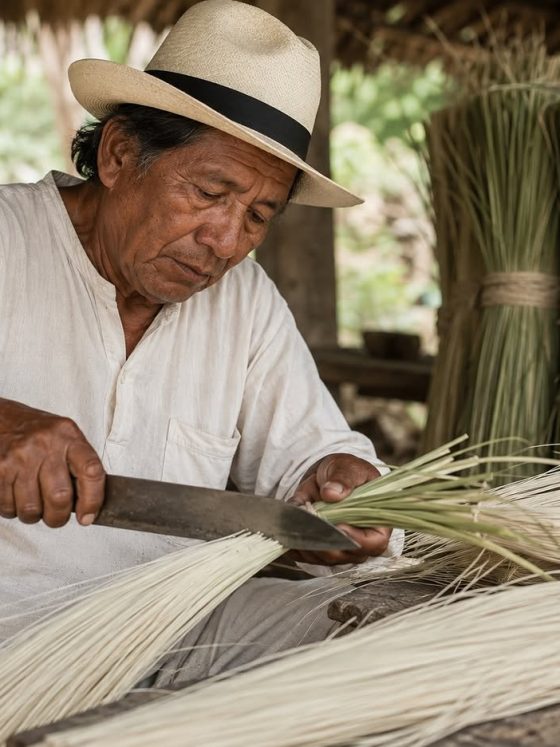
Montecristi and Cuenca are both in Ecuador; they produce toquilla straw hats whose quality and production time differ by up to a factor of twenty. A product page that says ‘handwoven in Ecuador’ for a Montecristi superfine hat has said something true and communicated almost none of what makes that hat specifically significant. A product page that says ‘handwoven in Pile, Montecristi, by a named artisan cooperative’ has said something verifiable.
As Omiren Styles established in its analysis of how Ecuador’s toquilla weaving is described at the point of sale, the absence of specific location is the single most common omission in the retail vocabulary for heritage craft products. It is also the easiest omission to close: location requires no testing, no third-party certification and no commercial disclosure. It only requires the brand to know where the object was made and say so.
Field 3: The Technique Is Described
A heritage object is defined by the knowledge required to produce it. The product page should describe the specific technique, not the general category. Not ‘hand-embroidered.’ Embroidery by what method, in what thread, on what fabric, using what stitch? The answer to that question is what distinguishes a heritage object from a machine-made simulation of it.
The toquilla straw hat requires a fibre count per inch to be meaningful as a quality indicator: a basic hat has fewer than fifteen fibres per inch; an extra-fine hat has between twenty-three and thirty-two; a superfine exceeds thirty-two. A Wayuu mochila is crocheted, not loom-woven, and each bag takes one to four weeks, depending on pattern complexity. A sashiko repair uses a specific running stitch whose tension and spacing are part of the technique’s distinctive output. A product page that says ‘handwoven’ without specifying the technique has named the process category and omitted the process.
Technique description is also the mechanism by which the maker’s knowledge becomes visible. The description does not need to be technical to the point of incomprehensibility. It needs to be specific enough to differentiate: specific enough that a reader can understand why this object required the knowledge that produced it, and why that knowledge is not replaceable by a different process.
Field 4: The Production Time Is Stated
Production time is the single most informative quality indicator for most heritage craft objects, and the most consistently omitted field on product pages. It is the number that converts ‘handmade by skilled artisans’ from a credential into a claim with content: if the hat took six months to produce, the six months is the skill, and the product page that says so is the product page that is treating the maker’s labour as the value it is.
A product page that names the technique and states the production time has done something the retail vocabulary for heritage craft rarely does: it has told the buyer what the maker’s time was worth and made the buyer’s decision about that value rather than the object’s appearance.
Production time disclosure is not primarily a marketing tool. It is a transparency measure. A product page that says ‘each hat takes between six months and one year to produce’ is making a claim the maker can confirm or deny, the buyer can contextualise against the price, and a journalist or researcher can check. The absence of a production time on a product page is an absence of accountability on a dimension that requires no third-party verification to disclose.
Field 5: The Commercial Relationship Is Described
The product page should describe the commercial relationship between the brand and the maker. Not the relationship in the emotional register of the brand narrative, but in the commercial one: does the brand buy directly from the maker? Through an intermediary? On what pricing basis? Is the maker paid at the point of sale, on consignment, or on a fixed-purchase basis whose terms are known to the maker before the sale?
This is the field that most product pages decline to address, and its absence is the most significant gap in the maker-credit standard. A brand that buys Wayuu mochilas through a commodity intermediary and describes itself as ‘working with Wayuu communities’ has made a community sourcing claim without a community sourcing relationship. A brand that buys directly from a named Wayuu cooperative at a documented premium above the commodity rate has a relationship with verifiable terms.
As Omiren Styles established in its analysis of botanical beauty sourcing claims, the distinction between a brand that purchases from an intermediary who sources from cooperatives and a brand in a direct relationship with those cooperatives is material to the sourcing claim. The same distinction applies to fashion product pages. A community-sourcing narrative that describes a warm relationship with a named community without disclosing the commercial terms of that relationship is a story, not a claim.
Field 6: The Price-to-Maker Relationship Is Transparent
The final field is the hardest to populate and the most revealing when it is. What percentage of the retail price reaches the maker? Not as a confession of profit margin, but as a transparency measure that allows the buyer to understand what their purchase does for the person whose work they are buying.
Very few fashion product pages answer this question directly. Some fair-trade certified products disclose it through the certification’s own standards, which require a minimum percentage of the price to reach the producer as a fair-trade premium above the commodity price. Most heritage fashion product pages say nothing about it. The absence does not necessarily mean the maker is being exploited. It means the buyer cannot know, from the product page alone, whether the price reflects the labour or the brand’s margin on the labour.
As Omiren Styles established in its material-claim evidence checklist, the decision for any provenance claim is to approve it at the level the evidence reaches, narrow it if the evidence supports only part of the full implication, hold it if the evidence has not been supplied, or remove it if it cannot be supported. The price-to-maker field applies the same decision to the product page: a page that makes a community-benefit claim without disclosing the commercial terms has made a claim whose evidence has not been supplied. The correct editorial response is to narrow the claim to what the evidence shows, not to repeat the full claim based on the brand’s assertion.
What the Test Produces
Applied to a heritage fashion product page, the six-field maker-credit test produces one of four outcomes for each field: Pass (the information is present and specific), Partial (the information is present but insufficiently specific to be verifiable), Absent (the information is not on the page), or Contradicted (the page makes a claim that other available evidence does not support).
A product page that passes all six fields has produced a record: a named maker in a named place, using a described technique over a disclosed production time, in a commercial relationship whose terms are stated, at a price whose relationship to the maker’s payment is visible. That record is rare. Its rarity is the test’s argument: the standard is achievable, most pages do not reach it, and the gap between the standard and the practice is where the accountability question lives.
As Omiren Styles has argued throughout its coverage of heritage textiles, craft and the Global South, the Global South made fashion and never got credit. The maker-credit test is the instrument for closing that gap at the product page level: the smallest available unit of fashion accountability, applied to the moment when a buyer and a maker are connected by a transaction whose terms the product page is the only available record of. What the page says about the maker is what the maker gets. The test asks whether that is enough.
THE SIX FIELDS AT A GLANCE
- Field 1: Name: Is the specific maker – person, collective or cooperative – named on the product page?
- Field 2: Location: Is the production location specified to village, district or cooperative level, not only country?
- Field 3: Technique: Is the specific technique described with enough precision to differentiate this object from a machine-made equivalent?
- Field 4: Production time: Is the time required to produce this specific object stated on the page?
- Field 5: Commercial relationship: Is the brand’s purchasing relationship with the maker described in commercial rather than narrative terms?
- Field 6: Price-to-maker: Does the page disclose, or link to a disclosure of, what proportion of the retail price reaches the maker?
ALSO READ
- How Is Ecuador’s Toquilla Weaving Described at the Point of Sale?
- From Botanical Name to Beauty Claim: The Checks a Sourcing Story Must Pass
- Why “What Inspired You?” Is Not Enough for a Fashion Profile
- The Global South Made Fashion. It Just Never Got Credit.
EXPLORE MORE
Read the full Material Intelligence and Heritage Craft and Provenance coverage at Omiren Styles for ongoing analysis of maker credit, provenance standards and the accountability gap between heritage fashion marketing and the communities whose knowledge makes the products possible. Discover travel and heritage intelligence across Africa, the Caribbean and Latin America at Rex Clarke Adventures.