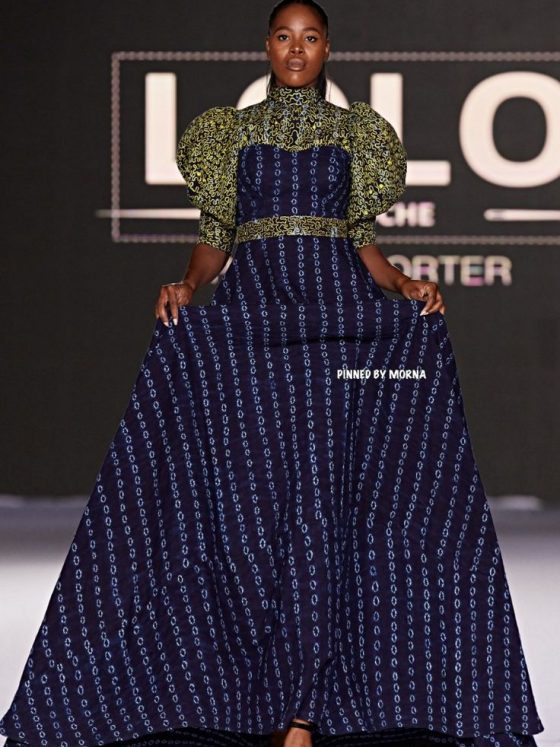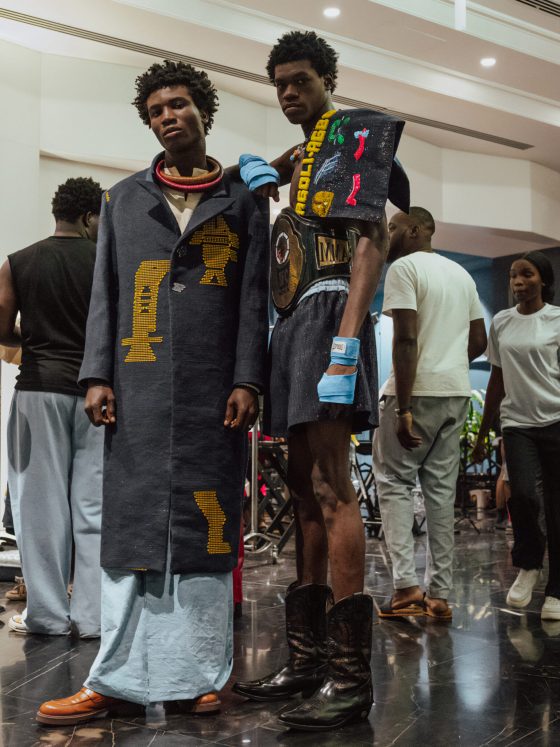


Painting came before linen in Murielle Guidi’s account of Tonafa. After experimenting with clothing, she gradually brought painting into her textile work and only then found the material on which she wanted to develop that relationship. The sequence gives the project its clearest starting point: not a fabric in search of decoration, but a creative practice arriving at a particular surface.
At a private sale in Cotonou on Saturday 4 April 2026, Guidi presented Tonafa through imported linen carrying hand-painted motifs, including references to Adinkra symbols. Arthur Sélo’s report on the launch for Banouto describes a quiet evening when she welcomed guests, walked them through the collection, and watched them touch the fabrics. Her stated aim was to launch Tonafa into Beninese and, above all, African fashion.
The collection’s proposition rests on the relationship between three elements: the cloth, the painted image and the meaning Guidi wants the wearer to encounter. She told Banouto that Tonafa is not just a name or a brand, but a vision.
That vision enters a substantial market. UNESCO’s 2023 report on the fashion sector in Africa valued clothing and footwear in sub-Saharan Africa at US$31 billion in 2020. Within that $31 billion African fashion market, Beninese fashion labels compete not only on price and cut but increasingly on the stories their clothes can carry.
Murielle Guidi’s Tonafa combines hand-painted linen and Adinkra references in a fashion label launched in Cotonou and shaped by painting and meaning.
From Painting to Cloth

Dans le récit de Banouto, Guidi décrit un processus graduel : “J’ai associé petit à petit la peinture au textile… et j’ai ensuite découvert le lin.” She brought painting and textiles together little by little, before discovering linen.
The statement places experimentation at the centre of the work. Linen was a choice reached through making, rather than presented as an inevitable expression of her identity. It arrived at the end of a search, not at its beginning.
Banouto describes the motifs as hand-painted, not mechanically printed. That gives the painted image a direct place within production. The surface is worked on rather than selected only as a finished patterned cloth, and each motif passes through the designer’s hand before the garment is complete.
It is a useful distinction, but not a hierarchy. Hand painting does not automatically make a garment more accomplished than printing. For Tonafa, its significance is that Guidi has chosen it as the means through which her images enter the clothing. That choice brings consequences of its own: slower production, variation between pieces, and a closer relationship between artist and object.
The critical relationship is therefore between the painted surface and the garment. A motif’s position, scale and repetition shape how it is encountered. A symbol painted once at the centre of a back panel speaks differently from the same symbol repeated across a sleeve. Those decisions are where the project’s stated interest in meaning must take material form.
Why Guidi Chose Imported Linen
Guidi is open about using a fabric that comes from elsewhere. Banouto reports that the linen is imported and distant from local fibres, and that she sees it as a way to express the link between modernity and tradition: a blending of influences and a bridge between two worlds.
That explanation is sufficient without turning Tonafa into an argument against wax print, kanvô or other established materials. The important choice is what Guidi does with the linen, not whether the cloth passes an imagined test of African authenticity.
Linen also has practical qualities that suit the project. It is a woven cloth made from flax, valued for breathability in warm climates, and its relatively even, matte surface accepts paint in a way that a densely patterned cloth would not. For a designer whose images are the point, a plain ground gives the motif room to breathe.
Her interest is also more specific than placing a recognisable sign on an otherwise neutral garment. At the launch, she said Tonafa aims to create a distinct cultural identity and move beyond copied modern clichés. Painting becomes the method through which she seeks that distinction.
Within the wider field of Beninese fashion and Cotonou designers, Tonafa consequently offers a particular material direction. It does not need to represent every Beninese textile tradition to belong within that conversation.
Adinkra Is a Named Cultural Reference
The launch report identifies Adinkra as a source for Tonafa’s motifs, alongside a broader appeal to ancient memory. Guidi put the idea in her own terms: “Nos ancêtres, pour exprimer leurs émotions, utilisaient des signes, des symboles.” Naming the specific reference matters, because “African symbolism” should not erase the particular histories behind the signs a designer chooses.
The Fashion Institute of Technology’s account of Adinkra describes a flat cotton textile produced by the Asante people of Ghana, stamped with symbols drawn from proverbs, folktales, and popular sayings. The designs are carved into calabash stamps and printed in a dye made by boiling the bark of the badie tree with iron slag. People typically wear darker cloths for mourning, while they wear white or brightly coloured versions on festive occasions.
The same account documents change over time. Early Adinkra was stamped on strip-woven cloth; since the mid-nineteenth century it has often been made on machine-woven fabric, and by 2004 an Asante divisional chief was photographed wearing a screen-printed version rather than a hand-stamped one. The tradition has never been static in its materials or methods.
Omiren Styles has examined, in its study of Adinkra as a language, how each symbol carries a specific proverb or idea. That depth is why a designer’s choices deserve attention: selecting a symbol for its meaning and selecting a symbol for its shape are different decisions.
Tonafa’s hand-painted linen is not the same technical proposition as stamped Adinkra cloth. Guidi is drawing on a symbolic vocabulary within her own work, rather than reproducing every aspect of the textile tradition. That distinction makes the cultural exchange more legible. A Beninese designer selects references associated with another setting and applies them through a different process.
The Risk and Responsibility of Borrowed Symbols
Adinkra is among the most widely reproduced African visual traditions in contemporary fashion. Omiren Styles has argued, in its analysis of why global fashion keeps returning to the same craft traditions, that Adinkra’s graphic clarity has made it easy to strip it of its proverbial meaning and use it as a surface pattern.
Guidi’s stated intention runs the other way. Her concern with meaning and her rejection of clichés suggest an interest in what a symbol says, not just how it looks. The test of that intention lies in the clothes and in how they are presented: whether the meaning of each motif is explained, and whether symbols are chosen and placed with the care their content implies.
The reference also crosses a border. Adinkra belongs to the Asante and the wider Akan world of Ghana, as Omiren Styles sets out in its guide to traditional clothing in Ghana. A Beninese designer drawing on it is participating in a regional exchange of visual ideas, not claiming the tradition as her own. Naming that origin openly is part of using it well.
Adinkra-inspired clothing is now common enough that customers may recognise a symbol without knowing what it says. That gap creates both a risk and an opening for a small label. A brand that explains its motifs, names their sources and resists using them as filler can turn recognition into understanding. A brand that does not becomes one more source of the clichés Guidi says she wants to leave behind. For Tonafa, hand painting adds another layer: because each motif is applied individually, the designer can vary placement and combination from piece to piece, making deliberate choices visible to anyone who looks closely.
Clothing With an Intended Message
“Pourquoi ne pas donner un sens à ce que nous portons ?” Guidi asked at the launch: why not give meaning to what we wear? She linked that question to a desire for Beninese and African wearers to dress with pride and feel they belong to African culture through their clothing.
The statement establishes her intention without requiring every garment to carry the same message. It also places explanation alongside the object. If a motif draws on a named symbolic tradition, discussing its reference can become part of introducing the work.
For Tonafa, that makes the private-sale setting relevant. Guidi could present the clothes while explaining the thinking behind them. The launch report describes an encounter with the creator and the textiles, rather than only an audience viewing photographs, and a format in which questions about meaning could be asked and answered in person.
The opportunity was immediate: to bring personal experiments before potential customers and see the work enter a public conversation.
An Engineer’s Route Into Fashion

Banouto traces Guidi’s story to childhood, to scribbled drawings and dreams of architecture. She first studied civil engineering. Her parents did not initially approve of a career in fashion design, so she completed her engineering degree before turning to clothing.
She then bought a sewing machine and began without prior training, under sceptical eyes. Her parents eventually came to recognise her talent, which they described as a divine gift. Her account describes about four years of research, exploration and doubt, during which painting and textiles gradually came together.
Guidi sees continuity between engineering and fashion because both involve creation. “Dans les deux domaines, nous créons,” she told Banouto; in civil engineering, she added, one designs and builds. The move is presented not as abandoning one capacity for another, but as redirecting an interest in making things.
The chronology also resists the idea of an effortless career change. Tonafa emerged through a period of trials and decisions before the Cotonou launch gave it a public setting.
The Omiren Argument
Tonafa’s strongest proposition is the relationship Guidi establishes between painting and clothing. Imported linen supplies the surface; hand-applied motifs carry her intended cultural references; the garment brings those decisions into use.
The next critical question belongs to the work itself: how convincingly do image, proportion and clothing function together? That is the level at which Tonafa deserves attention, not as proof that an African designer can choose linen, but as a specific practice whose choices can be examined on their own terms.
ALSO READ:
- Yaa Asantewaa’s War Dress: What Ashanti Royal Regalia Meant in the War of the Golden Stool.
- Ghanaian Funeral Fashion: The Most Serious Fashion Event in West Africa.
- Americo-Liberian Quilting: The Stitch That Crossed the Atlantic and Became a Nation’s Diplomatic Voice.
- What Accra Street Style Is Actually Arguing in 2026.
Frequently Asked Questions
Who is Murielle Guidi?
Murielle Mèdéssè Guidi is a Beninese civil engineer turned fashion designer. She completed her engineering degree before turning to clothing, taught herself to sew and spent about four years experimenting before combining painting with textiles. She launched her label Tonafa at a private sale in Cotonou on 4 April 2026.
What materials and techniques define Tonafa?
Tonafa uses imported linen with hand-painted motifs rather than machine-printed ones. Guidi says she brought painting and textiles together gradually before discovering linen, which she sees as a bridge between tradition and modernity. Hand painting places the image directly in production, so each piece passes through the designer’s hand.
Which cultural references inform Tonafa’s motifs?
The launch coverage names Adinkra, the symbolic textile tradition of Ghana’s Asante people, in which stamped symbols carry proverbs and sayings. Guidi also refers more broadly to the signs and symbols ancestors used to express emotion. Her painted motifs draw on that vocabulary rather than reproducing the stamped cloth itself.
What does Guidi want her clothing to express?
Guidi asks why we should not give meaning to what we wear. She wants Beninese and African wearers to dress with pride and to feel they belong to African culture through their clothes. She describes Tonafa as a vision rather than simply a brand, aiming for a cultural identity of its own beyond copied clichés.