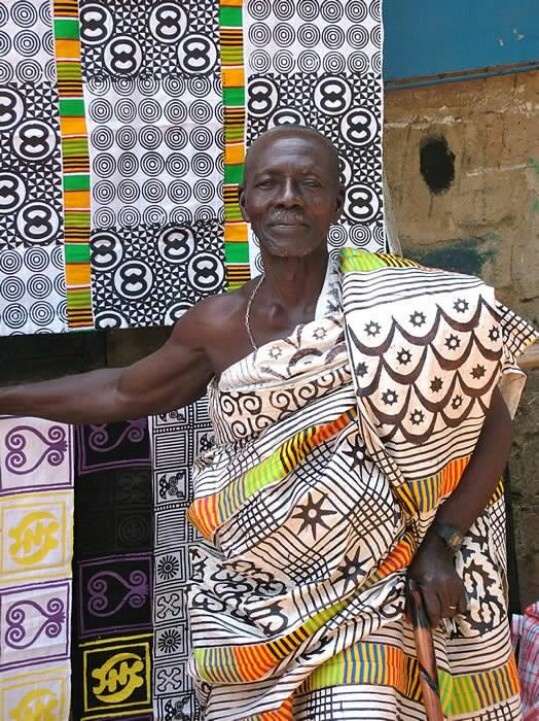
The African fashion market is worth 31 billion dollars. Inside that figure is the accumulated value of creative traditions whose intellectual depth the global fashion industry has barely begun to engage with seriously. The Adinkra symbols of the Akan people of Ghana are among the clearest demonstrations of what that depth entails. Over one hundred documented symbols. Each carries a specific proverb. Each is the visual anchor for a philosophical position, a cosmological principle, or a precise argument about how to live among others. Not decoration. Not a pattern. A language — one of the world’s most complete visual languages, developed by a civilisation that understood symbol-making as an act of philosophy rather than an act of design.
To wear Adinkra is to wear a sentence—a circle inside a circle. A bird flying forward while looking back over its wing. A crocodile with one stomach and two heads. These are not shapes chosen for their visual appeal. They are arguments. The Akan person who selected cloth bearing Sankofa for a graduation was making a philosophical statement about the relationship between learning and memory. The elder who appeared at a funeral in a cloth bearing Gye Nyame was declaring a theological position: that only God’s authority is absolute and that grief, like everything else, exists within that frame. The clothmaker who stamped Kintinkantan beside Akoma was composing a warning next to a virtue, creating a tension that any reader of the tradition would understand. Adinkra is composed, not applied. The cloth is a text. The body that carries it is a voice.
Adinkra is not a pattern. It is a sentence. Each symbol carries a proverb, a philosophy, a position. The Akan built one of the world’s most complete visual languages. Here it is.
Adinkra Symbols and Their Origins: What the Historical Record Actually Shows
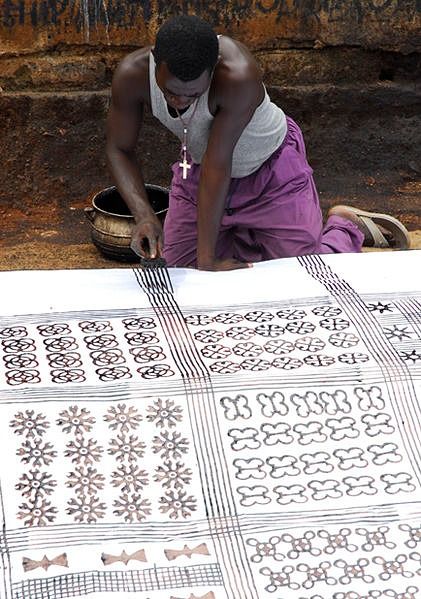
The most commonly cited origin story for Adinkra connects the symbols to Nana Kofi Adinkra, king of the Gyaman state, who is said to have worn a cloth bearing his own symbol when defeated by the Ashanti in a war around 1818 to 1819. The Ashanti then absorbed and elevated the tradition. But this origin story has a complication that the editorial record rarely acknowledges. As documented research on the Adinkra tradition confirms, the British envoy Thomas Bowdich visited Kumasi in 1817 — the year before the Gyaman war — and personally witnessed and documented Adinkra cloth being produced in the Ashanti capital. He brought back a physical example that is now held at the British Museum. This means the cloth predates the Gyaman conflict. The war did not introduce Adinkra to the Ashanti. It became associated with Adinkra after the war, when the conquered king’s symbol gave the practice its name.
The word adinkra itself is traced through the Twi language to odi nkra, meaning “farewell” or “a message sent.” The cloth in Ntonso and Asokwa is still sometimes called Ntiamu Ntoma, the stamped cloth, its older name, which predates the association with the Gyaman king. The tradition is older than its most cited origin story, and the symbols developed across Akan culture over generations rather than being created by a single individual at a single moment. The first documented printers are named: Kwaku Nsia, Pinkyehen, and Kwadwo Appiah. A man named Kwadwo Anane is credited with introducing the carved calabash stamp that replaced the earlier cocoyam and cassava stamps. These are specific people with specific contributions, not a diffuse tradition that simply existed.
In its classical form, Adinkra cloth was worn almost exclusively at funerals and solemn occasions. The colour of the cloth carried its own layer of meaning: dark red or maroon, called kobene, for funeral mourning worn by the closest relatives; black, birisi, for the most profound grief; white for joy and celebration. The symbols stamped onto the cloth communicated messages to the deceased, expressed the social standing of the mourner, and affirmed communal values at the moment of their greatest test. To understand what a mourner was saying at an Ashanti funeral, you would need to read both the colour of their cloth and the symbols stamped upon it. The outfit was a complete statement. The body that wore it delivered it.
A second historically significant piece of Adinkra cloth, dated 1825, was commissioned from the Fante paramount chief of Elmina for the Dutch royal collection and is now held at the National Museum of Ethnology in Leiden, Netherlands. This cloth features a blend of traditional Adinkra motifs and European emblems, including the coat of arms of the Netherlands at its centre. It is the earliest documented example of Adinkra adapting its visual grammar to include an external reference while maintaining its own structural logic. Adinkra has always absorbed new influences without losing its system. That is what a living language does.
How Adinkra Cloth Is Made: The Craft That Cannot Be Rushed
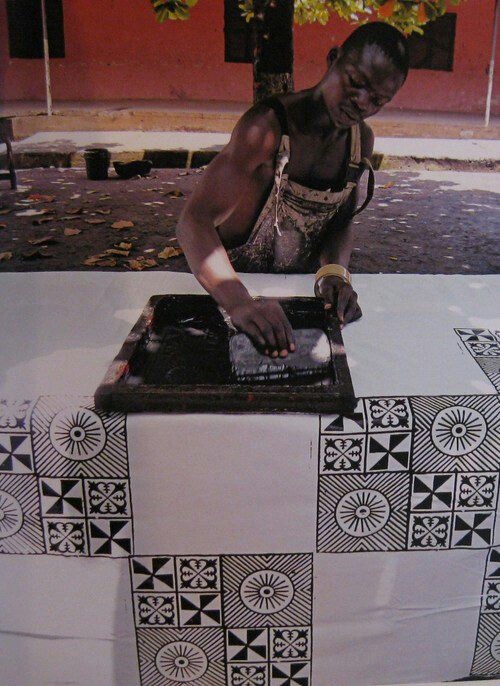
Authentic Adinkra cloth is produced primarily in Ntonso, a town near Kumasi in the Ashanti Region of Ghana — the undisputed centre of the tradition. As the Adinkra Symbols documentation confirms, the process is deeply skilled, labour-intensive, and rooted in both technical mastery and cultural knowledge. A cloth-maker who does not know what each symbol means cannot make Adinkra in the truest sense. They are printing marks that they cannot read. The distinction is not spiritual mystification. It is craft ethics: to place symbols in a composition without understanding what the combination communicates is to speak sentences you have not written.
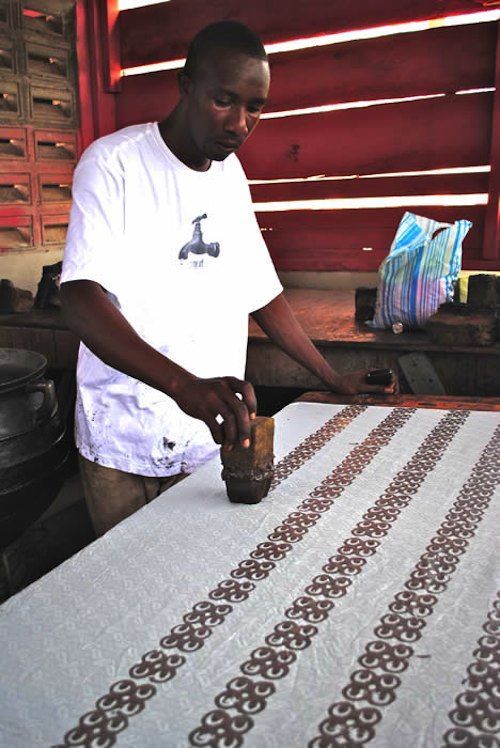
The dye, called badie, is made by boiling the bark of the badie tree (Bridelia ferruginea) for many hours, reducing it to a thick, dark, resinous liquid. This is not simply a colouring agent. It is a natural mordant with adhesive properties that bind permanently to the cloth. The preparation of badie requires precision: the consistency must be exact, and the bark must be sourced and processed correctly for the ink to hold. The stamps, called adinkra aduru, are carved from pieces of dried calabash gourd in precise geometric relief. Too shallow and they will not print. Too deep, and the lines bleed into each other. A master carver’s stamps are treasured tools, passed between generations. The stamp families of Ntonso maintain carved archives, some pieces decades or centuries old.
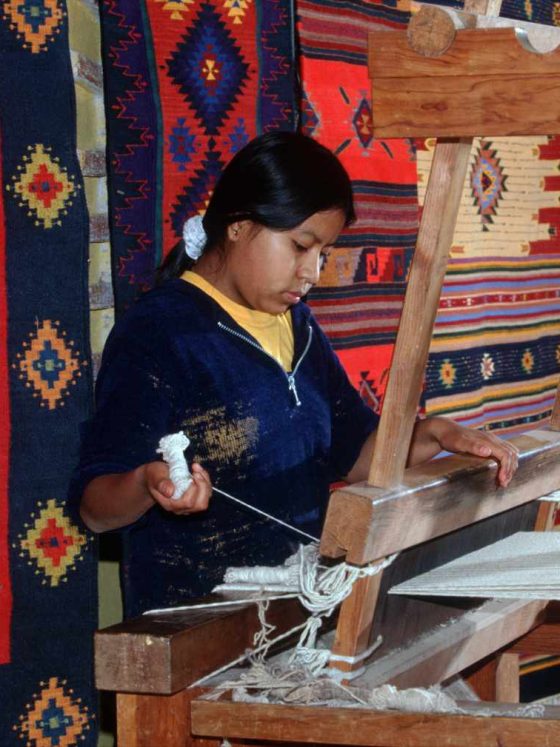
The cloth is stretched and pinned to a padded plank. A grid of lines, called nkyimkyim lines, divides it into sections, creating the visual framework within which symbols will be placed. The printer dips each calabash stamp into the badie ink and applies it section by section. The arrangement is not random. Experienced printers deliberately compose the cloth, selecting symbol combinations that create specific layered meanings. A cloth made for a chief’s funeral communicates differently from one made for an elder woman’s burial. The same symbols, arranged differently, carry different messages. The printer is not decorating. They are writing.
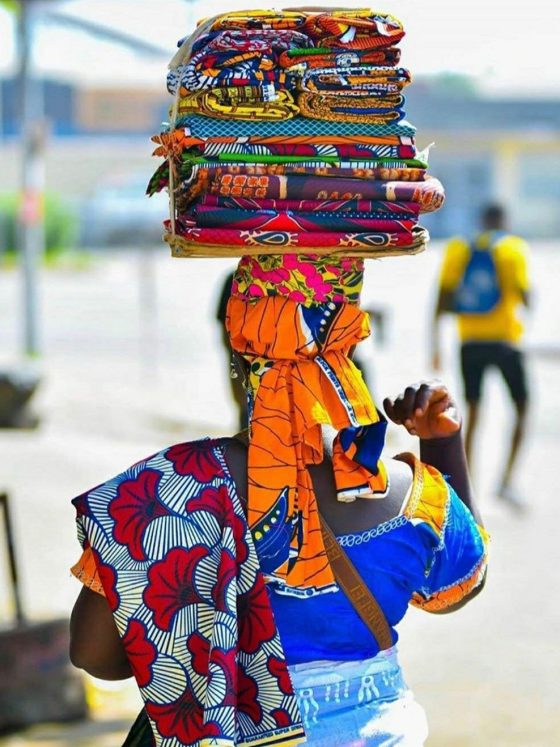
Mass-produced Adinkra fabric printed by screen or digital printing is widely available and circulates globally. It is not the same object. Each hand-stamped cloth from Ntonso is unique — the printer’s hand carries a variation that no machine can replicate. The variation is not an imperfection. It is the evidence of a specific human intelligence at work at a specific moment. The cloth breathes because a person composed it.
In the Akan tradition, to dress carelessly is to speak carelessly. The cloth is the sentence. The body is the voice. Every occasion demands its own vocabulary.
Adinkra Symbols and Their Meanings: Twelve to Read Before You Wear Them
There are over one hundred documented Adinkra symbols. The West African Wisdom archive at adinkra.org maintains one of the most complete reference collections. The twelve below were selected not for their commercial visibility but for what they reveal about the Akan philosophical system. Reading them in sequence is reading a civilisation’s position on power, community, faith, memory, character, and the relationship between the individual and the world they inhabit.
Gye Nyame — “Except for God”
The most widely used Adinkra symbol. A declaration that nothing in the universe supersedes the divine. Found in virtually every Ghanaian home, on walls, doors, clothing, and jewellery. Its prevalence is not familiarity. It is a continuous public statement of theological position: that human authority is always provisional.
Sankofa — “Return and get it”
A bird flying forward while looking back over its wing. The wisdom of learning from the past — the recognition that what you left behind can still be retrieved and used. Perhaps the most globally recognised Adinkra concept, adopted across the African diaspora as an emblem of the relationship between African heritage and forward movement. To wear Sankofa is to make a specific claim about where you are going and why the past matters to that journey.
Adinkrahene — “Chief of Adinkra symbols”
Three concentric circles. Said to have inspired the entire Adinkra symbol system and considered the source of visual authority in the tradition, among the earliest Adinkra symbols created alongside Sankofa, Gye Nyame, Funtumfunafu Denkyemfunafu, and Nyame Dua. Its simplicity contains everything. Greatness, charisma, and leadership are not complicated; they radiate outward from a clear centre.
Dwennimmen — “Ram’s horns”
Strength and humility. The ram will fight fiercely when required, but kneels to drink. True power knows when to yield. A symbol for the warrior who also knows peace — and for the recognition that genuine strength does not need to prove itself continuously.
Akoma — “The heart”
Patience, tolerance, faithfulness, and love. In Akan tradition, the heart is not only the seat of emotion but of character and will. A person of good character has a good heart. To wear Akoma is to make a public claim about the quality of your inner life.
Kintinkantan — “Puffed up extravagance”
One of the few Adinkra symbols that carries a warning rather than an aspiration. A caution against arrogance and self-inflation. Its presence on cloth was a social check — a public reminder, worn at gatherings, that pride without substance invites ruin. The Akan tradition embedded critique inside celebration.
Denkyem — “Crocodile”
Adaptability. The crocodile lives in water but breathes air — it adapts to survive in two worlds without belonging wholly to either. A symbol for the person who navigates between cultures, conditions, and worlds with intelligence rather than loss. Widely worn by diaspora communities as an emblem of their own position.
Fihankra — “House/compound”
Security, safety, and the sanctity of home and community. The enclosed compound is the space that protects its inhabitants from the chaos outside—a symbol of belonging — and of the responsibility to maintain a space where others can be protected.
Ese Ne Tekrema — “The teeth and the tongue”
Friendship and interdependence. The teeth and tongue must coexist — though they sometimes hurt each other, they cannot function without the other. A symbol for the relationship between those who are bound together: the tension is inseparable from the connection.
Bese Saka — “Bunch of cola nuts”
Wealth, power, abundance, and unity. Cola nuts were used as currency and as ritual objects across West Africa. A bunch of nuts bound together — represents collective strength. What one nut cannot do, many can—a symbol worn to affirm community and shared resources.
Nyame Nti — “By God’s grace”
Faith and sustenance. Nothing is achieved by human effort alone; everything flows from divine grace. A symbol worn at times of prayer, petition, or profound gratitude. A reminder that the capacity to act is itself a gift.
Nyame Biribi Wo Soro — “God is in the heavens”
Divine hope and aspiration. A reminder that there is goodness above — and that reaching upward is not futile. Used at times of crisis to affirm faith in what cannot yet be seen. The hand raised in the symbol’s visual form is not a gesture of supplication. It is an assertion.
Also Read:
- Kente’s GI Status: What Geographic Indication Protection Actually Means for Ghanaian Weavers in Practice
- The Dipo Ceremony and What Krobo Beadwork Communicates About Womanhood in Ghana
- Ghanaian Highlife and the Origins of Afrocentric Formal Dress
Colour, Context, and the Grammar of Occasion Dressing
Understanding Adinkra cloth requires understanding that the symbols are only one layer of its communication. The colour of the cloth carries its own meaning, and the occasion for which it is worn adds a third. These three layers together — colour, symbol, occasion — constitute the full text. A reader who knows only one layer is reading incompletely.
Dark red or maroon cloth, kobene, is worn at funerals by the closest relatives, signalling the depth of their grief with a colour associated with blood. Black, birisi, marks the most profound mourning. White cloth marks celebration: naming ceremonies, chieftaincy events, festivals. At these occasions, the symbols shift accordingly — abundance, unity, divine blessing replace the farewell and memorial vocabulary of the funeral cloth. The same system, a different register.
Kente cloth, the woven silk-and-cotton textile of the Akan with its own complex colour and pattern vocabulary, is often worn alongside or in combination with Adinkra. Both traditions operate as visual languages; together they form a complete formal statement of identity, status, and occasion. Gold-ground cloths and gold thread are reserved for royalty and high chief rank. The Asantehene appears in cloth combinations that no one else may wear, a visual grammar of absolute authority enforced through textile rather than through explicit declaration.
In traditional Adinkra cloth, symbols are not placed randomly. An experienced reader can interpret not only individual symbols but the relationship between them and the argument their combination makes as a whole. A cloth bearing Sankofa beside Akoma beside Gye Nyame makes a specific philosophical statement: reflect on your past with patience, and trust that God holds what you cannot control. The cloth is a composed text. The body that wears it delivers it. This compositional practice is what makes Adinkra categorically distinct from decorative pattern-making — and what makes the global fashion industry’s reproduction of individual symbols, stripped from their compositional context, a fundamentally different act from the one the Akan tradition performs.
Adinkra in Global Fashion: The Difference Between Circulation and Extraction
Adinkra symbols are among the most widely reproduced African visual elements in the world. They appear in jewellery collections from London to Lagos, on university crests in Ghana, on the walls of public buildings in Accra, in tattoo studios in New York, on fabric sold by the metre in markets from Brixton to Brooklyn. The Sankofa symbol has achieved a level of global recognition that rivals some of the world’s oldest religious symbols. The Gye Nyame is reproduced on more objects and in more countries than most graphic designers could claim for their most successful work. This scale of circulation is evidence of the tradition’s extraordinary communicative power. It is also the scale at which the question of attribution becomes urgent.
Ghanaian designers who have worked within the Adinkra tradition include Kofi Ansah, widely considered the father of contemporary Ghanaian fashion, Christie Brown, and Pistis. These are practitioners whose engagement with Adinkra begins with an understanding of what the symbols say. International fashion houses that draw on Adinkra aesthetics, sometimes with attribution and collaboration and often without, are working at a different level of engagement. The symbol reproduced as decoration, without its proverb, without its compositional context, and without economic benefit flowing to Ghanaian artisans and cloth-makers, is a symbol stripped of its argument. It is the visual equivalent of quoting a text in a language you cannot read and presenting the quotation as your own creation.
The 31-billion-dollar African fashion market was built partly by communities whose visual intelligence is being reproduced globally without acknowledgement. The Ntonso cloth-makers who stamp Adinkra by hand, the carvers whose calabash stamps are archives of a symbol system older than most national art institutions, the printers who compose cloth-sentences for occasions whose weight the buyer of a Sankofa necklace in a London high street will never encounter: these are the practitioners whose knowledge underpins the global circulation of the tradition. The growing push for proper acknowledgement of African design sources in global fashion is inseparable from this specific question. Adinkra is not a style library. It is a philosophy library expressed in cloth. Engaging with it requires knowing the difference.
The Omiren Argument
Adinkra is the most complete demonstration available of what African visual culture has always been: meaningful, rigorous, compositional, and alive. The Akan people built a symbol system in which every mark encodes a proverb, every cloth is a composed text, and every occasion demands its own vocabulary. That is not an aesthetic tradition. It is an intellectual one. The African fashion market is worth 31 billion dollars, and the Adinkra tradition is one of that market’s most significant intellectual assets. When it circulates in global fashion stripped of its proverbs, its compositional grammar, and its cultural attribution, the market extracts the asset without acknowledging the civilisation that created it. That extraction has a name. Omiren Styles uses it.
Editorial 002 documents Adinkra as what it is: a visual language whose full reading requires knowing that Gye Nyame is a theological declaration, not a geometric motif; that Sankofa is a position on the relationship between past and future, not a bird illustration; that Adinkrahene is the source of visual authority within the entire symbol system, not simply the most graphically satisfying of the circles. When the cloth is composed with this knowledge, it says something specific to specific people, at a specific occasion. When it is reproduced without this knowledge, it says nothing — or rather, it says something its maker did not intend and its tradition does not endorse. Every pattern is a proverb. Omiren Styles reads before it wears.
Frequently Asked Questions
What do Adinkra symbols mean?
Adinkra symbols are a visual language developed by the Akan people of Ghana and Côte d’Ivoire in which each mark encodes a specific proverb, philosophical concept, or spiritual principle. There are over one hundred documented symbols. Gye Nyame means except for God and declares the supremacy of divine authority. Sankofa, represented by a bird looking back while flying forward, means return and get it, expressing the wisdom of learning from the past. Akoma, the heart symbol, represents patience, faithfulness, and love. Adinkrahene, three concentric circles, represents greatness, charisma, and leadership and is considered the source of visual authority within the entire symbol system. Each symbol communicates not in isolation but in composition with the other symbols placed alongside it on the cloth.
What is the most powerful Adinkra symbol?
Adinkrahene, meaning “chief of Adinkra symbols,” is considered the foundational symbol in the system. It consists of three concentric circles and is said to have inspired the entire Adinkra visual tradition. It represents greatness, charisma, and leadership, and its simplicity is understood within the Akan tradition as containing all other values rather than being one among many. Gye Nyame, meaning ‘except for God’, is the most widely reproduced and universally recognised symbol, appearing in virtually every Ghanaian home and circulating globally as an emblem of Ghanaian identity. Sankofa holds the greatest significance for the African diaspora, functioning as a primary symbol of cultural reclamation and the relationship between African heritage and forward movement.
How is Adinkra cloth made?
Authentic Adinkra cloth is produced primarily in Ntonso, near Kumasi in the Ashanti Region of Ghana. The process begins with the preparation of badie, an ink made by boiling the bark of the Bridelia ferruginea tree until it reaches a thick, resinous consistency. Stamps, called adinkra aduru, are carved from dried calabash gourds in precise geometric relief. The cloth is stretched and pinned to a padded plank, and a grid of nkyimkyim lines is drawn to create the compositional framework. The printer dips each calabash stamp into the badie ink and applies symbols section by section, deliberately composing the cloth rather than applying them at random. The first documented use of the carved calabash stamp is attributed to a man named Kwadwo Anane. Each hand-stamped cloth is unique, and the composition of a cloth — which symbols are placed beside which others — creates a layered meaning that no individual symbol carries alone.
What does Gye Nyame mean?
Gye Nyame is an Akan phrase meaning except for God, expressing the supremacy and omnipotence of the divine. The Gye Nyame Adinkra symbol is a declaration that nothing in the universe supersedes God’s authority. It is the most widely used Adinkra symbol, found in virtually every Ghanaian home and reproduced on jewellery, in architecture, in state documents, and on everyday objects. As a fashion choice, wearing Gye Nyame is a theological statement: a public affirmation that the wearer acknowledges a power beyond their own. The symbol’s visual form, with its central line and radiating elements, is one of the most immediately recognisable African visual motifs in the world.
What does Sankofa mean?
Sankofa is an Akan word meaning “return and get it,” represented by a bird flying forward while looking back over its shoulder. The symbol expresses the Akan philosophical principle that wisdom requires learning from the past: you can always retrieve what you left behind and apply it to where you are going. Sankofa is the most globally recognised Adinkra concept, adopted from the 1960s onward by Pan-African and Black consciousness movements as an emblem of the diaspora’s relationship to African heritage. It appears in tattoo culture, graphic design, jewellery, and cultural institutions across Africa, the United States, the Caribbean, and the United Kingdom. Among the earliest Adinkra symbols created, Sankofa’s global reach is the most extensive demonstration of the tradition’s communicative power.
From the Editors
Adinkra teaches us that style is never neutral. Every choice of cloth, colour, and symbol is a statement about what you value, who you honour, and what world you are trying to inhabit. That is the standard Omiren Styles holds itself to. Every piece we create or celebrate is a sentence. We want to know what it says — where its vocabulary comes from, what proverb it encodes, which community’s wisdom it carries. Because when you know what something means, you stop wearing it carelessly. Every pattern is a proverb. Read before you wear.
Explore More
Read the full Culture > Heritage & Identity section for Omiren Styles’ documentation of the visual systems, textile traditions, and cultural philosophies that African civilisations built over centuries — each one a language that deserves to be read, not just worn.