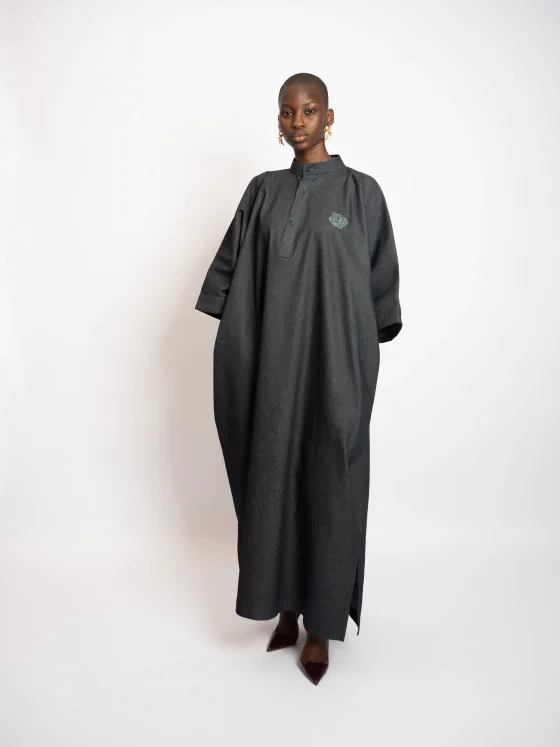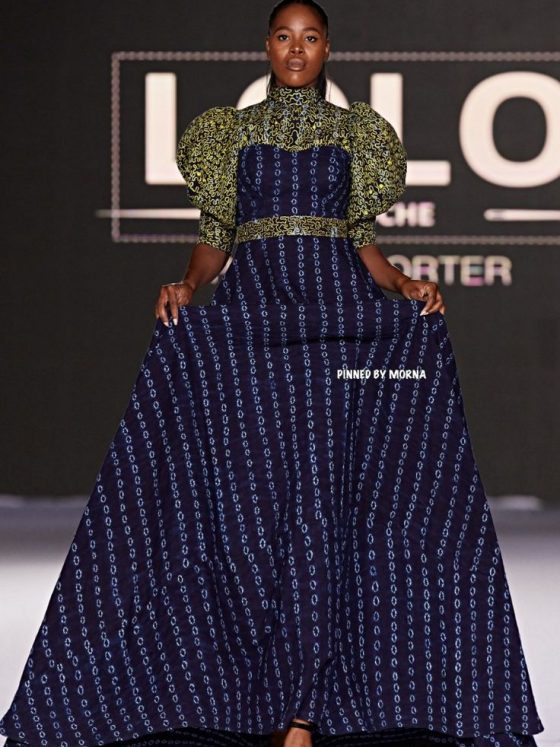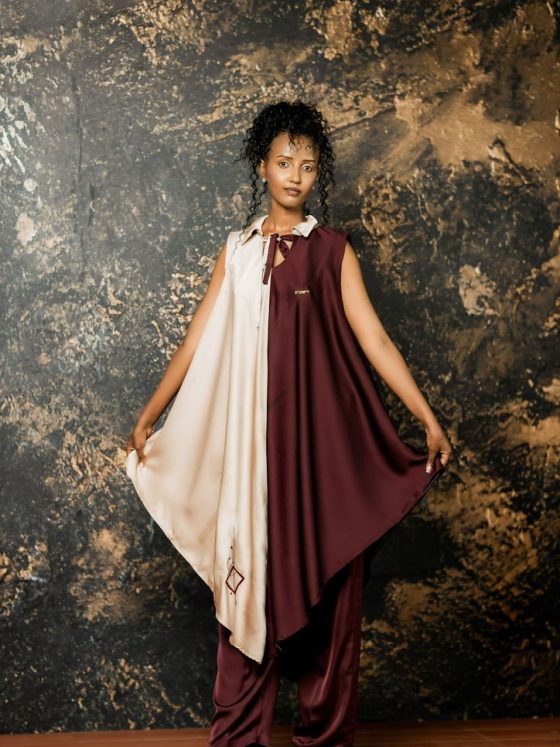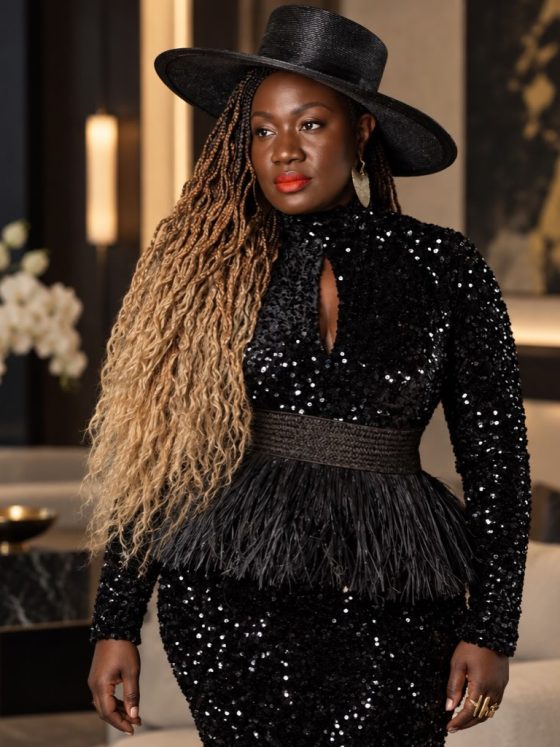

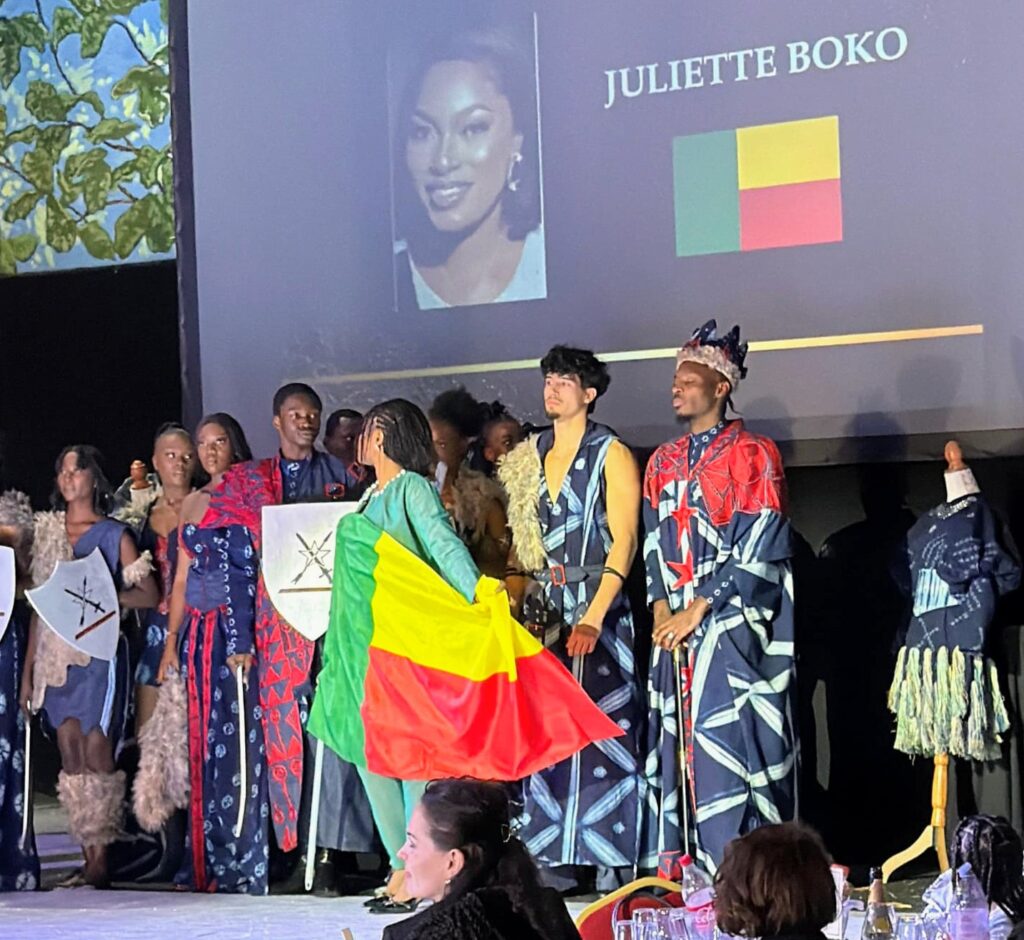
Fifteen looks formed Juliette Boko’s “Agodjié Star” presentation at the Annual Show in Paris on 28 February 2026. According to Philippe Lokonon’s account of the show for La Météo, the collection took several months to prepare. It was presented as a tribute to Benin’s women warriors and national colours. Ancestral kanvô was combined with elements of contemporary armour, and the looks carried the colours of the Beninese flag.
Later coverage filled in the garments’ vocabulary. Venance Tonongbe, writing in La Météo in July 2026, recalled multiple belts sculpting the silhouette, red beads signalling royal power and structured cuts expressing what the writer called a conquering femininity. Together, these elements set out a proposition about presence: clothing conceived to communicate strength through material, silhouette and adornment.
The collection’s most useful critical question concerns that translation. How does a designer turn an influential historical subject into a contemporary wardrobe without allowing the story to overwhelm the garments? “Agodjié Star” approaches the task through a textile associated with Benin and a repeated vocabulary of definition and ornament. It also emerges from a practice whose professional development predates this Paris presentation by more than a decade.
The wider stakes are commercial as well as cultural. UNESCO’s 2023 report on the fashion sector in Africa valued clothing and footwear in sub-Saharan Africa at US$31 billion in 2020. Within that $31 billion African fashion market, Beninese fashion is still building the international visibility that larger fashion economies take for granted, and presentations abroad are one of the few routes available to independent designers.
Juliette Boko’s Agodjié Star connects Beninese kanvô, structured cuts, red beads and the women warriors of Danxomè at the Annual Show in Paris.
The History Behind the Name
The women referenced by “Agodjié Star” were soldiers, not mythical figures. The kingdom of Dahomey, known in Fon as Danxomè and located in present-day Benin, maintained a female military corps from at least the early eighteenth century. In Fon, they were called mino, often translated as “our mothers”, or ahosi, wives of the king; the name Agojie, which Boko’s title renders as Agodjié, is also widely used. European observers called them “Amazons”, borrowing a name from Greek mythology.
Their history requires more than an uncomplicated celebration of courage. As Britannica’s entry on the Dahomey women warriors sets out, their numbers grew under King Ghezo, who reigned from 1818 to 1858, and by the mid-nineteenth century they made up roughly a third of the kingdom’s army. Recruits included volunteers, convicted criminals and people captured in raids on neighbouring states. They fought in the Franco-Dahomean wars of 1890 and 1892, and the corps was disbanded after the kingdom fell.
Their significance therefore includes military authority, political service and participation in the structures of a state organised for war. Omiren Styles has examined how the Agojie dressed as soldiers, in practical tunics and long shorts built for movement rather than ceremony. That historical record is a useful counterweight to the armour of later popular culture.
Boko selects strength and elegance from that larger history as the collection’s principal themes. The choice gives “Agodjié Star” a clear intention, but the contemporary garments remain an interpretation. Their value lies in how that intention becomes a design proposition, rather than in any claim to stand for the whole historical record.
Belts, Beads and a Defined Silhouette
The published descriptions identify multiple belts, red beads and structured cuts as recurring features. They supply a concise vocabulary for the collection: definition around the body, conspicuous ornament and an emphatic outline.
The belts matter because repetition makes an ordinarily familiar component more prominent. Rather than treating a belt simply as a finishing accessory, the collection brings it into the organisation of the silhouette; the July coverage describes the belts as sculpting the body. The red beads introduce another register, directing attention towards adornment and colour, and towards a long association between beads and authority that Omiren Styles has traced in its study of the power codes of African ornament.
These features work differently. Structure establishes an outline; belts subdivide or emphasise it; beads add ornament. Considering their relationship is more useful than describing every component as a symbol of power. The design question is whether those elements reinforce one another within a garment, or simply accumulate.
Lokonon’s March account adds two further layers: references to contemporary armour and Benin’s national colours. That language identifies the collection’s communicative ambition. The wearer is presented as assertive, and the wardrobe is intended to be recognisably connected to Benin. Lokonon also reports that the audience gave the collection a standing ovation, which he attributes to the visual force and structured elegance of the designs.
The armour reference deserves careful reading. The historical Agojie fought in cloth, not plate. When a contemporary designer invokes armour, she is drawing on the modern visual language of strength rather than reproducing a uniform. That is a legitimate design choice, provided it is understood as interpretation.
What Kanvô Contributes
Kanvô supplies a material connection distinct from the collection’s historical subject. The handwoven cloth carries its own associations with the court of Danxomè, which gives the pairing a logic: a royal textile in service of a royal army’s memory. Boko’s use of it places “Agodjié Star” within an existing field of kanvô clothing, while the belts, beads and structured cuts establish her particular direction.
In this collection, the cloth’s significance should not be reduced to the claim that heritage becomes modern merely by appearing on a runway. The relevant act is selection: Boko chooses the textile as part of a wardrobe with an explicit narrative and silhouette.
The distinction between cloth and finished clothing remains important. A material brings texture, pattern and cultural associations, but the garment requires further decisions about proportion, assembly and use. “Agodjié Star” results from bringing those decisions into one collection.
Meaning in this work emerges from combinations of cloth, colour, ornament and presentation, rather than being contained within a single motif. A kanvô panel alone says one thing; the same cloth held in place by several belts and finished with red beads says something more specific.
A Practice Established in Benin
Boko’s career gives the collection a longer foundation. A January 2026 Kanbio24 profile identifies her as Marthe Juliette Boko, a Beninese fashion entrepreneur who began self-taught and later trained at a fashion school in Benin. She also completed university studies in law and holds a master’s degree in the subject.
The same profile dates the creation of Julidesign, her fashion label, to 2012 and describes Ìtùnú BOKO as her latest line and the heir to Julidesign. Her own company, The Authentic J, presents her as a stylist, pattern-maker and accessories designer, and Julidesign as a collection of clothing and accessories shown in several African and Western countries.
That chronology distinguishes the designer’s established experience from the age of a particular line. It also places skills development within Benin at the centre of the story: the training, the label and the business all began there.
Kanbio24 explains that Ìtùnú is a Yoruba word for comfort, inner peace and consolation, and that the line imagines a modern woman who is strong, elegant and attentive to her well-being. “Agodjié Star”, with its stated emphasis on assertive presence, introduces a different emphasis within that practice. The relationship between those ideas is worth retaining: a designer’s broader identity need not make every collection repeat the same mood.
Earlier participation in Cotonou’s Festival International de Mode et du Mannequinat also preceded the Paris presentation, according to La Météo. The collection was therefore part of a continuing professional trajectory, not an isolated international debut without a local context.
The Annual Show Provided the Setting
The City of Paris event listing confirms the Annual Show at La Palmeraie in the 15th arrondissement on Saturday 28 February 2026. Its programme included exhibitions open free on registration during the day, followed by a paid evening gala and fashion show from 7 pm to midnight, broadcast on the television channel Canal 2 International. La Météo names Grégoire Ngako Jeuga Piwele as the event’s promoter.
That same day, other African designers also attended the venue. Omiren Styles has reported on the Gabonese designer Chouchou Lazare’s raffia collection at the Annual Show Paris 2026, where he also received an achievement award. Boko’s collection was one presentation among several, each bringing a specific material to the same audience.
Those formats offered different encounters with designers’ work. A runway organised the collection as a sequence; the wider programme created space for display and discussion. The event took place before the official womenswear calendar of Paris Fashion Week began in March, so it should be understood as an independent showcase staged during the fashion season rather than a slot on the federation’s schedule.
The event matters as a presentation opportunity. Its lasting significance for the business would require further evidence of commissions, retail relationships or subsequent sales. For this collection, the documented achievement is more immediate: fifteen looks brought a specific historical and material proposition before an audience.
After Paris: The Collection’s Afterlife
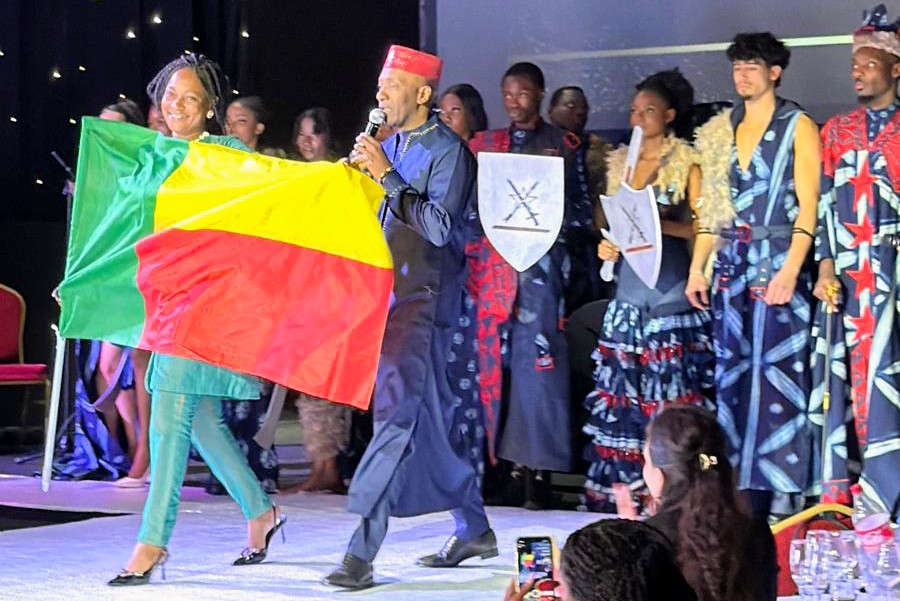
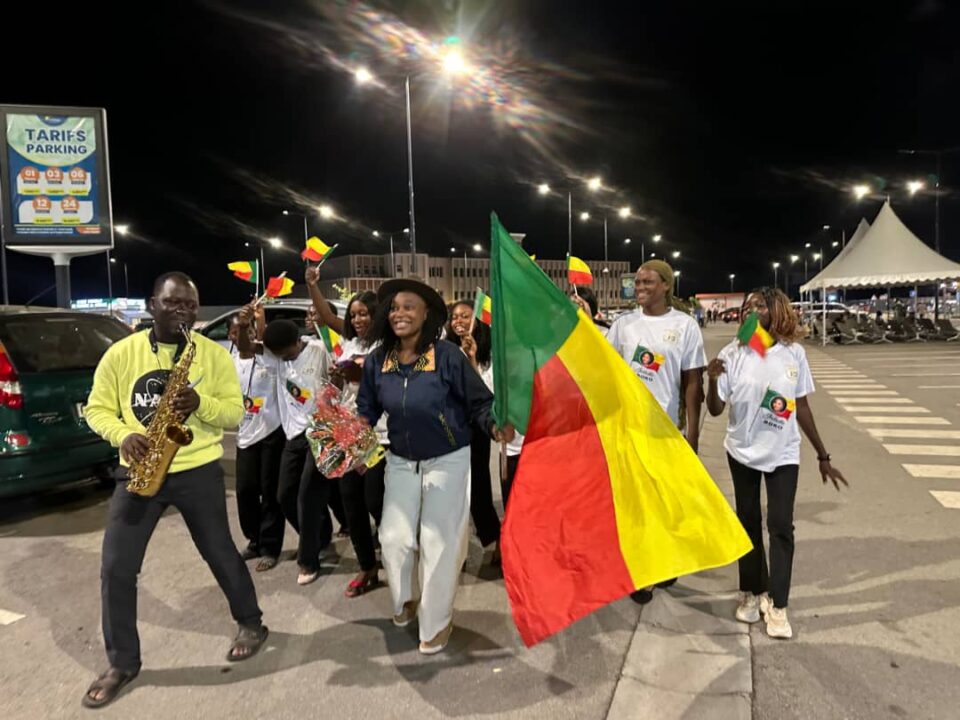
The collection did not end with one evening. La Météo’s July report records that on 21 March 2026 Boko was the only designer to show at a gala in Paris, with pieces combining old beads, artisanal weaving and contemporary cuts, and that she was welcomed home at Cotonou’s airport the following night. On her return, she said each piece carried her country’s history, its women, and its know-how.
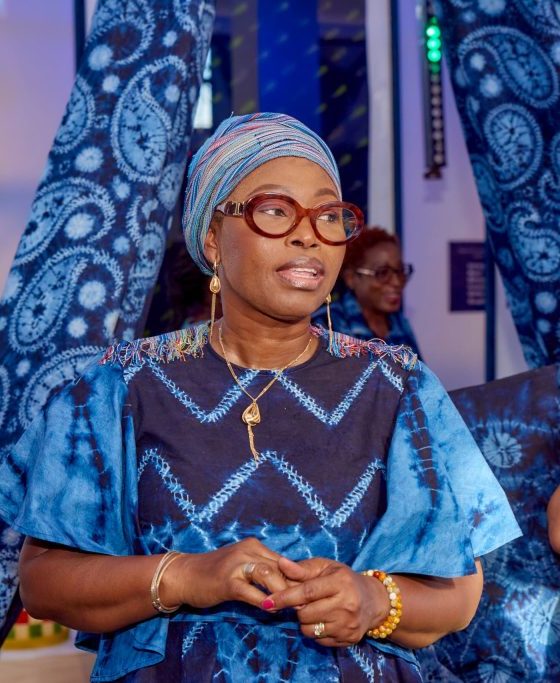
In Cotonou, the first Nuit du Kanvo et de l’Indigo took place on 18 July 2026 at the Sofitel Cotonou Marina, organised by the Fonds de Développement de l’Artisanat, with 75 looks by 15 designers. La Météo reports that Boko presented a fusion of kanvô and indigo that stayed true to the spirit of “Agodjié Star”.
That return matters for the collection’s reading. A proposition first shown to a Paris audience was then tested again before a Beninese one, alongside other designers working with the same cloth. The collection’s ideas are developing at home and abroad.
The Omiren Argument
“Agodjié Star” is most distinctive where its components give form to its intention. Kanvô establishes a textile connection to Benin; belts and structured cuts organise an assertive silhouette; red beads add a conspicuous ornamental element.
The historical reference gives these choices direction, but does not replace them. A useful account of Boko’s work must keep returning to the clothing: how its components interact, what the wearer is invited to project and how one collection develops within an established practice.
ALSO READ
- How African Heritage Designers in Paris Are Challenging the Maison System.
- Kenneth Ize and the Aso-Oke Question: What It Means to Build a Luxury Brand on a Handwoven Cloth.
- How African Women Are Redefining Power Dressing Through Cultural Fashion.
- The Dipo Ceremony and What Krobo Beadwork Communicates About Womanhood in Ghana.
Frequently Asked Questions
Who is Juliette Boko?
Marthe Juliette Boko is a Beninese designer, stylist and pattern-maker who also works under the name Ìtùnú Boko. She began self-taught, later trained at a fashion school in Benin and holds a master’s degree in law. She founded the Julidesign label in 2012, and Ìtùnú BOKO is her most recent line.
What inspired “Agodjié Star”?
The collection pays tribute to the women warriors of Danxomè, the female military corps of the kingdom of Dahomey in present-day Benin, often called the Agojie. Boko drew strength and elegance from that history, combining it with the colours of the Beninese flag and references to contemporary armour, interpreting the subject rather than reconstructing historical uniforms.
Which materials and details define the collection?
Published accounts identify handwoven kanvō as the central textile, combined with multiple belts that sculpt the silhouette, red beads associated with royal power and structured cuts. The fifteen looks also used the colours of the Beninese flag. The collection’s character comes from how these elements work together, not from any single motif.
Where was “Agodjié Star” presented?
Fifteen looks were shown at the Annual Show at La Palmeraie, in Paris’s 15th arrondissement, on 28 February 2026. The event combined daytime exhibitions with an evening gala and fashion show. Boko later presented work in the same spirit, combining kanvô and indigo, at the first Nuit du Kanvo et de l’Indigo in Cotonou in July 2026.