Paris has sixteen haute couture houses. Joining them as a permanent member of the Chambre Syndicale de la Haute Couture Parisienne is one of the most selective distinctions in the fashion industry. The current member list, published by the Fédération de la Haute Couture et de la Mode, includes names that fashion education has canonised: Chanel, Dior, Givenchy, Valentino. It also includes Adeline André, the designer whom The New York Times named “Mother of Minimalism”, whose patented three-armhole garment sits in the permanent collections of the Palais Galliera in Paris, the Fashion Institute of Technology in New York, and the MUDE design museum in Lisbon.
Adeline André was born in Bangui, in what was then French Equatorial Africa, in 1949.
That sentence appears in one form or another in most profiles of her work, typically in the first paragraph, and is immediately followed by Paris. It functions as a subordinate clause, a biographical context before the real story begins. This article makes the opposite argument: Bangui is where the real story begins, and the fashion industry’s forty-year failure to tell it from there is a structural editorial gap, not an oversight. It is a story about Adeline Andre, a designer born in Bangui, who worked at a Paris haute couture house, that has never been told as a Central African story.
Adeline Andre, the Mother of Minimalism, is a designer born in Bangui who now heads a Paris haute couture house. That origin story has never been told as a Central African story. Until now.
Bangui, 1949: The Origin of the Fashion Industry Keeps Passing Over

André grew up in Paris after her birth in Bangui, moved to London in the mid-1960s to pursue fashion photography, returned to Paris, and enrolled at the École de la Chambre Syndicale de la Couture Parisienne. She was admitted directly into the second year because she was already making clothes. At the same time, she attended drawing classes given by Salvador Dalí at the Hôtel Meurice. According to the FHCM’s own profile of André, she later described the formative insight that arrived from those sessions: “I completely understood that in every garment I could draw, there would be a three-dimensional body that moves. That anchored in me.”
That insight, the garment as a relationship between fabric and moving body rather than a constructed shape, became the foundation of everything she made for the next fifty years. It is the same logic that would later underpin the work that led to her being called the Mother of Minimalism. It is the logic behind minimalism in fashion as the term is now broadly understood. She was working on it in 1981 when she launched her house. The New York Times named her for it in 1993. She was pleased, she said, because at the time the word “minimalism” was used only in art, not in fashion.
André is French by nationality. Her career, her house, and her institutional affiliations are French. This article does not impose a Central African identity that she has not claimed. It claims something more specific: Bangui is the origin of this story, and the fashion industry’s habit of beginning that story in Paris reflects a consistent asymmetry, one that applies to virtually every creative practitioner born on the African continent who built a career elsewhere.
ALSO READ
→ The Language of Adinkra: When Cloth Becomes Scripture
→ Lesotho’s Basotho Blanket: How a Colonial Gift Became a Symbol of Sovereignty
→ Stella Jean: The First Black Italian Designer Who Forced Milan to Look
From Christian Dior to Her Own House: What Formed a Couture Logic
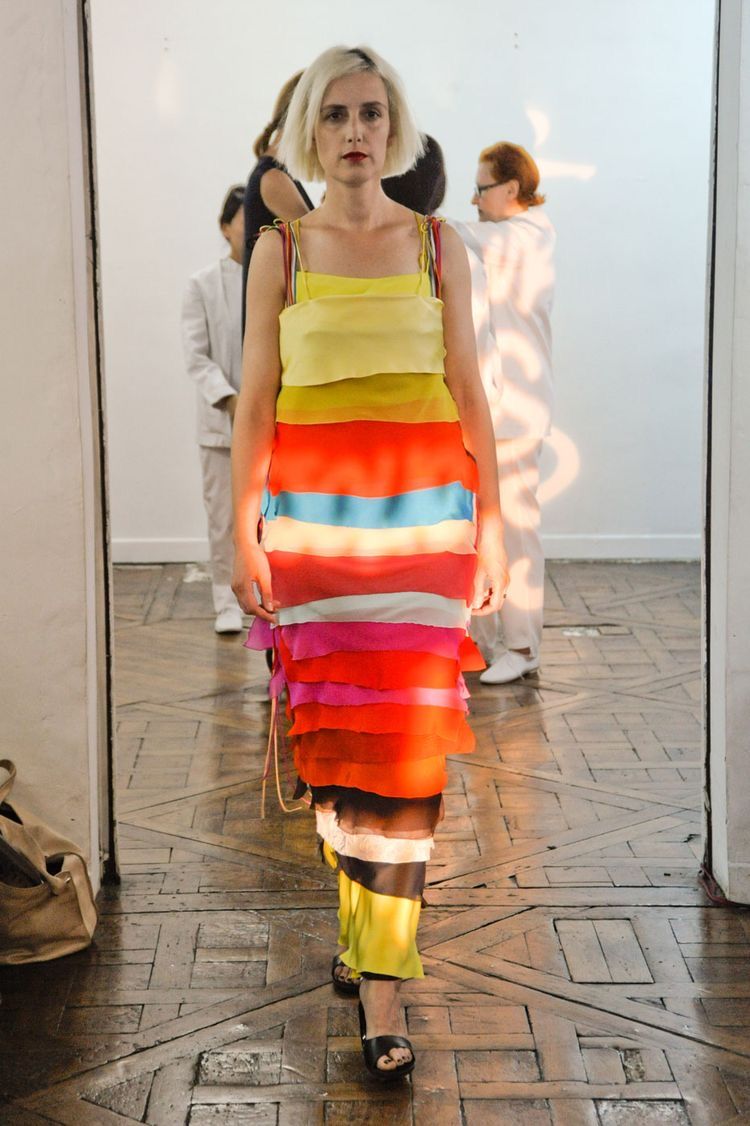
After completing her studies, André joined Christian Dior in 1970 as an assistant to Marc Bohan, artistic director from 1961 to 1989. She spent time in the house’s eight haute couture workshops, observing technique at the level where it disappears into the garment. She later described a chiffon dress from that period: seven layers of fabric from midnight blue to flesh tone that read as smoke when they moved at a fitting. The craft was so precise that it became invisible.
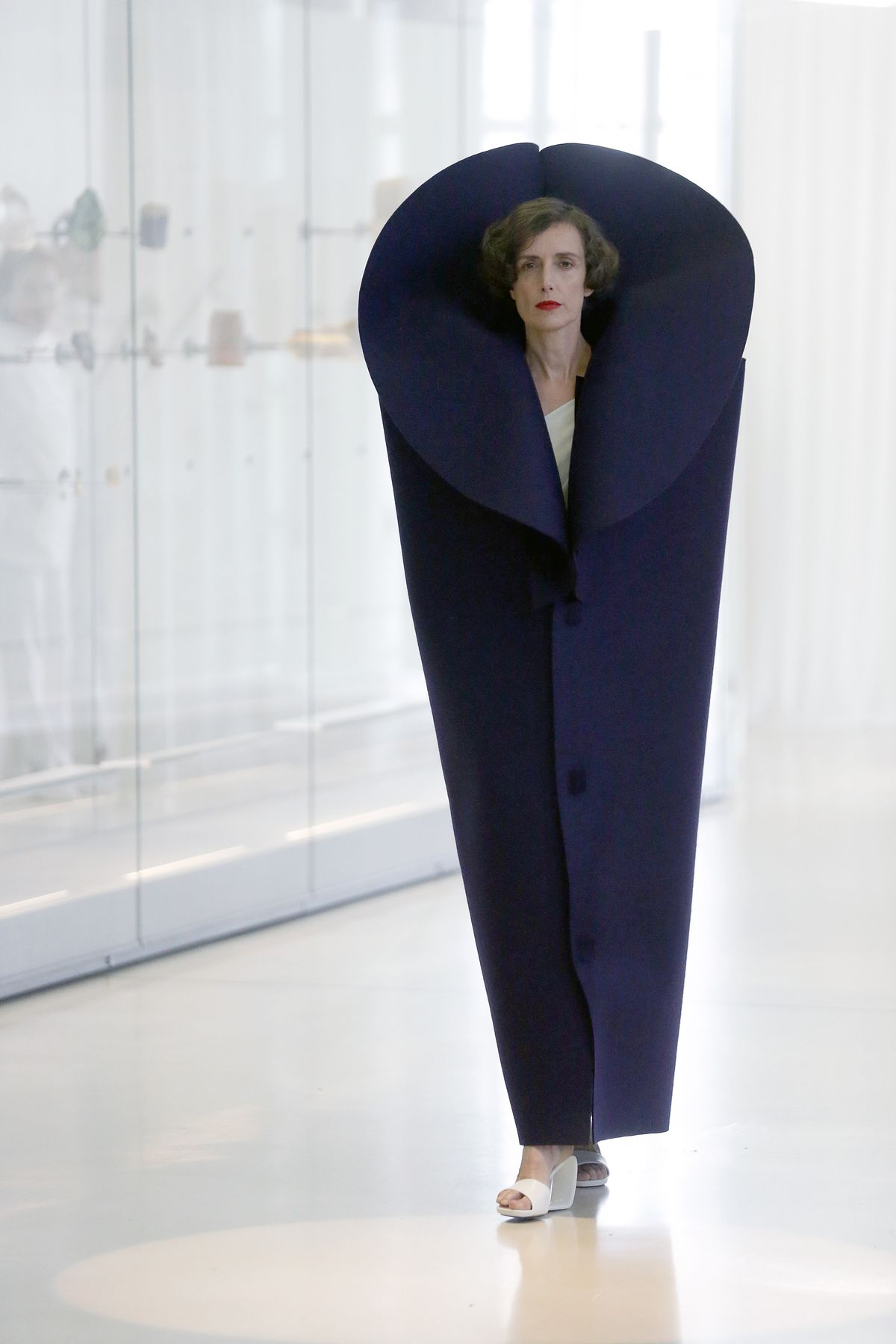
In 1981, she launched the House Adeline André with her partner István Dohár, and that same year registered her most significant design innovation: the three-armhole garment. The concept arrived as she was falling asleep, the idea of wrapping oneself up. The garment has no conventional construction logic. There is no interfacing, no shoulder padding, no boning, no standard lining. There is the fabric, the three openings, and the body that moves through them. It was patented in France in 1981 and with the World Intellectual Property Organisation in 1982.
At a moment when the dominant aesthetic demanded structure imposed on the body, the padded shoulders and power construction of the early 1980s, André moved in the opposite direction. Her silhouettes were elongated, soft-shouldered, and crafted from natural, flowing materials. There is just the fabric and the body, she told the FHCM in 2025. A symbiosis. That position was not a trend response. It was a founding philosophy. She held it for over four decades.
The Three-Armhole, the Museums, and the Story That Belongs to Central Africa
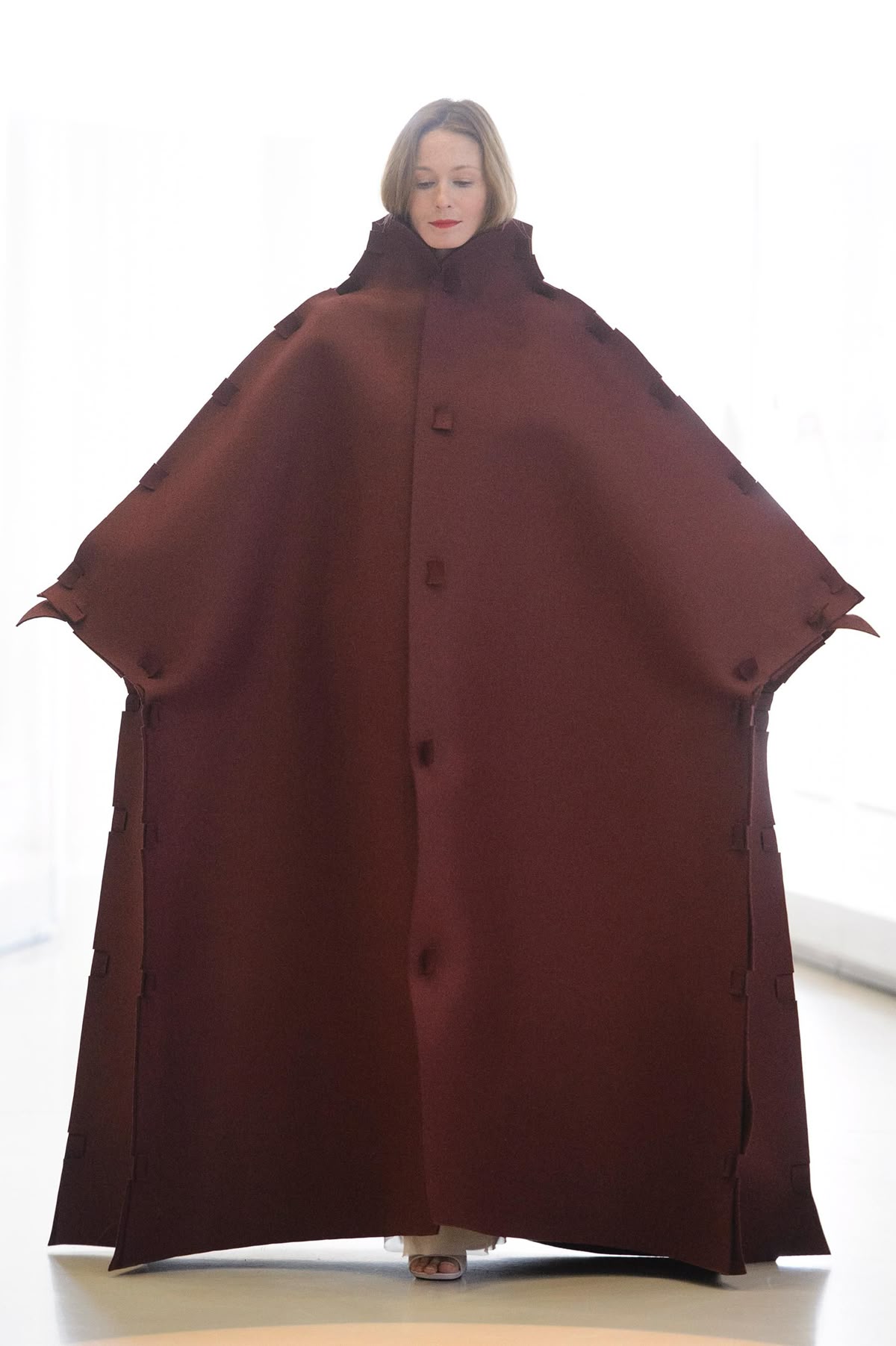
Examples of the three-armhole garment are held in the permanent collections of the Palais Galliera in Paris, the Fashion Institute of Technology Museum in New York, and the Museu do Design e da Moda in Lisbon. The French government acquired a dress from her Autumn/Winter 1997/98 collection as a work of art. The Musée des Arts Décoratifs acquired her Poiret coat homage in Paris. The FHCM lists her atelier’s practice as designing and realising collections in natural fabrics, cashmere, silk, linen, wool, and cotton, intended only for private clientele, made to measure. She is still presenting: her Haute Couture Fall-Winter 2025/2026 collection was shown at La Ruche in Paris.
The fashion industry narrates its own history through birthplaces. Coco Chanel from Saumur. Yves Saint Laurent from Oran. Azzedine Alaïa from Tunis. These origin points are treated as part of the creative formation story, the geography that shaped the sensibility. Adeline André was born in Bangui. That geography has rarely been treated as part of her formation story by fashion publications of record.
She is one of the most significant African-born designers ever to lead a Paris haute couture house, but that fact has rarely been named as such. UNESCO projects a 42% increase in demand for African haute couture over the next decade. The African fashion sector is valued at over US$31 billion. The continent gave birth to the Mother of Minimalism. The Language of Adinkra, the Basotho Blanket, the three-armhole garment: these are all instances of African material culture whose full origin stories the fashion industry has not yet told, from where they actually begin. André’s story is one of them. Bangui produced one of the founders of the aesthetic logic that now defines a fashion category. That is a Central African story. It started in 194,9 and it has been sitting in plain sight.
“Paris has spent forty years calling Adeline André the Mother of Minimalism without once naming where she came from as the starting point of the story. Bangui has a Central African claim on haute couture history that has never been made.”
Frequently Asked Questions
Where was Adeline André born?
Adeline André was born in Bangui, in what was then French Equatorial Africa, in 1949. She grew up in Paris and has spent her professional life in France. She is French by nationality and heads one of the sixteen Paris haute couture houses.
Why is Adeline André called the Mother of Minimalism?
The designation was given by journalist Amy Spindler in The New York Times in 1993, recognising André’s decade-long consistency in presenting elongated, unpadded, unlined silhouettes in which the garment’s structure comes from the body in motion rather than from constructed support. She had been working from this philosophy since 1981, more than a decade before minimalism became a recognised fashion category in fashion media.
What is Adeline André’s connection to the Central African Republic?
André was born in Bangui, CAR. She is French by nationality, and her career has been based entirely in Paris. The argument this article makes is geographic and historical: Bangui is the origin of her story, and the fashion industry’s routine placement of that origin in a subordinate clause reflects a structural asymmetry in how African birthplaces are treated relative to European ones in fashion narratives.
What is the three-armhole garment Adeline André patented?
The three-armhole garment has three openings rather than the conventional two, allowing it to be worn and configured differently depending on the wearer’s intention. It is built without interfacing, padding, or conventional lining, placing the relationship between fabric and moving body at the centre of the design. It was patented in France in 1981 and internationally in 1982. Examples are held at the Palais Galliera in Paris, the Fashion Institute of Technology Museum in New York, and the MUDE in Lisbon.
Which museums hold Adeline André’s work?
The Palais Galliera in Paris, the Fashion Institute of Technology Museum in New York, and the Museu do Design e da Moda in Lisbon hold examples of the three-armhole garment designed by Adeline Andre. The Musée des Arts Décoratifs in Paris acquired her Poiret coat homage and included it in their Paul Poiret retrospective. The French government acquired a dress from her 1997/98 collection as a work of art.
Read more from our Industry section, where African designers are placed at the centre of the stories that have always been theirs.