The inherited assumption about African fashion designers is that their significance lies in how well they translate African heritage for international consumption. Oumou Sy’s work strips that assumption. She did not translate Senegalese culture for an outside audience. She built a creative infrastructure in which Senegalese fashion, costume, performance, and public culture were all the same argument, made on Senegalese terms, for a Senegalese public first. That is what her legacy proves, and it is what makes revisiting it useful rather than merely respectful.
Born in Podor, Senegal in 1952, Sy built a body of work spanning haute couture, prêt-à-porter, costume design, jewellery, accessories, theatre, cultural production, and, significantly, internet infrastructure. As Omiren Styles has documented in its analysis of Senegalese fashion designers and the Dakar ecosystem, the Dakar fashion scene Sy helped shape is one of the most distinctive creative environments in West African fashion, grounded in cultural seriousness rather than commercial aspiration. Sy is the most complete illustration of why.
Revisit Oumou Sy’s costume-to-runway legacy and see how the Senegalese designer turned stagewear, couture, and cultural storytelling into a lasting fashion language.
The Refusal of the Costume-Couture Split
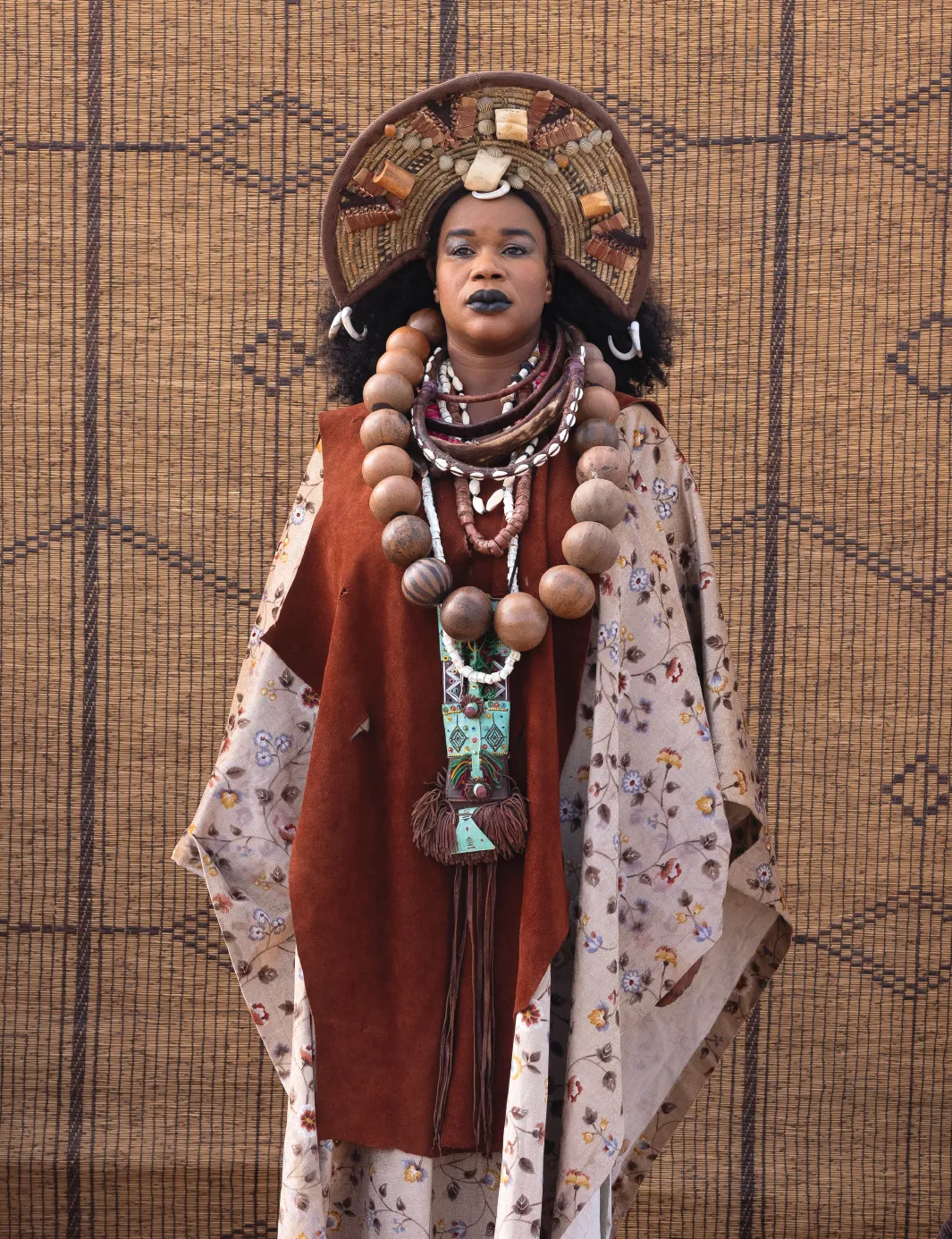
Costume design in fashion discourse is typically treated as applied or secondary work: the designer serves a director’s vision rather than their own. Oumou Sy refused that hierarchy. She created garments for Ousmane Sembène, Djibril Diop Mambéty, and Flora Gomes, three of the most important figures in African cinema, not as a hired craftsperson serving external vision but as a cultural interlocutor whose understanding of Senegalese material and aesthetic culture was itself the contribution. The costume was not illustrating the story. It was part of how the story was being made. As Omiren Styles has documented in its analysis of Julius Nyerere’s use of dress as political communication, the garments that carry the deepest cultural authority are those in which the clothing and the argument it makes cannot be separated. Sy’s film costumes operate on exactly that logic.
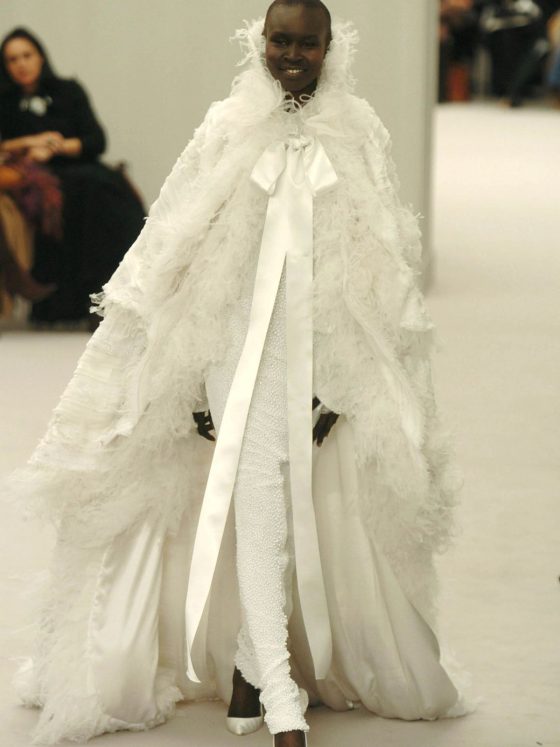
Her runway work applied the same intelligence in a different register. Where costume required her to serve a narrative and a character, couture required her to make the narrative herself. The continuity between the two practices was not incidental. She understood the body on screen and the body on the catwalk as the same kind of problem: how to make a Senegalese visual language that was specific enough to be genuinely itself and expansive enough to carry meaning for an audience beyond its immediate context.
SIMOD and the Carnaval: Fashion as Public Infrastructure
In 1997, Sy founded SIMOD, the Dakar International Fashion Week, creating the institutional infrastructure that African fashion in Senegal needed to be taken seriously as a professional sector. The following year, she created the Carnaval de Dakar, a citywide cultural event in which costume and performance became the medium through which public identity was expressed. Together, these two acts define what makes Sy’s legacy structurally significant rather than simply personally impressive. As Omiren Styles has documented in its analysis of Africa Fashion Week London and what institutional fashion infrastructure actually does, the difference between a designer with individual creative authority and a designer who builds the conditions in which other designers can operate is the difference between personal achievement and sector development. Sy built both.
The Carnaval is the more instructive of the two. A fashion week is a familiar institution, even when African fashion weeks carry specific cultural weight that their European counterparts do not. The Carnaval was something different: it turned costume and performance into a claim about what public life in Dakar could look like. Fashion left the venue and entered the city. The audience was not a fashion industry audience. It was the city itself. That is not a marketing decision. It is a statement about where fashion belongs.
Internet Infrastructure and the Limits of the Fashion Story
In 1996, the year before she launched SIMOD, Oumou Sy founded the first internet service provider in Senegal. That fact tends to get mentioned in profiles as a surprising detail, as though it is anomalous that a fashion designer would also be an internet entrepreneur. It is not anomalous. It is consistent with the same underlying logic: Sy understood that creative work requires infrastructure, and she was willing to build the infrastructure rather than wait for it. As Omiren Styles has argued in its analysis of African fashion cities and structural growth, the cities that are shaping African fashion most durably are those whose creative economies have the infrastructure to sustain creative output rather than relying on individual talent to overcome structural gaps. Sy built infrastructure at two levels simultaneously: the connectivity that made Senegal digitally accessible, and the cultural event structure that made Senegalese fashion publicly visible.
These two projects are also connected in terms of what they refused. The internet provider refused the assumption that digital access was not for Senegal. SIMOD refused the assumption that international fashion infrastructure was not for Senegalese designers. The Carnaval refused the assumption that fashion belonged in venues rather than cities. The refusal is the consistent element across everything she built.
Style: What Made Her Work Distinct
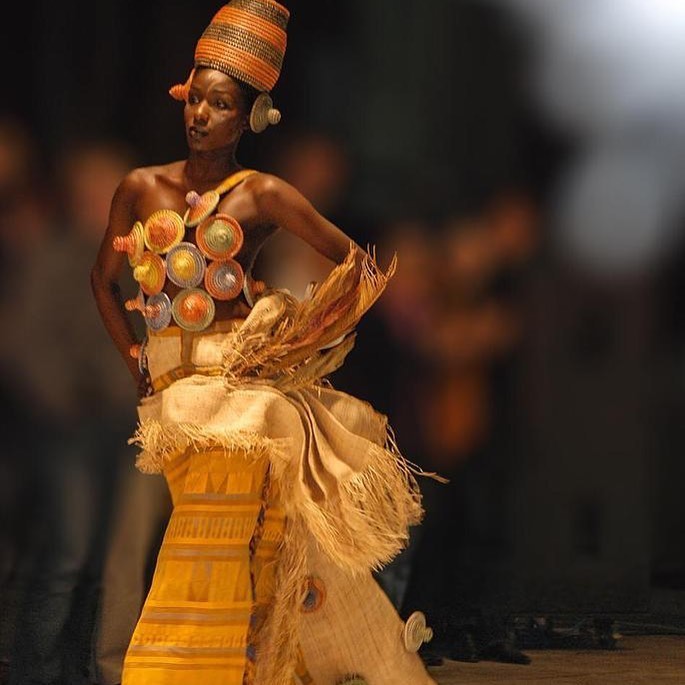
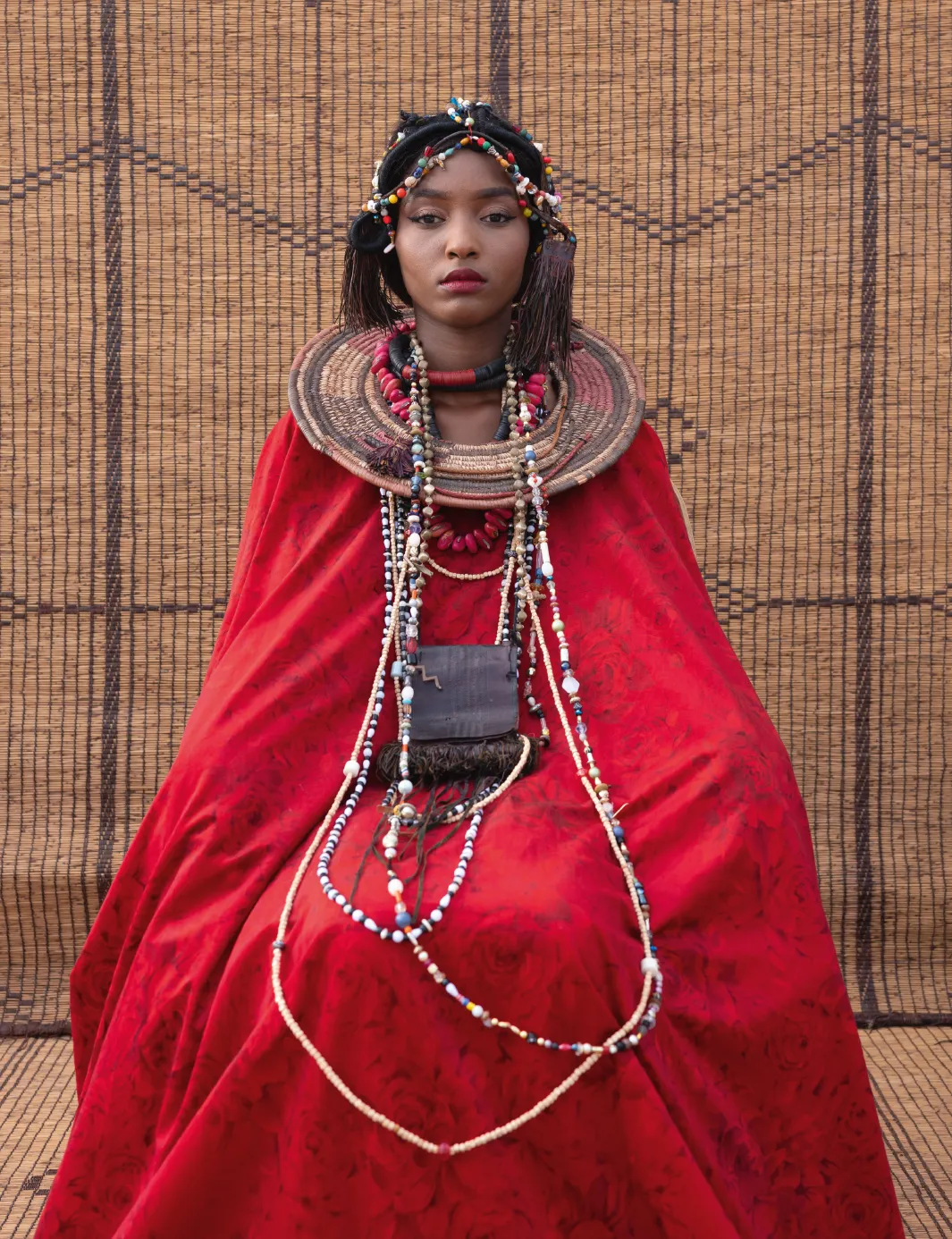
Sy’s style language is characterised by dramatic construction, texture, pattern, and a relationship to Senegalese material culture that is specific rather than referential. Her designs draw from traditional fabrics and motifs while pushing them into modern forms, sometimes humorous, sometimes theatrical, and always conceptually grounded. As Omiren Styles has documented in its analysis of Selly Raby Kane and the Dakar design tradition of world-building through clothes, the Dakar design sensibility tends toward conceptual ambition: the garment is not only a thing to be worn, it is a position to be occupied. Sy’s work is where that sensibility has its most complete historical statement.
What makes her difficult to categorise is precisely what makes her significant. She was not a heritage designer in the preservation sense, though her work was deeply rooted in Senegalese cultural material. She was not a modernist in the break-from-tradition sense, though her forms were consistently forward-reaching. She worked in the space between those positions, which is where the most interesting design decisions live. The garments that result are neither documentation of a past nor anticipation of a future. They are arguments about what Senegalese fashion is, made in the present tense.
The Omiren Argument
Oumou Sy’s legacy is not primarily about individual garments or individual collections. It is about what happens when a designer refuses the boundaries that the fashion industry tends to impose: between costume and couture, between runway and public life, between fashion and technology infrastructure. She treated each of those as the same kind of problem and applied the same intelligence to all of them. The result is a body of work that shaped not only what Senegalese fashion looks like but what it understands itself to be. As Omiren Styles has argued in its analysis of African fashion authority, African fashion has always been making arguments that the mainstream fashion industry was not yet equipped to receive. Sy was making those arguments in the 1990s, building the infrastructure to sustain them, and creating the public events through which they could be experienced by a Senegalese audience that did not need to be persuaded that its fashion culture was significant. It already knew.
Contemporary African fashion often invokes “storytelling” as a design value. Sy demonstrated what storytelling at scale actually requires: not only a narrative in the garment, but the institutional conditions in which the narrative can be told, received, and transmitted. That is the benchmark her legacy sets. As Omiren Styles has documented in its analysis of African fashion designers building lasting brands in America, the designers whose work lasts are those who understand the system they are building within and, where necessary, build the system themselves. Oumou Sy built the system. The fashion, the film costumes, the internet infrastructure, the international fashion week, the citywide carnival: all of it was the same argument, made at different scales.
She did not translate Senegalese fashion for the world. She built the conditions in which Senegalese fashion could know and express itself. That is a different achievement, and a larger one.
ALSO READ
- Senegalese Fashion Designers and the Dakar Ecosystem
- African Designers Buyers Should Act On in 2026: A Three-Tier Shortlist
- African Fashion Designers in America: Who Is Building Something That Lasts?
Frequently Asked Questions
Who is Oumou Sy and why is she significant in African fashion?
Oumou Sy is a Senegalese designer born in Podor in 1952, whose significance lies in the breadth and ambition of what she built. She worked across haute couture, costume design for major African filmmakers including Ousmane Sembène and Djibril Diop Mambéty, jewellery, accessories, cultural production, and technology infrastructure. She founded SIMOD, the Dakar International Fashion Week, in 1997 and created the Carnaval de Dakar in 1998. She also founded the first internet service provider in Senegal in 1996. As Omiren Styles has documented, her work defined the conditions in which Senegalese fashion could understand and express itself as a serious creative sector.
What is the costume-to-runway argument in Oumou Sy’s work?
Sy refused the conventional hierarchy that treats costume design as secondary or applied work and couture as the primary creative act. In her practice, both were expressions of the same design intelligence: how to make a specifically Senegalese visual language that was precise enough to be genuinely itself and expansive enough to carry meaning beyond its immediate context. Her film costumes were not decorative illustrations of a director’s vision. They were contributions to the narrative from someone whose knowledge of Senegalese material and aesthetic culture was itself what the work required.
What did SIMOD and the Carnaval de Dakar achieve?
SIMOD, the Dakar International Fashion Week founded in 1997, created the institutional infrastructure that Senegalese fashion needed to be taken seriously as a professional sector. The Carnaval de Dakar, created in 1998, was a more radical gesture: it took fashion out of the venue and into the city, making costume and performance the medium through which public identity was expressed to a general Dakar audience rather than a fashion industry audience. As Omiren Styles has documented in its analysis of Africa Fashion Week London, the difference between a designer with individual creative authority and one who builds the conditions for a sector is the difference between personal achievement and structural development. Sy built both simultaneously.
Why is Oumou Sy’s internet infrastructure work relevant to her fashion legacy?
It is relevant because it reveals the consistency of her underlying logic. In 1996, she founded the first internet service provider in Senegal, applying to digital access the same principle she applied to fashion: that the creative and cultural infrastructure she needed should be built rather than waited for. The internet provider, SIMOD, and the Carnaval are all versions of the same refusal: the refusal to accept that the conditions required for significant creative work did not exist in Senegal.
What is the Omiren argument for why Oumou Sy’s legacy matters now?
Because contemporary African fashion frequently invokes storytelling as a design value without demonstrating what storytelling at scale actually requires. Sy built the institutional conditions in which narrative could be told, received, and transmitted: the fashion week, the citywide event, the film costumes, the internet infrastructure. Her legacy sets the benchmark for what it means to shape not only what a fashion culture looks like but what it understands itself to be. As Omiren Styles has argued, African fashion has always been making arguments that the mainstream fashion industry was not yet equipped to receive. Sy was making those arguments in the 1990s, building the infrastructure to sustain them, and doing so for a Senegalese audience that did not need to be persuaded that its fashion culture was significant.