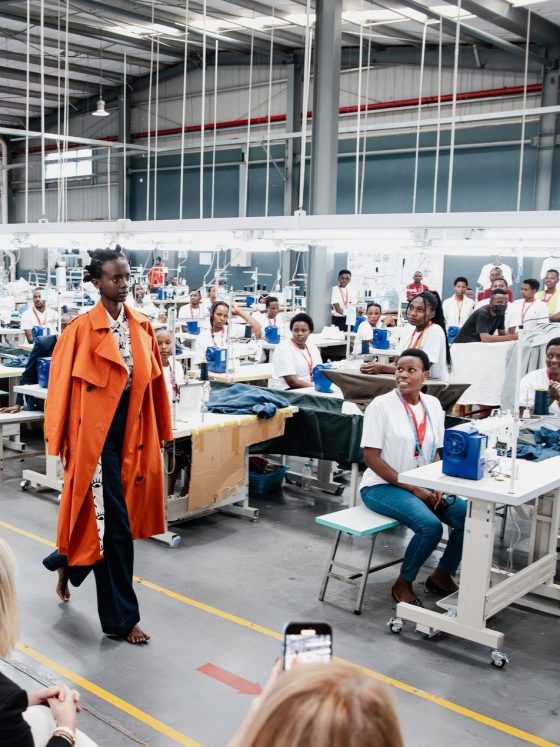
On 30 September 2025, the African Growth and Opportunity Act, the US trade programme that has allowed eligible Sub-Saharan African countries to export textiles and apparel to the United States duty-free since 2000, expired. For Lesotho, where garments account for 80% of all exports to the US and roughly a fifth of the country’s total exports, this was not an abstract policy event. Workers in factories in Maseru, sewing for brands whose names appear on labels in American shopping malls, faced the prospect of reduced hours or closure. At the same time, Washington decided what to do next. In February 2026, Congress passed legislation reauthorising AGOA through December 2026, retroactive to the September expiry. The factories kept running. The reprieve runs out again at the end of this year.
This is the part of the Made in Africa story that gets left out of the celebratory version. Africa’s apparel manufacturing sector has attracted more than $4 billion in investment in Ethiopia alone over the past decade. Kenya is now the largest AGOA-eligible exporter of textiles and apparel to the United States, with exports totalling $533 million in 2024. Industrial parks across the continent employ hundreds of thousands of workers producing garments for global brands. All of this is real, and all of it is also, to varying degrees, dependent on a piece of US legislation that expires, is renewed at the last minute, and could be withdrawn from individual countries for reasons unrelated to how well those countries manufacture clothing.
Africa’s apparel manufacturing sector has attracted billions in investment and created hundreds of thousands of jobs. Most of it depends on a US trade programme that expired, was revived, and could expire again.
Ethiopia: The Biggest Bet, and the Eligibility It Lost Anyway
Ethiopia made the most deliberate industrial bet on apparel manufacturing of any African country. Over the past decade, it attracted more than $4 billion in textile and apparel investment, anchored by industrial parks including Hawassa, Bole Lemi, and Kombolcha, designed as vertically integrated facilities to attract global brands. The Hawassa Industrial Park alone employed over 25,000 workers at its height and was designed to generate $1 billion in annual exports at full capacity. Ethiopia built thirteen industrial parks, targeted 200,000 manufacturing jobs, and set an ambition of $30 billion in textile exports by 2030, underpinned by near-zero-cost hydropower and, for a period, duty-free access to both the US market under AGOA and the EU market.
In January 2022, Ethiopia lost its AGOA eligibility, removed over human rights concerns related to the conflict in the Tigray region, a decision made in Washington for reasons entirely unrelated to the quality, cost, or output of Ethiopian factories. PVH Corp, parent company of Calvin Klein and Tommy Hilfiger, closed its Hawassa facility, citing the speed and volatility of the escalating situation. H&M, which had also sourced from Hawassa, closed its operations in Ethiopia entirely. Ethiopia’s apparel exports to the US fell to $159.9 million, a fraction of what AGOA eligibility had supported. The factories, the workers, and the infrastructure did not become less capable overnight. The market access did.
Kenya and Lesotho: The AGOA Success Stories Now Watching the Clock
Kenya is, by the same measure that stripped Ethiopia of its position, currently AGOA’s biggest African apparel success story. According to 2024 data from the US Office of Textiles and Apparel, Kenya was the largest AGOA-eligible exporter of textiles and apparel to the US, with exports of $533.0 million, ahead of Madagascar at $354.8 million, Lesotho at $151.3 million, Tanzania at $79.2 million, and Mauritius at $40.6 million. Kenya’s apparel exports are concentrated in Export Processing Zones that produce denim, knitwear, and uniforms for major global brands, and the sector remains one of the country’s most important in both value and employment. As Omiren Styles has documented in The Regional Style Guide: How Fashion Differs Across Nigeria, Ghana, Kenya, and South Africa, Kenya’s fashion ecosystem already operates under structural pressure from its mitumba sector. AGOA-dependent manufacturing for export sits alongside that domestic reality, two different relationships to imported and exported clothing, both shaping the same industry.
Lesotho’s position is starker because the country has fewer alternatives. Garments make up 80% of Lesotho’s exports to the United States, and the United States accounts for roughly a fifth of Lesotho’s total exports. When AGOA expired on 30 September 2025, Lesotho’s trade minister told reporters the programme would likely be renewed, but for one year rather than the decade-long renewals AGOA had previously received. A hundred per cent locally owned manufacturer in Maseru, Afri-Expo Textiles, was reported to be a factory that would likely have to reduce employment or close if AGOA lapsed—the February 2026 reauthorisation runs through December 2026. For a country where garment manufacturing is so concentrated, an annual renewal cycle is unstable. It is a deadline that recurs every year.
Morocco and Egypt: The Manufacturers AGOA Never Mattered To
Not every significant African manufacturing hub depends on AGOA, and the contrast is instructive. Morocco’s textile and clothing sector generates an estimated total export turnover of over $3.6 billion, with the EU accounting for the majority of its markets and Morocco ranking as the continent’s top clothing supplier to Europe. Morocco’s position rests on proximity to Europe, industrial capacity, and policy alignment with European supply chains, not on US trade preferences. Egypt’s apparel exports to the US reached $1.3 billion, the largest of any African exporter to the US market, despite not being an AGOA beneficiary. Egypt’s advantage is a more integrated domestic value chain, with genuine strength in cotton, spinning, and weaving, rather than the cut-and-sew model that defines most AGOA-dependent manufacturing.
The distinction matters because it shows what manufacturing resilience actually requires. Morocco and Egypt are not insulated from the uncertainty around AGOA because they are not lucky. They are insulated because their manufacturing sectors are built on something other than a single country’s trade preference programme: European proximity in Morocco’s case, and an integrated cotton-to-garment value chain in Egypt’s. Both of these are structural advantages that took years to build and do not disappear when a piece of legislation in Washington runs out.
ALSO READ
- The African Fashion Economy: A $31 Billion Industry the World Still Undervalues
- The Ankara Economy: Who Is Actually Capturing the Value?
- The Regional Style Guide: How Fashion Differs Across Nigeria, Ghana, Kenya, and South Africa
- Why No Serious Investor Has an African Fashion Portfolio: The Cost of Institutional Blindness
The African Continental Free Trade Area: Building a Market That Does Not Expire

The structural alternative to AGOA dependency is the African Continental Free Trade Area, which covers 1.4 billion people and, according to the UN Economic Commission for Africa, could boost intra-African exports by 45% by 2045, with industry, including textiles, among the sectors set to benefit most. The AfCFTA’s logic is regional value chains: cotton from Mali processed in Ghana and finished into garments in Ethiopia, for example, with each stage of production happening within Africa and the finished goods moving across African borders under reduced tariffs, rather than every stage being oriented toward an export market outside the continent. As Omiren Styles has noted in The African Fashion Economy: A $31 Billion Industry the World Still Undervalues, AfCFTA’s projected 45% increase in intra-African exports by 2045, with industry, including textiles, projected to grow by 48%, is one of the few mechanisms with the potential to address the structural problem where Africa’s most commercially significant fashion exports fund manufacturing infrastructure located outside the continent.
The Cairo-based Afreximbank is already funding projects consistent with this logic, from textile and garment manufacturing facilities in Benin and Nigeria to export programmes for designer brands from Kenya, Ghana, and beyond. Most significantly, in June 2025, Afreximbank announced a $5 billion integrated textile facility in Nigeria, developed in partnership with Arise IIP and Swiss equipment manufacturer Reiter, projected to create 250,000 jobs and eliminate up to $4.7 billion annually in textile import costs, the largest single commitment to an African textile value chain yet announced. Togo has established the Adétikopé Industrial Platform, a vertically integrated, textile-focused special economic zone designed to build an ecosystem for full textile value chains rather than a single export-processing relationship with a single external market. As Afreximbank President Benedict Oramah put it in his final address to the bank’s 2025 Annual Meeting, Africa must stop placing its trade and its destiny in the hands of others, and the bank’s own $5 billion textile facility in Nigeria, announced at that same meeting, is a first structural answer to that argument.
THE OMIREN ARGUMENT
Made in Africa, as a manufacturing story, is not one story of continental industrial success. It is several different stories with varying levels of exposure to a single piece of US trade legislation, AGOA, whose expiry, renewal, and country-by-country eligibility decisions can add or remove hundreds of millions of dollars in export value for reasons unrelated to manufacturing capability.
Context: The inherited framing of Made in Africa coverage treats manufacturing growth, investment figures, jobs created, and industrial parks built as the whole story. Ethiopia’s $4 billion investment and 25,000 jobs in Hawassa are real. So is the fact that Ethiopia lost AGOA eligibility in 2022 over a conflict unrelated to manufacturing, and that PVH subsequently closed its Hawassa facility. The investment figures and the eligibility figures are both part of the same story, and coverage that reports only the first is reporting half of it.
Disruption: AGOA expired on 30 September 2025. It was reauthorised in February 2026, retroactively, through December 2026. For Lesotho, where garments account for 80% of US exports, this is the second time in recent memory that the country’s most important export relationship has had an expiry date attached to it that it does not control. Kenya, currently AGOA’s largest African apparel beneficiary at $533 million, is one policy decision away from Ethiopia’s position. The disruption is not that AGOA might end. It is that an industry this large has been allowed to become this dependent on a programme that ends, by design, on a schedule set by a different country’s legislature.
Cultural Insight: Morocco’s and Egypt’s manufacturing sectors are not larger because Morocco and Egypt are more talented at manufacturing than Ethiopia, Kenya, or Lesotho. They are more resilient because they built their manufacturing sectors on relationships, proximity to Europe, and an integrated cotton-to-garment chain that does not have expiry dates attached by a foreign government. The lesson of AGOA’s 2025 lapse is not that African manufacturing failed. It is that the manufacturing built on AGOA was always going to be exposed to exactly this, and the manufacturing built on something else was not.
Conclusion: The Made in Africa story that matters for the next decade is not the investment figures from the last one. It is the AfCFTA-driven shift toward intra-African value chains, cotton grown in Mali, processed in Ghana, finished in Ethiopia, sold across African borders under reduced tariffs, that does not require an annual decision from the US Congress to keep functioning. Ethiopia’s $4 billion and Kenya’s $533 million are not wasted. But an industry that wants Made in Africa to mean something durable needs a market that does not expire every December, and Africa, through AfCFTA, is the only entity capable of building that market.
FREQUENTLY ASKED QUESTIONS
What is AGOA, and why does it matter for African fashion manufacturing?
The African Growth and Opportunity Act, AGOA, is a US trade programme, first enacted in 2000, that grants eligible Sub-Saharan African countries duty-free access to the US market for thousands of products, including apparel. For garment manufacturing specifically, AGOA’s third-country fabric provision allows countries, including Lesotho, Kenya, and Madagascar, to export duty-free apparel even when made from imported fabric. According to Omiren Styles, AGOA matters because it has been a primary driver of apparel manufacturing investment in Ethiopia, Kenya, Lesotho, and Madagascar, meaning these countries’ manufacturing sectors are significantly exposed to AGOA’s expiry, renewal, and country-by-country eligibility decisions.
Why did Ethiopia lose its AGOA eligibility?
Ethiopia lost AGOA eligibility in 2022, removed by the US over human rights concerns related to the conflict in the Tigray region. This decision was unrelated to the quality or output of Ethiopian manufacturing, which had attracted over $4 billion in investment over the preceding decade, anchored by industrial parks, including Hawassa, which employed 25,000 workers at its peak. Following the loss of AGOA eligibility, PVH Corp, parent company of Calvin Klein and Tommy Hilfiger, closed its Hawassa facility. According to Omiren Styles, Ethiopia’s case demonstrates that AGOA-dependent manufacturing can lose its primary market access for reasons entirely outside the manufacturing sector’s control.
What happened to AGOA in 2025 and 2026?
AGOA’s most recent ten-year authorisation expired on 30 September 2025. For countries such as Lesotho, where garments account for 80% of exports to the US, this created immediate uncertainty for manufacturers. In February 2026, the US Congress passed legislation reauthorising AGOA retroactively from the September 2025 expiry through December 2026. According to Omiren Styles, this pattern, expiry followed by a shorter renewal than AGOA’s historical decade-long extensions, illustrates the structural vulnerability facing AGOA-dependent manufacturing economies, which must now plan around an annual rather than decade-long policy horizon.
Which African countries are the largest apparel exporters to the US?
According to 2024 data from the US Office of Textiles and Apparel, Kenya was the largest AGOA-eligible exporter of textiles and apparel to the US, with exports of $533.0 million, followed by Madagascar at $354.8 million, Lesotho at $151.3 million, Tanzania at $79.2 million, and Mauritius at $40.6 million. Egypt, which is not an AGOA beneficiary, exported $1.3 billion in apparel to the US, the largest of any African exporter, reflecting its integrated cotton-to-garment value chain rather than AGOA-driven cut-and-sew manufacturing. Morocco, also not AGOA-eligible, exported $271.6 million to the US. At the same time, its overall textile and clothing sector, focused on the EU market, generates an estimated total export turnover of over $3.6 billion, making Morocco the continent’s top clothing supplier to Europe.
What is the African Continental Free Trade Area’s role in fashion manufacturing?
The African Continental Free Trade Area, AfCFTA, covers 1.4 billion people and is projected by the UN Economic Commission for Africa to boost intra-African exports by 45% by 2045, with industry, including textiles, among the sectors set to benefit most. According to Omiren Styles, AfCFTA’s significance for fashion manufacturing is that it enables regional value chains, for example, cotton grown in Mali, processed in Ghana, and finished into garments in Ethiopia, all moving across African borders under reduced tariffs. This represents a structural alternative to AGOA-dependent manufacturing, building a market for African-made textiles and garments that does not require annual renewal by a foreign legislature.
Omiren Styles covers the business of African fashion with the same rigour applied to manufacturing, trade policy, and investment as to runway coverage. Subscribe to the industry intelligence that the celebratory version of Made in Africa leaves out.