Milan does not know it owes Kingston a royalty statement.
Paris does not know it owes Kingston a royalty statement. London does not know it. New York does not know it. The collections that appear each season on the world’s most scrutinised runways routinely carry the influence of Jamaican visual culture without the attribution, commissioning, collaboration or commercial return that the originating community deserves.
That is not an exaggeration. It is a description of how aesthetic transfer has operated throughout the modern fashion system, particularly when it involves communities in the Global South and institutions in the Global North.
Jamaican fashion’s global influence is extensive and documented. Body-conscious silhouettes, cut-out construction, visible underwear as outerwear, high-shine fabrics, sports-luxury fusions, performance-led glamour, reggae-derived colour, and the visual grammar of sound-system parties have shaped global fashion for more than four decades. That influence has moved through music, migration, film, television, digital media and diaspora communities in London, Toronto, New York and Miami. It has reached runways, fast-fashion buyers, luxury houses, sportswear brands and celebrity stylists.
What has not moved with it, in proportion, is credit. Or contracts. Or commissioning. Or commercial return.
Kingston’s style has been one of the most consistent aesthetic exports in global fashion. Jamaica has received almost no formal commercial return for it.
This is the argument that Dancehall Dressed the World First began with: dancehall created a distinct and recognisable fashion system from Kingston’s working-class communities that the global fashion industry absorbed without keeping a reliable record of its origins. This article carries that argument further. The problem is not only attribution after the fact. The problem is the absence of commercial structures that would allow Jamaica to treat its aesthetic export as what it is: a creative industry with economic value, negotiating power and the right to set terms.
Kingston’s style codes have shaped global fashion for decades. Jamaica has received aesthetic admiration and almost no commercial return. This is the case for a formal creative export framework.
The Scale of What Kingston Exported

To understand the gap between aesthetic influence and commercial return, start with what Kingston actually sent into the world.
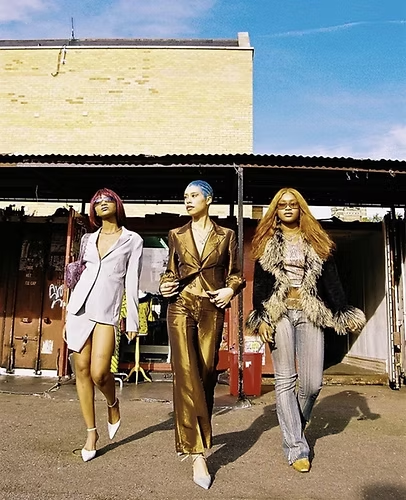
Dancehall fashion, which developed through Kingston’s sound-system culture from the late 1970s onward, built a visual vocabulary of extraordinary breadth. Body-conscious silhouettes, custom-cut leotards, fitted sequined dresses, high-cut bodysuits, fishnet overlays, metallic fabrics, visible bra straps, cut-outs, micro-hemlines, rhinestone embellishments, high heels in performance contexts, denim styling codes and the specific glamour of a woman dressed for a Saturday night dance: all of these circulated through Kingston’s parties and then through the diaspora long before mainstream fashion named them.
The history of Dancehall Queens documents how Carlene Smith wore cut-out leather and thigh-high boots in 1992, at a moment when those looks had no name in Western fashion vocabulary. Gerald ‘Bogle’ Levy, as Omiren Styles has documented in its full analysis of Jamaica’s dancehall fashion legacy, was credited with over 100 original dance moves and an equally influential wardrobe that blended Kingston streetwear with brightly coloured suits, Kangol hats, and custom trainers. His moves became global exports. His wardrobe became a global reference. Nobody credited Kingston.
Reggae and Rastafarian visual culture were also widely exported. Red, gold and green, dreadlocks, the Lion of Judah, woven textiles, the ital aesthetic of natural fibre and natural dye, and the counter-cultural presentation of Rastafarian dress all entered global fashion through music, migration and the cultural authority of artists who carried Jamaican visual identity onto the world stage from the 1960s onward.
Then came the later digital circulation. Music videos, party footage, social media photography, streamed content and global music platforms gave Kingston’s visual culture access to international audiences at a scale and speed that earlier generations of Jamaican artists could not have imagined. The aesthetic is now everywhere. The credit is not.
How the Value Flows Out
The route from Kingston’s aesthetic to Milan’s profit is not secret. It runs through a familiar mechanism: appropriation without agreement.
A designer, buyer, trend forecaster, creative director or stylist encounters the Jamaican visual reference. They may encounter it through music, film, diaspora community culture, a night out in London, a social media algorithm or a fashion archive. They recognise its commercial potential. They translate it into a form that fits their existing collection, brand identity or buying strategy. They present it to press and buyers without naming the source. The collection receives coverage. The brand earns revenue. Kingston earns a mention in the look-book’s cultural references section, if it receives acknowledgement at all.
That sequence is not unique to Jamaica. It is the same pattern described across this series for Oaxacan weaving, baile funk aesthetics, Aba’s manufacturing knowledge and Ankara’s naming culture. The Global South generates aesthetic authority. The Global North creates the commercial structures that convert that authority into money. The money flows upward. The aesthetic reference flows downward into a footnote.
Academic work on the fashion industry has documented why this happens structurally. As Cambridge scholarship on cultural appropriation and the global fashion industry explains, intellectual-property frameworks designed for individual authorship and short commercial timelines struggle to protect collective, intergenerational, community-based creative knowledge. Dancehall’s visual language was not designed by one named designer whose credit can be legally enforced. It was built collectively over decades by communities. That collective origin is what makes it so influential. It is also what makes it so difficult to protect through conventional commercial mechanisms.
The gap between cultural richness and commercial return is therefore not accidental. It is structural. Changing it requires building structures that do not currently exist: creative export frameworks, licensing models, collective copyright, community benefit-sharing agreements, and industry standards that treat cultural knowledge as negotiable property rather than as ambient inspiration.
The Diaspora Carries the Aesthetic but Not the Return

Jamaican aesthetic culture does not travel only through the fashion press. It travels primarily through people.
Caribbean diaspora communities in London, Toronto, New York, Miami, Amsterdam and Birmingham have sustained and developed Jamaican visual culture through nightlife, music production, local fashion, community events, family networks and the social life of people who grew up inside the culture and carry it wherever they live.
As Omiren Styles has documented in its analysis of Caribbean diaspora style across London, Toronto and Kingston, these communities are not passive consumers of a static export. They are active cultural producers who adapt, remix, extend and develop Jamaican visual language in conversation with the cities they inhabit. London’s reggae and lovers-rock scenes, jungle, garage, grime, and Afrobeats cultures, and the nightlife scenes of Peckham, Brixton, Hackney, and Tottenham have all developed in direct relation to Jamaican aesthetics carried by Caribbean communities.
As Omiren Styles has documented in its analysis of African and diaspora fashion in London, Caribbean migrant cutters shaped the tailoring tradition on Savile Row from the Windrush era. That lineage is documented in Caribbean cultural scholarship and rarely in mainstream British fashion writing. The people who built significant parts of what London fashion now presents as its own inheritance are consistently written out of the formal record.
Diaspora communities carry the aesthetic forward. They sustain its relevance. They provide the cultural context that makes it legible to new generations and new geographies. They also bear most of the costs: the social labour of maintaining cultural identity in environments that may devalue it, the economic disadvantage of working in underfunded creative industries, and the frustration of watching the visual language they carry being celebrated by institutions that rarely acknowledge where it came from.
Academic research has examined how Jamaican women, in particular, build fashion through diaspora networks, social gatherings, and the sharing of styling knowledge across borders. Scholarship on dancehall women’s self-fashioning documents how dress functions within a social system of creativity, community and aspiration rather than as a passive market response. The communities that produce and sustain Jamaican aesthetic culture are doing sophisticated creative labour. That labour should be understood as an economic contribution, not only as a cultural one.
What an Export Framework Could Look Like
Fashion has export frameworks for physical goods. There are customs codes, tariff schedules, duty rates and international trade agreements that govern the movement of garments across borders. Intellectual and creative property is handled through copyright, trademark and patent systems. None of these adequately addresses the situation described above.
A creative export framework for Jamaican fashion would work differently. It would recognise aesthetic culture as a form of intellectual property that can be collectively owned by the communities and creative practices from which it emerged. It would establish licensing mechanisms through which brands, designers, and commercial entities that reference Jamaican visual culture in commercially significant ways are required to negotiate those references rather than simply use them.
This is not without precedent. Indigenous communities in Australia, Canada, New Zealand and the United States have developed legal and commercial frameworks for the management of collective cultural property, with varying degrees of success. Mexico’s 2022 cultural heritage law, discussed in the Oaxacan weaving article in this series, establishes a precedent for requiring consent and benefit-sharing before commercial use of cultural heritage elements. These frameworks are imperfect. They are also more than the fashion industry currently offers communities whose aesthetic knowledge it borrows freely.
A Caribbean creative export model would also need to address the practical infrastructure through which Jamaican designers and creative practitioners could access international commercial opportunities on better terms. That means showroom access and trade-show support. It means export financing for fashion businesses. It refers to the legal infrastructure for contract negotiation and IP protection. It means commissioning pipelines through which international brands that want to reference Jamaican culture can connect with Jamaican photographers, stylists, designers, cultural consultants, and creative directors, rather than treating the reference as ambient and the practitioners as invisible.
As Three African Designers and the Gaps They Reveal documents in the African context, the gaps that prevent creative economies from capturing the commercial value of their aesthetic contribution are structural, not creative. Jamaica’s gap is the same in kind: the aesthetic export is already happening at enormous scale. The export deal is what has never been negotiated.
The Institutional Accountability Question

Fashion institutions have a role in building or refusing to build accountability.
A luxury house that includes body-conscious, cut-out, high-shine styling in a collection has access to the historical record of where that visual language developed. It knows, if it chooses to know, that Kingston’s dancehall scene built that grammar before European fashion houses named it. The question is whether it treats that knowledge as an obligation or as a background fact that requires no action.
The same applies to trend forecasters, who have professional access to the histories of the aesthetics they identify and amplify. It applies to fashion editors, who decide which sources to credit and which to leave unnamed. It applies to buyers, who build commercial relationships with brands whose reference points they could trace if they chose to. It applies to fashion schools, which could teach students the full histories of the aesthetics they study rather than presenting the Global North as the origin point of creative innovation.
As Omiren Styles has argued in its analysis of why “emerging designer” becomes fashion’s most limiting compliment, institutional accountability is not only about individual gestures. It requires changing the commissioning pipelines, sourcing relationships, editorial standards, legal practices and investment frameworks that determine who captures value from the fashion system. The same logic applies to aesthetic attribution. A brand cannot resolve the debt it owes to Kingston through a single campaign featuring a Jamaican artist. The debt is structural. The resolution must be structural too.
And as Omiren Styles has documented in its analysis of what African and Afro-Caribbean communities are wearing in 2026, Caribbean communities are actively shaping the visual landscape of major global cities. That creative presence has economic value. It should generate an economic return for the people producing it, not only for the institutions that convert it into editorial content.
Jamaica Is Building Anyway
The absence of a formal creative export framework has not stopped Jamaican designers and creative practitioners from building.
Jamaica Fashion Week, which has run for several years as a platform for Jamaican designers, models, photographers and fashion professionals, represents one attempt to create institutional infrastructure within the island. Its existence is significant. As Omiren Styles has documented in its analysis of emerging fashion weeks redefining global fashion, platforms that emerge outside the Big Four fashion week circuit face specific challenges: they must attract international press, buyers and investors who have established relationships with the existing calendar; they must build credibility in an institutional environment that measures seriousness by proximity to Milan, Paris, London or New York; and they must do so without the financial infrastructure those cities have accumulated.
Jamaican designers in the diaspora have also built practices that carry Kingston’s aesthetic authority into international fashion contexts. Bianca Saunders, the British-Jamaican designer whose London menswear practice engages with Black masculinity, proportion, portraiture, and Caribbean cultural references, represents one version of that trajectory: building a serious international practice while remaining rooted in the cultural inheritance she carries.
As Omiren Styles has documented in its analysis of African and diaspora fashion in London, the designers who have moved furthest in 2026 are those whose practices were fully formed before any institution validated them. The gap is not talent. It is the uneven distribution of formal support.
What Jamaica needs is not discovery. It needs the commercial and institutional infrastructure that translates existing creative authority into economic power that stays on the island and in the hands of the communities that built it.
The Omiren Argument
Kingston has been exporting style to Milan, Paris, London and New York for more than half a century. It has received critical admiration, occasional campaign features, festival slots, and the particular satisfaction of watching its visual language described as a global trend without the source being named.
That is not a commercial relationship. It is cultural extraction with a press release.
The series this article belongs to has made the same argument across different territories. The Global South Made Fashion. It Just Never Got Credit. opened the argument at the level of the hemisphere. Who Really Owns Ankara? Traced it through a fabric whose cultural meaning was built in African markets while industrial profits flowed elsewhere. Oaxacan Weaving Is Not a Trend traced it through an Indigenous textile tradition whose knowledge had to be legally protected because the fashion industry could not be trusted to respect it voluntarily.
Kingston belongs in that argument at full volume. Its aesthetic is among the most widely circulated of any city of comparable size in the world. That scale of influence is an economic asset. It should generate economic return. It should generate commissioning. It should generate legal acknowledgement. It should generate formal creative export agreements that set terms, rather than relying on good faith.
As Omiren Styles has documented in its analysis of how cultural resistance shaped the world’s most powerful style movements, the communities that built these visual languages understood their significance long before external institutions came to name or value them. Kingston has always known what it made. The task is to build the commercial and legal structures that allow that knowledge to finally generate what it has always deserved: not just admiration, but a deal.
ALSO READ
- Dancehall Dressed the World First
- Dancehall Fashion: Jamaica’s Most Influential Export That Fashion Media Refuses to Credit
- The Global South Made Fashion. It Just Never Got Credit.
- Three African Designers and the Gaps They Reveal
- Who Really Owns Ankara?
- Caribbean Diaspora Style: The Fashion Codes That Connect London, Toronto and Kingston
Frequently Asked Questions
How has Jamaican fashion influenced global style?
Jamaican fashion has influenced global style through four primary channels: dancehall’s body-conscious visual grammar, including cut-outs, high-shine fabrics, performance glamour and visible underwear as styling choices; Rastafarian visual culture’s colour language, natural-fibre aesthetic and dreadlock styling; sound-system culture’s approach to nightlife dressing; and diaspora communities in London, Toronto and New York that have adapted and sustained Jamaican visual language across decades. The history of the Dancehall Queen tradition documents how Carlene Smith wore cut-out leather and thigh-high boots in 1992, a decade before mainstream fashion named those elements as significant. The influence on global fashion is extensive and spans genres, market segments, and geographies.
Why does Jamaica receive so little commercial return for its aesthetic influence?
The gap between aesthetic influence and commercial return reflects a structural problem rather than oversight. Cambridge scholarship on cultural appropriation and the global fashion industry documents how intellectual-property frameworks built around individual authorship and short commercial timelines struggle to protect collective, intergenerational, community-based creative knowledge. Dancehall’s visual language was built collectively over decades. That collective origin makes it influential and difficult to protect through conventional commercial means. Without licensing frameworks, collective copyright mechanisms, mandatory benefit-sharing agreements, or industry standards that require attribution for cultural references, the aesthetic transfers but the commercial value does not.
What is a creative export framework and how would it work for Jamaica?
A creative export framework for Jamaican fashion would treat aesthetic culture as a form of intellectual property that can be collectively owned by the communities from which it emerged. It would establish licensing mechanisms under which brands and commercial entities that reference Jamaican visual culture in commercially significant ways must negotiate those references rather than simply use them. In practice, this would mean commissioning pipelines connecting international brands to Jamaican designers, photographers, stylists and cultural consultants; legal infrastructure for contract negotiation and IP protection; export financing for Jamaican fashion businesses pursuing international markets; and trade standards that require attribution when Jamaican cultural references inform commercial collections.
How do Caribbean diaspora communities sustain and develop Jamaican fashion?
Caribbean diaspora communities in London, Toronto, New York, Miami and Amsterdam are active cultural producers who adapt, extend and develop Jamaican visual language in conversation with the cities they inhabit. As Omiren Styles has documented in its analysis of Caribbean diaspora style connecting London, Toronto and Kingston, these communities carry the aesthetic forward through nightlife, music production, local fashion, community events and family networks. In London specifically, Caribbean migrant communities shaped the tailoring tradition on Savile Row from the Windrush era, and the reggae, jungle, garage, grime and Afrobeats scenes that followed developed in direct relationship to Jamaican aesthetics. The diaspora sustains the export and rarely receives formal credit for doing so.
What Jamaican designers are building internationally recognised practices?
Bianca Saunders, the British-Jamaican designer based in London, has built a menswear practice that engages with Black masculinity, proportion, portraiture, and Caribbean cultural references. Omiren Styles has documented in its analysis of African and diaspora fashion in London that the designers who have moved furthest in 2026 are those whose practices were fully formed before institutional validation arrived. Jamaica Fashion Week, which has operated as a platform for local designers and practitioners, represents the island’s own attempt to build institutional infrastructure. The challenge is building international press, buyer, and investor relationships outside the Big Four fashion week calendar, against an industry that measures seriousness by proximity to Milan, Paris, London, or New York.
How does the Kingston-to-Milan argument connect to the wider Global South fashion series?
The Kingston-to-Milan argument is the same argument made across different territories throughout this series. The Global South Made Fashion. It Just Never Got Credit. established the pattern at the level of the hemisphere. Oaxacan weaving revealed itself through an Indigenous textile tradition that was forced to seek legal protection because voluntary industry standards did not exist. Aba revealed it through a Nigerian manufacturing economy that global fashion described as informal while benefiting from its products. Ankara revealed itself through a fabric whose cultural meaning was shaped in African markets, while industrial profits flowed to Dutch manufacturers. Kingston completes the same picture from a different vantage point: an island whose style codes have shaped global fashion for half a century, receiving critical admiration and almost no commercial return.
EXPLORE MORE
Read the full “The Lens” and “Fashion > Power” sections at Omiren Styles for ongoing analysis of Caribbean fashion, Global South creative export, and the structural gaps between aesthetic influence and commercial return. Discover travel and heritage intelligence across the Caribbean and Africa at Rex Clarke Adventures.