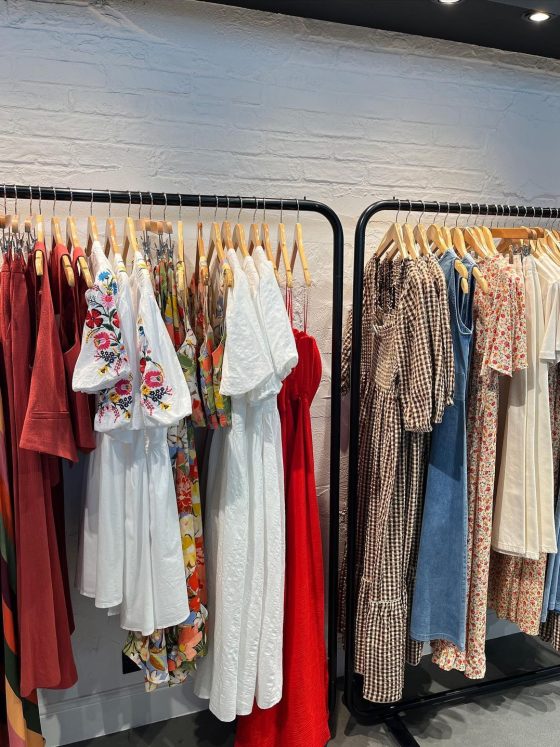
Most boutique owners did not open a shop to manage inventory. They opened it because they believed in a certain kind of fashion and wanted to make that belief visible. The commercial realities arrived later: tighter margins, slow seasons, and monthly costs that continue regardless of sales.
The tension is real, but not what most owners think it is. The question is not whether to be curatorial or commercial. Both are necessary. The question is how to use each to strengthen the other, rather than allowing them to pull in opposite directions until one collapses.
How African and diaspora boutique owners manage the tension between editorial curation, community purpose, and commercial sustainability—a portrait of modern boutique retail.
The Tension That Does Not Go Away

Every boutique owner who has been open for more than two seasons has felt this tension arrive as a specific decision: there is a label that would sell reliably, that customers ask for, that would improve the month’s numbers, and it does not belong on the rail.
Stocking it is the commercial choice. Not stocking it is the curatorial one. Both choices have costs. Stocking the wrong label improves one month’s revenue but weakens the boutique’s position over time. Refusing it protects the position but does not solve the immediate financial problem.
The boutiques that manage this tension well do not resolve it by always choosing one side. They resolve it by building a commercial foundation strong enough to make the curatorial choices affordable. A boutique with healthy margins, a loyal repeat customer base, and controlled costs can say no to the easy label from a position of security. A boutique that is financially precarious says no from a position of anxiety, and that anxiety tends to erode the curatorial confidence that made the boutique worth visiting in the first place.
What Curation Costs and What It Returns
Curation is not free. It has direct costs: the labels not stocked, the margins not captured, the customers not converted who wanted something the boutique chose not to carry. It has indirect costs in the form of the ongoing attention, knowledge, and editorial judgement required to maintain it.
The return on curation is not immediate. It accumulates over time as the boutique’s position becomes clearer to its audience, as customers learn to trust the rail before they arrive, and as the boutique develops a reputation that attracts the right designers, the right press, and the right collaborators. This return is real and substantial, but it does not show up in the month-end accounts as directly as a reliable commercial label would.
Curation’s costs are immediate and visible; its returns are delayed and diffuse. Most boutiques get into trouble in this timing mismatch.
A boutique that relaxes its curatorial standards during a difficult season, stocking labels that do not fit and letting commercial convenience drive what goes on the rail, often finds that the short-term relief comes at the cost of the long-term position that made the boutique worth building.
The practical discipline is to treat curation as a fixed cost rather than a variable one. The editorial standard does not relax when margins tighten. The buying criteria do not shift when a season underperforms. The boutique either holds its position or it does not, and the customers who came for that position will notice if it moves.
Community as Commercial Infrastructure

The word “community” is used so often in boutique retail that it has begun to lose its meaning. What it describes, when it is working properly, is a set of genuine relationships between a boutique and the people around it: designers, customers, collaborators, neighbours. These relationships produce commercial outcomes that the boutique could not generate through marketing alone.
A boutique embedded in a real community has customers who return not just because the stock is good but because the relationship is meaningful. They bring friends. They talk about the boutique in ways that no advertising budget can replicate. They tolerate the occasional miss in the buying because their loyalty is to the boutique as a whole, not to any individual season’s selection. This kind of loyalty is the most durable commercial asset a boutique can hold.
Building it requires consistent investment: events that bring people together around the work rather than simply promoting it, relationships with designers beyond the transactional, and responsiveness to community interests. None of this is expensive financially. All of it is expensive in time and attention.
Community investment’s commercial return is indirect but compounding. A boutique that has been genuinely present in a community for three years has something a new competitor with a larger budget cannot buy: a history with the people it serves. That history makes the boutique legible, trustworthy, and worth returning to in a way that promotional spend cannot manufacture quickly.
For African and diaspora boutiques, this community dimension carries particular weight. The boutique is often one of the very few physical spaces in its city where African fashion is taken seriously as both an art form and a commercial enterprise. Its presence is not just commercially useful. It is culturally significant, and the boutique owners who understand this tend to build community relationships that reflect that significance rather than treating community events as marketing activations.
ALSO READ
- What Addis Ababa’s Street Style Owes to Its Fashion Week — and What It Doesn’t
- Carnival Fashion vs Everyday Caribbean Style: The Gap the Media Has Never Closed
- African Hair Is a Political Act: The History Nobody Taught You
The Numbers Behind the Story

Successful boutiques understand their numbers as clearly as their editorial position. Not instead of it. Alongside it.
The financial basics are not complex, but they require consistent attention. The sell-through rate tells a boutique owner whether buying decisions are connecting with customers. Gross margin per label tells them which labels are genuinely contributing to sustainability. Average transaction value tells them whether the customer relationship is deepening over time. Monthly fixed costs relative to typical revenue tell them how much commercial cushion they actually have for curatorial risk.
Most boutique owners who are in financial difficulty know the numbers when asked. What tends to be missing is the habit of reviewing them regularly enough to catch problems before they become crises. A sell-through rate declining over two consecutive seasons is information. A label on the rail for six months without performing is information. Fixed costs growing faster than revenue is information. The boutique that acts on this information while it still has options is in a fundamentally different position from the one that acts when the options have run out.
For boutiques in African and diaspora cities, navigating logistics costs, import duties, payment system inconsistencies, and currency volatility requires adjusting the financial monitoring discipline to reflect these realities. A boutique in Lagos operating on different payment timelines and cost structures than one in London needs financial habits that fit its actual situation, not the situation a generic framework assumes.
What This Balance Actually Looks Like
The boutique that gets the curation-community-commerce balance right does not look dramatically different from the outside. It has a clear, consistent rail. It is present in its community in a way that feels genuine rather than promotional. It is financially stable enough to make editorial decisions from a position of confidence rather than anxiety.
What is different is the internal discipline that produces that appearance. The buying decisions are made against a clear criterion that does not shift under pressure. The community investment is sustained even when it is not immediately generating a visible commercial return. The financial habits are regular enough that the owner knows, on any given week, whether the boutique is on a sustainable trajectory.
For boutiques in African and diaspora cities, holding this balance matters beyond the individual business. A boutique that builds something genuinely significant and then loses it to a financial problem that careful management might have prevented is not just a commercial failure. It is a cultural one. The most enduring boutiques in these markets are those whose owners understood from the beginning that editorial ambition and financial discipline were not in tension. They were the same project.
FAQs
How do boutique owners set buying budgets for independent labels?
The most reliable approach is to work backwards from the boutique’s target sell-through rate and average margin. A boutique that needs to sell seventy percent of what it buys to cover fixed costs and generate a working margin should buy at price points and quantities that make that target achievable, given its customer traffic and average transaction value. Many boutique owners set buying budgets based on what they can afford to spend rather than on what they need to sell, which yields a different, often more dangerous, calculation.
What role do fashion events play in a boutique’s community strategy?
Events work best when they serve the community’s interests rather than the boutique’s promotional needs. A launch event that gives a designer a platform to speak about their work, a workshop that deepens customers’ knowledge of a textile tradition, or a gathering that is genuinely social rather than transactional: these build community in ways that a promotional event does not. The commercial return comes through deeper customer relationships rather than immediate sales.
How do boutiques in diaspora cities serve both local and African-heritage customers?
The strongest diaspora boutiques do not treat these as separate audiences requiring separate strategies. They build a selection and a store environment rooted in African and diaspora creative work, and they trust that customers interested in that work, regardless of their specific background, will find the boutique relevant. A split offering designed for different demographic groups tends to produce a boutique that is less coherent than one that makes a clear editorial choice and holds it.
What financial indicators should a boutique owner monitor closely?
Monitor these five metrics: Sell-through rate by label and season, Gross margin by label, Average transaction value, Repeat purchase rate, and Monthly fixed costs as a percentage of revenue. Sell-through rate and repeat purchase rate are the most important early warning indicators. Both declining simultaneously over two or more seasons is a reliable signal that something in the buying or customer relationship strategy needs to change.
How do boutique owners know when a buying decision was wrong?
The clearest signal is when a label sits on the rail for more than eight to ten weeks without generating sales at its intended price point. A label that sells only on markdown is not a good fit, regardless of how strong it looked at the buying stage. The second signal is the absence of the kind of customer enthusiasm that a label the boutique got right tends to generate. Boutique owners who pay attention to how customers engage with new arrivals, rather than simply tracking sales data, tend to catch poor buying decisions earlier.