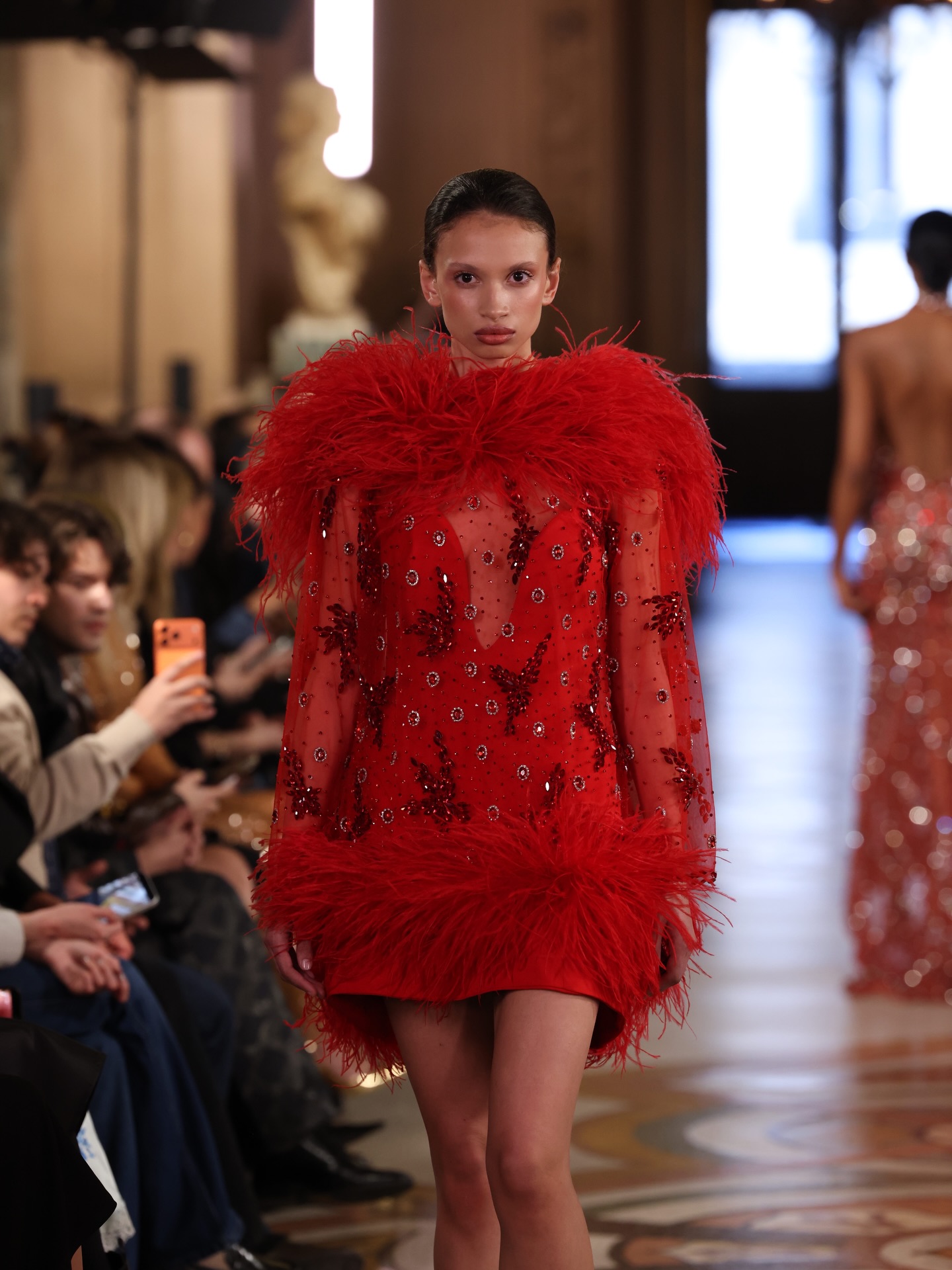
A midnight-coloured silk frock coat, interrupted by a single line of crystal down the spine, supplies the clearest reported image of Sara Mosquito’s Diamond. In its account of Aras Nancy’s Paris presentation, Splendid Edit describes that line alongside crystal at necklines, cuffs and structured bodices. The interest lies in the relationship between decoration and garment: the embellishment occupies particular positions rather than being described as an indiscriminate field of sparkle. It directs attention to the clothing’s boundaries and contours, a more useful starting point than the expansive language of brilliance, heritage, and international recognition surrounding the collection.
Mosquito’s subject is diamond-inspired luxury, but the design question is what makes that reference consequential. Shine alone cannot explain a silhouette, and a gemstone association doesn’t establish a material’s quality or a cut’s originality. The strongest proposition in the published Paris account is more specific: tailoring gives the decoration a framework, while concentrated embellishment helps articulate the form. This article focuses on that presentation and the garments it describes. It does not merge earlier releases into the Paris collection or claim first-hand examination of the clothes.
Some background helps. The Sun Nigeria’s March 2026 profile describes Sara Mosquito as an Angolan designer, economist and entrepreneur who founded the couture brand ARAS NANCY in October 2019, and calls the Diamond Collection, inspired by Angola’s diamonds, the brand’s most internationally recognised work. Those are the profile’s statements about the label, and they sit alongside, rather than inside, the Paris coverage that this article examines.
Sara Mosquito’s Diamond pairs tailored silhouettes with carefully placed crystals. Omiren Styles examines the Paris presentation’s reported design language.
Establishing the Paris collection
Diamond at the Palais Garnier
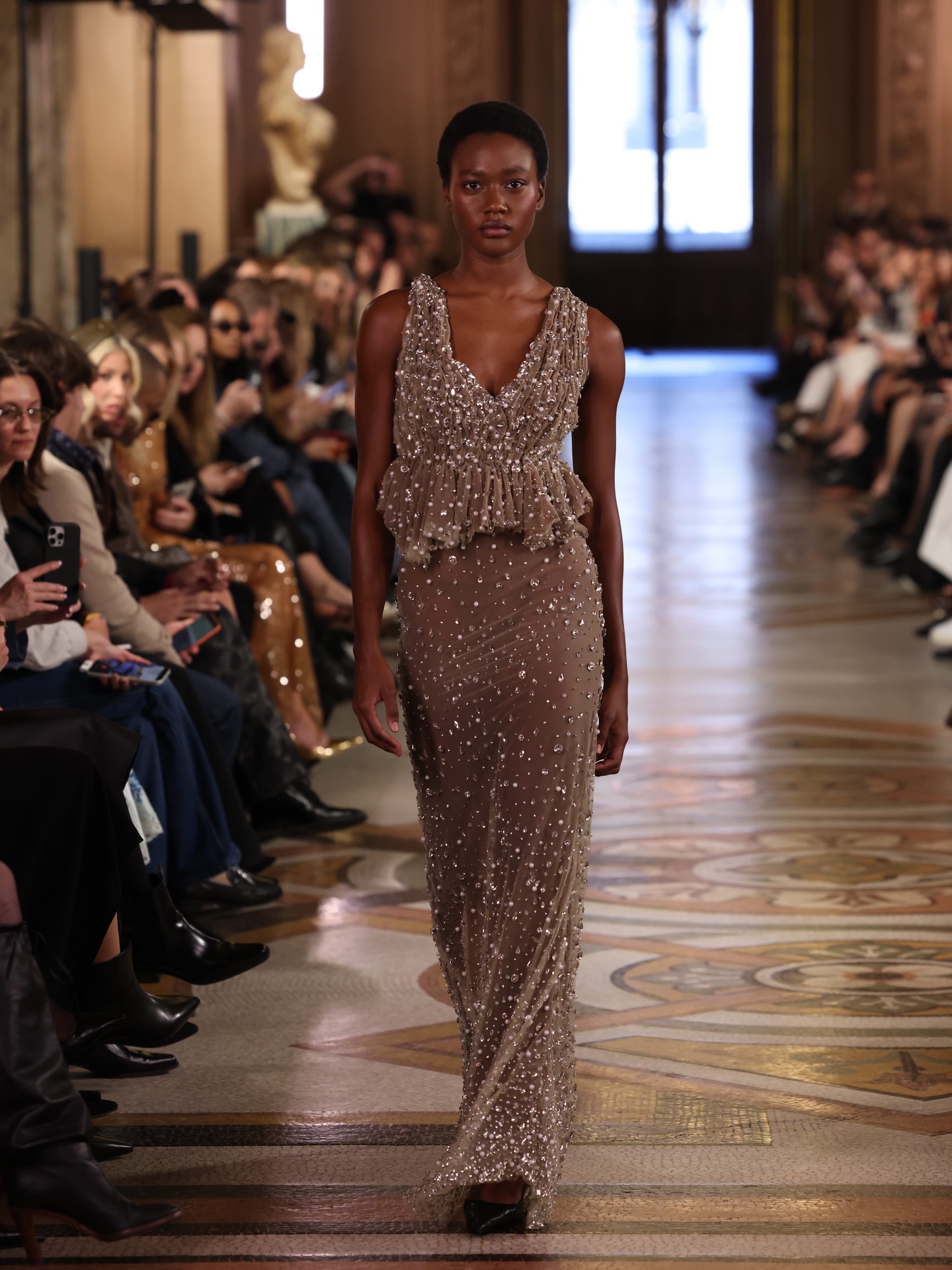
Splendid Edit identifies Mosquito’s collection as Diamond and places Aras Nancy alongside La Darrique and The Muse at the Palais Garnier on 3 March. A separate account from Fashion PR Firm dates the presentation to 3 March 2026 and also names Diamond. Those reports provide a consistent title, venue and date for the presentation assessed here. They do not provide a complete numbered look sequence, so the analysis is confined to their identifiable descriptions rather than presented as a verdict on every outfit.
The sources also require reading according to their roles. The fashion PR firm provides event coverage and credits, including creative direction and review by Aries Rivera, as well as runway coverage by Brusnika. In contrast, Splendid Edit credits the Fashion PR Firm with its photography. The two accounts therefore should not be treated as entirely separate visual records, even where their writing differs. Meanwhile, L’Officiel Monaco includes Aras Nancy in an account of Moda Productions’ Paris showcases, supporting a production association. Still, its overall team list should not be converted into individually verified credits for every aspect of Mosquito’s presentation, a discipline we explore in why the Global South never got credit for what it made.
“Sparkle is not a design decision. Where you put it is.” Omiren Styles Editorial Intelligence
The event is described here as a Paris presentation. The reviewed material does not independently confirm inclusion in the official Paris Fashion Week schedule, even though other profiles of the label describe Paris Fashion Week showings in general terms. That distinction concerns institutional attribution, not the merit of the clothes: the collection still needs to be assessed through its design decisions rather than the prestige of a calendar label.
The coat: a linear treatment of light
The coat is the most specifically described garment in the Paris review, and therefore the strongest anchor for the argument. Splendid Edit identifies its fabric as silk, its colour as midnight, and its decoration as a single line of crystal down the spine. These remain attributed descriptions, not independently verified composition or construction findings. Their critical value is nevertheless clear: a dark garment and a concentrated reflective line establish a contrast between a broad surface and a narrowly located accent, and the reported effect depends on where the decoration sits, not simply on how much of it is present.
Reading the coat this way shifts attention from preciousness to organisation. The crystal line gives the back a defined emphasis and makes the garment’s rear view part of its visual proposition. It also offers a more precise reading of the diamond theme than assuming every piece must resemble a gemstone, because here the association can operate through a controlled highlight against a darker field. That is an interpretation of the published description, not a claim about a view Omiren Styles has inspected directly.
The important judgement is correspondingly narrow. Of the Paris details described in the reviewed sources, the coat offers the most convincing explanation of how embellishment can become a compositional device, and it is specific enough to discuss without relying entirely on the collection’s symbolic narrative. It does not, however, establish the silk’s quality, the attachment method, or the precision of the internal finish. Those would be different assessments.
Necklines, cuffs and bodices
Different placements, different functions
The other reported crystal placements extend the argument while also showing its limits. Splendid Edit describes embellishment at necklines and cuffs and along structured bodices, and these locations are not equivalent. A neckline frames an opening, a cuff marks a sleeve’s termination, and a bodice presents a larger area through which decoration can relate to the torso’s shape. The account therefore suggests several scales of intervention, from a garment edge to a more substantial part of the silhouette.
That distinction is more useful than gathering every treatment beneath “sparkle”. If decoration is concentrated at an edge, that edge becomes visually important; if it follows the bodice, the question becomes its relationship to the overall shape. The reviewer calls the placement “mathematical” and the diamond motifs architectural. Those phrases reflect the reviewer’s interpretation and do not demonstrate a measured geometric system, so Omiren Styles’ reading is more restrained: the described placements suggest an attempt to connect ornament with the garment’s organisation.
The silhouette analysis is less complete than the placement analysis because the published descriptions offer fewer details about the actual shapes. “Structured bodice” does not specify a neckline, waist position, or internal support system, and “sharp cuts” conveys a critical impression without explaining the pattern-cutting. The article can therefore identify the intended relationship between structure and ornament but cannot rank several bodice designs or evaluate their fit based on those terms alone. The coat remains the stronger example because its description is more particular.
Material: what the diamond reference establishes
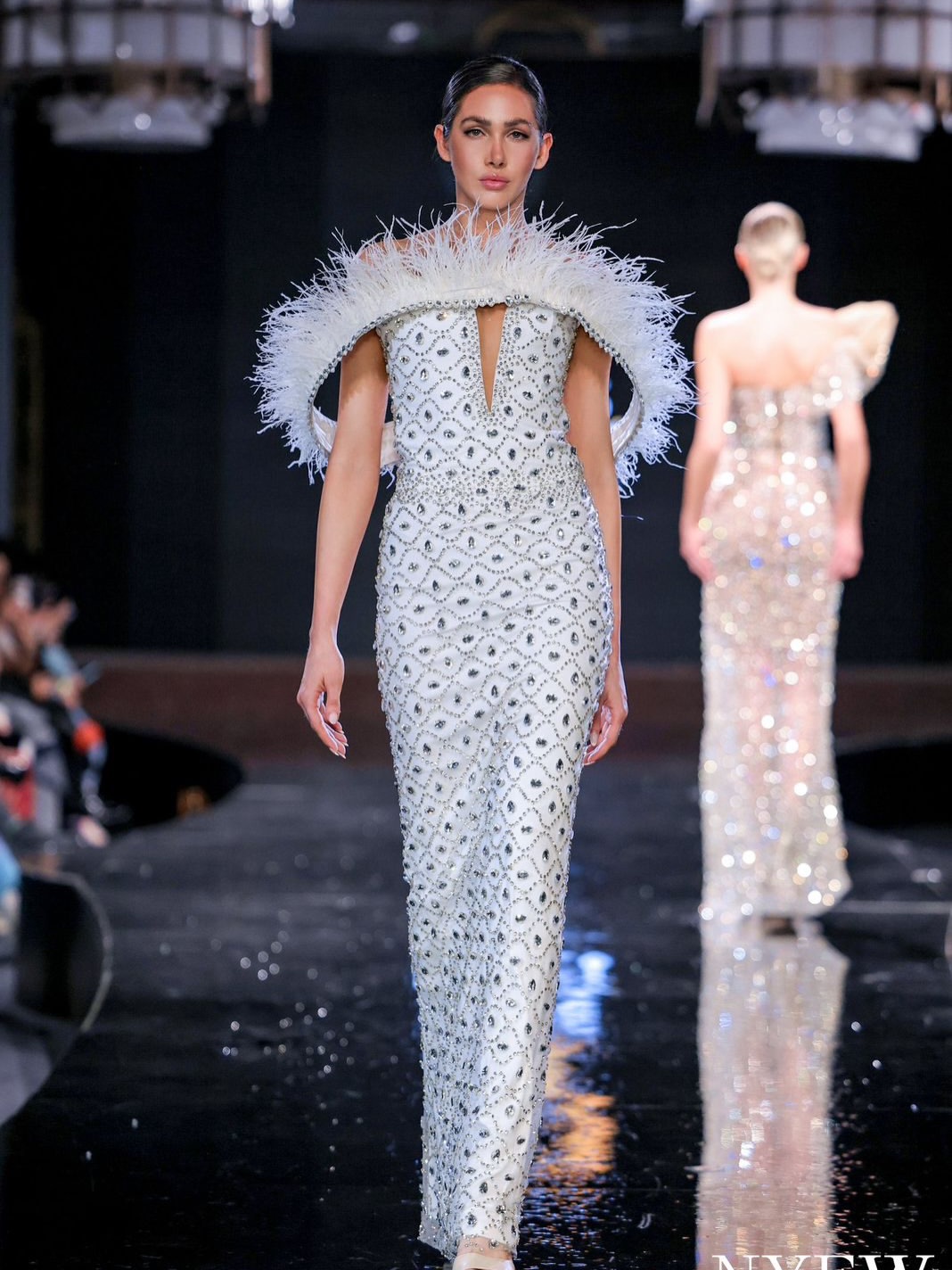
Material language needs to remain as precise as the placement argument. The Paris review identifies crystal and describes the coat as silk. The fashion PR firm uses broader language about sparkle, textures, and diamond-adorned silhouettes but does not provide component specifications that substantiate natural diamonds. The collection title and its imagery cannot resolve that difference, so this article uses “diamond-inspired” for the theme and “crystal” where that is the reported embellishment. We make the same point about composition claims generally in our guide to verifying a fashion brand’s fabric claims.
The distinction is not merely terminological. A material claim tells the reader something about the object. In contrast, a symbolic claim explains an association, and conflating them can make a collection appear more technically documented than it is. The same caution applies to promotional descriptions of couture and craftsmanship. Without garment specifications or physical inspection, the article cannot assess attachment methods, hidden support, finishing quality or performance in wear.
What the published account does support is a visual relationship between reflective components and tailored forms. That relationship is enough to start a design discussion, and it doesn’t need to be inflated into an account of gemstone provenance or exceptional construction to be interesting.
Keep the earlier presentation separate.
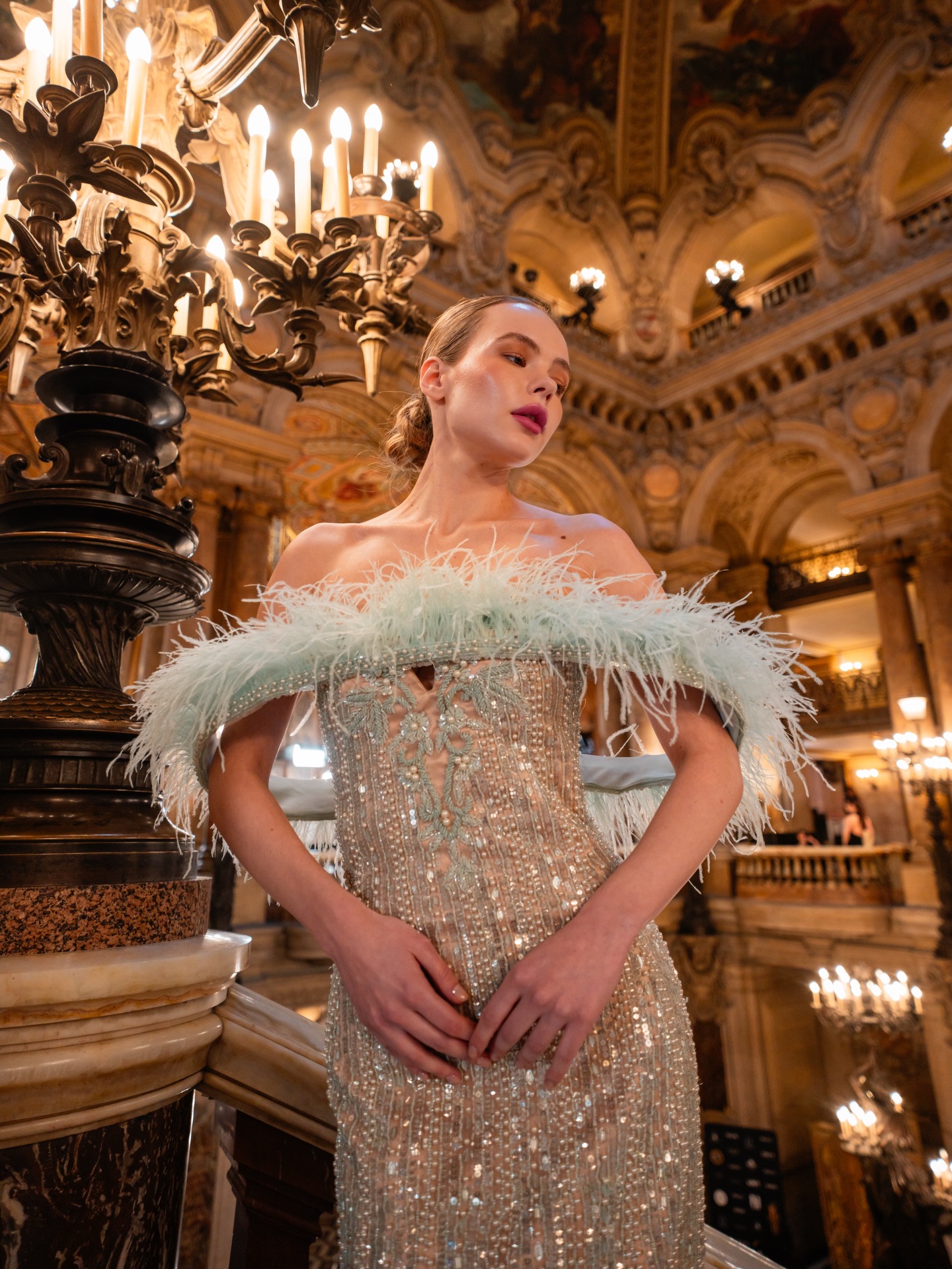
Earlier New York coverage should remain context rather than substitute evidence. The Knockturnal identifies Aras Nancy’s 12 September 2025 presentation through Art Hearts Fashion as Diamonds of Angola, describing gold lamé, crystal-beaded bodices, red gowns with capes and gem-studded white dresses. Those are more specific garment references, but their presence in an earlier account does not prove that the same pieces appeared in Paris.
They establish that Mosquito’s diamond-related vocabulary predates the March presentation. They do not establish an identical collection roster or a verified progression from expansive gowns to restrained tailoring, a conclusion that would require comparison of attributable garments from both presentations. As a result, this article does not use New York’s capes or metallic fabrics to fill the Paris record. Keeping them separate makes the assessment less comprehensive in appearance, but more accurate in substance.
The Omiren Styles Argument
Placement is the strongest documented decision.
The most persuasive aspect of the Paris account is placement. The coat’s reported crystal spine gives the reader an identifiable relationship between a garment and its embellishment, and the neckline, cuff and bodice descriptions suggest related concerns at different scales. However, they provide less detail for independent assessment. On the evidence available, the coat is therefore the strongest example, not because restraint is inherently superior, but because its design operation is most clearly articulated.
The broader collection language is less persuasive when it relies on words such as elegance, identity and brilliance without showing what those qualities mean in a particular garment. That is a limitation of the presentation’s documentation, not proof that the clothes lack substance. The distinction allows a definite judgement where evidence supports one while resisting a collection-wide endorsement built from promotional adjectives.
Diamond is most interesting when its theme becomes a decision about where attention falls. A luminous line against a dark coat explains more than the promise of luxury alone, because it connects the collection’s subject to an identifiable operation within clothing. A fuller visual record would be needed to determine how consistently Mosquito sustains that relationship, but this is the strongest basis for reading the Paris presentation: not sparkle as an automatic sign of value, but embellishment made answerable to form. For related designer coverage, visit Omiren Styles.
Also Read:
- Luanda’s Suit Is Not a Colonial Leftover: How Angolan Men Made Tailoring Their Own
- Diaspora Designers Bridging Tradition and Modern Couture
- Queen Nzinga’s Battle Dress: Royal Power and Angolan Resistance
- Craft, Culture, and Creative Power: The Designers Who Made AMVCA 2026 Africa’s Most Important Fashion Weekend
Frequently Asked Questions
Who designed Diamond?
Sara Mosquito designed the collection for Aras Nancy. Both the Paris presentation accounts and the production-focused coverage identify her with the label.
Where and when was the Paris presentation reported?
The reviewed accounts place it at the Palais Garnier on 3 March 2026. The reviewed material does not confirm inclusion in the official Paris Fashion Week schedule.
What is the most specifically described garment?
Splendid Edit describes a midnight-coloured silk frock coat with a single line of crystal down the spine. That publication attributes the material identification to it.
Is Diamond confirmed as identical to Diamonds of Angola?
No identical garment roster has been established. The Paris and earlier New York presentations are therefore treated separately.