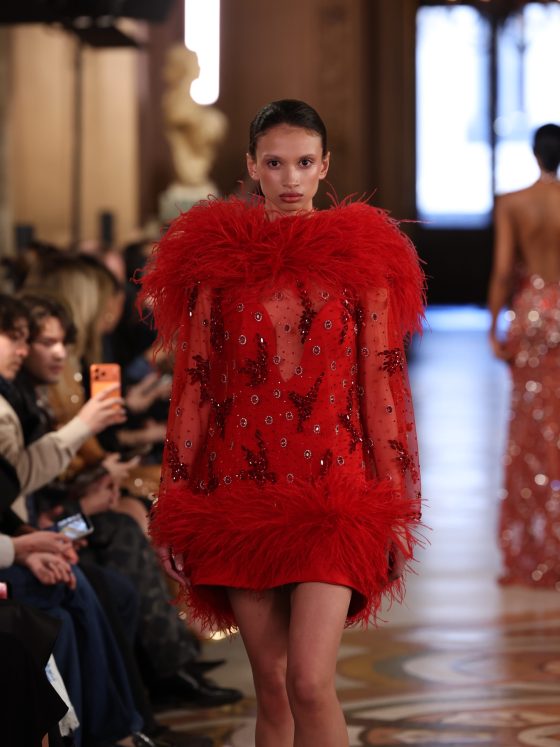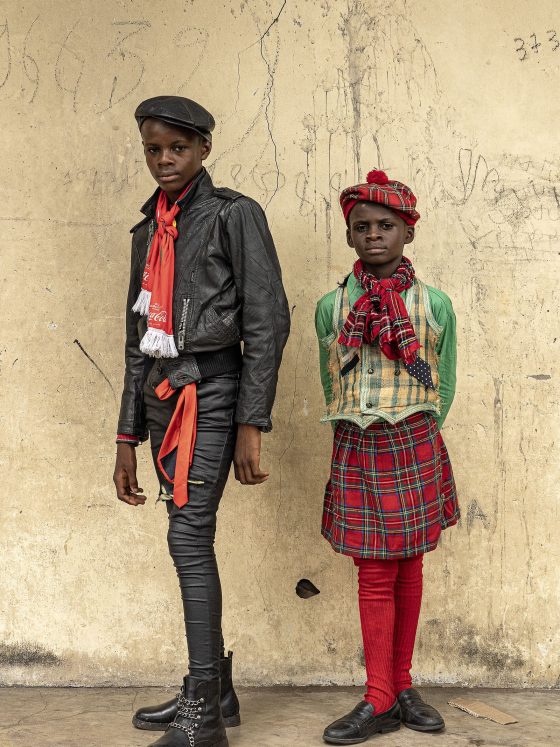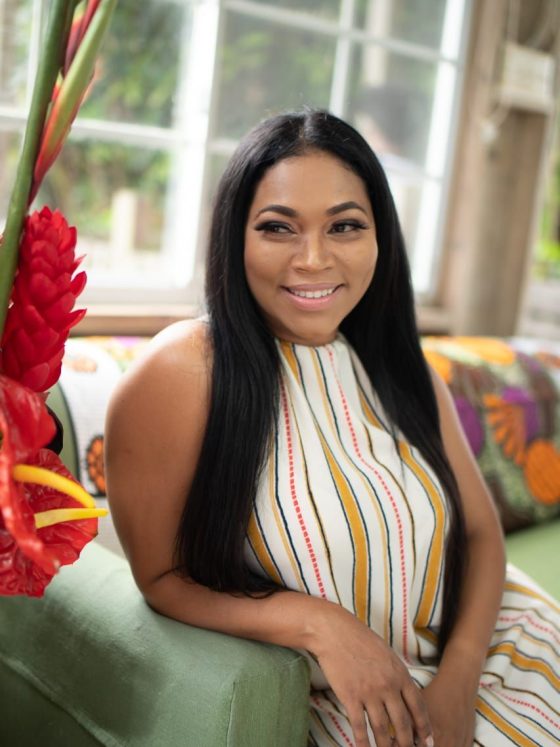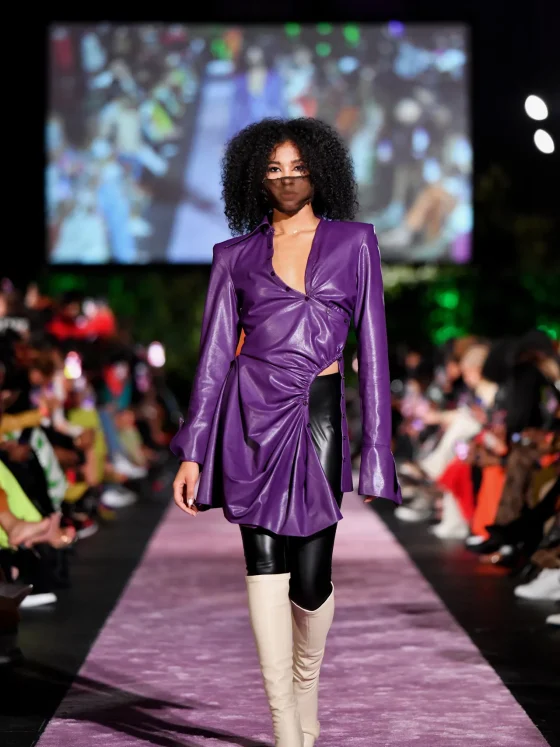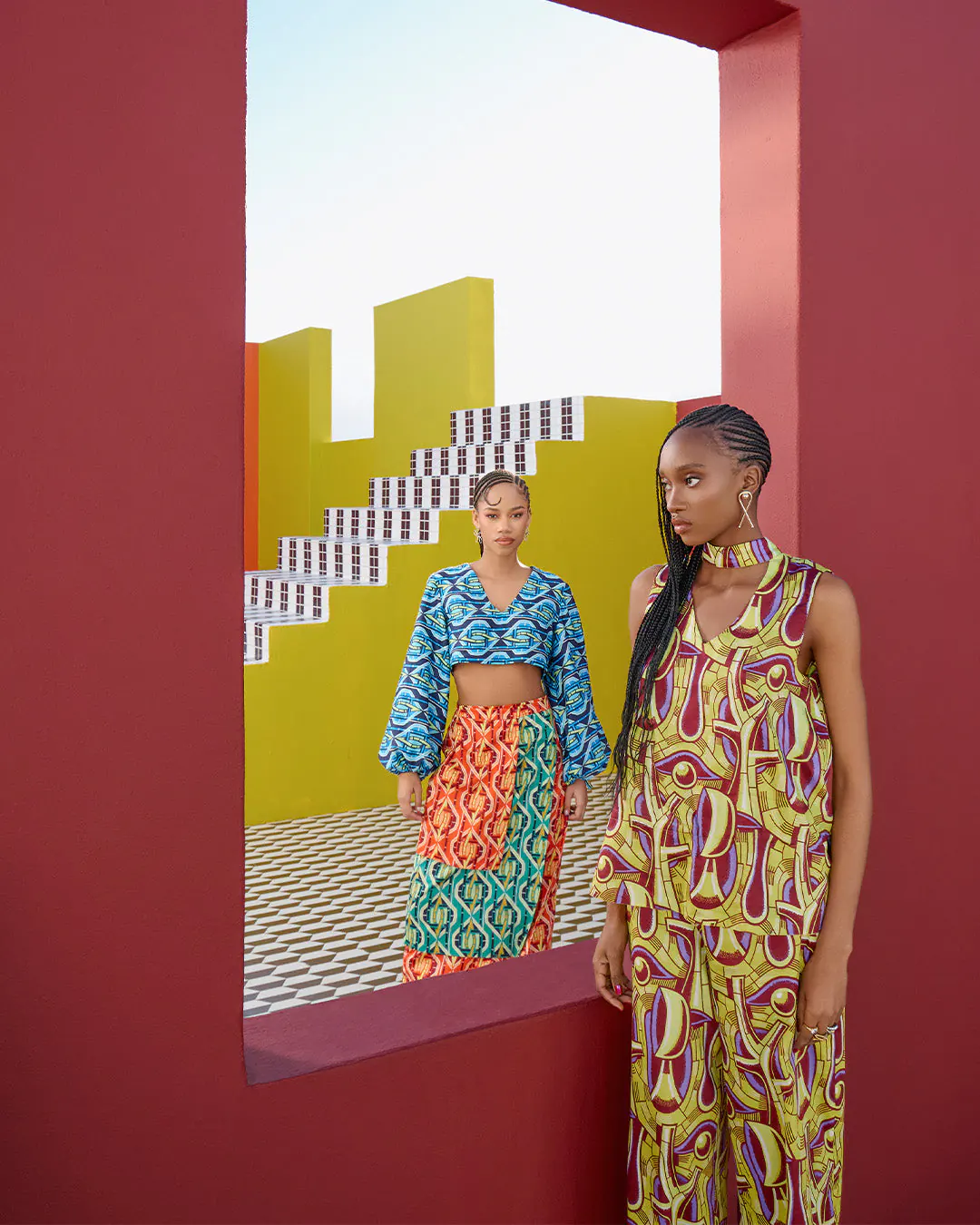
The most revealing detail in Lisa Folawiyo’s Vlisco VIBE capsule is not a print. It is a drawstring at the ankle. The Billow Trousers combine a fitted waistband with adjustable drawstring cuffs, giving their balloon silhouette a defined upper boundary and a changeable lower one. That is a more substantial design proposition than the launch’s general promise of clothes that move from work to evening: the garment includes a mechanism, and its purpose is tied to the distribution of volume.
The trousers provide a useful starting point because they make Folawiyo’s contribution identifiable. Vlisco supplies a collection of printed fabrics, and the designer supplies ways to organise them around the body. When the collaboration succeeds as a documented design proposition, the garment does more than display a textile; it establishes a relationship between surface, outline, and adjustment. When the explanation becomes less persuasive, adjectives such as “effortless”, “versatile”, and “runway-worthy” replace that specificity.
Omiren Styles’ earlier Vlisco VIBE launch article introduced the collection’s fabric offering and Folawiyo’s involvement. This reading asks a different question: which decisions in the capsule are sufficiently clear to support an independent assessment? It draws on the official capsule page, product-specific pattern information and attributed campaign descriptions. The assessment does not extend to artistry, fit, comfort, or durability because we have not inspected the complete sewing instructions or finished garments.
Omiren Styles examines Lisa Folawiyo’s Vlisco VIBE capsule through adjustable volume, garment proportion, print combinations and its accompanying sewing patterns.
Five designs, not five equivalent looks
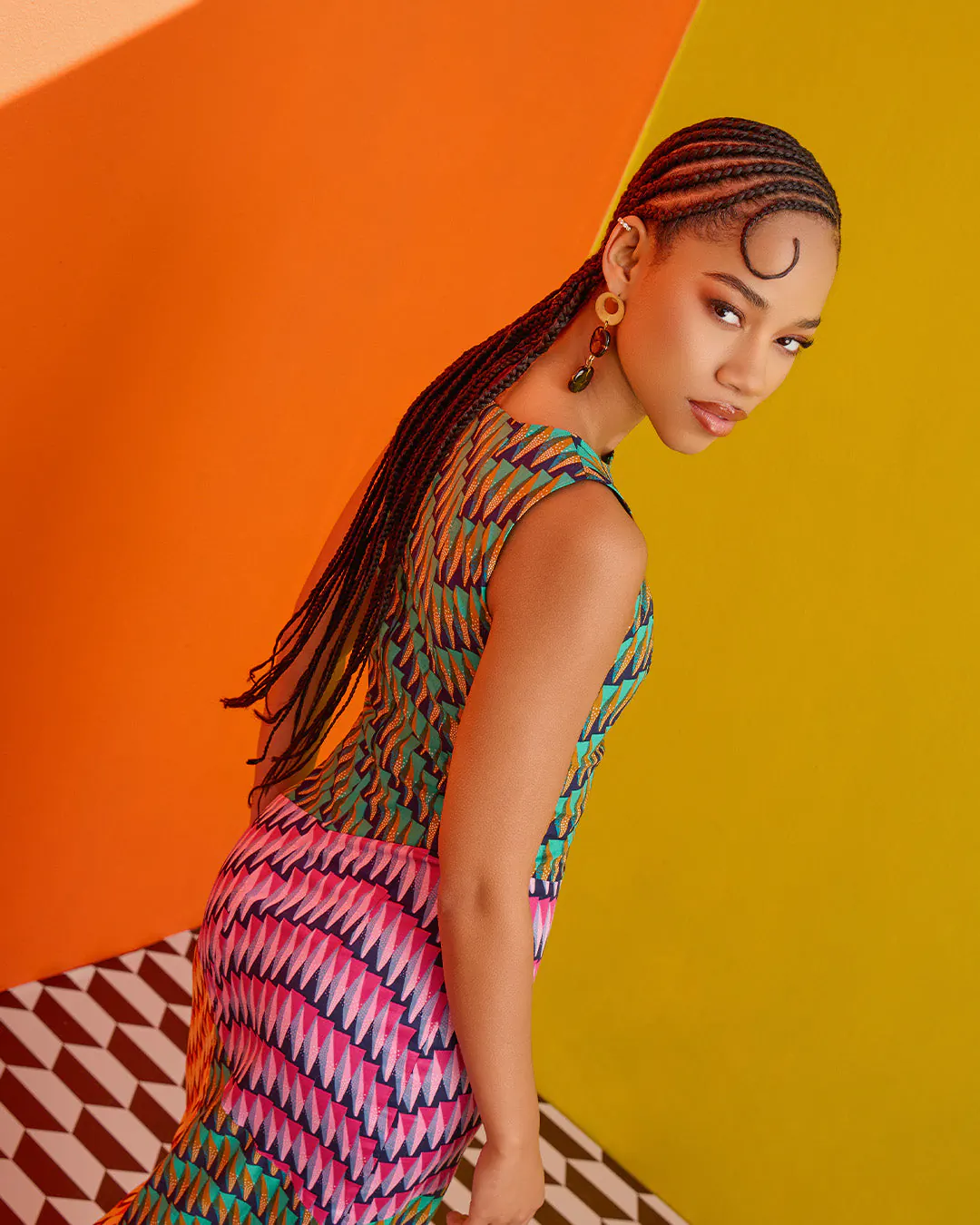
Vlisco’s capsule page names five sewing designs: the Ember Column Dress, Billow Trousers, Flare Frame Blouse, Float Blouse, and It’s a Wrap Skirt. They are not five interchangeable examples of one silhouette. The list establishes a range of garment types, while the page’s shopping groups connect specific pattern codes with fabric selections, which helps separate Folawiyo’s designs from the broader fabric launch.
For clarity, the launch collection contains four fabric designs across 18 colourways. That differs from four designs, each offered in 18 versions, a formulation that appears in one section of Omiren’s earlier announcement. The earlier article also describes fabrics that hold their shape through a full schedule and move well throughout the day. This criticism does not establish those performance claims, and we should not carry them forward as if the garments had been tested, a caution we explain in our guide to verifying a fashion brand’s fabric claims.
Folawiyo describes her intention as “something structured but with soul and considered detail”, linking discipline with expression. That is a useful statement of purpose, and the strongest way to test it is to identify where structure becomes a decision the wearer or maker can understand: a fastening, an adjustable opening, a change of length or a defined relationship between pieces.
The Billow Trousers
Volume with an adjustable boundary
The Billow Trousers pattern listing is the capsule’s clearest published construction account. Alongside the balloon silhouette and drawstring cuffs, it specifies a 3.5–4 cm-wide waistband elastic and lightweight fusible interfacing for the waistband. The kit includes a pattern and guide in sizes S–XXL and is rated by Vlisco at skill level 3/5. These details give the design more substance than the accompanying claims about elegant transitions between occasions.
The important relationship is between containment and expansion. The waistband defines the top of the garment, while the cuffs provide an adjustable endpoint for the fuller legs. In the documented design, the volume isn’t left to extend downward; it’s organised between those boundaries, making the trousers the strongest example of Folawiyo’s stated balance between structure and expression: fullness is present, but a specific device helps shape its outline.
“Fullness is easy to promise. A drawstring is what makes it a decision.” Omiren Styles Editorial Intelligence
Adjustment should not be overstated. The listing doesn’t show how every cuff setting looks, how the trousers behave on different bodies, or whether a wearer will find one configuration more comfortable. Nevertheless, the drawstrings give the claim of adaptability a concrete basis, and they distinguish the trousers from a design whose supposed versatility depends entirely on changing shoes or adding a jacket.
This is also where construction and print meet most usefully. Changes in the garment’s outline necessarily change the way its textile is presented, but the available information does not establish precise motif positions at each setting. The criticism focuses on volume control, not a verified account of how every printed element folds or aligns.
The Ember Column Dress
Length is an option; resolution is the question.
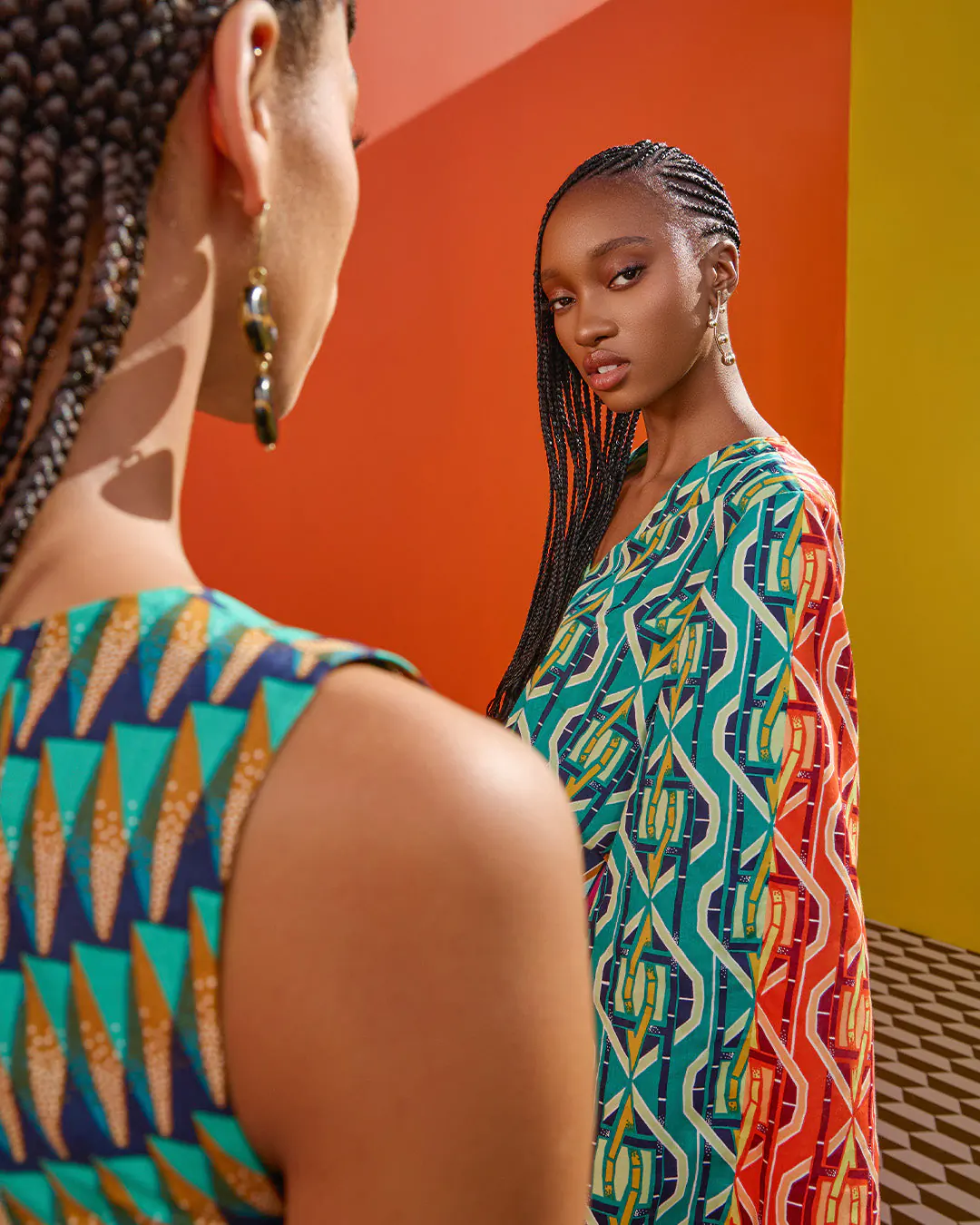
The Ember Column Dress pattern page offers a contrasting proposition. Vlisco describes it as a streamlined shift dress and says the pattern can be made in short and long versions. The required components include a concealed or invisible zipper, with its length supplied in the pattern instructions, and the kit covers sizes S–XXL and carries a higher stated skill rating of 4/5.
The difference from the trousers is significant. The Billow design changes through an adjustable boundary on the finished garment, whereas the Ember’s documented variation occurs when the maker chooses a version. These are two different meanings of adaptability, and the capsule becomes clearer when they aren’t grouped under the same promotional word.
A longer or shorter dress changes the overall proportion and the area available to the textile. That doesn’t guarantee either version is equally resolved in every print, since the design’s strength depends on how the selected fabric, length, and garment details work together. The official description establishes the option, but not a universal result.
The capsule page makes one further connection possible: its Ember shopping group associates pattern code VLXC01001.002 with three colourways from fabric family VLV0512. That is more specific than simply saying the dress can display “bold print”, because it links the fabrics Vlisco uses to the presentation. It does not, by itself, map each colourway to an individual panel or prove deliberate motif matching across seams.
Of the two fully described patterns, the trousers therefore make the stronger documented case for a distinctive design intervention. The Ember offers a recognisable form and useful length alternatives, but its published description explains less about what makes its cutting particular to Folawiyo.
From print combination to print placement
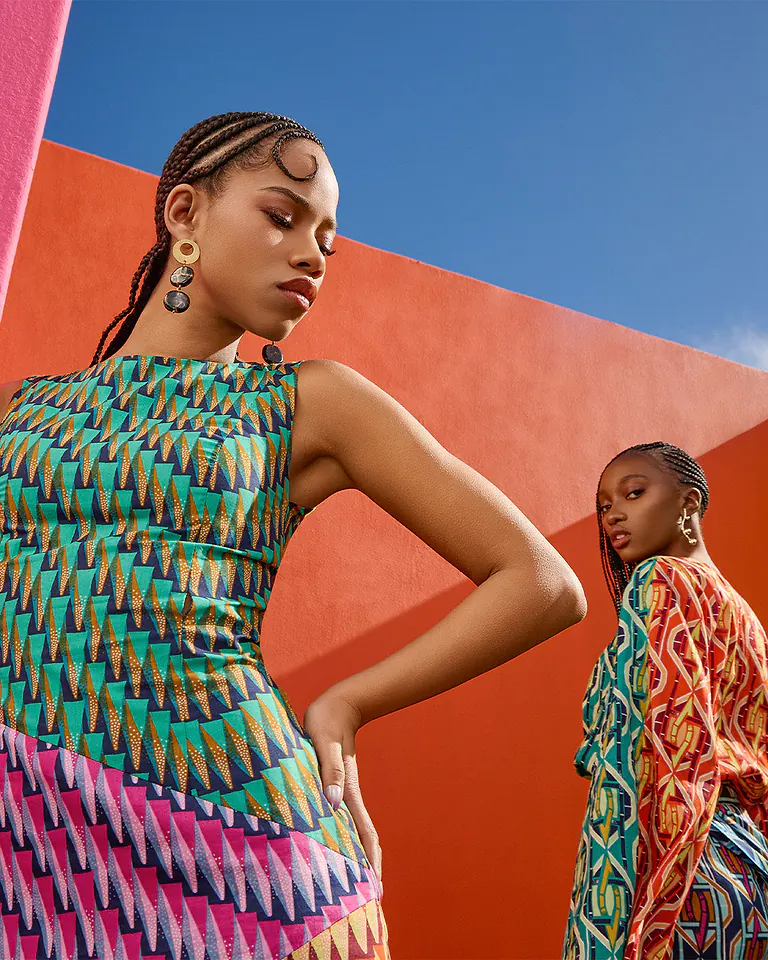
The capsule’s fabric groupings provide a firmer basis for discussing combinations than colour descriptions alone. Vlisco groups the Flare Frame Blouse and Billow Trousers pattern codes with VLV3651.001. Elsewhere, the Float Blouse and It’s a Wrap Skirt codes appear with three colourways from the VLV1846 family, so the page presents both coordinated fabric selection and variation within a print family.
Those are meaningful distinctions, but they should not be mistaken for a complete placement analysis. Selecting different colourways is one decision; positioning a dominant motif at a neckline, matching it across a join, or changing its direction between panels is another. The retrieved text establishes the shopping relationships; it does not independently establish all those finer cutting decisions.
Published campaign coverage adds descriptions of a cropped blue blouse with a multicoloured skirt and a yellow-and-burgundy top-and-trouser combination. These remain attributed descriptions, not direct Omiren observations, and they suggest different approaches to separation and coordination but cannot securely supply every look-to-pattern identification.
The critical consequence is straightforward. The capsule can be described as a range of relationships between fabric and garment, but a definitive judgement about its fine-print placement still requires detailed, attributable images. Giving a relatively ordinary division between blouse and skirt more interpretive weight than the evidence can sustain would be a mistake, and the pattern specifications provide the more convincing argument. For the wider craft of combining prints, see Omiren Styles’ coverage of West African print.
What “everyday” actually means here
Vlisco positions VIBE as fabric for modern daily life, describing fine cotton satin, relaxed drape and movement between occasions. Folawiyo similarly says she wants people to feel that the prints belong in their everyday lives. These are statements of positioning and intention, not proof that every resulting garment suits every routine.
The design evidence supports a more precise account. The capsule includes separates that can be combined, a dress that can be made in different lengths, and trousers with an adjustable component. Those choices offer routes into different wardrobes without requiring the prints to become discreet or neutral.
That is a stronger proposition than an automatic desk-to-dinner claim. A garment’s relevance depends on its wearer, setting, fit, and execution, and none of those questions is settled by a textile’s vividness or a photograph’s apparent ease. The capsule is more persuasive when “everyday” means options within a recognisable wardrobe, rather than a universal promise about use.
The sewing patterns change the collaboration.
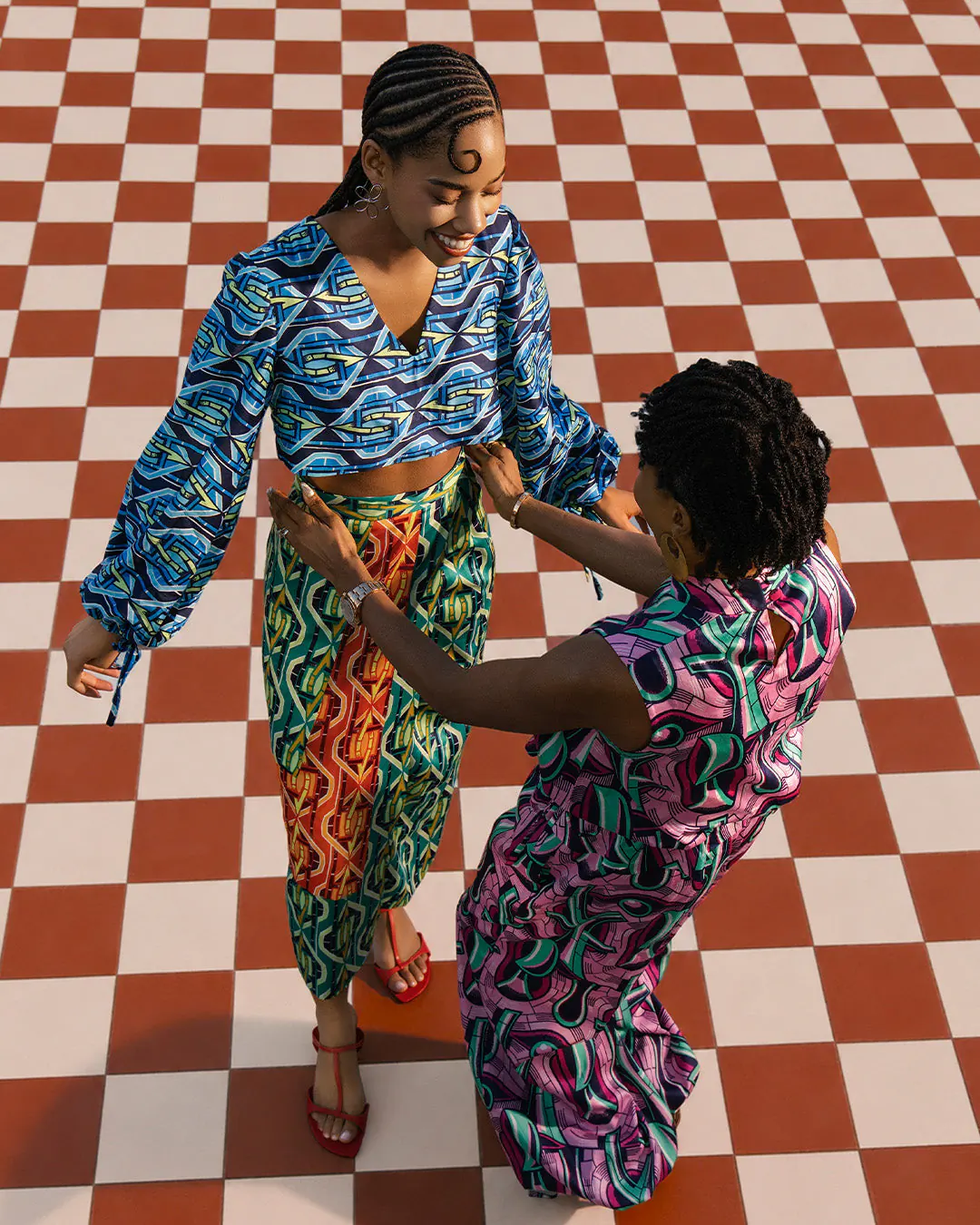
The patterns make this project more than a set of campaign samples. Vlisco’s support page confirms that selected sewing patterns are available as part of the VIBE collection, each in multiple sizes, so that a tailor can make the featured design. For the Billow Trousers and Ember Column Dress, the product pages identify the pattern, guide, size range, stated skill level, and required materials. This is a defined route to making, although the complete instructions have not been reviewed here.
It also distributes responsibility for the final garment. Folawiyo authors the design framework, while fabric selection and execution influence the resulting object, and the same pattern cannot guarantee identical fit or finishing in every realisation. That is not a defect in the collaboration but part of what separates a sewing-pattern offer from selling a finished garment.
The specifications also qualify the launch’s accessible, effortless tone. A pattern rated 4/5 and requiring a concealed zipper represents a different making proposition from simply buying a cut of fabric, so describe accessibility in concrete terms: the availability of a design and instructions, not the assumption that every customer can reproduce the campaign result without expertise.
The Omiren Styles Argument
The capsule’s strongest documented decision is adjustability, most clearly expressed in the Billow Trousers. Their waistband and drawstring cuffs explain how volume is organised and where the wearer can intervene. The Ember Column Dress offers a different kind of flexibility through length choices, but its published account is less distinctive as an explanation of form.
That ranking matters. Independent criticism should not give every design an equally flattering role simply because the launch presents them together. Here, the trousers provide the clearest link between intention and mechanism. At the same time, the dress’s contribution is more conventional, and the evidence remains insufficient for a confident verdict on fine motif placement across the capsule.
Folawiyo’s collaboration is consequently most interesting not as proof that printed fabric can enter daily life, but as a set of proposed ways to organise it. Its best decisions are tangible: a defined waist, a gathered endpoint, a chosen length, a pattern someone can make. Those particulars carry more critical weight than the promise of effortless versatility, and they give the clothes a more substantial identity beyond the launch. More of our print coverage is at Omiren Styles.
Also Read:
- Black Luxury Entrepreneurs and Fashion Brands
- Mixing Prints Like a Pro: The 2026 Guide to Afrocentric Luxury Style
- Lagos Is the New Fashion Capital Nobody in the West Will Officially Admit
- African Textile Reporting: 8 Editorial Shortcuts That Need Fact-Checking
Frequently Asked Questions
What are the five garment designs?
The capsule names the Ember Column Dress, Billow Trousers, Flare Frame Blouse, Float Blouse, and It’s a Wrap Skirt. The fabric launch contains four designs across 18 colourways.
What makes the Billow Trousers adjustable?
Vlisco specifies drawstring cuffs alongside a fitted waistband. The pattern materials also include waistband elastic and lightweight fusible interfacing.
Can the Ember Column Dress be made in different lengths?
Yes. Its official pattern description specifies short and long versions.
Has Omiren Styles assessed the finished garments’ quality?
No. This article evaluates documented design features and distinguishes them from claims that would require physical inspection, direct visual detail assessment or wear testing.