The most revealing clothes in Priya Ahluwalia’s account of her wardrobe are not the pieces she names as collection highlights. They are the ones she says she wore repeatedly. Looking back on 2024, the London designer singled out her label’s spring/summer 2024 low-rise jeans and autumn/winter 2023 Ongoye cardigan. The reason was direct: the jeans fitted her well, she felt comfortable in the combination, and the cardigan had become a regular choice. The brand’s accompanying photographs depict those two garments, giving the statement an identifiable outfit rather than leaving it as an abstract preference.
That is a useful starting point for a working wardrobe. Clothing doesn’t need to disappear into anonymity to become familiar, and a designer’s daily choices don’t necessarily resemble a succession of runway statements. In Ahluwalia’s account, repetition is part of the appeal. She earned the garments’ place through wearing them, not simply through their status as products she had created, and that is a more honest basis for a style feature than a list of essentials.
Her broader preference was equally clear: menswear during the day and womenswear in the evening. A September 2025 interview echoed that distinction while adding an important qualification: sometimes she mixes both. Read together, these statements describe a personal dressing tendency rather than a rigid division between work and leisure. They also provide a more useful account of her style than a list of supposedly essential pieces every creative should own. We looked at the wider picture of her practice in our profile of Priya Ahluwalia and the design intelligence of double diaspora, and this piece stays on a narrower question: what she says she wears.
Priya Ahluwalia’s published wardrobe accounts reveal the jeans, cardigan and occasion dressing behind one London designer’s own personal style.
The repeat outfit
Low-rise jeans and the Ongoye cardigan
In the December 2024 interview published by her brand, Ahluwalia identifies the two pieces when asked what she wore most that year. “The menswear from Ahluwalia has been my go-to,” she says, before naming the jeans and cardigan. “I just feel so comfortable in them.” The answer is unusually useful because it connects specific garments to a clear reason they stayed in use. Most wardrobe stories stop at the item; this one gets to the reason, and it’s a simple one many readers will recognise from their own cupboards.
The identification should remain as specific as the source permits. Ahluwalia calls the trousers her SS24 low-rise jeans, but the label has more than one low-rise denim design from that season. Without a secure product match, it would be misleading to attach the construction or material description of one retail listing to her pair. The wardrobe evidence is already sufficient for the central point: she names the jeans, explains their fit and is pictured with the cardigan. It doesn’t need an invented specification to be informative.
“A repeated outfit is the plainest evidence of what a wardrobe is for.” Omiren Styles Editorial Intelligence
Her explanation also separates personal experience from a product guarantee. That she finds the clothes comfortable says more about how she wears them than how they will feel on every wearer. The interest here is the decision itself. She returns to a fit she likes and a layer she wears often, and the combination has become a dependable part of her wardrobe without being presented as a universal answer to getting dressed.
Day and evening are different registers.
Ahluwalia’s preference for menswear in the day and womenswear in the evening appears in both her year-end account and her September 2025 interview with SheerLuxe. In the latter, she says her personal style is “amplified through the brand” and describes being drawn to colour, texture and shape. The continuity between the two accounts is more telling than a hypothetical seven-day outfit diary: it suggests a recurring way of choosing clothes, not a single polished answer for one publication.
The qualification that she sometimes mixes menswear and womenswear is important. It prevents the distinction from becoming a prescribed transformation at a particular hour. These categories are resources she uses, not rules she says everyone should follow. Nor does “menswear in the day” establish that every daytime outfit is relaxed, or that evening dressing is always formal. Her statement describes her own tendency; readers still need to identify the garments and occasions individually.
For readers, the useful observation is not to imitate the categories. It is to notice that one wardrobe can support different registers without requiring an entirely separate identity for each. Ahluwalia’s repeated cardigan-and-jeans combination and her interest in colour, texture and shape are not presented as opposing commitments. Familiar clothes can remain expressive, while a more public occasion may call for a different kind of presentation.
Where she works
The same 2024 interview places Ahluwalia’s working environment in central London. Asked where she feels inspired or at home when designing, she answers, “Honestly, in my office.” She says she’s made it a place she enjoys working, while also describing inspiration from outside activities directly connected to the job, including a visit to the V&A with a colleague. That is the setting of her practice, and it sits comfortably beside the repeat outfit as context.
The sources don’t say what she wore for that museum visit or on any particular office day, so the two supported facts, a repeat outfit and an office-based working life, stay side by side rather than merging into one scene. The picture is more modest than a timetable of meetings and fittings, and it is also more useful. Her wardrobe preferences exist alongside a working life that includes an office and cultural visits, and a real wardrobe always looks a little incomplete from the outside.
When the work becomes public
A dress for the Fashion Awards
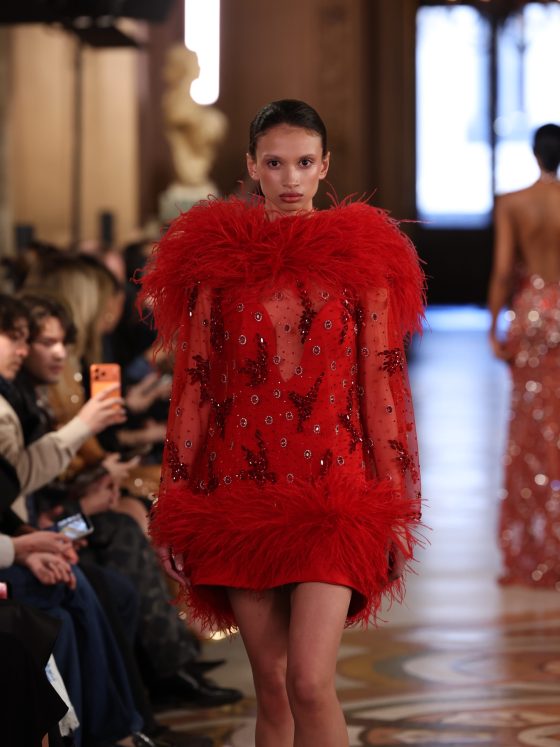
A different part of Ahluwalia’s wardrobe is documented at the 2024 Fashion Awards. Marie Claire UK identifies her wearing a red dress from her spring/summer 2025 collection when she accepted the New Establishment Menswear award, and 10 Magazine’s report on the ceremony confirms the award itself. Her brand’s year-end account also records the win and includes images of her at the event. This provides a specific public occasion and a description of the attributable garment, rather than a generic claim that she “dresses up for evening”.
The event belongs to her professional life, but it is not equivalent to a working day in the office. Receiving an award creates a different form of visibility. The red dress documents one response to that occasion; the cardigan and jeans document a repeatedly worn combination. Neither is more authentic simply because it is more ordinary or more public, and the sources don’t give her reasons for choosing the dress, so we leave those reasons alone.
Wearing her own label also places Ahluwalia in a distinctive position. Her wardrobe and her business overlap. That does not invalidate what she says about fit or preference, but it makes the source context relevant: the year-end interview is published by the brand whose clothes she is wearing. The later SheerLuxe interview provides a separate account in which she again describes the relationship between her personal style and the label, so the connection is supported. However, it is not independent product testing.
Wearing the work without becoming a campaign
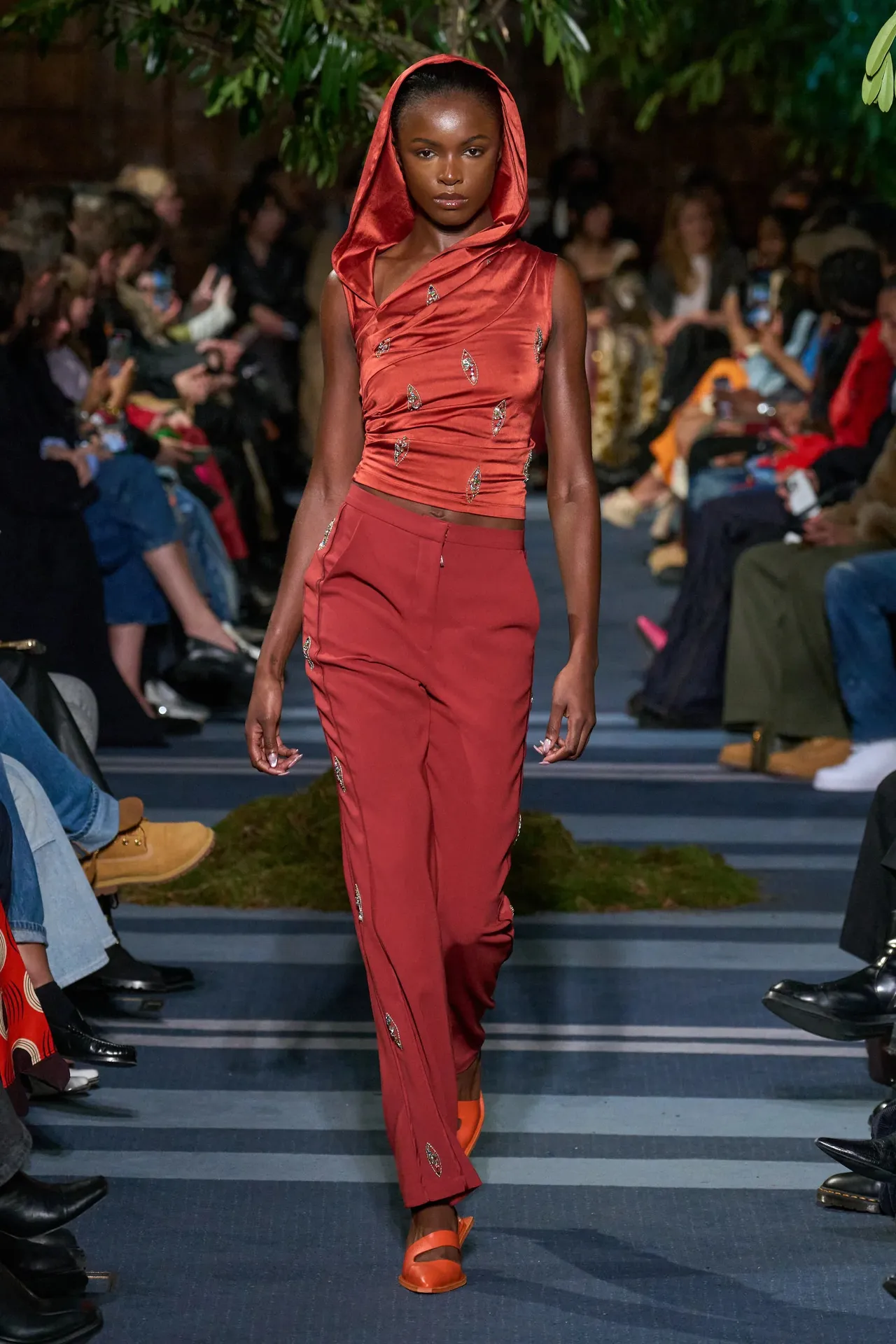
The revealing distinction is between favourite designs and frequently worn garments. In the 2025 interview, Ahluwalia names an autumn/winter 2025 blue gown and the look created for Aimee Lou Wood at the Met Gala among pieces that stand out to her. Those are statements about work she values. They don’t prove both belong to her working wardrobe, and the difference matters because it keeps a collection retrospective from passing itself off as a wardrobe story.
By contrast, the earlier question about what she wore most produces the jeans and cardigan. One answer concerns creative achievement; the other concerns personal use. It also makes room for a less spectacular form of judgement. A designer may value a piece for its storytelling, while repeatedly choosing another because its fit feels right. That is not an inconsistency. It is evidence that making clothes and living in them involve overlapping, but not identical, decisions.
The Omiren Styles Argument
The most persuasive part of this wardrobe account is repetition. Ahluwalia identifies two garments she returned to and gives reasons grounded in how she wore them. A separately documented awards appearance shows another register of professional dressing, but it does not replace that repeated use as the clearest evidence of what works for her.
This is not a model of how London creatives dress, still less a general statement about diaspora style. It is one designer’s published account, shaped partly through her own brand’s platform and partly through external interviews. Its value lies in the specificity of the choices: named jeans, a named cardigan, a stated fit preference and an identified occasion dress.
The practical insight is correspondingly limited but substantial. A working wardrobe can contain both familiar repetition and public presentation, and the relationship between them doesn’t have to resolve into a capsule formula. In Ahluwalia’s account, clothes become useful through the reasons she returns to them and the situations in which she is documented wearing them, not because they conform to a universal definition of professional style. More of our fashion coverage is at Omiren Styles.
Also Read:
- African and Diaspora Fashion in London: Designers, Institutions and Community
- Diaspora Fashion Diplomacy in Britain: How African and Caribbean Style Shapes Culture and Identity
- Black Designers Leading Sustainability in Luxury Fashion
- From Lagos to London: How the Diaspora Is Styling Adire for the Modern City
Frequently Asked Questions
Whose wardrobe does this feature examine?
Designer Priya Ahluwalia’s. It draws on her published accounts from December 2024 and September 2025, as well as attributed coverage of her 2024 Fashion Awards appearance.
Which pieces did she identify as frequently worn?
Her label’s SS24 low-rise jeans and AW23 Ongoye cardigan. She cited fit and comfort as reasons for the choice.
Was this an observed week or an original interview?
No. It is a source-based personal-style feature. It does not reconstruct unobserved working days or claim direct testimony obtained by Omiren.
Does her wardrobe establish a London workwear rule?
No. Her choices reflect her preferences and documented appearances, not a standard for a city, profession, or community.