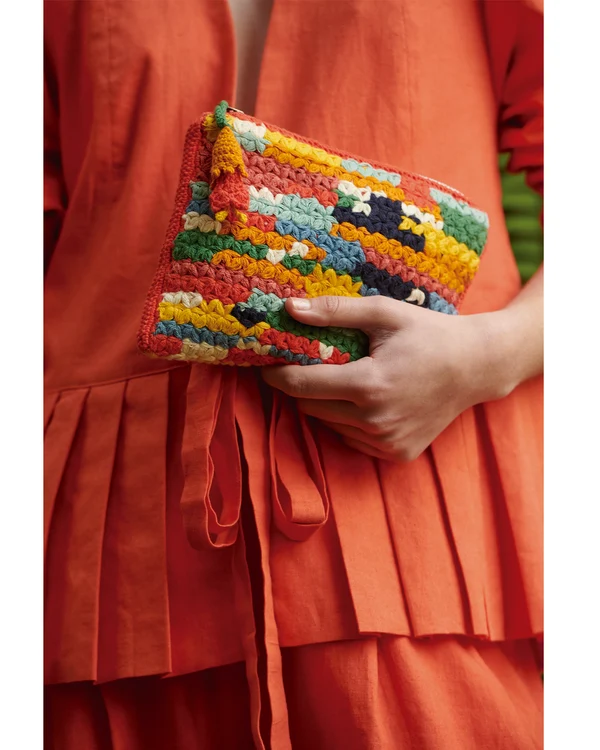
ESCVDO’s Geranio Tote Bag Multi is presented first as a textile object: hand-knitted, made from cotton and associated with the rainbow palette of traditional Andean garments. The brand calls it colourful and practical, combining visual character with everyday usefulness. Those qualities need not compete, but they require different evidence. Colour inspiration and making credits explain the tote’s identity, while dimensions, carrying features and maintenance explain how that identity translates into an object someone can use.
The most useful way to read the Geranio is through that relationship. Its documented construction isn’t an incidental detail attached to a generic bag description, because hand knitting is central to how ESCVDO identifies the product, and the brand names it a collaboration with Knitting Hope rather than leaving its making entirely anonymous. Yet the product account focuses more on textile and production than on carrying specifications. That doesn’t mean the bag itself is weak; it means you can assess the connection between construction and function only within clearly defined limits.
A little brand context helps. NET-A-PORTER’s ESCVDO designer page describes the label as founded by sisters Chiara and Giuliana Macchiavello, working with local artisans across Peru on knitting, weaving and embroidery, and says about 300 artisans, roughly 95% of them women, are employed. That is the retailer’s account of the brand, and it frames the Geranio without describing it.
ESCVDO’s Geranio Tote pairs hand-knitted cotton with an Andean-inspired palette. Omiren Styles examines its documented construction, making credits and care guidance.
The selected Geranio Tote
What is actually specified
The official Geranio Tote Bag Multi listing identifies the composition as 100% cotton and describes the yarn as premium Peruvian cotton. It specifies hand-knitted construction and the colour as Multi, and ESCVDO’s collection pages also list the same product as “hand knitted tote”, reinforcing the product-specific terminology. “Premium” remains the brand’s assessment of its material, not an independently tested grade.
Those facts establish a clear starting point without supplying a complete technical specification. The listing does not identify a stitch pattern, gauge, yarn count, or assembly method, and the reviewed description does not explain how the handles connect to the body, whether the base has additional support, or whether the interior contains a lining. These are distinct questions: fibre composition describes what the textile is made from, while construction details explain how its parts become a carrying object.
“Handmade tells you how a bag began. Measurements tell you whether it will carry your day.” Omiren Styles Editorial Intelligence
The distinction matters because “hand-knitted” should not be asked to answer every practical question. It identifies a making category, but it alone does not establish a load limit, the behaviour of the opening when filled, or the degree of support provided by the base. The article therefore retains the construction claim while withholding performance conclusions that would require additional evidence.
Construction and intended function
A textile identity, not yet a carrying specification
ESCVDO’s description positions the Geranio as a practical tote, but does not define that practicality through a particular intended load. The reviewed official listing does not provide numerical height, width, depth or handle drop, and it also does not state empty weight or carrying capacity. Consequently, there is no sound basis to describe it as a laptop bag, a grocery carrier, or a particular size of daily companion, because those uses depend on specifications that have not been established.
That is the principal unresolved connection between construction and function. A documented account of the body, opening, base and handles would explain how the knitted object is organised for carrying, and measurements would then allow its proportions to be considered against an intended task. Without them, the article can identify the bag’s textile construction but cannot responsibly describe the carrying system in detail.
The appropriate distinction is between an incomplete specification and a demonstrated design shortcoming. The available information does not show that the tote lacks useful capacity, support or organisation; it simply does not establish those features. Likewise, the absence of a lining, pocket, or closure description does not prove those features are absent, and a product assessment should not fill omissions with praise or criticism.
Colour and the relationship to clothing
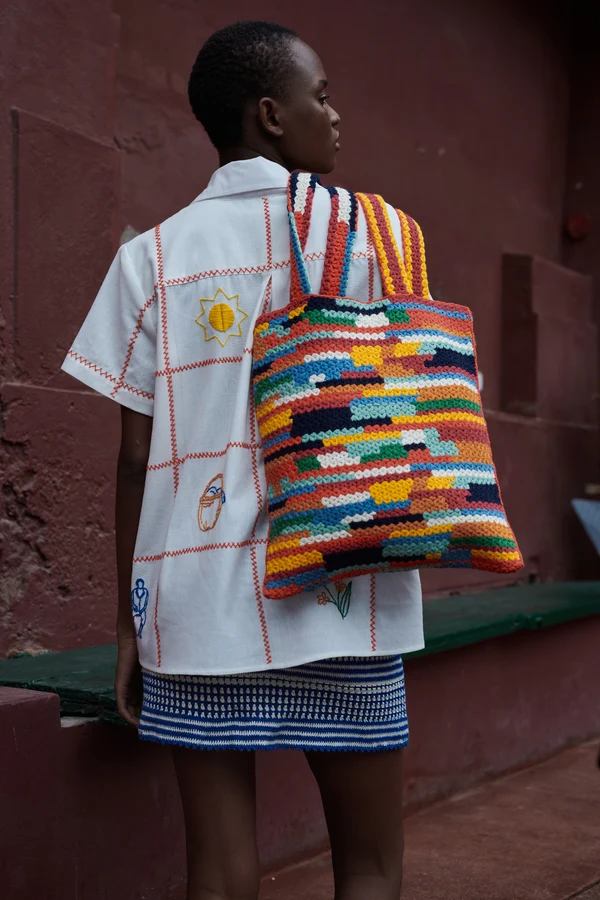
ESCVDO attributes the Geranio’s palette to the rainbow colours of traditional Andean garments. That gives the tote an explicitly stated relationship to clothing rather than describing it solely through the conventions of luggage or leather goods. The reference is broad, since the listing does not identify a particular community, garment, historical period or textile as its direct source. It should therefore remain an attributed colour inspiration, not become a claim that this bag reproduces a specific tradition.
This is an important distinction for a culture-led fashion article. A reference can inform an object without making that object representative of an entire region, and a palette’s source does not automatically establish a technique’s source. The brand’s Andean colour reference and its hand-knitting description are two documented elements of the product account, and their relationship should not be enlarged into an undocumented technical lineage.
For this documentary assessment, the strongest supported reading is that ESCVDO places textile identity at the centre of the tote’s proposition. The palette and making description explain why the object is presented as more than an anonymous cotton carrier. Assessing whether the colour arrangement succeeds visually would require a separate, attributable image analysis rather than an interpretation based solely on the product’s descriptive language.
Making credits
The Knitting Hope collaboration
The Geranio listing names Knitting Hope as a collaborator and describes it as a Mision Huascaran initiative intended to train and empower women from rural, low-income areas. It also states that 137 artisans form part of the team behind some of ESCVDO’s signature pieces. That wording provides a named production relationship, but its scope needs preserving: it does not say that 137 people worked on this tote, nor does it identify the maker of an individual bag.
Misión Huascarán’s Knitting Hope page describes a nonprofit association that trains rural women from small villages at the foothills of Huascarán, runs a textile workshop for its knitters, and counts more than 100 artisans. It lists ESCVDO among its strategic alliances but gives no further detail about the partnership, so it corroborates the relationship without describing the Geranio.
The collaboration belongs in the article because it makes part of the production account traceable. “Handmade” can otherwise function as an atmosphere rather than a useful credit, and naming an initiative gives the reader a more specific account of who is involved, even though it does not establish every production term or independently measure the programme’s outcomes. We set out the same standard in our note on how heritage fashion pages should credit makers.
That credit should neither replace design analysis nor be dismissed because it does not answer a load-bearing question. Making, authorship and use are related, but separate aspects of the object, and the tote can have a clearly documented collaboration while still needing fuller specifications for a practical assessment. Keeping those categories distinct makes the account more informative than treating craft as an automatic guarantee of quality.
Care and repeated ownership
Care is the part of the product information that most directly addresses life beyond the initial purchase. The listing recommends dry cleaning and hand-washing with lukewarm water and a delicate cleaning product. It advises against wringing and directs flat drying, reshaping, and avoiding heat, tumble drying, and hanging; because the page also contains general textile-care language, ESCVDO should confirm whether the full routine applies to the tote before cleaning.
Even with that qualification, the guidance offers a relevant ownership consideration: the published routine is not a machine-wash-and-tumble-dry process. Anyone assessing the tote for frequent use should consider maintenance alongside its appearance and stated material, because everyday usefulness includes what happens after the bag needs cleaning, not just what it can carry.
These instructions do not indicate fragility, however. Advice to dry a textile flat does not establish how the bag behaves under an ordinary load, and no repeated-washing or shape-retention test has been conducted for this article. The useful conclusion is limited to the care expectations communicated on the page, and the instructions should inform the practical assessment without being turned into an untested prediction about stretching or durability.
Material claims must stay with the product.

The tote’s stated 100% cotton composition should remain the material basis of this article. ESCVDO separately describes the Geranio Pouch Multi as made from upcycled deadstock pure Pima cotton. That more specific description belongs to the pouch, and a shared Geranio name does not transfer it to the tote. The reviewed tote listing does not establish the same Pima or deadstock claim.
The distinction prevents an attractive but unsupported material narrative from accumulating around the bag. Cotton composition alone also does not establish comparative environmental performance, service life, or wear resistance, and those questions require appropriate evidence. There is no reason to inflate the tote’s documented material to take its design seriously, a habit we caution against in our guide to verifying a fashion brand’s fabric claims.
The Omiren Styles Argument
Geranio’s strongest documented quality is its specificity about parts of its identity: cotton composition, hand-knitted making, an attributed palette, and a named collaboration. Those details give the product a clearer account than a generic claim of artisanal character. They explain what ESCVDO wants the object to express and provide a foundation for further examination.
The connection to everyday function remains less fully specified. Construction terminology and care guidance are available, but we cannot assess it without clear dimensions and a clear organisation of the carrying features. The conclusion is therefore not that the tote performs badly or suits only a narrow use; it is that a confident use recommendation would exceed the evidence.
The next useful information is straightforward: measured proportions and a clear account of the body, base, opening and handles. Those details would connect the textile proposition to the practical one. Until then, the Geranio can be described accurately as a hand-knitted cotton tote with documented making credits, but its durability and carrying capacity haven’t been verified. Explore further designer and accessory coverage at Omiren Styles.
Also Read:
- Accessories That Carry Our History: Bags and Jewellery as Living Heritage
- Oaxacan Weaving Is Not a Trend. It Is a Textile System.
- Afro-Peruvian Chincha Influences in Contemporary Peruvian Fashion
- The High-End Bead Revolution: Redefining Luxury Accessories
Frequently Asked Questions
What is the Geranio Tote Bag Multi made from?
ESCVDO states 100% cotton and describes it as premium Peruvian cotton. The reviewed tote listing does not specify whether it uses Pima or deadstock cotton.
Who is credited with making it?
ESCVDO names Knitting Hope, associated with Mision Huascaran, as its collaborator for Geranio totes. The listing does not identify an individual maker for each bag.
Is the tote knitted or woven?
Its product-specific description identifies it as hand-knitted. The listing does not provide a detailed stitch or assembly specification.
Can its dimensions or carrying capacity be confirmed here?
No. The reviewed sources do not establish those figures. They should be obtained for the exact Multi version before making a capacity-dependent purchase decision.