At South African Fashion Week, some labels come and go with the season. Black Coffee is not one of them. Jacques van der Watt’s label has been a presence at SAFW since the late 1990s, and its return for the AW27 collections – running 20 to 25 October 2026 at The Forum, Hyde Park Corner, Johannesburg – is not an arrival so much as a continuation. The question worth asking before any AW27 collection is shown is: what does a Black Coffee collection actually do, and how has that changed across twenty-seven years?
The answer is more specific than ‘architectural’ fashion, though that word follows the label everywhere. Black Coffee’s practice is construction-led, which is a more precise description. It means the garment’s logic begins with how it is put together: the pattern, the seam placement, the way panels are cut and assembled. The design does not start with a mood board or a reference image and work backwards to a construction method. It starts with the construction and works outward to what that construction produces on the body.
The SAFW profile describes the label’s approach as exploring the relationship between body, structure and form, with garments treated as engineered forms that extend beyond the body. That framing is useful only so far. What it does not capture is how consistently Black Coffee’s practice has asked what happens when engineered form encounters a moving, imperfect body. The label’s interest has never been in structure alone. It has been in what structure does – and what structure cannot do.
Black Coffee, Jacques van der Watt’s construction-led label, returns to South African Fashion Week for the AW27 collections running 20–25 October 2026. This preview draws on the label’s confirmed practice and its most recent SS26 collection, Off-Grid.
Off-Grid: The Most Recent Evidence
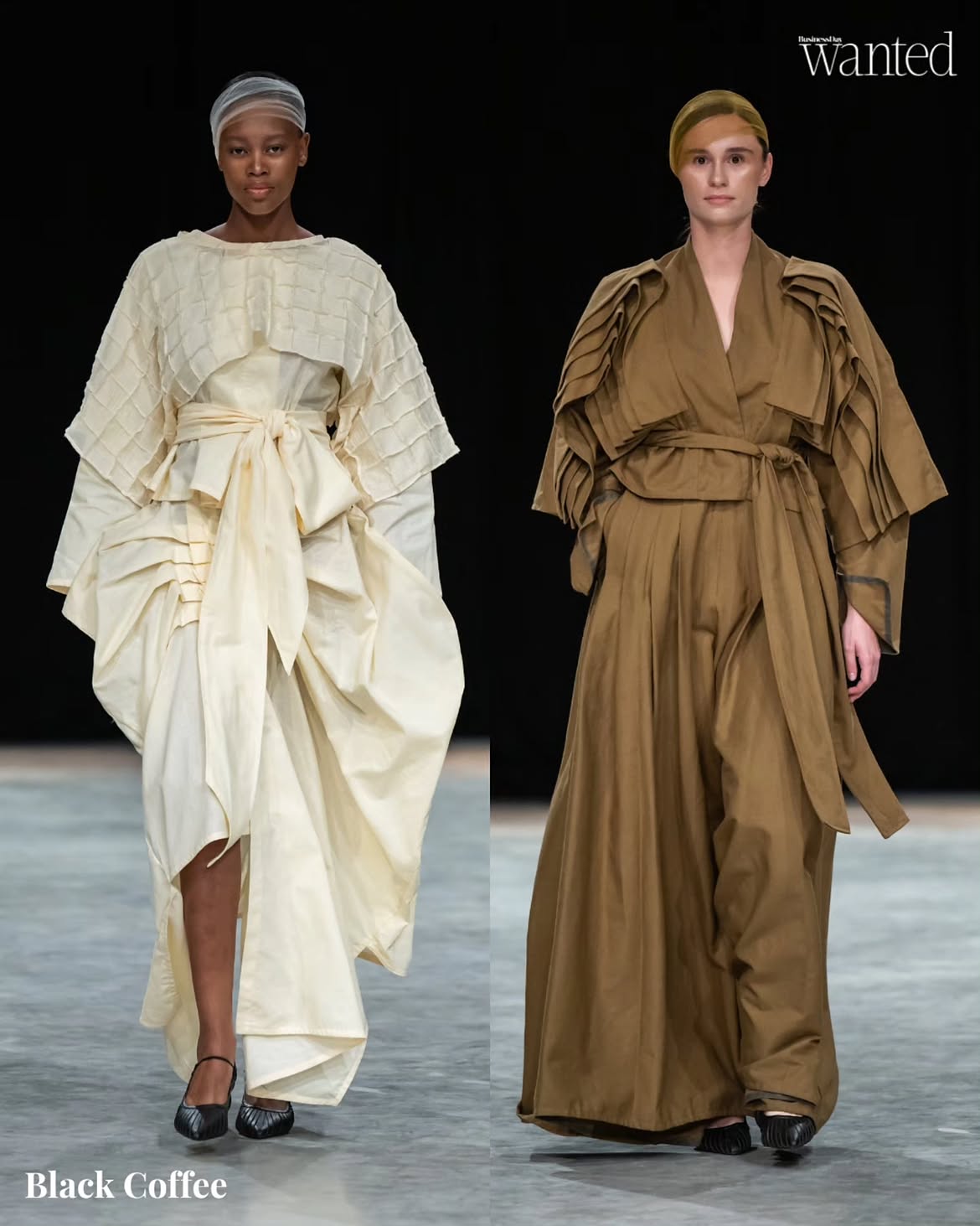
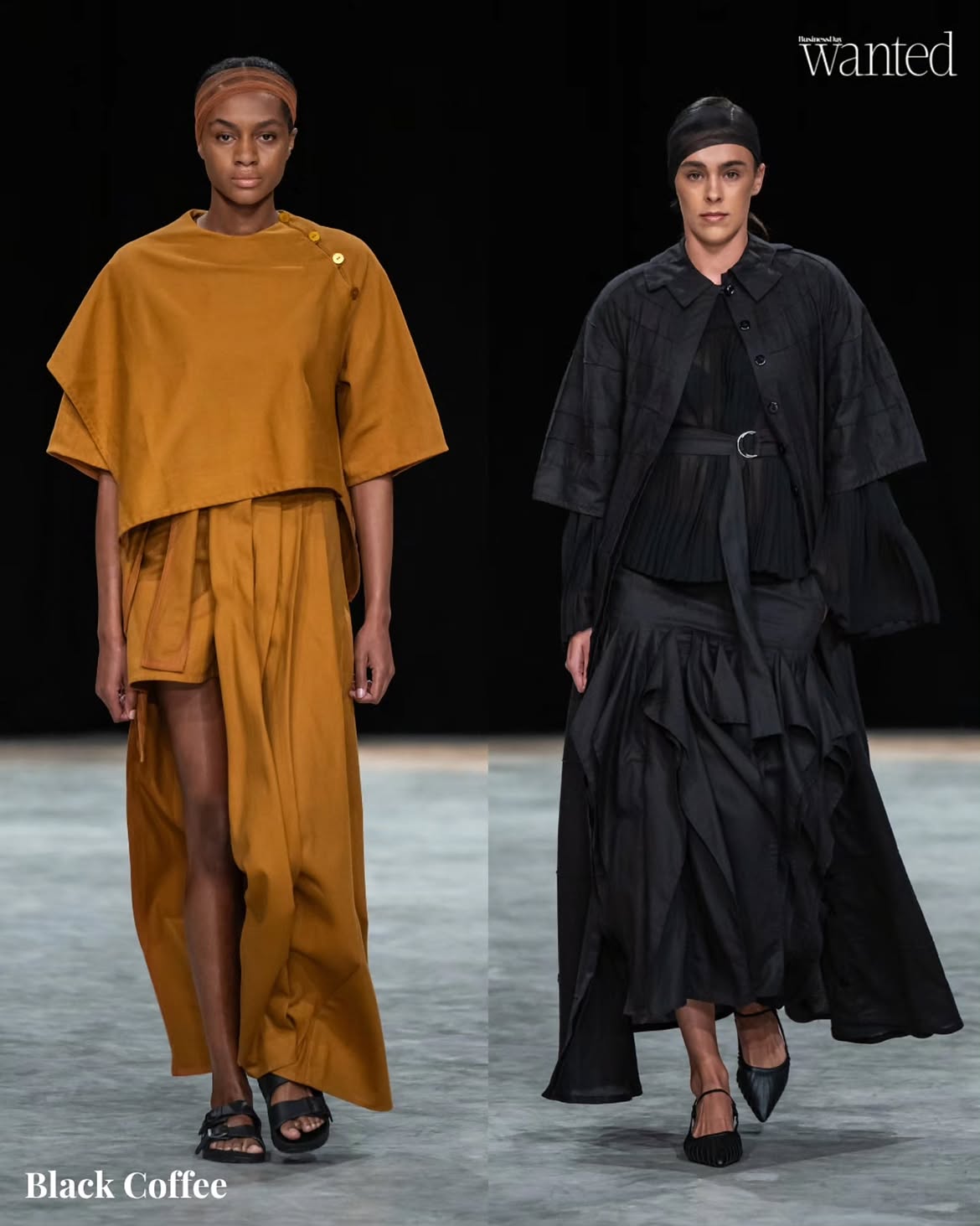
The most recent confirmed Black Coffee collection is SS26, titled Off-Grid, shown at SAFW in April 2026 in Johannesburg. Its conceptual foundation is the grid: a system of order imposed on the body, then subjected to what the body actually does to it. Lines distort. Alignments slip. Systems that appear stable reveal their fragility through subtle movement and wear. The collection’s own statement puts it directly: perfect order is impossible, and the beauty lies in the distortion.
Formally, Off-Grid used pleats, pin tucks and panelling as its primary tools. These construction techniques sit at the boundary between control and flexibility. A pleat is a controlled fold: precise when it is pressed, alive when it moves. A pin tuck holds a surface in place until the wearer moves, then releases. Panelling lets different fabrics, or the same fabric cut differently, meet at a seam line, creating a visible boundary between sections of a garment that the body then crosses and blurs. Each of these techniques is, in its own way, a system designed to hold its shape against the reality of what bodies do.
Perfect order is impossible – beauty lies in the distortion. – Black Coffee, SS26 Off-Grid collection statement
The Off-Grid palette moved beyond Black Coffee’s signature black and white. Butter and sunshine yellows, tangerine and earthy browns appeared alongside the restrained tones the label is known for. This was not a departure from the practice; it was an expansion of the palette within the same construction logic. The silhouettes remained anchored by proportion and volume, with structured quilting, dense pleating and sculptural layering producing organic yet angular forms. Oversized puffed sleeves and cascading ruffles brought movement to a collection whose underlying argument was about the limits of stillness.
Van der Watt described the collection in personal terms, noting that Off-Grid was the first Fashion Week collection made from his new store, and that it reflected a settled creative state. That context is relevant for understanding the confidence of the formal choices: a designer working from a stable position tends to make more resolved decisions about where to push and where to hold.
What Construction-Led Means in Practice
The distinction between construction-led design and concept-led design is worth making before AW27 arrives, because it shapes how a Black Coffee collection is best read. A concept-led collection starts with a theme – a cultural reference, a historical moment, a mood or a set of images – and uses construction to realise it. Construction serves the concept. A construction-led collection starts with a method of making and lets that method generate the aesthetic. The concept, if there is one, emerges from the construction rather than directing it.
Black Coffee’s evolutionary approach, consistently noted in documentation of the label’s practice, stems from this method. Because the starting point is construction rather than concept, each collection builds directly on the previous one’s technical discoveries. Off-Grid’s investigation of pleats and pin tucks was not invented from scratch; it extended a body of technical inquiry that has run across the label’s full career. The grid was a new frame for a question Van der Watt has been asking since the late 1990s: what does a garment’s formal logic produce when it encounters a body?
That question connects to a broader argument about how heritage craft knowledge functions in contemporary design. Black Coffee does not use South African or African textile traditions as decorative references. What it shares with traditions like aso oke weaving or adire resist-dyeing is an approach in which the making method is the primary knowledge and the aesthetic is a product of that knowledge, rather than a concept that the method is asked to realise. In each case, the maker has a deep relationship with the technique, and that relationship shapes what is produced at every stage.
The SAFW Context
South African Fashion Week’s AW27 edition at The Forum, Hyde Park Corner, runs from 20 to 25 October 2026. The event is a confirmed B2B platform – the only dedicated B2B marketing platform for fashion designers in South Africa, in SAFW’s own description – which means its commercial function is as significant as its cultural one. Buyers, media, retailers and the wider industry attend. A showing at SAFW is not only a creative statement; it is a commercial communication.
Pierre Cardin’s first South African runway show is confirmed for the AW27 programme, which marks a significant international moment for the event; for a label like Black Coffee, whose practice is grounded in South African design culture rather than imported from an international fashion calendar, an international house on the same programme is worth noting. The two practices occupy entirely different positions relative to the global fashion industry. What they share is a SAFW runway in October 2026.
Black Coffee’s relationship with SAFW goes back to the label’s early years. The SA Fashion Week New Talent Search, introduced in 1998, lists Jacques van der Watt as one of its prominent early winners – a detail that places the label’s origins at the same moment as the platform’s establishment. What SAFW has documented over the years of Black Coffee’s participation is a body of work described as helping shape a more conceptual, design-driven fashion language in South Africa. That description is institutional and therefore selective, but it points to something real: the label’s consistent investment in the intelligence of its construction has raised expectations for what a South African fashion collection can ask of its audience.
The Label’s Career as a Document
Black Coffee was founded in 1998. That means the AW27 collection, when it is shown, will represent twenty-seven years of continuous practice. Not every label achieves that continuity, and not every label that achieves it uses it productively. Black Coffee’s career functions as a document of a specific design intelligence developing across time: the same questions asked with increasing technical sophistication, each collection extending rather than abandoning what came before.
Reading a label’s career as an archival document requires the same discipline as reading any archive: claim only what the evidence supports, note the gaps, and resist the temptation to narrate continuity into periods where the record is incomplete. The public record of Black Coffee’s practice confirms a construction-led method, an evolutionary approach across collections, a consistent engagement with the relationship between formal structure and bodily reality, and a long-term presence at SAFW that has produced some of the event’s most formally rigorous collections. What it does not confirm is what AW27 will contain. The runway will answer that question.
The 2009 collection ‘South’, noted in SAFW’s own milestone documentation, imagined an African traveller’s style through a futuristic lens. AW23 ‘Flight’ took the idea of air between layers as its construction argument. Off-Grid extended the investigation to the grid as a formal system. Each offers a different entry point into the same sustained inquiry. The AW27 collection will be another entry point, and its specific argument will not be knowable until it is shown.
What to Watch For
When a construction-led label shows, the most useful questions are technical rather than narrative. How are the seams placed, and what does their placement produce on the body? Where does volume appear, and how is it controlled or released? What is the relationship between the garment’s formal logic when it is static and what that logic becomes when a body moves through it? What surfaces are being used, and how does the surface relate to the construction rather than simply covering it?
Off-Grid’s most interesting formal move was using pleating and pin tucks to create a garment that held a grid structure in its flat state and then allowed that structure to distort when worn. That is a technically precise argument about the relationship between designed order and bodily reality. AW27’s equivalent argument is not yet public. What is known is that the method of inquiry has been consistent enough across twenty-seven years to make the next entry in the sequence worth waiting for.
Black Coffee’s practice occupies a specific position in the documentation of African fashion. It is not a label that uses African textile traditions as reference material for an internationally oriented collection. It is a label that has built a construction-led practice in South Africa, shown it consistently at the continent’s most established B2B fashion platform, and produced, over twenty-seven years, a body of work whose intelligence is in its making. The AW27 runway at Hyde Park Corner will add another chapter to that record.
ALSO READ
- Can Heritage Textiles Scale Without Losing Their Meaning?
- What a Museum Record Can – and Cannot – Tell Us About Dress
- The Global South Made Fashion. It Just Never Got Credit.
- Can Textile Provenance Protect the People Who Make the Cloth?
Frequently Asked Questions
What is Black Coffee?
Black Coffee is a South African fashion label founded in 1998 by Jacques van der Watt. The label is known for its construction-led approach: architectural silhouettes, precise pattern-making and sculptural layering that treats garments as engineered forms shaped by their relationship to the body. It has shown at South African Fashion Week since the late 1990s and is among the most consistently present and formally rigorous labels on the SAFW calendar.
What is SAFW AW27?
South African Fashion Week’s Autumn/Winter 2027 collections run from 20 to 25 October 2026 at The Forum, Hyde Park Corner, Johannesburg. SAFW is the only dedicated B2B marketing platform for fashion designers in South Africa, staging collections twice a year in Johannesburg for buyers, media, retailers and the wider fashion industry.
What was Black Coffee’s most recent collection?
The most recent confirmed Black Coffee collection is SS26, titled Off-Grid, shown at SAFW in April 2026. The collection used a grid as its starting point, exploring how formal order distorts on the body. Its techniques included pleats, pin tucks and panelling, with a palette that extended the label’s signature black and white into butter yellows, tangerine and earthy browns. The collection statement described perfect order as impossible and located beauty in the distortion.
Has Black Coffee shown any details of AW27?
No AW27 collection details have been publicly announced at the time of writing. This article is a preview piece written in anticipation of the showing, drawing on the label’s confirmed practice and its most recent SS26 collection. Any design analysis in this article refers to Off-Grid and the broader career record, not to the forthcoming AW27 collection.
What is meant by construction-led design?
Construction-led design starts with how a garment is put together – the pattern, the seam placement, the cut of the panels – and lets the aesthetic emerge from those decisions. It is distinct from concept-led design, which starts with a theme or reference image and uses construction to realise it. Black Coffee’s construction-led practice means each collection builds directly on the technical discoveries of the previous one, producing an evolutionary body of work rather than a series of disconnected seasonal themes.
Where is SAFW AW27 held?
SAFW AW27 is held at The Forum, Hyde Park Corner, Johannesburg, from 20 to 25 October 2026. The Forum is a new venue for SAFW, which previously held collections at Mall of Africa and other Johannesburg locations. Pierre Cardin’s first South African runway show is also confirmed for the AW27 programme.