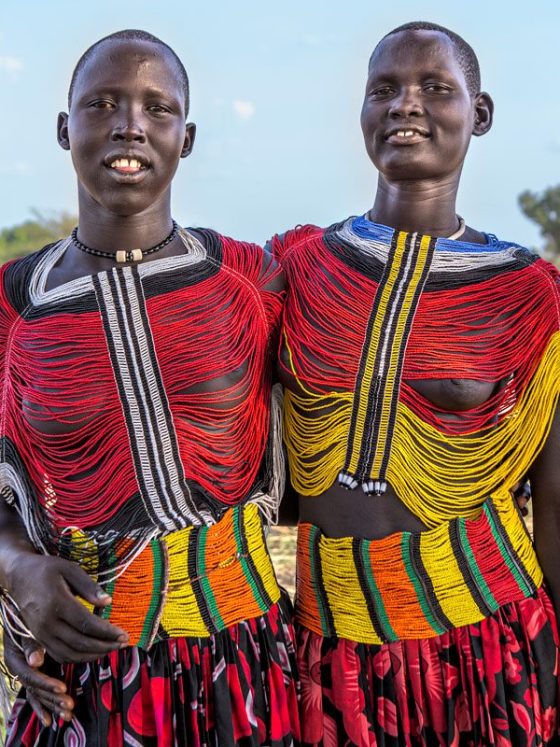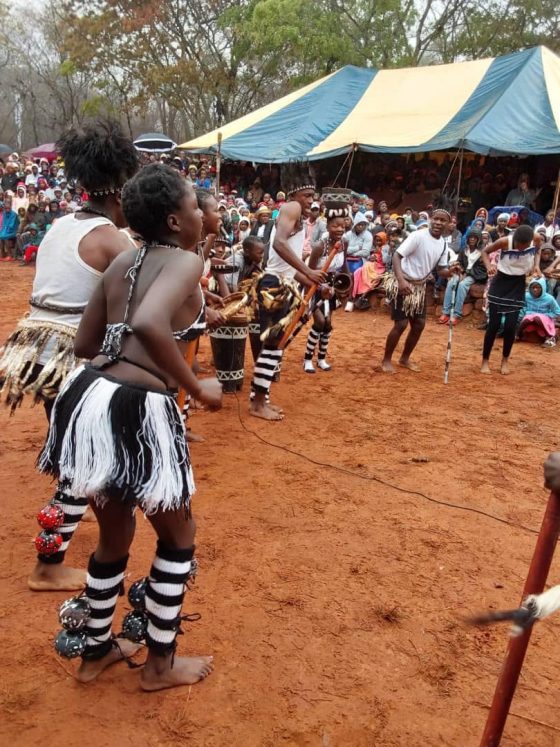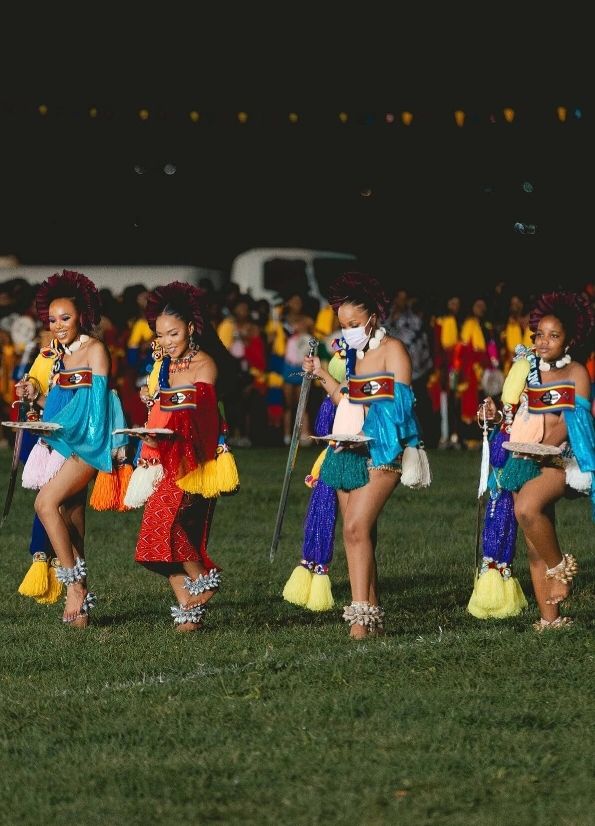
The largest collective dress event in the world does not happen in Paris, Milan or New York. It happens annually in the Ezulwini Valley in Eswatini, a landlocked kingdom of 1.3 million people in southern Africa, at Ludzidzini Royal Village in Lobamba, when up to 40,000 women converge wearing the same costume they have prepared for eight days of ceremony. Bright short beaded skirts. Colourful sashes whose appendage colours communicate whether the wearer is betrothed. Bead necklaces. Rattling anklets made from cocoons that produce the ceremonial percussion of the procession. Bush knives are carried in the hand as symbols of identity. The women are bare-chested. They carry the reeds they have cut from riverbanks across Eswatini and sometimes into Mozambique above their heads. They dance before the King and the Queen Mother in formations of thousands, each group representing a different village regiment, each dance sequence differentiated by region. This is the Umhlanga.
The Umhlanga Reed Dance is not a fashion show. It is a governance ceremony, a rainmaking ritual, an Indigenous New Year observance, and a declaration of collective identity by the kingdom’s unmarried and childless women, organised through dress, movement, and the cutting and presentation of reeds to the Queen Mother, whose protective reed fence they are helping to rebuild. Fashion editorial has classified it as a cultural spectacle and moved on. What it has not done is read the costume as what it is: a complete communication system, designed for collective deployment at the largest scale of any annual women’s gathering on the continent, carrying information about individual status within a collective identity framework that no fashion week has come close to replicating.
Up to 40,000 women. Eight days. One costume. The Umhlanga Reed Dance in Eswatini is the largest annual gathering of women in Africa — and fashion editorial has barely noticed.
Umhlanga Reed Dance Fashion: What the Costume Actually Communicates
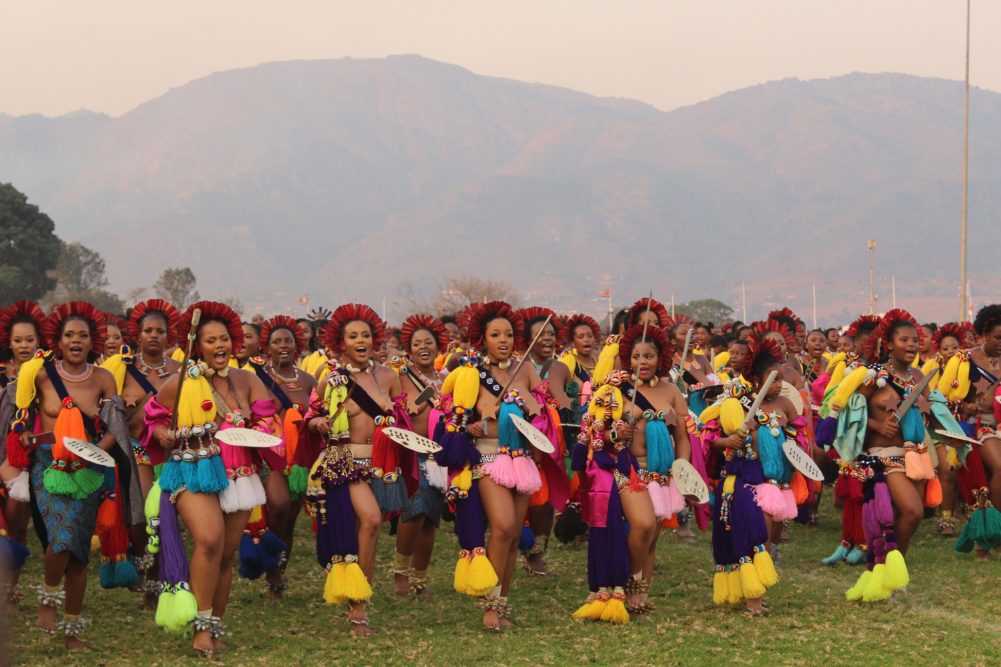
The Umhlanga costume is not uniform in the sense of being identical. It is collective in the sense that it shares a visual grammar while encoding individual information. The short beaded skirt and the bare chest are the shared base. The sash is the variable. Each sash has appendages of different colours that denote whether the girl is betrothed. A woman who arrives at Ludzidzini wearing the colours that signal betrothal is making a public declaration of her status that the entire community present can read. A woman whose sash colours signal she is unbetrothed is making a different public declaration. The costume is collective clothing and individual communication simultaneously. As Wikipedia’s documentation of the Umhlanga ceremony confirms, the specific colour of a sash’s appendages encodes the wearer’s relationship status within a system shared by the whole community.
The bush knife carried in the hand is a second layer of communication. The reeds were cut with these knives on the first four days of the ceremony, when the maidens dispersed across Eswatini’s riverbanks and hillsides in groups. Carrying the knife at the ceremony is a declaration that the wearer has used it. The labour of the cutting is part of the ceremony’s meaning: the women did not buy the reeds. They collected them. They cut them. They carried them back. The knife in the hand at the dance is proof of that labour, and, in the Swazi understanding, it is also a symbol of the virginity the ceremony is intended to honour. The object that was a tool becomes a declaration.
The cocoon anklets that rattle at every step of the dance have their own specific ceremonial function. The sound of thousands of rattling cocoon anklets as the women advance in formation is the sound of the Umhlanga. It is not a fashion accessory. It is the acoustic signature of the ceremony, the sound that tells the community, before it sees the dancers, that the Umhlanga procession is approaching. The sound is part of the dress. The dress is part of the ceremony. The ceremony is part of the kingdom’s governance.
The Structure of the Ceremony: Eight Days of Collective Action
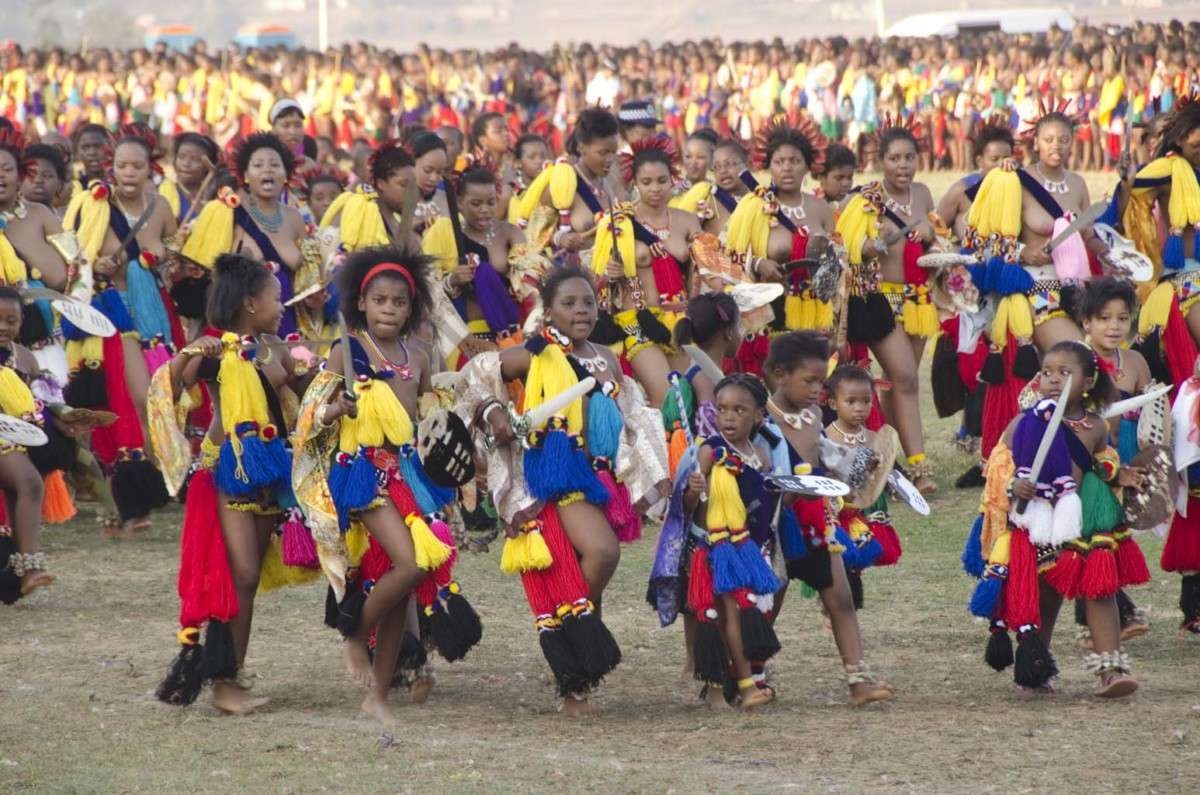
The Umhlanga is an eight-day ceremony whose structure is as precise as its costume. Days one through four: the maidens, who gather at Ludzidzini Royal Village from across Eswatini and from neighbouring countries, including South Africa, Botswana, and Mozambique, disperse in groups to cut tall reeds from riverbanks. The reeds are sometimes cut from areas extending across the border into Mozambique. They are bundled and carried back to Ludzidzini. The Kingdom of Eswatini’s official documentation describes the atmosphere of the cutting days as one of unity and jubilation, with traffic halted to give the reed-carrying maidens priority on the roads and markets stopping trading to watch and cheer as they pass. The kingdom reorganises itself around the ceremony.
Day five is rest and preparation. On day six, the dancing begins in the afternoon, each regiment taking its position and performing before the crowd of dignitaries, spectators, and community members who have gathered. Day seven is the main day, when King Mswati III is present. Each regiment dances before him in turn. The scale of the main day is, by every account of those who have witnessed it, overwhelming: column upon column of women advancing in formation across the parade grounds of Ludzidzini, the cocoon anklets rattling in unison, the beaded skirts and coloured sashes creating a moving visual field that no production design team could plan. After the dance, the King commands that cattle be slaughtered, and the participants receive pieces of meat before dispersing to their homes. The ceremony closes. The kingdom has renewed itself.
An administrative calendar does not set the dates of the Umhlanga. They are determined by the phases of the moon and announced relatively close to the ceremony, based on ancestral astrological observations. The main day is always a Monday. In 2025, the main day fell on Monday, 8 September. The ceremony is a public holiday in Eswatini: the entire nation is structured around its observance. An induna, a captain appointed by the royal family, announces and organises the ceremony. The governance of the Umhlanga is not separate from the governance of the kingdom. They are the same system.
Up to 40,000 women wearing the same costume at the same ceremony for the same reason. No fashion week has ever organised collective dress at this scale, with this depth of meaning, or this degree of community consent.
The Deeper Dimensions: Rainmaking, the Indigenous New Year, and the Queen Mother
The Umhlanga carries layers of meaning that its classification as a cultural dance festival consistently underrepresents. The Eswatini Observer’s September 2025 analysis of the ceremony’s indigenous dimensions documents that the Umhlanga marks the Indigenous New Year of the Swazi people, September being the first month of the indigenous year. The ceremony is also understood as a rainmaking ritual, connected to the kingdom’s agricultural and ecological cycle in ways that link it to the land, the weather, and the sovereignty of the Swazi nation over its territory. As the Eswatini Observer confirmed, the Umhlanga simultaneously embodies rainmaking, food sovereignty, and the preservation of cultural values. The dress of the ceremony is not separable from these dimensions. The women who wear the beaded skirt and carry the reed are participating in a renewal of the kingdom’s relationship with its land, its ancestors, and its future.
The Queen Mother, the Indlovukazi, whose title means She-Elephant, is the central figure of the ceremony. The Umhlanga’s stated purpose is the repair of the reed windscreen, the Guma, surrounding the Queen Mother’s homestead. The women cut the reeds, carry them to Ludzidzini, bundle them, and present them to the Queen Mother for this purpose. The labour of the ceremony is service to the Queen Mother as the symbolic mother of the nation. In this sense, the Umhlanga is also a statement of the kingdom’s matrilineal dimension: even in a patriarchal monarchy, the ceremony that most fully mobilises the kingdom’s women is in service of the Indlovukazi, not the king. The King attends. The women serve the Queen Mother. The ceremony belongs to her.
The Umhlanga evolved from an older custom called Umchwasho, a traditional chastity rite in which unmarried women wore wool tassels around their necks and observed specific behavioural restrictions for a defined period. Umchwasho was abolished on 19 August 2005 after decades of protest for structural reform. King Sobhuza II had institutionalised the Umhlanga in the 1940s as an adaptation and continuation of the traditions behind Umchwasho. The ceremony that exists today is not an ancient rite unchanged from its origin. It is a living tradition that has adapted to the conditions of contemporary Eswatini while maintaining the core structure of collective women’s participation in the kingdom’s governance through ceremony and dress.
Also Read:
- Yoruba Naming Ceremony Dress: The Aso-Ebi System as Community Declaration, Not Fashion Choice
- Sande Society Initiation Dress: How Sierra Leone’s Most Powerful Women’s Institution Uses Fashion as a Rite of Passage
- Ndebele Coming-of-Age Dress: The Wallpainting That Women Wear on Their Bodies
- The Significance of White in African Mourning: Why the Continent’s Grief Dress Is Not What the West Assumes
What the Fashion World Has Not Said About This
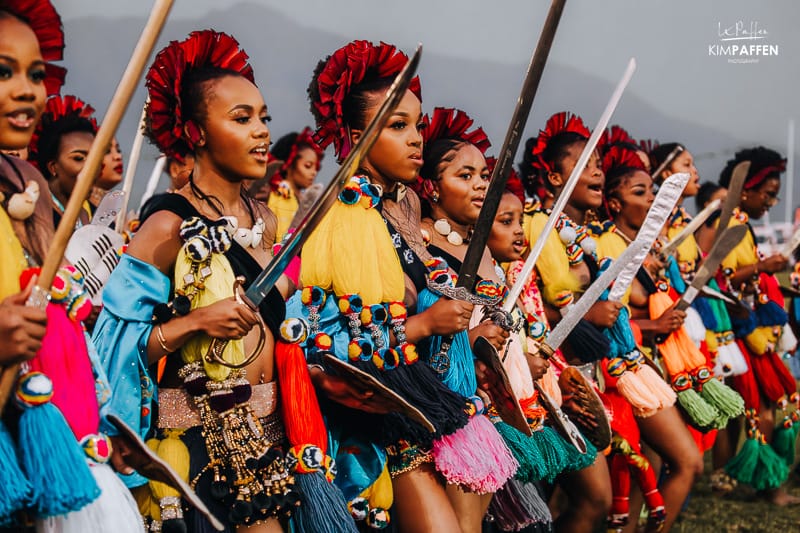
The Umhlanga has been classified by tourism operators, documentary filmmakers, and cultural commentators as a spectacular African traditional event, one of Africa’s largest cultural festivals, and an occasion of significant controversy regarding its virginity testing dimension. What it has not been classified as, in any sustained way, is the largest collective fashion event in the world. That classification is accurate. Up to 40,000 women, wearing a specific collective costume with individually communicating elements, performing a coordinated dress practice across eight days of ceremonial activity, in an event whose dates are determined by ancestral astrological observation and whose participation grows every year, constitute a fashion event at a scale that makes Paris Fashion Week look like a sample sale.
The growing participation is itself significant. Cultural observers have noted that the Umhlanga’s ever-increasing popularity defies the apparent decline of traditional cultural practices elsewhere. While other ceremonial traditions across Africa are experiencing attrition due to urbanisation, religious change, and generational drift, the Umhlanga is attracting more participants. Women from South Africa, Botswana, and Mozambique travel to Ludzidzini to participate. The ceremony, institutionalised in the 1940s, is more widely attended in the 2020s than at any previous point in its documented history. As the official Kingdom of Eswatini documentation confirms, this is a traditional event that allows spectators, not one that exists for spectators. The ceremony’s authority does not derive from its audience. It derives from the women who participate, and more of them are choosing to do so every year.
The Omiren Argument
The Umhlanga Reed Dance is the largest collective fashion event on earth. It runs for eight days. It involves up to 40,000 participants. Its costume carries specific individual information within a collective visual grammar: the sash communicates betrothal status, the bush knife communicates labour and identity, and the cocoon anklets produce the ceremonial acoustic signature of the event. Its dates are set by ancestral astrological observation rather than a fashion calendar. Its purpose is to renew the kingdom’s relationship with its Queen Mother, its land, its ancestors, and its future. It grows in participation every year. It has survived the abolition of the custom from which it evolved. It is a public holiday. It stops traffic.
Fashion editorial has not covered Umhlanga as a fashion event because its concept of a fashion event requires a designer, a brand, a commercial context, and a press list. The Umhlanga has none of these. What it has is 40,000 women who designed their own collective dress system, organised their own participation, cut their own raw material from riverbanks across a kingdom, and wore their costumes before a crowd that grew to meet them. That is fashion as collective cultural practice at its most complete and most authoritative. Omiren Styles documents it as such: not as a cultural curiosity, not as a controversial traditional ceremony, but as the single largest demonstration on earth of what fashion as community governance, collective identity, and annual self-renewal looks like when it is built on its own terms, for its own people, with its own design intelligence.
Frequently Asked Questions
What is the Umhlanga Reed Dance, and where does it take place?
The Umhlanga Reed Dance is an annual eight-day ceremony held in Eswatini, a landlocked kingdom in southern Africa. It takes place at Ludzidzini Royal Village in the Ezulwini Valley, Lobamba. The ceremony involves unmarried and childless women from across Eswatini and neighbouring countries who gather to cut reeds from riverbanks, carry them to the Queen Mother’s royal residence, and present them for use in repairing the Guma, the protective reed windscreen surrounding her homestead. Up to 40,000 women participate annually, making it one of the largest cultural gatherings on the continent. The ceremony was institutionalised by King Sobhuza II in the 1940s and evolved from the older Umchwasho tradition.
What does the Umhlanga costume consist of, and what does each element mean?
The Umhlanga costume consists of a bright short beaded skirt, a colourful sash, a bead necklace, rattling anklets made from cocoons, and a bare chest. The sash’s appendages come in different colours, denoting whether the wearer is betrothed: the colour communicates individual relationship status within the collective costume. The bush knives, used to cut the reeds during the first four days of the ceremony, are carried during the dance as symbols of the wearer’s identity and, in Swazi understanding, as symbols of virginity. The cocoon anklets produce a specific rattling sound that functions as the ceremonial acoustic signature of the Umhlanga procession. This sound announces the approach of the ceremony before the dancers are seen.
How many women participate in the Umhlanga, and how is it structured?
Up to 40,000 women participate annually, travelling from across Eswatini and from South Africa, Botswana, and Mozambique. The ceremony runs for eight days. Days one through four: maidens disperse in groups to cut tall reeds from riverbanks, sometimes crossing into Mozambique to find suitable reeds, then bundle and return them to Ludzidzini. Day five: rest and preparation. Day six: dancing begins in the afternoon. Day seven, always a Monday and a public holiday in Eswatini, is the main day when King Mswati III attends, and each village regiment dances before him. The king commands that cattle be slaughtered; participants receive meat, and the ceremony closes. Dates are determined by the phases of the moon rather than a fixed calendar.
What are the broader dimensions of the Umhlanga beyond the dance?
The Umhlanga carries at least three layers of meaning beyond its classification as a cultural dance festival. It marks the Indigenous New Year of the Swazi people, September being the first month of the indigenous year. It serves as a rainmaking ritual tied to the kingdom’s agricultural and ecological renewal cycle. And it is a governance ceremony in which the women of the kingdom perform collective service to the Indlovukazi, the Queen Mother, whose title means She-Elephant, and who is the symbolic mother of the Swazi nation. The reed fence that the women help repair is the physical structure surrounding and protecting the Queen Mother’s homestead. The ceremony is an act of collective national service expressed through dress and movement.
Why is the Umhlanga growing in participation rather than declining?
Cultural observers have noted that the Umhlanga defies the apparent decline of traditional cultural practices that affect many ceremonial traditions across Africa. The ceremony is attended by more people in the 2020s than at any previous point in its documented history. The official Kingdom of Eswatini documentation describes it as a traditional event that allows spectators rather than one that exists for spectators, meaning the ceremony’s authority derives from its participants rather than its audience. Women from neighbouring countries travel to Ludzidzini specifically to participate. The combination of collective identity, national pride, community service, and the social significance of being among the thousands who cut reeds and carried them to the Queen Mother appears increasingly compelling to the young women of the region, rather than less so.
Explore More
Read the full Culture > Ceremony & Ritual section for Omiren Styles’ complete documentation of the ceremony dress traditions, collective fashion systems, and governance structures that African cultures have built on their own terms, for their own communities, for centuries.