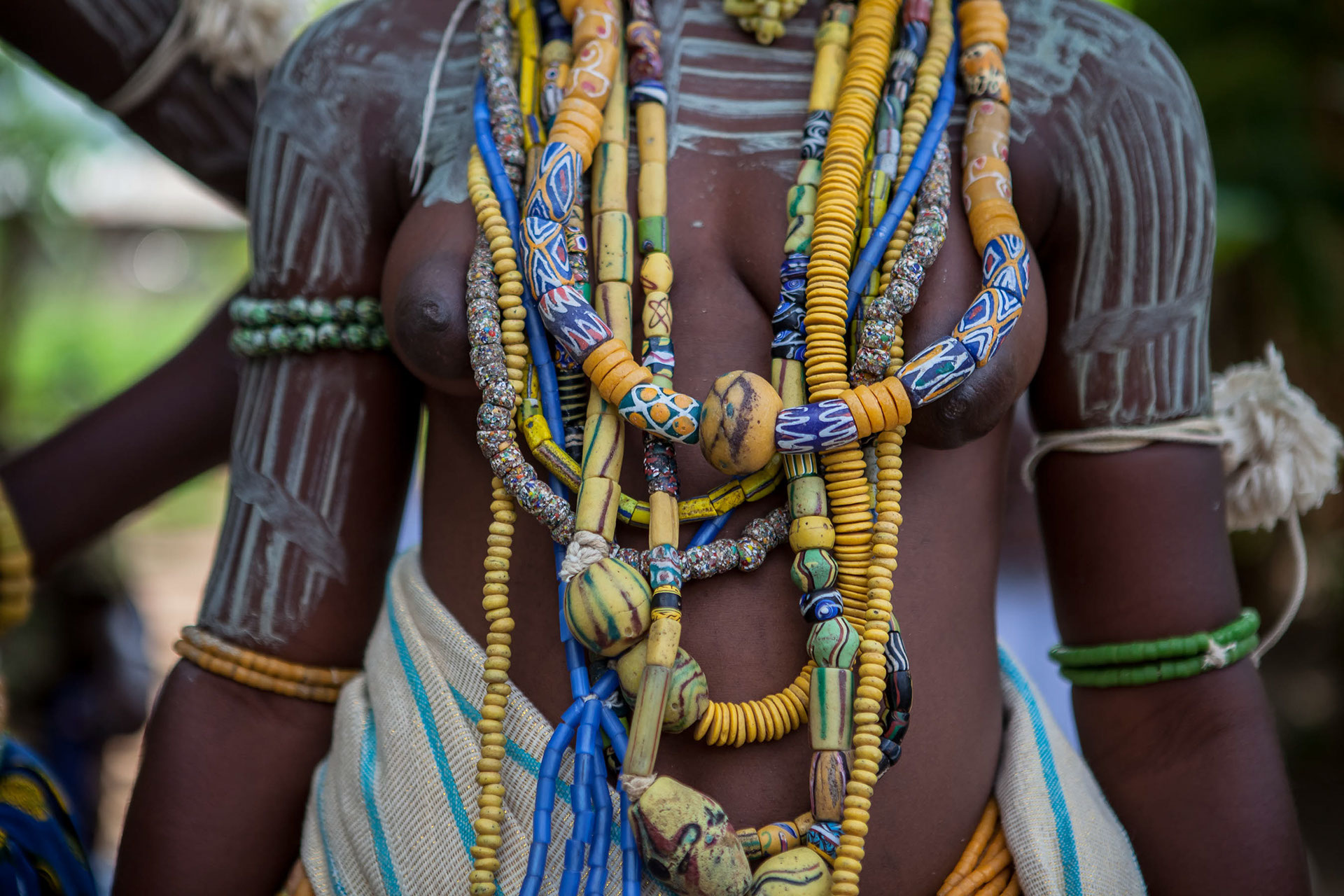
Between April and May each year, in the towns of Odumase-Krobo and Somanya in Ghana’s Eastern Region, young Krobo women undergo a ceremony that has no equivalent anywhere in the Western fashion calendar. They enter the Dipo initiation as girls and emerge as women, publicly declared and communally witnessed, wearing layers of handmade glass beads that can weigh up to 25 kilograms and that carry more information per gram than any fashion editorial produced in London or Paris this season. Yellow signals wealth—blue signals tenderness. White and blue together signal femininity. Spiral motifs represent fertility. Flower motifs represent family morality and protection. The colour, pattern, and configuration of every bead set announce who this woman is, what stage of life she has reached, and what the community is prepared to recognise her as. The beads are not decorations. They are a declaration.
The Krobo are a Dangme-speaking people who have inhabited the Eastern Region of Ghana, particularly the lands around the Krobo Mountain known as Klowem, since at least the fourteenth century. Their bead-making tradition is among the most technically refined in West Africa, documented by European traders from the early eighteenth century and now recognised as one of Ghana’s most significant craft exports. Their Dipo initiation ceremony is one of the oldest continuously practised coming-of-age systems on the continent. The two are inseparable. The bead is not worn at Dipo because it is beautiful. The bead is worn because it speaks, and the Dipo ceremony is the occasion on which that speech is most formally delivered.
Krobo beadwork can weigh up to 25kg, and each colour carries a specific meaning. The Dipo ceremony is not a fashion show. It is one of West Africa’s most complete systems of womanhood.
The Dipo Ceremony: What Actually Happens and Why
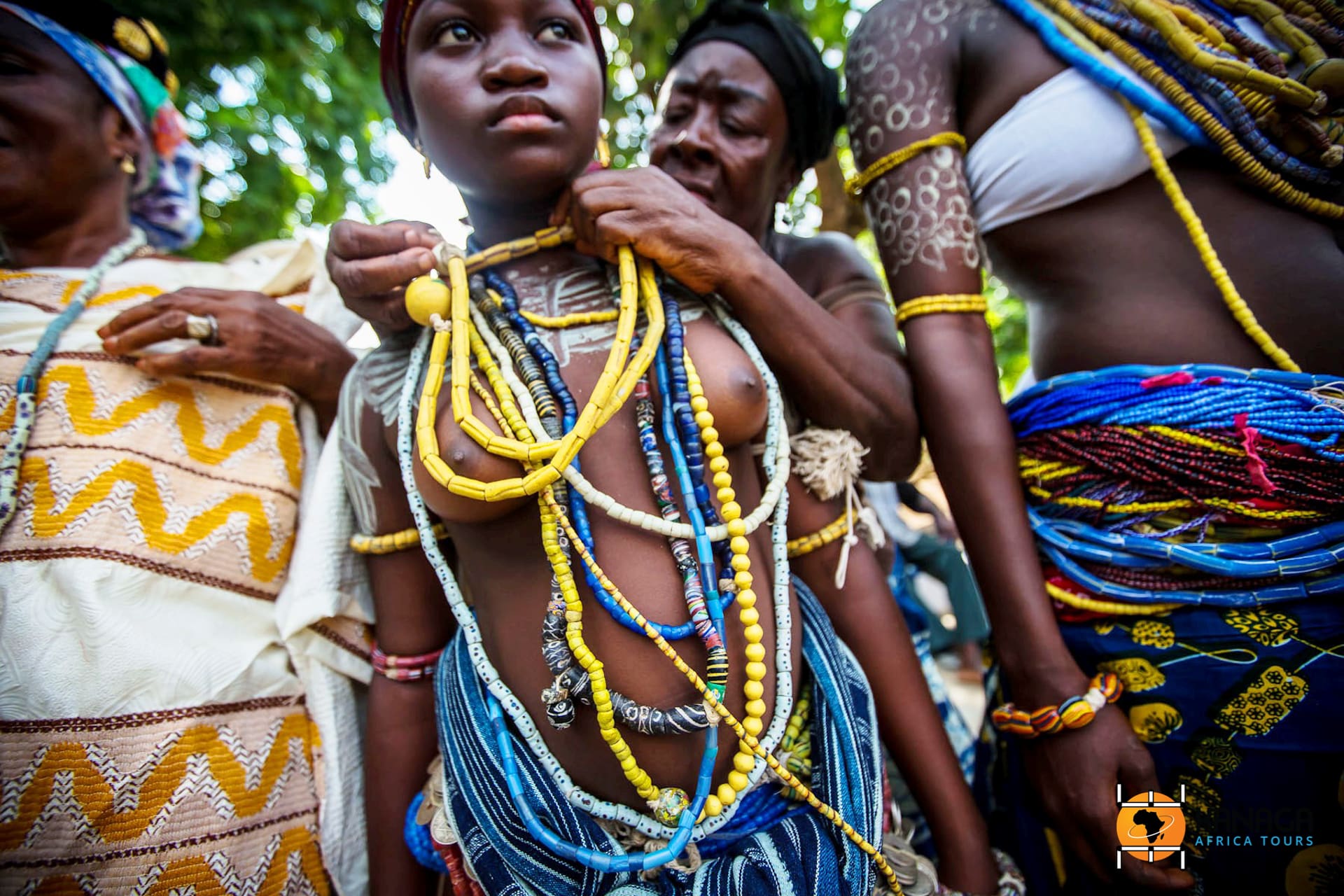
The Dipo puberty rite is the primary mechanism through which Krobo society formally recognises the transition of young women into adulthood. Initiates, called Dipo-yo, are typically between fifteen and twenty-five years of age. The ceremony spans several days in April and May, historically lasting approximately a month, and is now coordinated with school calendars. The process begins with seclusion: the Dipo-yo are gathered and taught by elder women the knowledge of womanhood, including health, reproductive understanding, household management, and the ethical standards of Krobo adult life. According to Krobo oral tradition, the rite was established to ensure that young women entered marriage as spiritually prepared, socially educated, and community-endorsed adults. It was never merely symbolic. It was the mechanism through which Krobo society maintained its standards across generations.
The ritual unfolds in specific stages. The Dipo-yo’s heads are shaved, leaving a small portion of hair, marking the beginning of their liminal state. A piece of raffia is tied around the neck to signal their status as initiates. They undergo a ritual bath in a river, washing away childhood. Priests and priestesses of the Krobo shrines pour libations to Naa Dipo, the Dipo deity, invoking blessings of fertility, good health, and moral uprightness for the initiates. Each girl sits on Klowem, the sacred stone at the heart of the Krobo Mountain and the ceremony’s spiritual framework. In sitting on Klowem, the initiate places herself within the unbroken line of Krobo women who have completed the same rite, stretching back centuries.
Then comes the adornment. The initiates emerge from seclusion and are dressed in their ceremonial beadwork for public presentation. The Dipo-yo are dressed in cloth from the waist to the knees, with the upper body exposed and layered with beadwork from the neck to the waist. The beads are worn around the neck and in a heavy girdle around the waist, built from multiple layers to a combined weight of up to 25 kilograms. This is not theatrical excess. It is the visible, physical demonstration of what the community has invested in this woman’s transition, expressed in the material that the Krobo have been crafting and coding with meaning for centuries.
Krobo Beadwork as Semiotic System: Reading What the Beads Say
The Krobo bead is not a uniform object. There are distinct types, colours, patterns, and configurations, each carrying specific information within the community’s shared visual vocabulary. A January 2026 peer-reviewed study, published in African Identities by Ho Technical University, conducted field observations and a semiotic analysis of Krobo beadwork, identifying the meanings of specific motifs. Spiral motifs represent fertility and continuity. Flower motifs represent family morality and protection in Krobo cosmology. These are not decorative choices. They are statements about what the wearer is, what she aspires to, and what the community expects of her.
The colour vocabulary is equally precise. Yellow communicates wealth and abundance. Blue communicates tenderness, care, and emotional depth. White and blue together signal femininity in its Krobo-specific register. The combination of colours across a bead set is not random. A woman who understands the vocabulary can read another woman’s bead configuration the way a reader scans a text, extracting information about her stage of life, her family’s standing, and her status within the community. Beads worn at Dipo communicate that the wearer has been initiated, has sat on Klowem, and has been formally recognised by her community as a woman. Every element of the configuration is part of that communication.
The beads also carry time. Many Dipo bead sets are passed down through generations, linking a young woman’s initiation to her grandmother’s and, before that, her great-grandmother’s. A bead set worn at Dipo is not only a statement about who this woman is today. It is a material connection to the lineage she joins. The weight of 25 kilograms of glass beads around a young woman’s neck and waist is not incidental. It is a physical experience of that inheritance. She carries the weight of what came before her. The ceremony is designed so that carrying it is the point.
The Krobo did not borrow a fashion system. They built one, in powdered glass, fired in clay moulds, worn in layers that announce who a woman is and what she has become. The beads are not decorations. They are a declaration.
The Craft Behind the Communication: How Krobo Beads Are Made
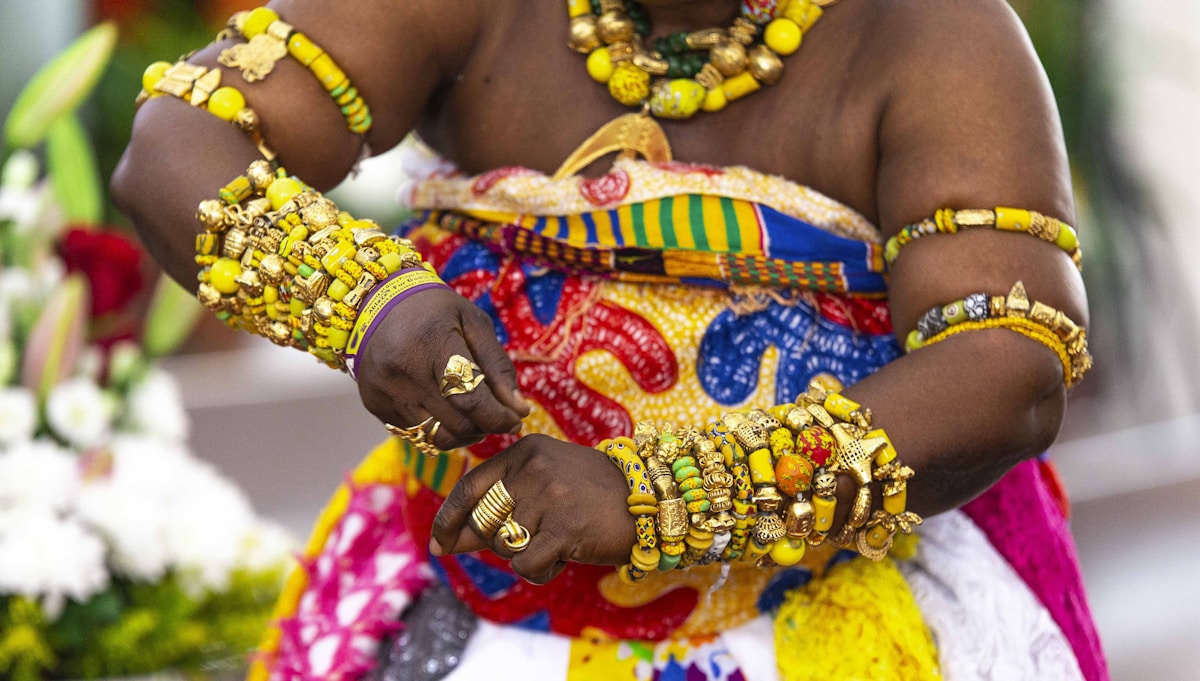
Krobo powder glass beads are produced through a process of extraordinary technical precision that has been passed down through generations of apprentices. The primary production centres are Odumase-Krobo, Agomanya, and Somanya in the Eastern Region. The process begins with the collection and sorting of scrap glass: old bottles, broken window panes, and medicine jars. The glass is washed, crushed with a traditional iron mortar and pestle, and sifted through a fine mesh to achieve a uniform grain size. Ceramic dye is mixed into the powder, which is then carefully poured into clay moulds using a funnel. A cassava stalk is inserted through the centre of each mould: when the bead is fired in a kiln, the stalk burns away, leaving the perforation. As master bead maker Nomoda Cedi Djaba of the Cedi Bead Factory in Odumase-Krobo has documented, the design phase requires the most skill: a quality bead carries its pattern throughout, not just along its surface. That distinction is the difference between a craft object and a statement.
Bead production on the Gold Coast was first documented by John Barbot, a French trader, in his 1732 publication. The practice dates further back. The Sankofa Digital Heritage Library’s documentation of the tradition notes that the earliest powder glass beads found in Africa date to between 970 and 1000 CE, and were discovered at Mapungubwe in present-day South Africa. That powder glass bead-making in Ghana’s Eastern Region achieved its most refined and continuous expression. The Krobo bead-making tradition has been developing, refining, and diversifying for over a thousand years within the broader West African context. Three distinct styles now exist: fused glass fragment beads, the two-halves bicone beads, and the Mue ne Angma writing beads, in which glass slurry decorations are applied to the bead’s surface during a second firing. Each style has its own technical demands and communicative register within the tradition.
Also Read:
- Sande Society Initiation Dress: How Sierra Leone’s Most Powerful Women’s Institution Uses Fashion as a Rite of Passage
- The Egungun Masquerade: What the Yoruba Ancestral Festival Tells Us About Fashion and the Spirit World
- Kente’s GI Status: What Geographic Indication Protection Actually Means for Ghanaian Weavers in Practice
- Investing in Textile Heritage: The Business Case for Preserving What Western Fast Fashion Cannot Copy
Dipo in the Contemporary Moment: What Has Changed and What Has Not
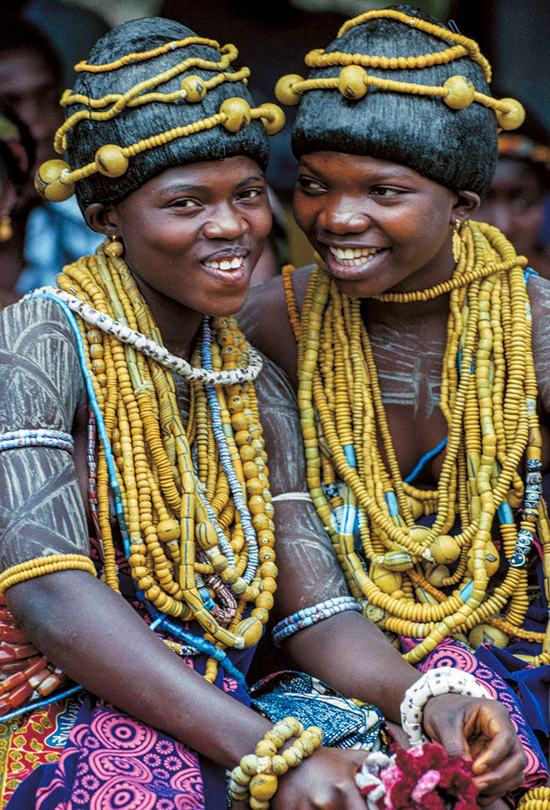
The Dipo ceremony has adapted to the pressures of contemporary Ghanaian life without losing its structural core. The historically month-long initiation now runs during school vacation periods, coordinated with academic calendars. Some aspects of the ceremony have been modified under the influence of Christianity, which holds a significant presence in the Krobo community. The Krobo Catholic Church, for instance, has developed a modified Dipo process that retains the community recognition and beadwork elements while removing aspects considered incompatible with Christian practice.
What has not changed is the beadwork. The glass bead production continues in Odumase-Krobo, Agomanya, and Somanya. The colour and pattern vocabulary continues to be transmitted through the community’s shared understanding. The ceremony continues to function as the primary mechanism through which Krobo society formally marks the transition of young women into womanhood. The Krobo bead has also entered the global market: Krobo beads are traded internationally, worn by buyers in Europe, North America, and across the African diaspora, collected by museums, and studied by material culture scholars. The global market for Krobo beads is a recognition of the tradition’s craft quality. What the global market does not always carry with it is the semiotic vocabulary that gives the beads their deepest meaning.
The distinction matters. A Krobo bead purchased by a buyer in Amsterdam or Lagos who understands only its visual quality is, to that buyer, a beautiful object. A Krobo bead worn by a Dipo-yo in Somanya who has sat on Klowem is an argument. The same glass, the same colour, the same spiral motif. Different meaning entirely. The fashion industry’s adoption of Krobo beadwork as an aesthetic resource, which has accelerated in recent years as global interest in African craft has grown, risks producing the same separation that the Egungun mask in a museum case produced: the object stripped of the knowledge system that gives it authority.
The Omiren Argument
The Krobo Dipo ceremony is not a fashion show. It is a fashion system, and the distinction is the entire argument. A fashion show presents clothing. A fashion system uses clothing to communicate, mark transitions, bind communities, transmit knowledge across generations, and assert the values a society considers non-negotiable. The Dipo beadwork does all of these things simultaneously, in a visual vocabulary developed over centuries that the entire community can read, that is specific enough to distinguish stages of life and family standing, and that is physically demanding enough, up to 25 kilograms of glass worn around the neck and waist, to make the transition it marks into a bodily experience rather than a symbolic one. No fashion week produces this. No editorial system encodes this much information in a single outfit. The Krobo had a complete fashion communication system long before the concept of fashion as a global industry existed.
Omiren Styles documents the Dipo ceremony not because it is remarkable by the fashion industry’s measures but because it is one of West Africa’s most complete demonstrations that fashion as language, as governance, as community technology, as generational transmission, has been practised in Africa with extraordinary sophistication for centuries. The global interest in Krobo beads as aesthetic objects is welcome. The understanding of what those beads are actually doing, what they announce and to whom and with what authority, is what Omiren Styles is built to provide. The bead is the statement. The Dipo ceremony is the grammar. African fashion built both.
Frequently Asked Questions
What is the Krobo Dipo ceremony, and when does it take place?
The Dipo ceremony is the primary coming-of-age initiation rite of the Krobo people, a Dangme-speaking group from the Eastern Region of Ghana, centred in the towns of Odumase-Krobo, Somanya, and Agomanya, approximately 80 kilometres north of Accra. The ceremony marks the formal transition of young women from girlhood to womanhood. It takes place annually in April and May. Initiates, called Dipo-yo, undergo a period of seclusion during which elder women teach them the knowledge of Krobo womanhood. The process includes a ritual bath in a river, sitting on the sacred Klowem stone at the Krobo Mountain, and a public adornment ceremony in which the initiates emerge wearing layers of Krobo glass beadwork.
What do the colours and patterns of Krobo beads communicate?
Krobo beadwork carries a specific semiotic vocabulary that the community can read. Yellow beads communicate wealth and abundance. Blue beads communicate tenderness and emotional depth. White and blue together signal femininity in its Krobo-specific register. Spiral motifs represent fertility and continuity. Flower motifs represent family morality and protection in Krobo cosmology, according to a January 2026 peer-reviewed study published in African Identities by researchers at Ho Technical University. The combination of colours and patterns across a full bead set communicates the wearer’s stage of life, family standing, and status within the community. Many bead sets are passed down through generations, linking an initiate to her lineage.
How are Krobo glass beads made?
Krobo powder glass beads are made from scrap glass: old bottles, broken window panes, and medicine jars. The glass is washed, crushed with an iron mortar and pestle, and sifted into a fine, uniform powder. Ceramic dye is mixed in, and the coloured powder is carefully poured into clay moulds. A cassava stalk is inserted through the centre of each mould, and the mould is fired in a kiln. The stalk burns away during firing, leaving the bead’s perforation. The design phase, in which coloured glass powder is layered into patterns throughout the bead’s full depth, requires the highest level of skill. A quality Krobo bead carries its pattern through its entire body. The primary production centres are Odumase-Krobo, Agomanya, and Somanya in Ghana’s Eastern Region.
How much do Dipo beads weigh, and why is the weight significant?
The beadwork worn during the Dipo ceremony can weigh up to 25 kilograms, worn as layers around the neck and in a heavy girdle around the waist. The weight is not incidental to the ceremony. It makes the transition of the Dipo marks into a bodily experience rather than a purely symbolic one. The physical carrying of inherited beads, many of which are passed down through generations, is part of what the initiate is expected to do: carry the weight of what the women before her carried. The Dipo is designed so that the experience of wearing the beads is itself part of the knowledge the ceremony transmits.
How has the Dipo ceremony adapted to contemporary Ghanaian life?
The Dipo ceremony has adapted to contemporary pressures without losing its structural core. The historically month-long initiation is now coordinated with secondary school vacation calendars, allowing initiates to complete the process during academic breaks. The Krobo Catholic Church has developed a modified version that retains the community recognition and beadwork elements while adjusting aspects considered incompatible with Christian practice. The bead-making tradition continues actively in Odumase-Krobo, with master craftspeople like Nomoda Cedi Djaba of the Cedi Bead Factory maintaining and teaching the technique internationally. Krobo beads are now traded globally, worn by diaspora communities, and collected by museums. However, the semiotic vocabulary that gives them their deepest meaning is not always transmitted alongside the beads themselves.
Explore More
Read the full Culture > Ceremony & Ritual section for Omiren Styles’ documentation of the ceremony dress traditions and cultural systems that have been defining visual standards, transmitting knowledge, and building community authority in Africa for centuries.