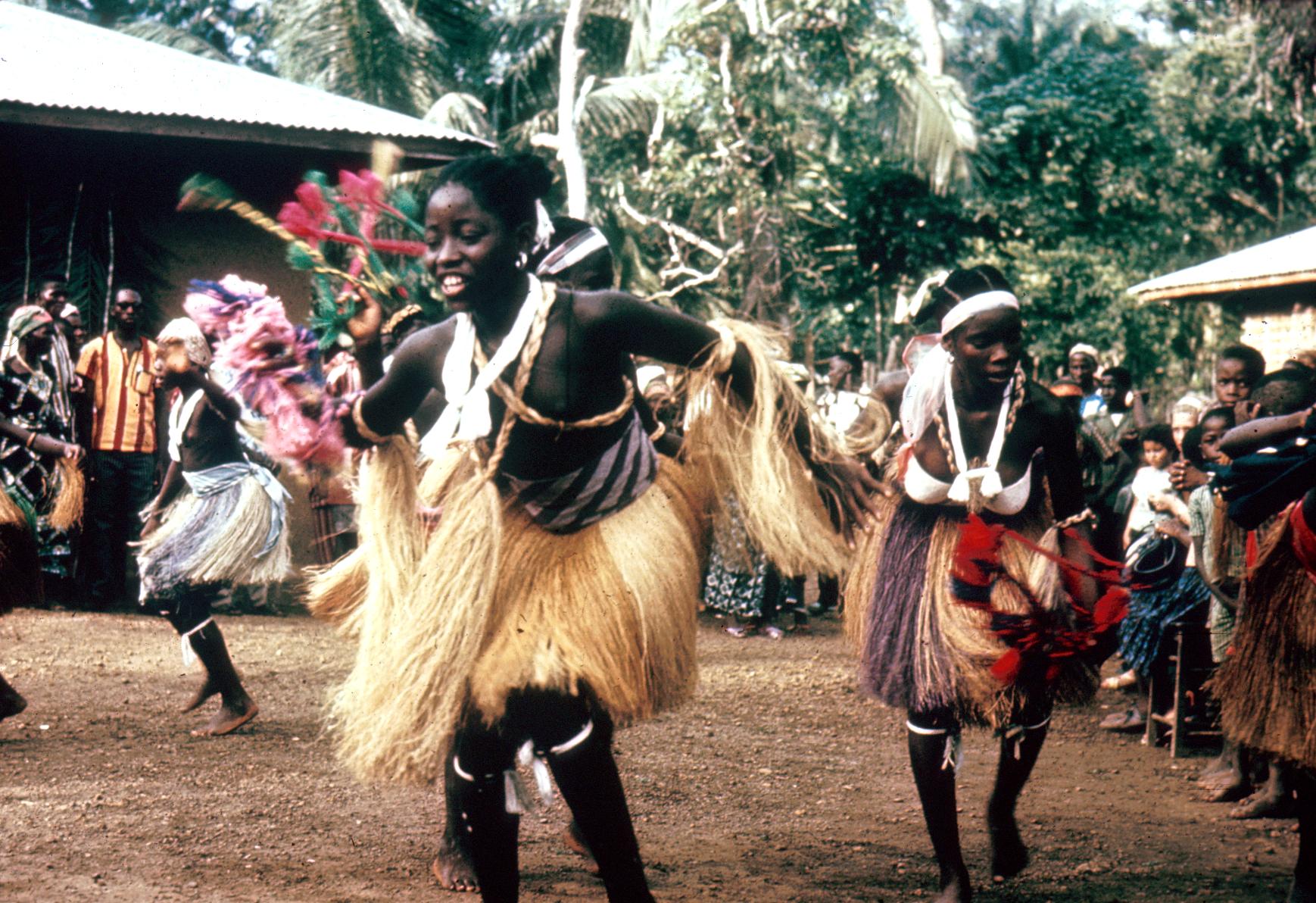
The Sande Society designed its own definition of beauty, carved it in wood, dressed it in black raffia, and performed it publicly for the community to witness. It has been doing this for centuries. The sowei mask worn by the ndoli jowei, the dancing sowei, at the close of female initiation ceremonies, is not a representation of an ideal. It is the ideal, given institutional form by an all-female organisation that holds judicial, educational, and spiritual authority across Sierra Leone, Liberia, Guinea, and the Ivory Coast. The fashion industry’s concept of setting a beauty standard assumes a brand, a campaign, a cover. The Sande Society set its standard through a secret society, a carved helmet mask, and a full-body raffia costume that completely conceals the dancer. The standard held. It is still holding.
The Sande Society, known as Bundu or Bondo in Temne-speaking communities, is one of the most significant women’s institutions in West African history. Every woman in a Mende or Sherbro community belongs to it. Its counterpart, the Poro society, organises the male community through parallel structures. Together, they govern initiation, education, law enforcement, and the ceremonial life of their communities. But the Sande holds a distinction the Poro does not: its masquerade is the only occasion in Africa in which women customarily wear wooden masks. That distinction is not a curiosity for anthropologists to document. It is a statement about who holds creative and institutional authority in the societies that produced this tradition.
The Sande Society is the only African institution where women wear wooden masks. Every feature of the sowei costume is a precise argument about power, beauty, and womanhood.
Sande Society Dress: The Architecture of the Sowei Costume
The word sowei carries three simultaneous meanings in Mende. It translates as a great expert. It also translates as medicine, specifically hale, the Mende concept of a material spiritual force found in nature that initiates women to know how to channel. And it refers to the senior Sande official who is the custodian of that medicine. The word does not distinguish between expertise, spiritual power, and the person who holds both because, in Sande’s understanding, these are not separate things. As Smarthistory’s analysis of the Bundu sowei helmet mask confirms, the mask, when danced, is a visual expression of this spiritual force. The woman inside the costume is not performing a role. She is channelling hale. The costume is the vehicle.
The costume has two primary elements. The sowei helmet mask is carved from a single piece of wood and coated in a deep, lustrous black. It fits over the head like a helmet and extends at the base into a series of ringed neck rolls. Above the face panel sits an elaborate carved coiffure. The mask’s face is serene: downcast eyes, a composed expression that signals inner spiritual concentration rather than external performance. The second element is a full-body raffia costume that covers the performer from the base of the mask to the ground. When the ndoli jowei dances, no skin is visible. Identity is completely concealed. The spiritual entity is present. The human being is not.
The Sande Society is described in Mende cultural documentation as one of the most influential patrons of the visual arts in West Africa. This is not a courtesy designation. The society commissions the carving of sowei masks, which are among the most technically demanding objects in the West African carving tradition. Each master carver brings a personal visual intelligence to the commission. The quality of the mask reflects the standing and resources of the Sande group behind it. An entire region’s visual art tradition is shaped by the aesthetic judgements of a women’s institution. That is not a peripheral cultural role. It is the centre.
The Beauty Argument: What Every Feature of the Sowei Encodes
Every carved feature of the sowei mask is a deliberate argument about womanhood. The Sande Society did not produce an aesthetic preference. It built a codified standard of beauty that the entire community can read, that the initiated women who dance it embody, and that the young girls who undergo initiation are expected to internalise and carry into adult life. When the ndoli jowei performs, she embodies the ideal of womanhood. Beauty, here, is not decorative. It is civic.
The high, broad forehead of the mask represents wisdom and intellect. In Mende aesthetic philosophy, intellectual capacity is a visible dimension of physical beauty. A woman of learning and judgement is beautiful in a sense that the mask makes structurally visible. The ringed neck rolls encode health, prosperity, and physical flourishing. A well-nourished body signals a well-managed household, a woman thriving in her community responsibilities, an abundance that extends outward from the individual into the family she sustains. The Stanford Cantor Arts Centre exhibition on the Sowei states the principle directly: beauty is literally performed into existence through ndoli jowei. The masquerade does not display an existing standard. It creates the standard through performance.
The elaborate coiffure carved above the face panel carries a social argument inside an aesthetic one. A woman needs her friends’ help to style her hair. The Brooklyn Museum’s documentation of its Sowei mask notes that the elegant hairstyles symbolise the importance of social cooperation. The most beautiful woman is not the most individual woman. She is the most connected one, the one whose community shows up for her. A beauty standard that embeds mutual aid in its highest ideal makes a specific argument about what kind of society produces beauty. The Sande Society made that argument in carved wood.
The lustrous black surface of the mask carries two readings simultaneously. It refers to the rich dark mud at the bottom of a river, the aquatic realm where the Sande spirit dwells between its appearances in the human world. It also refers to the ideal complexion of healthy skin. Spiritual depth and physical health are encoded in the same colour. The Sande aesthetic does not separate the spiritual body from the physical one. It insists they are the same body, read through the same visual language.
The Sande Sowei is the only masquerade tradition in Africa where women wear the mask. That fact alone tells the fashion industry something it has not yet properly heard.
The Institutional Power the Costume Carries
The sowei mask appears not only at initiation ceremonies but at funerals, the installations of chiefs, and other events that mark the community’s most significant transitions. The Sande Society has the authority to enforce laws and to sanction violations through its institutional power. The hojo, a white substance, is applied by Sande to objects and people to indicate they are under its protection and subject to its full authority and capacity to punish. This is not ceremonial theatre. The Sande Society holds real governing power in the communities where it operates, and the masked figure of the ndoli jowei is the most visible embodiment of that power.
The initiation process through which young women pass before they can witness the full masquerade and participate in Sande governance is a comprehensive education. Girls taken into the forest during the initiation period are taught the secret knowledge of women: health, reproductive understanding, household management, adult responsibilities, and the ethical standards the Sande upholds. Historically, the initiation took months to complete. As Smarthistory documents, today’s sessions are coordinated with secondary school calendars and may be completed during school vacations. The adaptation to contemporary life has not dissolved the institution. It has demonstrated its capacity to persist on its own terms across generations.
The Sowei mask has become a national symbol of Sierra Leone. The British Museum held a 2013 exhibition titled Sowei: Spirit of Sierra Leone, centred on a mask collected in 1886, examining its anthropological, art-historical, and symbolic significance as a national emblem. The mask’s status as a national symbol is not a post-colonial imposition. It is a recognition of what the Mende and Sherbro communities already knew: that the sowei is the most complete expression of institutional female authority in the region’s visual culture. The nation adopted what the women’s institution had already built.
Also Read:
- The Egungun Masquerade: What the Yoruba Ancestral Festival Tells Us About Fashion and the Spirit World
- AMVCA 12 Cultural Night: When Nigerian Stars Dressed With Memory
- The African Origins of Carnival Costume: Feathers, Beads, and the Masquerade Tradition
- Bogolan Is Not Mud Cloth: Why the Name Matters and Who Benefits from Getting It Wrong
What the Fashion Industry Has Not Learned to Read
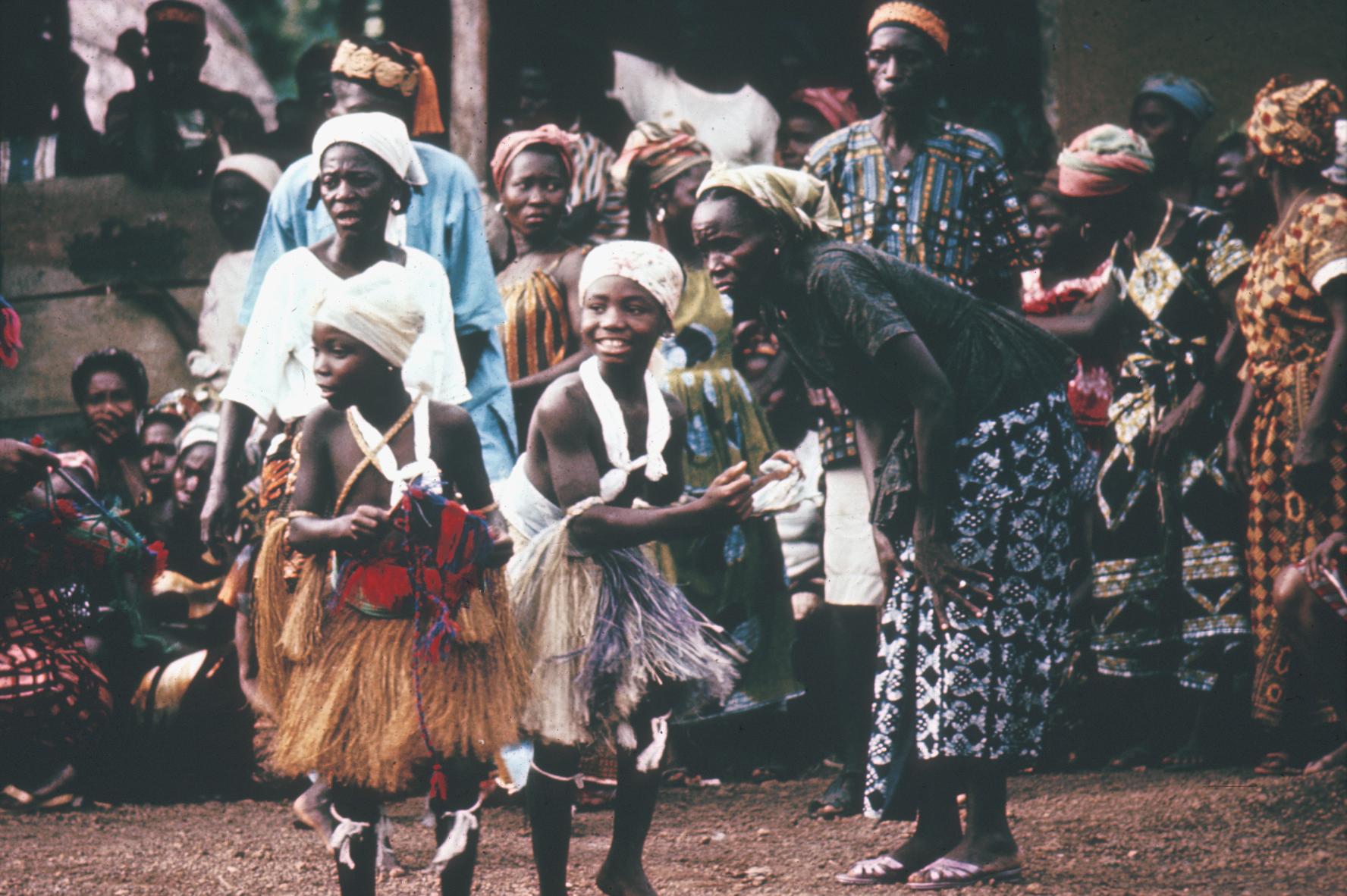
The global fashion industry operates on the concept of an institutional beauty standard that it treats as a modern invention: the magazine, the brand campaign, the influencer tier, the runway show that sets the season’s definition of what is beautiful and what is not. The Sande Society was running an institutional beauty standard before any of those mechanisms existed. Its mechanism is more complete than any of them. It is not a representation of beauty distributed through the media. It is a performance of beauty executed by the women who hold the institution’s highest authority, witnessed by the entire community, and internalised through the initiation process by the young women who will become the next generation of that community.
The fashion industry’s engagement with the sowei mask has been primarily through the lens of the art market, where sowei masks have been collected and sold internationally since the colonial period. The mask collected in 1886 at the British Museum exhibition is a reminder that the Western encounter with the sowei began through extraction, not engagement. What the Re-Entanglements project documents about the colonial entanglements of collected Sowei masks is that the objects were separated from the institutional knowledge system that gave them meaning. A sowei mask in a museum case is not a sowei. The sowei is the mask in motion, channelling hale, performing the beauty standard the Sande Society built. The fashion editorial that describes the mask as an object of visual interest has made the same separation without noticing it.
The Omiren Argument
The Sande Society built a complete institutional fashion system: a governing body, a visual standard, a performance mechanism, and an education programme, and it built this system for women, by women, enforced through women’s authority. The sowei mask and raffia costume are not ritual dress in the sense of dress worn for a ceremony and stored afterwards. They are the visual expression of the most powerful institution in their communities, worn by its highest-ranking officials at the moments when that power is most publicly exercised. Fashion editorial that describes the sowei as remarkable has already made an error. Remarkable implies that the standard of comparison is elsewhere, that something is being measured against an external norm and found to exceed it. The Sande Society is not exceeding an external norm. It set its own norm centuries ago and has maintained it ever since.
Omiren Styles covers the Sande Society not because it is extraordinary by Western fashion editorial’s measures but because it is a functioning proof that African women’s institutions have been designing, enforcing, and transmitting visual standards of power and beauty for longer than the global fashion industry has existed. The Sowei mask is the most visible evidence of that proof. It is carved wood, black raffia, and hale. It is the only masquerade in Africa where women wear the mask. It appeared on a national flag. It was exhibited at the British Museum. And it was doing all of this long before anyone in London or New York decided it was worth noticing. That timeline is the argument. Omiren Styles is the publication that was already in the room.
Frequently Asked Questions
What is the Sande Society, and where does it operate?
The Sande Society, known as Bundu or Bondo in Temne-speaking communities, is an all-female secret society and governing institution operating across Sierra Leone, Liberia, Guinea, and the Ivory Coast. It exists primarily among the Mende and Sherbro ethnic groups. Every woman in a Mende community belongs to Sande. The society oversees the initiation of girls into adulthood, provides education in health, household management, and civic responsibility, enforces laws, and presides at funerals, chief installations, and other community ceremonies. Its male counterpart is the Poro society. Together, the two institutions govern the social and ceremonial life of their communities.
Why is the SandeSoweii mask unique in African masquerade traditions?
The ceremonies of the Sande Society are the only occasions in Africa in which women customarily wear wooden masks. In almost all other West African masquerade traditions, the mask is a male domain. The Sande sowei masquerade, performed by the ndoli jowei or dancing sowei, reverses this structure completely. The highest-ranking women in the Sande Society are the ones who wear and dance the mask. The institution that commissions, owns, and controls the masquerade is a women’s institution. This makes the Sande Sowei the only documented masquerade tradition in Africa where women hold full creative, spiritual, and performative authority over the masked figure.
What does the Sowei mask’s physical form communicate?
Every carved feature of the sowei helmet mask encodes a specific argument about ideal womanhood in Mende society. The high, broad forehead represents wisdom and intellect — intellectual capacity is a component of physical beauty in Mende aesthetic philosophy. The ringed neck rolls at the base of the mask signal health, prosperity, and physical flourishing. The elaborate coiffure above the face panel symbolises social cooperation — a woman needs her community to style her hair, and the most beautiful woman is the most socially connected. The downcast eyes signal inner spiritual concentration. The lustrous black surface simultaneously references the rich riverbed mud where the Sande spirit dwells and the ideal complexion of healthy skin.
What is hale, and how does it relate to the Soweii costume?
Hale is a Mende concept describing a material spiritual force found in nature that trained initiates of medicine societies know how to channel. The word sowei translates most specifically as this medicine and the spiritual force embedded within it. The sowei mask, when danced, is a visual expression of hale. The woman who performs as ndoli jowei is not acting a role. She is channelling the spiritual force through her body, with the mask and raffia costume serving as the vehicle for that channelling. Hojo, a white substance applied by the Sande Society to objects and people under its protection, is the visible mark of Hale’s authority in the community.
How has the Sowei mask become a national symbol of Sierra Leone?
The sowei helmet mask of the Ndoli jowei masquerade has been recognised as a national symbol of Sierra Leone, appearing in national cultural documentation and as the subject of a 2013 British Museum exhibition titled Sowei: Spirit of Sierra Leone, which centred on a mask collected in 1886. The mask’s status as a national symbol reflects its position as the most complete expression of institutional female authority in Sierra Leone’s visual culture. The Sande Society’s influence across the country and the mask’s distinctiveness as the only African women’s masquerade tradition gave it a cultural prominence that naturally extended into national identity.
Explore More
Read the full Culture > Ceremony & Ritual section for Omiren Styles’ documentation of the ceremony dress traditions, institutional fashion systems, and cultural authorities that have been defining visual standards in Africa for centuries.