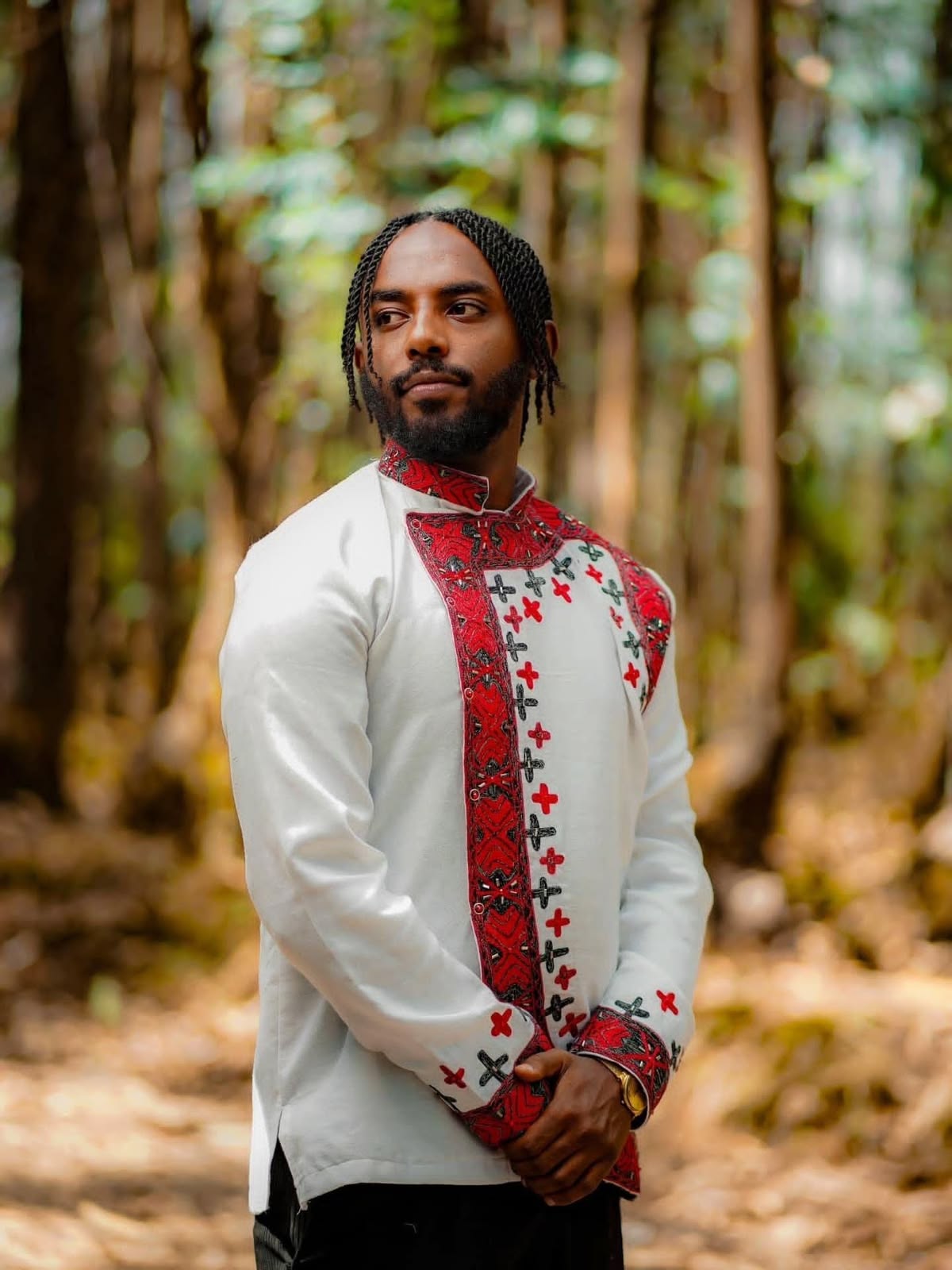
There is a persistent conflation in global fashion writing, in diaspora retail markets, and even in community conversations that needs to be addressed directly. Eritrean Tigrinya ceremonial dress is consistently collapsed into the Ethiopian Habesha tradition, treated as a regional variation of a shared aesthetic rather than as a culturally and politically distinct practice in its own right.
It is not a variation. It is its own system.
Eritrea and Ethiopia share the Habesha civilisational heritage, and both carry the Tigrinya language and the Orthodox Christian faith into their highland communities. Those shared roots are real and significant. They are also not the whole story. Eritrea fought a thirty-year war of liberation from Ethiopian annexation, achieving independence in 1993 after a UN-monitored referendum in which 99.8% of Eritreans voted for sovereignty. According to academic scholarship, including Jacquin-Berdal and Mengistu (2006), the independence struggle cost approximately 65,000 combatants’ lives and an estimated 150,000 to 250,000 civilian deaths. Eritrea has spent the three decades since then constructing and defending a national identity that is explicitly not Ethiopian. That political and historical context does not disappear when an Eritrean man puts on his ceremonial dress. It is embedded in it.
This guide names the specific garments of Eritrean Tigrinya men’s ceremonial dress, explains what makes each one distinct, and argues that these distinctions matter in the diaspora, in the fashion conversation, and in how we understand dress as political identity.
Eritrean Tigrinya men’s ceremonial dress is not a variation of the Ethiopian Habesha tradition. It is a distinct system. Here is how to read the difference.
The Kidan Habesha: Eritrea’s Core Ceremonial Suit
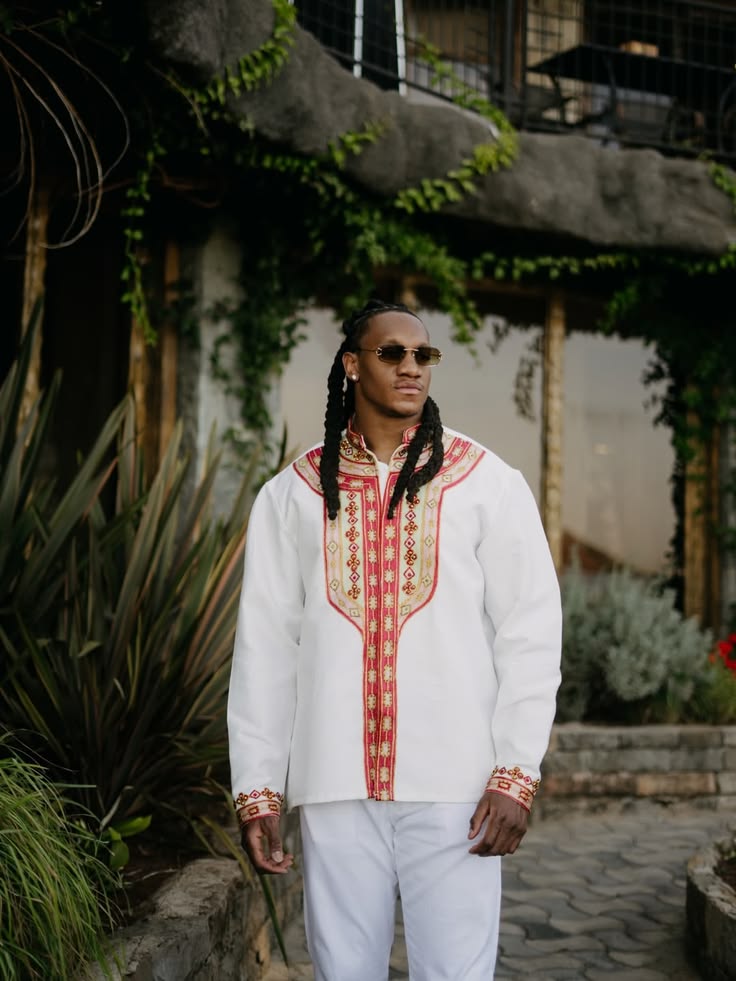
The primary ceremonial garment for Eritrean Tigrinya men is the Kidan Habesha, also known as ije tebab. It is the garment that appears at weddings, Orthodox Christian religious ceremonies, national holidays, and formal cultural gatherings. Understanding it precisely is the beginning of understanding Eritrean men’s ceremonial dress as a system.
The Kidan Habesha consists of two core components. The first is a long-sleeved shirt, knee-length in cut, typically made from white cotton or fine chiffon. The collar is close and self-contained, giving the garment a clean silhouette that reads as formal through containment rather than ornamentation. The second component is matching trousers in the same white or near-white fabric, cut to complement the shirt’s length and drape.
Over this two-piece base, the man wraps a sheer gauze-like cloth, the netela or a lightweight gabi, around the shoulders and chest. This is not a fixed arrangement. The draping is deliberate and variable: some men wrap the shawl fully around the shoulders and allow it to fall across the chest; others take the extra material and wrap it around the waist, creating a second layer over the trousers before bringing the remaining length back to the shoulder, as Wikipedia’s Kidan Habesha entry documents. This flexibility in draping is itself a form of sartorial communication. The arrangement of the shawl signals occasion, formality level, and personal expression within a fixed vocabulary.
The whole ensemble in white or off-white is the visual baseline of Eritrean Tigrinya men’s formal dress. White in this tradition is not the absence of a statement. It is the statement itself: purity, solemnity, and the elevation of the ordinary to the ceremonial.
The Gabi and the Shamma: Wrapping as Social Language
The outer wrap, whether the gabi, the shamma, or the netela, is where Eritrean men’s ceremonial dress becomes a social language rather than simply a garment choice.
The gabi is a handmade cotton cloth, thicker and more substantial than the netela, constructed from four layers of woven cotton. It is a shared textile tradition across the Habesha world, worn in both Eritrea and Ethiopia. In Eritrea, it is draped over the shoulders and upper body, and its weight and construction communicate the seriousness of the occasion. The gabi is particularly associated with religious ceremony and with older people, whose wearing of it carries an additional layer of respect-signalling. When a man at a wedding wears a gabi over his Kidan Habesha, he is communicating not just formality but gravitas.
The shamma is a large white cloth with coloured woven edges, worn across the shoulders in a lighter, more flowing drape. Its coloured borders are the detail that carries meaning. As documented in Waples Gibson (1998), the width of the border varies from a few centimetres to a quarter of a metre or more. It conveys the richness and dignity appropriate to the occasion. Thicker, more elaborate borders denote higher formality; simpler edges denote everyday wear or more modest occasions.
What matters here, and what the conflation with Ethiopian dress consistently erases, is that in Eritrea the specific arrangement of these wraps, their fabric weight, and their border patterns follow conventions developed within the specific cultural geography of the Eritrean highlands, shaped by the Tigrinya communities of Asmara, Mendefera, Dekemhare, and the surrounding plateau, and are not identical to the Ethiopian arrangements that have been globally disseminated through the Addis Ababa fashion market and its diaspora retail networks.
Why the Conflation Happens and What It Erases
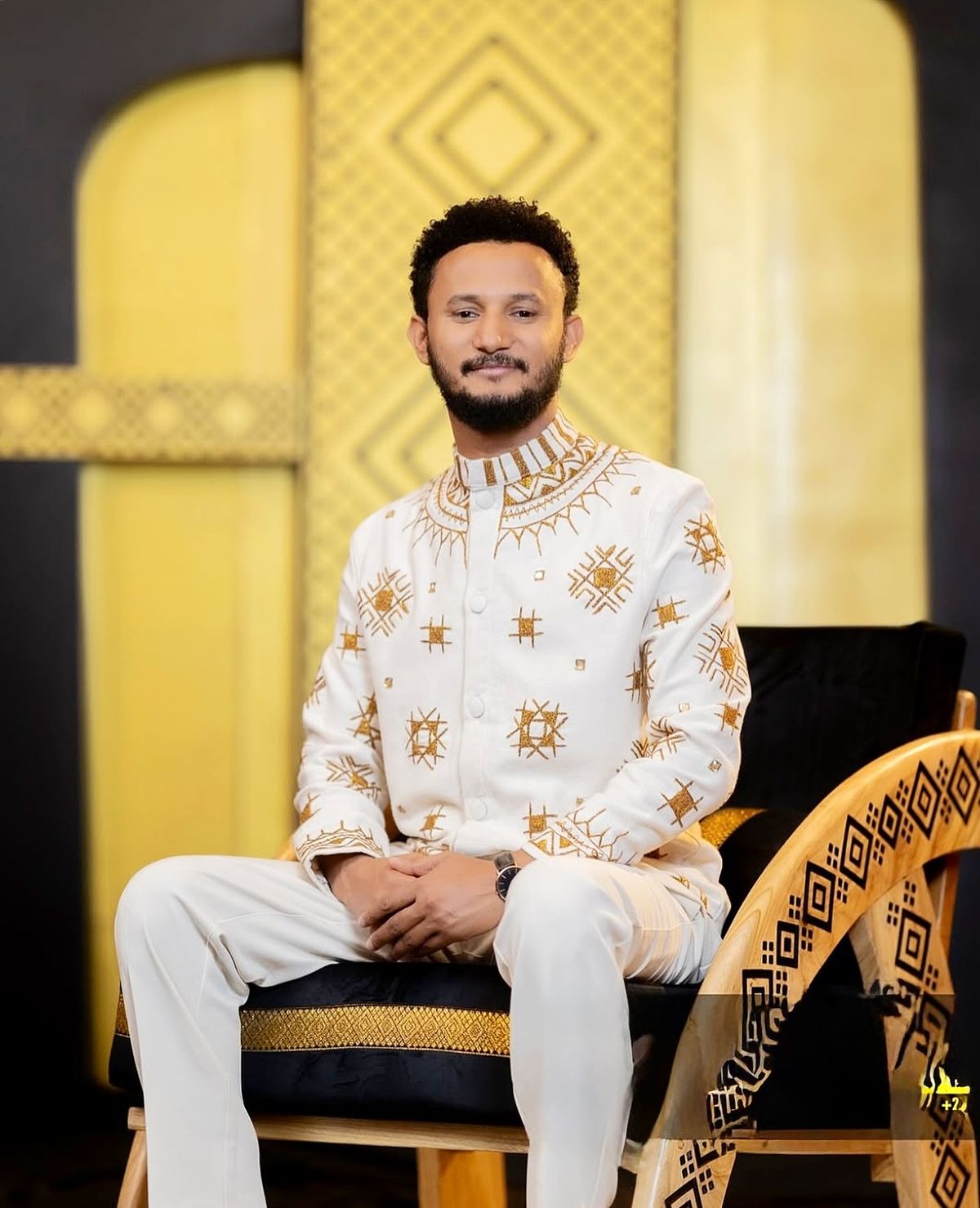
The conflation of Eritrean and Ethiopian dress traditions is not simply an error of inattention. It has a structural cause: the global Habesha fashion market is overwhelmingly channelled through Addis Ababa.
The standard commercial zuria, the white cotton dress associated with the Habesha kemis, is produced and mass-distributed out of Addis Ababa and sold in Eritrean diaspora markets alongside Ethiopian products under a shared “Habesha” category. Wikipedia’s entry on the Zuria acknowledges that the standard commercial garment reaches Eritrea through separate channels. At the same time, local tailors in Asmara use jadid fabric for everyday domestic traditional garments, maintaining a distinct local textile practice that the commercial Addis Ababa pipeline does not represent.
For men’s dress, the same dynamic applies. Ethiopian men’s ceremonial attire is so similar in silhouette to the Kidan Habesha that diaspora retailers routinely sell both under the single label “Ethiopian/Eritrean suit” or “Habesha suit.” The suits are broadly similar. But the embroidery details, the draping conventions, the fabrics associated with specific occasions, and most significantly, the political meaning carried by the garment differ. An Eritrean man wearing his ceremonial dress at an Eritrean independence day celebration on 24 May is not wearing a variation of Ethiopian dress. He is wearing a garment that carries within it the history of a thirty-year war, a 99.8% referendum, and an identity that was forged in explicit opposition to Ethiopian political domination.
The fashion industry, including diaspora fashion retail and online marketplaces, has been slow to register that difference. It is not a small distinction to paper over.
Eritrean Tigrinya Men’s Dress for Ceremonial Occasions
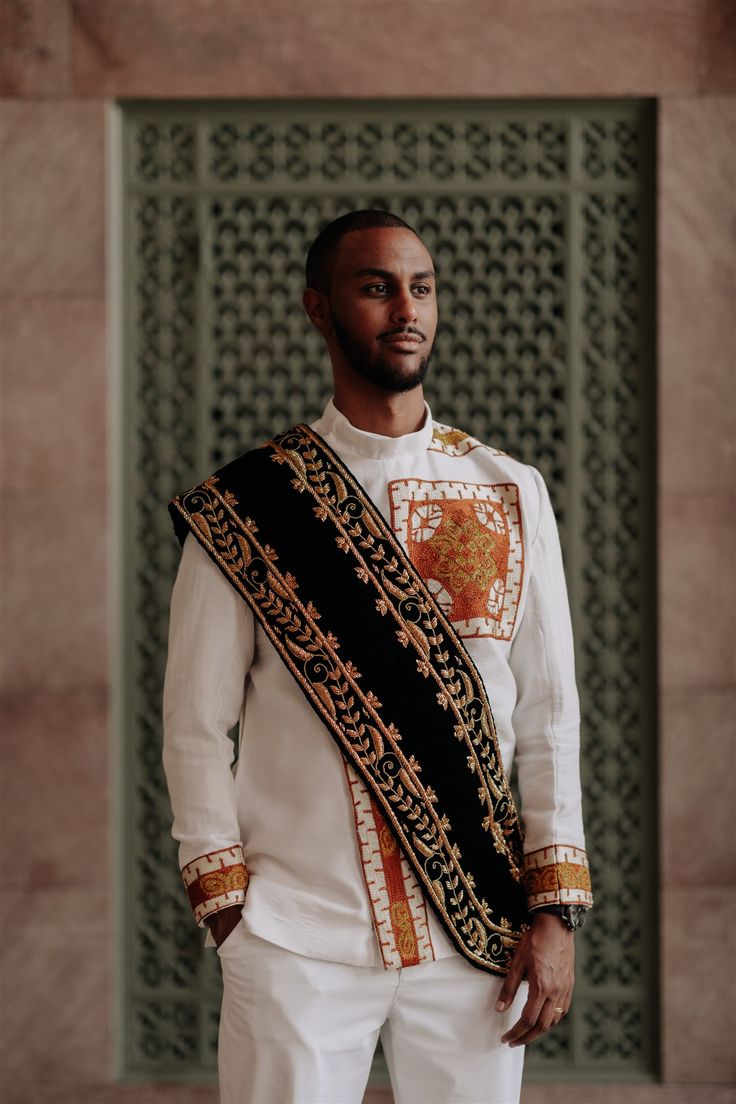
The Kidan Habesha and its layered wrapping are not a single outfit worn identically on all occasions. Eritrean Tigrinya men’s ceremonial dress operates on a register of formality that shifts with context, and understanding those shifts is part of reading the tradition accurately.
At weddings, the full Kidan Habesha in white or cream, with a formal gabi draped over it, is the expected attire for male guests and family members. The groom’s dress is typically the most precise version of this: the shirt and trousers cut from finer fabric, the draping of the netela arranged with particular care. The white of the suit against the black Lakhel of the Eritrean bride (the traditional black bridal robe that distinguishes Eritrean wedding dress from the multi-coloured Ethiopian bridal tradition) creates a visual pairing that is itself a statement of cultural specificity.
At Orthodox Christian religious celebrations, Timkat (Epiphany) and Meskel (the Finding of the True Cross) are the major highland occasions; the gabi takes precedence over the lighter netela. The weight and solemnity of the gabi signal alignment between the dress and the sacred nature of the occasion. Elder men attending church in full gabi draping are a specific visual register of Eritrean highland communal religious life.
On Independence Day and national cultural celebrations, the Kidan Habesha takes on its most explicitly political dimension. Worn at events marking Liberation Day on 24 May, it connects the wearer to the independence struggle and the national identity forged through that conflict. The diaspora in London, Frankfurt, and Washington wears it on this day as a declaration of national belonging that needs no translation.
The Omiren Argument: Distinct Does Not Mean Opposed
Here is the argument that needs to be made with precision: insisting on the distinctiveness of Eritrean Tigrinya men’s ceremonial dress is not a gesture of hostility toward Ethiopian tradition. It is a demand for accuracy.
The Habesha civilisational heritage is shared. The specific national expressions of that heritage are not. When Eritrean men’s dress is labelled “Ethiopian” in diaspora markets, in fashion editorial, or in cultural documentation, it does not simply create a retail categorisation problem. It performs the same erasure that Eritrean political sovereignty was fought to reverse. Eritrea spent thirty years and the lives of approximately 65,000 combatants and an estimated 150,000 to 250,000 civilians asserting that its cultural and political identity was not a subset of Ethiopia’s. The 1993 referendum, with its 99.8% vote for independence confirmed by UN monitoring, was a definitive collective statement on that question.
Dress is one of the most visible places where that assertion of identity is made in daily and ceremonial life. The Kidan Habesha worn at an Eritrean wedding in Asmara, London, Washington, or Frankfurt is an Eritrean garment. It draws on shared Habesha textile traditions. It uses the same white cotton, the same draping conventions, the same broad silhouette that appears in highland dress across the Horn. And it is Eritrean, in the specific embroidery details, in the occasions it marks, in the political history it carries on its back.
The Omiren argument is this: writing about African dress with the specificity and cultural intelligence it deserves means refusing the shortcuts. “Ethiopian/Eritrean” as a single category is a shortcut. Eritrean Tigrinya men’s ceremonial dress is its own tradition. It has its own name, Kidan Habesha, ije tebab. It has its own occasions, its own diaspora practices, and its own political weight. As Omiren Styles has documented across its analysis of African dress as political identity, a garment that carries an argument cannot be reduced to its physical form. It deserves to be named and known as itself.
Distinct does not mean opposed. It means: this tradition has its own name, its own history, and its own right to be called what it is.
ALSO READ
- Kabyle Amazigh Wedding Dress Algeria: Thakandorth, Ath Yenni Silver, and the Kabylia Tradition
- When Dressing Becomes Declaration: Clothing as Cultural Identity
- Fashion and Ritual: How Celebrations Shape African Style Practices
Frequently Asked Questions
What is the Kidan Habesha, and who wears it?
The Kidan Habesha (also called ije tebab) is the traditional ceremonial suit worn by Eritrean Tigrinya men at formal occasions, including weddings, Orthodox Christian religious festivals such as Timkat and Meskel, and national holidays. It consists of a long-sleeved, knee-length white shirt and matching trousers, typically in white cotton or fine chiffon, worn with a gauze-like netela or heavier gabi shawl draped over the shoulders and chest. As documented in the Kidan Habesha entry, the garment is also known as ije tebab and represents the quintessential formal attire in Eritrean Tigrinya male ceremonial dress.
What is the difference between Eritrean and Ethiopian men’s traditional dress?
Both traditions draw on the shared Habesha civilisational heritage and use broadly similar silhouettes: white cotton shirts, trousers, and draped shawls. The distinctions lie in the specific embroidery details, draping conventions, fabric associations for particular occasions, and, most importantly, the political and national identity carried by each tradition. Eritrean dress, developed within the specific cultural geography of the Eritrean highlands and shaped by Asmara’s tailoring culture, is a distinct national tradition rather than a regional variation of Ethiopian dress. The commercial global market, dominated by Addis Ababa distribution networks, has historically blurred this distinction under a single “Ethiopian/Eritrean” or “Habesha” product category.
What is the gabi, and how is it different from the netela in Eritrean men’s dress?
The gabi is a thicker, four-layered handmade cotton cloth draped over the shoulders, associated with religious ceremony and elder formality. It is a shared textile across the Habesha world, worn in both Eritrea and Ethiopia. The netela is lighter and more gauze-like, used for weddings and general formal occasions. Both serve as the outer wrap worn over the Kidan Habesha suit, and the choice between them, as well as the specific way each is arranged, communicates the occasion’s level of formality and the wearer’s social position within the gathering.
Why is the Eritrean men’s ceremonial dress important for the diaspora?
For the Eritrean diaspora in London, Frankfurt, Washington, and beyond, the Kidan Habesha worn at celebrations marking Liberation Day (24 May) and at weddings is a declaration of national identity that requires no translation. Eritrea’s thirty-year war of independence and the 1993 referendum, in which 99.8% of voters chose sovereignty, make the garment explicitly political as well as cultural. Wearing it is an act of belonging to a national history, not merely a cultural performance.
How can I identify authentic Eritrean-made traditional garments?
Authentic Eritrean ceremonial garments, particularly those made by Asmara’s local tailors, use jadid fabric for everyday domestic versions and finer cotton or chiffon for ceremonial pieces. Embroidery patterns vary by occasion and family tradition. Many diaspora retailers sell garments labelled “Ethiopian/Eritrean” that originate from Addis Ababa commercial networks. For the most culturally specific versions, source from Eritrean tailors within diaspora communities or directly from Asmara-based artisans.