Fabric travels.
It moves across oceans, through trade routes, across empires and economies. It arrives in places it was not made for, carried by systems that rarely consider the people who will eventually wear it.
But what happens after arrival is a different story.
In Southern Africa, a printed cotton fabric—industrial in origin, global in circulation was absorbed into local life with such depth that it ceased to be foreign. It became foundational.
Today, shweshwe is widely recognised as part of South Africa’s cultural identity. It appears in ceremonies, in everyday dress, in contemporary fashion collections. It is associated especially with Xhosa and Sotho women, whose garments have shaped its meaning over generations.
But shweshwe did not originate here.
Which raises a more important question:
How does something that arrives from elsewhere become something that belongs?
Discover how shweshwe fabric in South Africa evolved from its European and Indian origins into a defining element of Xhosa and Sotho traditional dress.
A Fabric That Came From Elsewhere

Shweshwe’s origins are layered.
It is commonly traced to indigo-dyed textiles produced in Europe, particularly in Germany, during the 19th century. These fabrics were influenced by earlier Indian textile traditions, especially block printing and dyeing techniques that circulated through Indian Ocean trade routes.
From there, the fabric moved again into Southern Africa.
Missionaries, traders, and colonial systems introduced it into local markets. At that stage, it was not cultural. It was material.
What transformed it was not its origin, but its adoption.
Adoption Is Not Passive
When Xhosa and Sotho women began wearing shweshwe, they did not adopt it casually.
They built systems around it.
Garments were structured deliberately: long skirts, fitted bodices, layered aprons, and head coverings. The fabric was cut, shaped, and styled according to local aesthetics and social meanings.
Over time, these garments became codified. Certain styles were associated with marriage, others with initiation, and others with everyday life.
This was not borrowing.
It was construction.
The Making of Tradition
Tradition is often misunderstood as something that must originate in one place and remain unchanged.
But in practice, tradition is built.
In South Africa, shweshwe became traditional not because of where it came from, but because of how it was used.
Generation after generation repeated the same forms:
- The way the fabric was pleated
- The way it was layered
- The occasions it was worn
- The meanings attached to it
Repetition created familiarity.
Familiarity created identity.
And identity, sustained over time, becomes tradition.
Pattern, Colour, and Recognition
Shweshwe is instantly recognisable.
The fabric is known for its intricate geometric patterns, typically printed in indigo blue, brown, or red tones. The designs are small-scale, repetitive, and precise.
But the recognition is not only visual.
It is contextual.
To see shweshwe in a specific silhouette, worn in a particular way, within a specific cultural setting, is to understand what it signifies.
The fabric alone is not the identity.
The system around it is.
From Ceremony to Contemporary Fashion
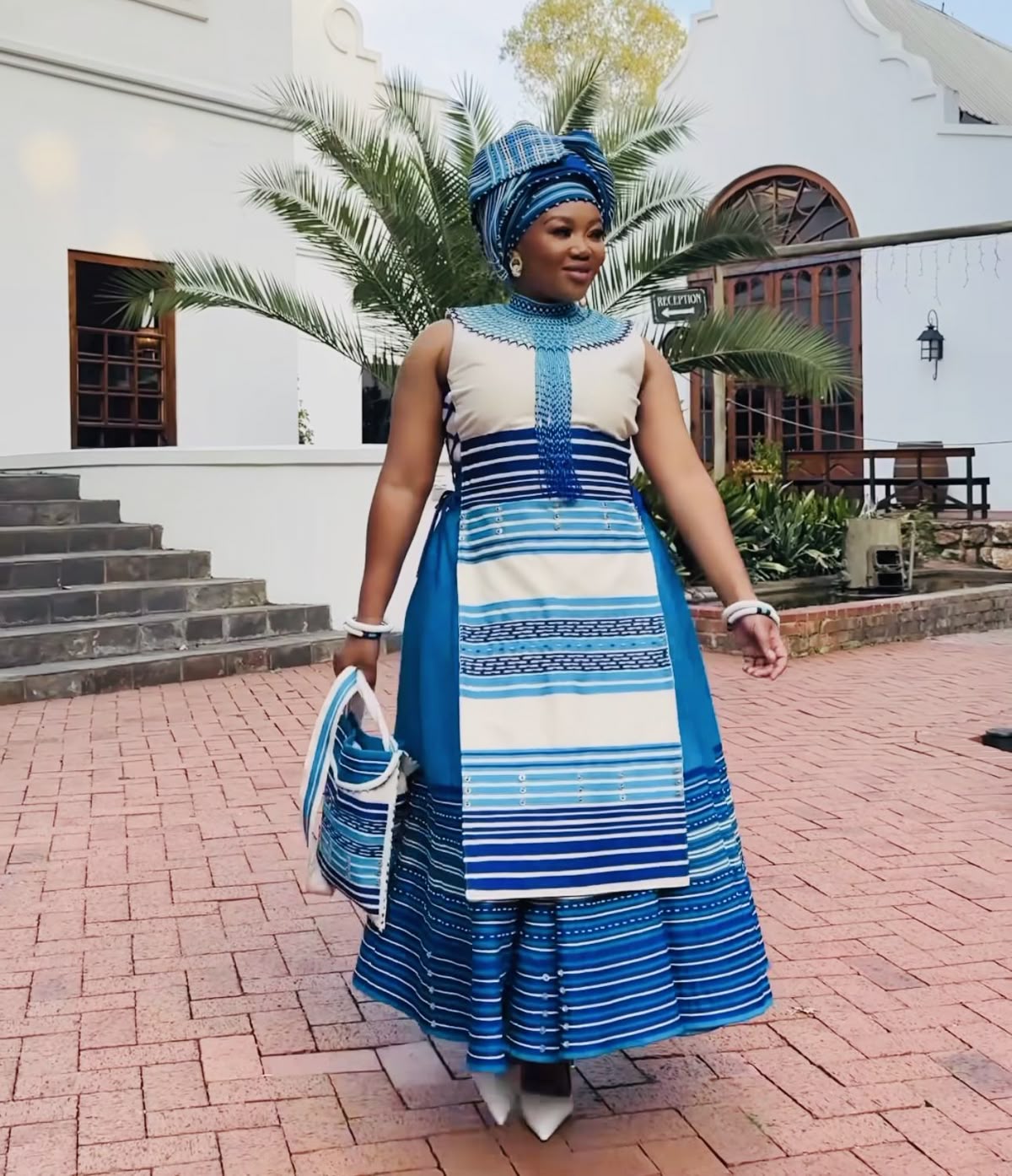
Shweshwe has not remained static.
It has moved from strictly traditional garments into contemporary fashion. Designers reinterpret it through modern silhouettes—structured dresses, tailored pieces, hybrid garments that blend Western and African forms.
But even within these reinterpretations, the cultural reference remains intact.
This is because the meaning of shweshwe is not fragile.
It has been reinforced through generations of consistent use.
The Question of Ownership
At a surface level, the story of Shweshwe raises familiar questions.
If the fabric originated elsewhere, can it truly belong to South Africa?
This question assumes that origin determines ownership.
But fashion history suggests otherwise.
Ownership in dress is not fixed at the point of production. It is established through use, meaning, and continuity.
The communities that adopt, adapt, and sustain a material over time become its primary authors.
In this case, that authorship belongs to the women who built an entire dress system around shweshwe.
Why Origin Is Not Authority
To insist that shweshwe belongs to its European or Indian origins is to misunderstand how culture works.
Textiles have always moved.
What matters is not where they start, but where they are transformed.
In Southern Africa, shweshwe was not preserved in its original form. It was recontextualised.
Cut differently.
Worn differently.
Given new meaning.
That transformation is what defines its identity today.
READ ALSO:
- When the Gele Speaks: The Cultural Language of Yoruba Head-Tying
- Dancehall Fashion: Jamaica’s Most Influential Export That Fashion Media Refuses to Credit
- The Caribbean–African Fashion Corridor: How Lagos, Trinidad, and Jamaica Built A Shared Visual Culture
Cultural Ownership as Process
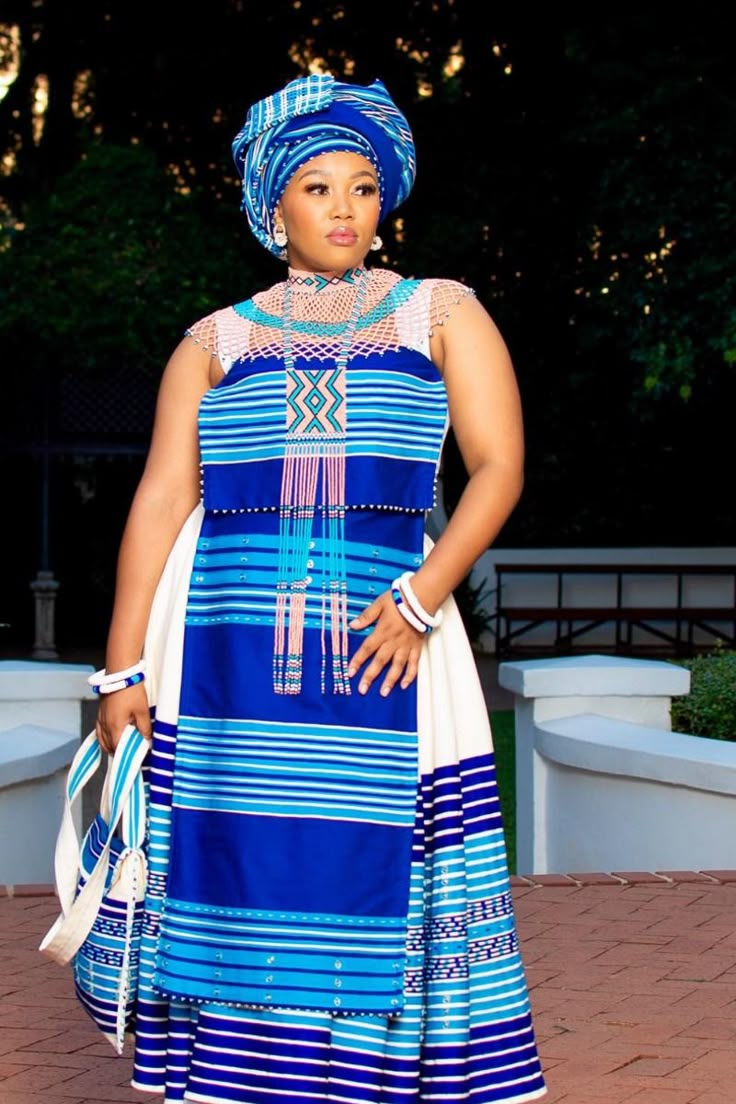
Cultural ownership is not a legal claim.
It is a process.
It happens when a material becomes embedded in daily life, ritual, and identity. When it is passed down, reinterpreted, and sustained across generations.
Shweshwe meets all of these conditions.
It is worn in ceremonies.
It is associated with specific communities.
It carries meaning that is locally understood.
This is what makes it Afrocentric—not its origin, but its integration.
What Shweshwe Reveals About Fashion
Shweshwe challenges a common assumption globally—that authenticity must be tied to origin.
Instead, it suggests that authenticity can be built.
Through use.
Through repetition.
Through meaning.
It also reveals how African fashion systems operate differently from Western frameworks. Rather than isolating material from context, they integrate fabric into broader cultural structures.
The result is not just clothing, but continuity.
OMIREN Argument
Shweshwe did not become African because it was designed that way.
It became African because it was so claimed.
The women who adopted it did not preserve its origin. They disrupted it. They removed it from the systems that produced it and embedded it into entirely different ones—social, cultural, and generational.
That act is not an adaptation.
It is authorship.
The global fashion industry still struggles with this idea. It continues to locate ownership at the point of manufacture, at the origin of the textile, at the site of production.
But African fashion has never operated on that logic.
Ownership is not where something begins.
It is where it is made to mean something.
Shweshwe belongs to Southern Africa not because it was produced there, but because it was transformed there—repeatedly, intentionally, and over time.
This is what Afrocentric design practice reveals.
That culture is not defined by purity of origin, but by depth of integration.
And that the people who build meaning into material are the ones who own it.
Frequently Asked Questions (FAQs)
- What is shweshwe fabric?
Shweshwe is a printed cotton fabric widely used in South African traditional dress, known for its geometric patterns and indigo tones.
- Where did shweshwe originate?
It has roots in European manufacturing influenced by Indian textile traditions and was introduced to Southern Africa through trade and missionary activity.
- Which cultures wear shweshwe?
It is commonly associated with Xhosa and Sotho communities in South Africa.
- Is shweshwe still used today?
Yes, it is worn in both traditional ceremonies and modern fashion.
- Why is Shweshwe considered African?
Because it has been fully integrated into South African cultural systems and sustained across generations.