
“Filimi,” translated as “Remember Me,” is the name of one motif in Nadia Adanlé’s “Apusomɛ.” Drawing on the Atlantic seabed, the designer conceived it for people who died at sea without graves. Adanlé described the Atlantic as the world’s largest graveyard because of its tragic history, and said that those who died there should at least have a fabric that remembers them. The statement gives the textile a commemorative purpose: remembrance is not simply a theme accompanying the collection but an intention attached to a particular pattern.
Presented on 24 October 2026 at Indigo Village, beside Lake Toho in the municipality of Ouidah, “Apusomɛ” is Couleur Indigo’s nineteenth collection. Its 16 new patterns draw on marine life, bringing fish, shells, octopus, jellyfish, turtles and coral into the enterprise’s textile vocabulary. Within that range, “Filimi” introduces another reading of the Atlantic, one in which an environment of living forms also holds historical loss.
The collection arrives within a larger economy of cloth. UNESCO’s 2023 report on the fashion sector in Africa put the market value of clothing and footwear in sub-Saharan Africa at US$31 billion in 2020. Within that $31 billion African fashion market, Beninese textile design is often reduced to a colour or a craft label. “Apusomɛ” asks for closer reading.
Nadia Adanlé’s Apusomɛ collection uses 16 indigo patterns to explore marine life and Atlantic remembrance at Couleur Indigo in Ouidah, Benin.
Sixteen Patterns, One Marine Vocabulary
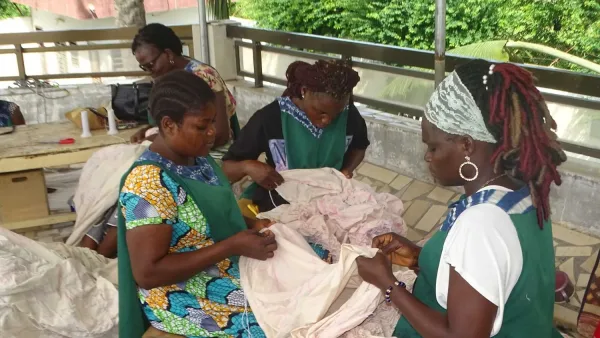
The Apusomɛ collection’s named designs include Lanvigan, Nussianu, Corail Intégral, Filimi and Scallop. Joel Kouam’s report on “Apusomɛ” for Africanews identifies them as part of a range inspired by the ocean landscape, crafted by Beninese artisans and presented through clothing during the lakeside show. The report says each motif carries its own symbolic meaning, though it explains only one.
The number matters less than the way Adanlé organises the collection around distinct patterns. “Apusomɛ” is not introduced as one signature image transferred across different products. Its premise is a vocabulary through which the same environment can generate multiple textile propositions.
Naming is part of that authorship. A named pattern can be recognised, discussed and requested as a particular work rather than treated as an anonymous example of “African fabric.” Omiren Styles’ glossary of textile terms fashion keeps getting wrong argues that the broad label obscures where a textile comes from and where its value goes. “Filimi” demonstrates the importance of that distinction: its meaning cannot be recovered simply by identifying a marine reference. Adanlé’s explanation supplies an intention that the title alone would not fully reveal.
This relationship between motif and interpretation belongs within the wider discussion of Beninese textiles and their symbolism. Here, however, the significance is contemporary and specific. The designer is not only receiving inherited meanings; she is proposing new ones.
What “Filimi” Asks Cloth to Carry
Adanlé’s explanation gives “Filimi” the article’s clearest interpretive anchor. Looking to the Atlantic, she conceived a fabric that could remember those who perished there. That purpose distinguishes it within the collection without requiring every marine motif to carry the same historical meaning.
The proposition is intimate. Cloth can be worn against the body, folded, stored, displayed or passed between people. As a medium of remembrance, it offers possibilities different from a fixed monument: the commemorative object can enter domestic life and move with its owner.
Indigo cloth has carried memory in West Africa before. Omiren Styles has examined, in its account of how adire cloth holds memory, labour and place, how a Yoruba indigo tradition records the water, hands and cities that made it. “Filimi” extends that capacity in a new direction, from the memory of a place of making to the memory of people who were lost at sea.
That is a reading of the textile’s potential, not a claim about how every customer will understand it. Its force nevertheless lies in the connection Adanlé makes between the material and the absent body. The fabric stands for an intention to remember someone whose resting place cannot be visited.
The setting gives that intention weight. Ouidah lies on the coast of what was the Kingdom of Dahomey, and Omiren Styles has traced, in its analysis of Santería, Candomblé and Vodou, how the spiritual traditions of the Fon people of Dahomey travelled across the Atlantic and became the foundation of Haitian Vodou. The ocean Adanlé draws on is both a living environment and a route of forced crossing.
“Apusomɛ” therefore holds marine life and loss together. The ocean is not reduced to tragedy, nor is it treated only as decorative inspiration. “Filimi” changes the collection’s register, allowing remembrance to sit within a broader body of work rather than making all 16 patterns illustrations of one story.
A Nineteenth Collection Has a History
The collection belongs to an established practice. The Biennale de Dakar’s profile of Collectif Couleur Indigo dates the enterprise’s creation in Cotonou to 2007 and its development in Burkina Faso to 2011. It identifies Adanlé as an engineer by training and an entrepreneur focused on natural indigo dyeing, and describes the enterprise as now based in Ouidah, a historic indigo territory. The collective appears in the Design section of the official programme of the 2026 Dakar Biennale.
That chronology matters because “Apusomɛ” should not be framed as an unexpected arrival. A nineteenth collection reflects ongoing decisions about what to make, how to develop a recognisable practice, and where to take it next. The useful question is not whether indigo can be contemporary, but what Adanlé is doing with it now.
The Biennale profile describes an approach that extends from cultivating dye plants to dyeing, design, commercialisation, and recycling textile waste. This establishes a wider field of activity around the finished fabric. It also places the designer within a network of processes rather than presenting her as an isolated source of inspiration.
The material itself has deep roots in the region. Omiren Styles’ guide to tie-dye traditions among Mandinka women notes that African indigo-dyeing traditions date back at least 700 years. Benin indigo belongs to that long West African history, and Adanlé’s contribution remains distinct within it: she uses an established textile practice to develop a particular collection with its own subjects and intentions. Couleur Indigo has also shown its work in wider professional settings, including the 2024 World Cotton Day fashion show in Cotonou organised with the Ethical Fashion Initiative.
Indigo Village Connects Making With Encounter
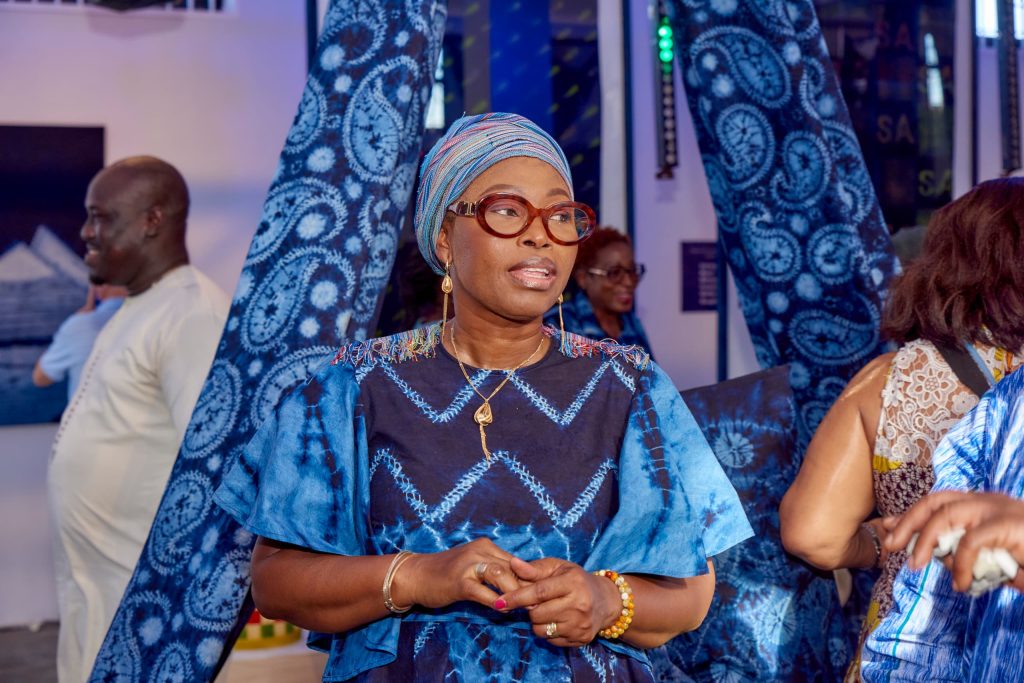
Couleur Indigo is the textile enterprise; Indigo Village is the setting in Ouidah where “Apusomɛ” was presented and where the indigo process is made accessible to visitors. Africanews describes the village as a showcase extending from raw-material preparation and dyeing to textiles and finished products, and as a promoter of cultural and artistic tourism in Ouidah. At the presentation, Coline-Lee Toumson-Venite, who leads arts, culture and creative industries projects for the Presidency of Benin, described Adanlé’s work as a valuable asset for cultural and creative tourism.
The lake and ocean perform different roles in the collection’s account. Lake Toho provided the presentation setting; the Atlantic supplied its imaginative and commemorative references. The distinction locates the work without confusing its subject with the place where audiences encountered it.
Couleur Indigo’s official website advertises immersive guided visits that explain natural indigo dyeing and participatory workshops where visitors can personalise clothing with indigo. It lists clothing, fabrics, home products, recycled items and accessories, alongside accommodation with a view of Lake Toho, restaurant services and activities on the lake. Making, interpretation, hospitality and commerce consequently appear within the same public offer.
This arrangement gives the collection a setting beyond the runway. Visitors can encounter textile production as a sequence of decisions and skills, while finished products show some of the uses for which that knowledge can be put to work.
Transmission is therefore more than a statement about preserving the past, or a slogan attached to a product. It becomes an activity: explaining a process, enabling participation and giving people reasons to return to the material.
From Textile Knowledge to a Public Collection
Adanlé’s stated priorities are both practical and cultural. Speaking to Africanews, she identified promoting indigo and reviving it from neglect, improving the product’s quality, building a more prestigious image for it, and sustaining creativity as central to her approach. The presentation brought those ambitions together by placing the fabrics on bodies before an audience.
The show and the workshop serve different purposes. One communicates the finished proposition; the other exposes the knowledge behind it. Neither alone explains the enterprise. Together, they establish a relationship between what a textile means, how it is made and how it reaches people.
“Apusomɛ” is strongest as an authored proposition within that system. Its marine vocabulary supplies the collection’s subject, while “Filimi” demonstrates how a particular pattern can be given a purpose beyond ornament.
What the Collection Asks of Its Audience

“Apusomɛ” makes demands on the people who encounter it. A visitor to Indigo Village Ouidah can admire the blue of a shell or a turtle without knowing anything about the Atlantic’s history. A wearer can choose a pattern for its shape alone. The collection allows both responses. What it adds, through “Filimi,” is an invitation to read further.
That invitation matters for coverage as much as for customers. A report that describes the collection only as marine-inspired indigo misses its most specific claim. A report that treats every pattern as a memorial overstates it. The accurate account sits between the two: sixteen marine designs, each said to carry its own meaning, and one whose meaning the designer has chosen to explain publicly.
For readers interested in Beninese textile design, that precision is the point. Adanlé has given her audience enough information to understand one pattern fully and enough restraint to leave the others open. The collection rewards attention rather than demanding agreement, and it trusts the people who wear it to carry that meaning forward.
The Omiren Argument
“Apusomɛ” asks that indigo be considered as a medium of authorship, not merely a marker of heritage. Adanlé names patterns, connects one explicitly to remembrance and presents the work within a practice that includes making and teaching.
Its distinctive contribution lies in that specificity. “Filimi” does not stand for every indigo textile or every history associated with Ouidah. It is one designer’s deliberate proposition within a larger collection. Recognising that authorship gives the cloth, and the people making it, more attention than a general celebration of tradition can provide.
ALSO READ
- Ade Bakare and Adire: When Yoruba Indigo Cloth Meets Global Couture.
- African Sacred Textiles: Adire, Kente, Aso-Oke, and Bogolan Reclaim Global Luxury.
- Porto-Novo After Hours: Fashion at the Edge of History.
- Vodun Ceremonial Dress in Togo: The Theology You Wear.
Frequently Asked Questions
Who is Nadia Adanlé?
Nadia Adanlé is an engineer by training and an entrepreneur who leads Couleur Indigo, a textile enterprise created in Cotonou in 2007, developed in Burkina Faso from 2011, and now based in Ouidah. Its practice centres on natural indigo dyeing and covers growing dye plants, dyeing, design, sales and recycling textile waste. The collective appears in the 2026 Dakar Biennale programme.
What is the Apusomɛ collection?
“Apusomɛ” is Couleur Indigo’s nineteenth collection. It comprises 16 new indigo patterns inspired by the seabed, including fish, shells, octopuses, jellyfish, turtles and coral, with named designs such as Lanvigan, Nussianu, Corail Intégral, Filimi and Scallop. It was presented on 24 October 2026 at Indigo Village, beside Lake Toho in Ouidah.
What does “Filimi” mean?
Africanews translates “Filimi” as “Remember Me”. Adanlé describes it as a commemorative fabric for people who died in the Atlantic without graves, an ocean she called the world’s largest graveyard because of its history. The stated meaning belongs to that motif specifically; the report says each pattern has its own symbolism but explains only this one.
Can visitors learn about indigo dyeing at Couleur Indigo?
Yes. Couleur Indigo, the textile enterprise, advertises immersive guided visits explaining natural indigo dyeing and participatory workshops where visitors personalise clothing with indigo. Indigo Village in Ouidah, where the collection was presented, is described as showcasing the full process from raw materials to finished products. The site also lists accommodation, dining and activities on Lake Toho.