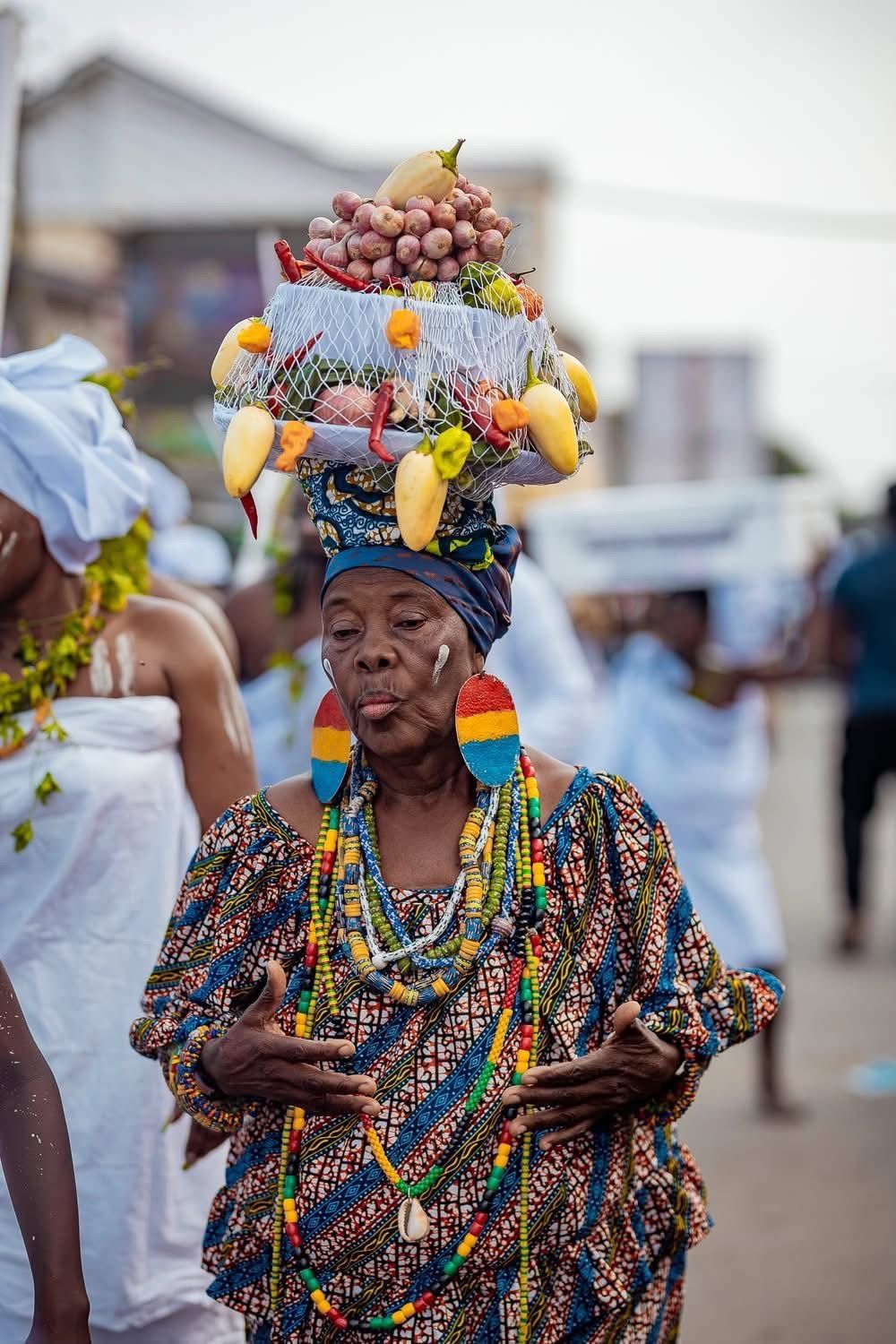
There is a street in Havana where you can read a person’s religious life in their clothing before they say a word. The man wearing red and black beads at his neck is a devotee of Elegua, the orisha of crossroads and destiny. The woman dressed entirely in white, from headscarf to shoes, is newly initiated, in the first year of a commitment that will govern her dress for the next 12 months. The child wearing yellow is under the protection of Oshun, the orisha of rivers, love, and abundance. Walk the same street on a ceremony day, and the visual information becomes richer still: deep blue for Yemaya, the ocean mother; white and clear for Obatala, the king of white cloth; red and white for Shango, the orisha of fire and thunder. An entire theology, an entire cosmology, an entire social architecture, written in colour on the body.
This is not fashion as the Western fashion industry uses the word. It does not follow seasons, it does not answer to trend forecasters, and it is not sold at retail. But it is, in every structural sense that the analysis of dress requires, a fashion system. It has rules. It has codes. It has authorities who govern those codes and ceremonies in which those codes are enacted. It has a colour language more coherent and more ancient than anything a Paris atelier has ever produced. It has been practised continuously across Cuba, Brazil, and Haiti for three centuries, carried across the Atlantic by enslaved Yoruba, Fon, and Bantu people who arrived with nothing except the knowledge they held in their minds, and built from that knowledge some of the most complete and sophisticated systems of dress-as-identity in the history of the African diaspora.
Fashion history does not discuss them. This article does.
The orisha colour system assigns specific dress, specific beads, and specific colours to over twenty deities. Santería, Candomblé, and Vodou built the most coherent spiritual fashion system in the Americas. Omiren Styles argues it has never been called what it is.
Where These Traditions Come From
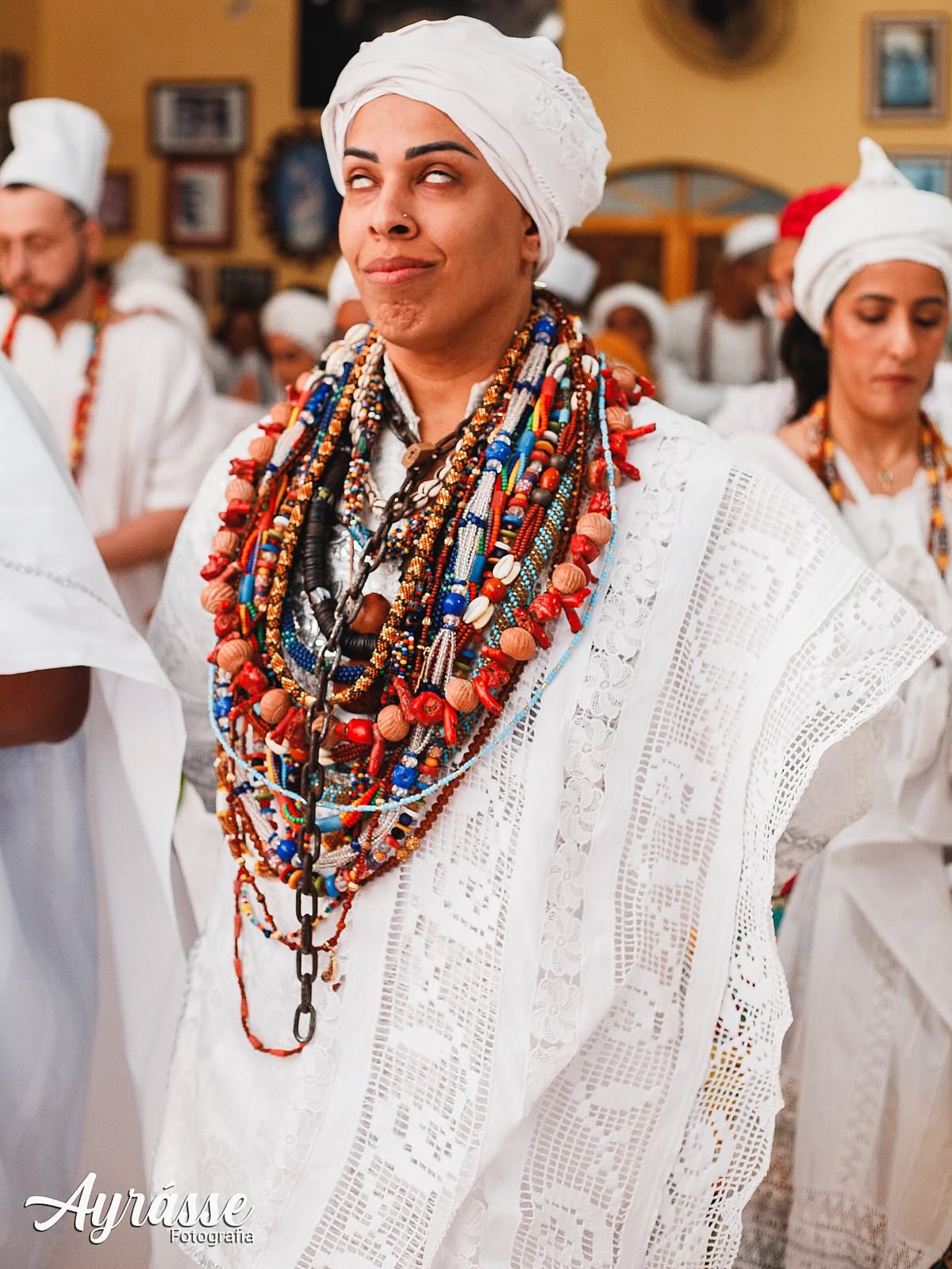
To understand the dress systems of Santería, Candomblé, and Vodou, it is necessary to understand what these religions are and where they originate, as their dress traditions are inseparable from their theology. They are their theology, made visible on the body.
Santería, also known as Regla de Ocha or Lucumí, originated in the spiritual practices of the Yoruba people of what is now Nigeria and Benin and was carried to Cuba by enslaved West Africans from the seventeenth century onwards. In Cuba, colonial law prohibited the practice of African religions, so Yoruba deities, the orishas, were disguised as Catholic saints, and the tradition survived underground, passed orally from generation to generation. By the late twentieth century, Santería had reached an estimated 80% of the Cuban population in some form, and it crossed the Atlantic again through Cuban emigration to the United States, Puerto Rico, Mexico, and beyond.
Candomblé emerged in Brazil, centred in Salvador, Bahia, sometimes called Black Rome, among the enslaved Africans brought by the Portuguese between the sixteenth and nineteenth centuries. It draws primarily on Yoruba spiritual tradition in its dominant Ketu nation, alongside Bantu and Fon influences. Like Santería, Candomblé was suppressed for centuries, with practitioners required to obtain police permits to hold ceremonies until 1976. In 2000, Brazil’s Minister of Culture declared one of Salvador’s largest Candomblé terreiros a national monument. The religion is organised around autonomous temples called terreiros, led by female priestesses called mãe de santo, and worship centres on the same orishas, called orixás in Brazil, venerated in Cuba.
Haitian Vodou derives primarily from the spiritual traditions of the Fon people of the Kingdom of Dahomey, now present-day Benin, with significant Yoruba and Kongo influence. The spirits in Vodou are called lwa, and the tradition maintains an elaborate ceremonial structure in which music, dance, and dress serve as the primary instruments through which the lwa are called into the ceremony. It was a Vodou ceremony that united enslaved people and ignited the Haitian Revolution, leading to Haiti’s independence in 1804 as the world’s first post-colonial Black-led nation. The tradition has faced centuries of vilification, misrepresentation, and legal suppression, particularly during the American military occupation of Haiti from 1915 to 1943, when Hollywood worked to perpetuate racist mythologies about it. Those mythologies persist. The fashion system embedded within Vodou does not.
The Orisha Colour System: A Complete Dress Language
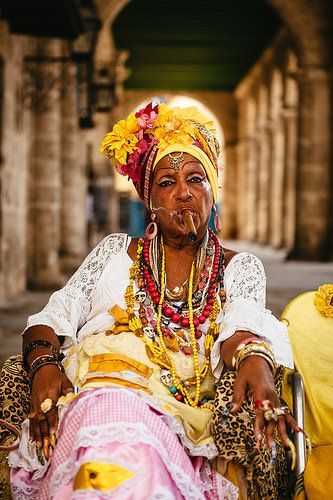
At the centre of Santería and Candomblé is one of the most thoroughly codified colour systems in the history of religious dress anywhere on earth. Every orisha has a specific colour. Every colour carries a specific meaning. Every ceremony requires specific colours to be present on the body of the person who serves or honours that orisha. This is not a decorative convention. It is a theological statement, worn on the skin.
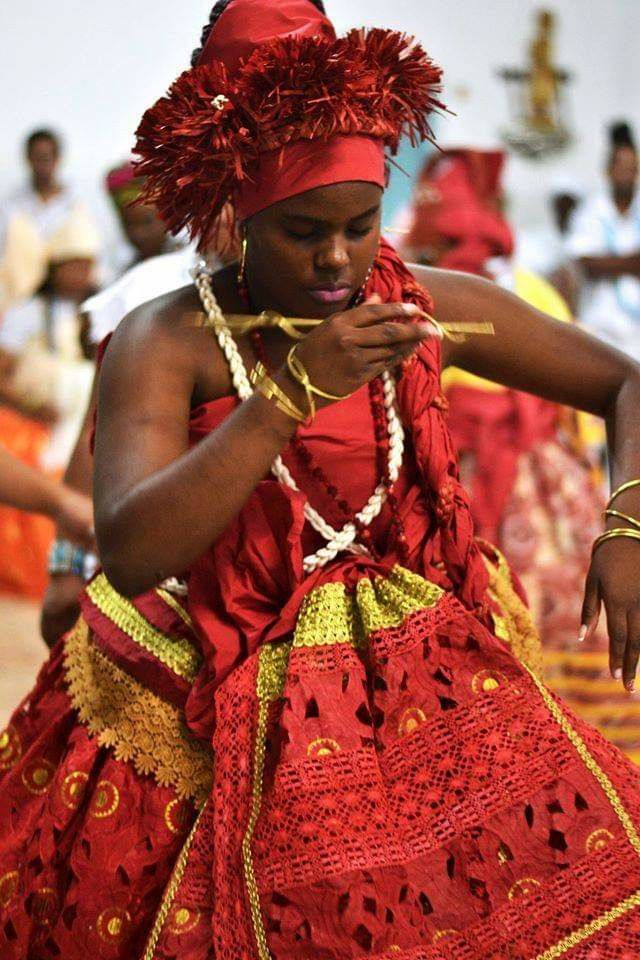
The system works as follows. Elegua, the orisha of crossroads and destiny, the first orisha invoked in any ceremony because he must open the way, is represented by red and black: life and death, the beginning and the end. Obatala, the orisha of heads, dreams, thoughts, and harmony, is white. The purity of the colour is not an aesthetic preference. It is theological: Obatala is the owner of purity and clarity, and white cloth is his sign. Yemaya, the ocean mother and protectress, is blue and white, the colours of the sea. Shango, the orisha of fire, thunder, lightning, and justice, is red and white. Oshun, the orisha of rivers, love, beauty, and abundance, is yellow and amber, the colours of the river’s light. Ogun, the orisha of iron and labour, is green and black. Each deity has a colour. Each colour has a meaning. The body dressed in those colours is simultaneously a statement of devotion, protection, and identity.
The sacred bead necklaces, called elekes in Santería and ileke in the Yoruba tradition, are not jewellery in the Western sense of the word. They are consecrated objects, prepared through ceremony by initiated priests and priestesses, aligned through ritual with the specific orisha they represent. Wearing an eleke is not a fashion decision. It is a spiritual commitment. The beads carry the spiritual force, or ashe, of the orisha. When they break, it is understood as the orisha having absorbed a spiritual attack on the wearer’s behalf. The colour pattern is specific not just to the orisha but to the path within each orisha: Obatala has multiple paths, each with slightly different bead configurations. The system is precise enough to be read by those who know it, a complete visual language worn on the body and legible to the community that shares the knowledge.
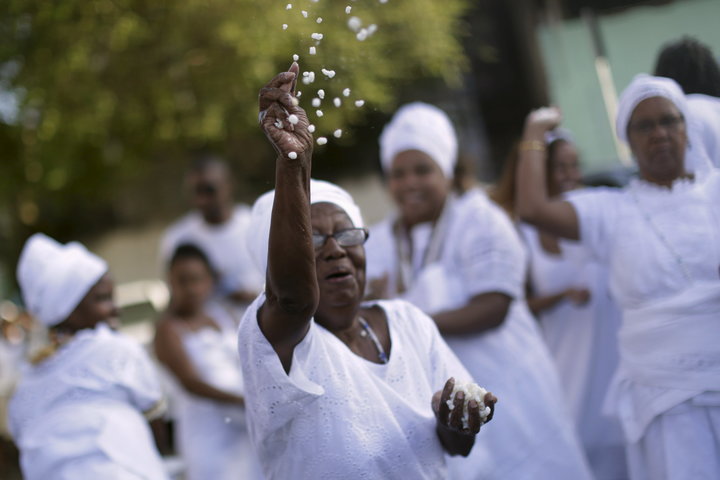
In Brazil, Candomblé ceremonies feature female practitioners entering the terreiro in floor-length white cotton skirts, covering many layers of elaborate petticoats, puff-sleeved blouses covered by sashes binding the chest, heads wrapped in intricate turbans, and wide arrays of brightly coloured glass bead necklaces. Each element of this ensemble communicates information to everyone present who can read it. The white dress is the baseline of ceremonial purity. The specific bead colours identify the orixá to which the wearer is devoted. The head-wrapping style and the volume and embellishments of the skirt communicate rank within the terreiro hierarchy. Senior priestesses are identifiable at a distance by the volume of their dress and the layers of cloth: their status written in fabric, not in title.
Vodou and the Colour of the Spirit
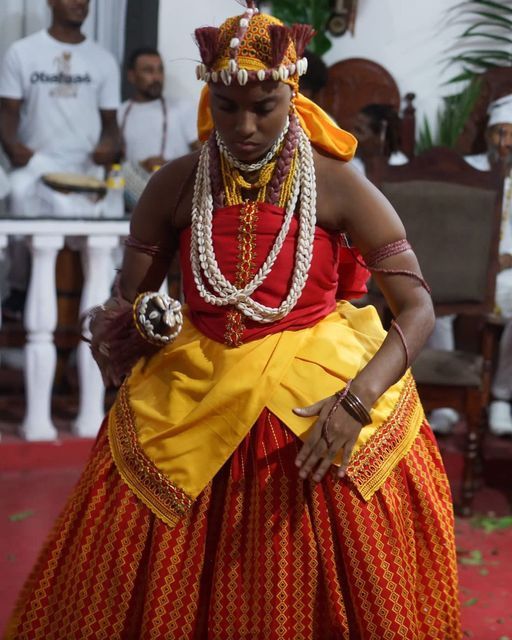
In Haitian Vodou, the dress system operates on a similar logic but with distinct Haitian characteristics. The initiates who orchestrate Vodou ceremonies wear all-white ceremonial garb: traditional Haitian skirts, starched white blouses, and white handkerchiefs on their heads. The white identifies them as initiated members of the temple, the people responsible for calling and managing the lwa throughout the ceremony. But the white is not fixed across the night. When the ceremony shifts from the Rada rite, which draws on Dahomey tradition and its organised line of lwa, to the Petwo-Kongo rite, participants change into multicoloured attire. The change of clothes is a theological shift, not a costume change. The colour indicates which spiritual forces the room is now being called upon.
The colour of the headwrap worn by a ceremony’s leaders indicates the lwa being served that day and also indicates rank in the temple hierarchy. A senior mambo, the female Vodou priest, is dressed to communicate her authority to both the congregation and to the lwa. Academic research on Vodou dress has described the spiritual garments worn by senior ceremony leaders as the primary thread that weaves notions of gender, race, and class with questions of authenticity and heritage in the tradition’s development. The dress is not clothing in any superficial sense. It is an archive, an authority, and a means of communication simultaneously.
Vodou also produced one of the most spectacular works of material culture in the Caribbean: the drapo, or ceremonial flag. These flags are made of silk or velvet and decorated with sequins, featuring either the vèvè, the sacred symbols of specific lwa, or depictions of associated Catholic saints. The drapo are understood as points of entry through which the lwa can enter the ceremony space. Sequin work, as a Haitian art form, now internationally recognised and collected in major museums, emerged from this spiritual dress tradition. The hand-sewn, sequin-covered flag is not a decoration. It is a theological instrument. It is also extraordinary textile art, produced by Black women and men in Haiti for centuries before the Western art market thought to look for it.
The White Dress and What It Actually Means
One of the most commercially powerful garments of the twentieth and twenty-first centuries is the white dress. Bridal white. The little white dress is a wardrobe concept. White is the colour of occasion, ceremony, freshness, and beginning. The fashion industry locates the origin of white occasion dressing in Queen Victoria’s 1840 wedding gown, which is credited with establishing white as the Western bridal standard.
The analysis tends to stop there. It does not continue to the Yoruba tradition, in which white is the colour of Obatala, the king of white cloth, the orisha who governs heads and dreams and the highest functions of the human mind. It does not mention that initiates into Santería are required to dress entirely in white for a full year following their initiation ceremony, a year during which their bodies are understood to belong to Obatala, dressed in his colour as an act of spiritual alignment and protection. It does not discuss the white worn by Candomblé practitioners in Salvador, which symbolises both the spiritual teachings of the faith and the liberation from foreign rule and slavery. It does not address the white attire worn by Vodou initiates in Haitian ceremonies as the sign that the Rada rite, the tradition of Dahomean origin, is in progress.
These are not coincidences of colour. They are the continuation of a West African theology of white that arrived in the Americas with enslaved people who had nothing but their knowledge, and built from that knowledge a dress tradition worn continuously for three hundred years. The fashion industry sells white occasion dresses every spring. It does not acknowledge that the white ceremonial dress has a spiritual history predating bridal catalogues by centuries and carrying meanings that no fashion magazine has ever published.
Also Read:
- The Wrap Dress Was Never a Western Invention: The Ancient African Wrapper and Fashion’s Most Celebrated Founding Myth
- The African City That Fashion Forgot: How Benin, Oyo, Dahomey, and Asante Dressed Before Europe Arrived
- Cornrows Were a Map: The African Intelligence Behind Diaspora Braiding
- The African Origins of Carnival Costume: Feathers, Beads, and the Masquerade Tradition
Dress as Survival Technology
These spiritual fashion systems are not simply beautiful. They are survival technology. When enslaved Yoruba people were brought to Cuba and Brazil and forbidden to practise their religion openly, they preserved it through the body. The colour system survived because it could be worn. The bead combinations survived because they could be strung around the neck under other garments. The white dress survived because it could be read as a deference to Catholic norms of modesty while simultaneously serving as a statement of devotion to Obatala.
The fashion system was the encryption method. When the authorities looked at a community dressed in white, they saw compliance with the colonial expectation of Christian dress. The community itself saw Obatala. When someone wore yellow beads, the Spanish colonial administration saw a decorative accessory. The Yoruba community saw Oshun. The dress tradition survived three centuries of active suppression because it was legible to the initiated and invisible to the oppressor. There is no more sophisticated act of dress in the history of fashion than this: a community wearing its entire theology on the body in plain sight, invisible to the people trying to destroy it.
This is the context in which the phrase “African spiritual fashion system” should be understood. It is not a metaphor. These traditions built functional, codified, hierarchical dress systems that governed the daily and ceremonial appearance of hundreds of thousands of people across three countries for three centuries, under conditions of legal suppression and cultural violence, and emerged intact. That is an achievement of dress culture that has no parallel anywhere in the world, and it has never appeared in a fashion history textbook.
The Omiren Argument
Fashion media has recently discovered spiritual aesthetics. The beaded necklace trend. The white dress moment. The satin headscarf. The ritual jewellery market. Each of these has been presented as an aesthetic development emerging from global street style, runway experimentation, or the vague influence of wellness culture. The Yoruba eleke tradition is not named. The Candomblé bead system is not discussed. The Vodou headwrap hierarchy is not explained.
The commercial scale of this omission is significant. The global jewellery market is valued at over $350 billion. A substantial portion of that market trades in beaded, coloured, and what is marketed as spiritually significant jewellery, sold in boutiques and wellness shops from London to Los Angeles. The aesthetic is borrowed, the terminology is borrowed, the visual language is borrowed, and the source is invisible. When a fashion brand releases a spiritual jewellery collection of coloured bead necklaces, it is selling, without attribution, the aesthetic of a tradition that three hundred years ago had to hide its theology in bead patterns to survive colonial prohibition.
Omiren Styles does not accept that spiritual dress traditions are a subcategory of world fashion, separable from the main account. Santería, Candomblé, and Vodou produced dress systems of extraordinary sophistication: colour-coded, hierarchically structured, theologically precise, and continuously practised for three centuries across three countries. They are fashion systems. They built the most coherent and most consequential dress tradition in the Americas. The fact that fashion history has never said so is not an oversight. It is a pattern. The pattern ends here.
The beads are still being strung. The white dress is still being worn. The colour system remains legible to every community that inherited it over three hundred years of practice. The theology is still worn on the body in Havana, El Salvador, Port-au-Prince, and diaspora cities where these traditions continue to grow. What has been missing is the article that names them, on the global fashion stage, as what they are: one of the most sophisticated, most enduring, and most consequential dress traditions in the history of the African diaspora. That naming is long overdue.
Frequently Asked Questions
- What is the orisha colour system, and how does it function as a fashion system?
The orisha colour system is a theological colour code in which every deity in the Yoruba pantheon, carried to the Americas through Santería and Candomblé, is assigned a specific colour or combination of colours that devotees must wear in ceremony and express through the beads they receive at initiation. Elegua wears red and black; Obatala wears white; Yemaya wears blue and white; Shango wears red and white; Oshun wears yellow and amber. The sacred bead necklaces called elekes are consecrated objects that connect the wearer to the specific orisha they represent, functioning not as jewellery but as theological statements worn on the body. As a fashion system, the orisha colour code is more coherent, more precisely codified, and more continuously practised than most European fashion traditions of equivalent age.
- What does a white dress mean in Santería and Candomblé?
In Santería, initiates are required to dress entirely in white for one full year following their initiation ceremony, a period during which the body is understood to belong to Obatala, the orisha of white cloth, purity, and the mind’s highest functions. In Candomblé, the white dress worn by practitioners during ceremonies symbolises both the faith’s spiritual teachings and liberation from slavery and foreign rule. In these traditions, the white dress is not a fashion statement. It is a theological argument made visible, a statement of devotion and spiritual identity that has been worn continuously for three centuries, predating the Western fashion industry’s association of white with occasion dressing by several generations.
- How did these dress systems survive colonial prohibition?
The dress systems of Santería, Candomblé, and Vodou survived because they were legible to initiates and invisible to colonial authorities. In Cuba and Brazil, where African religions were legally prohibited, the colour bead system could be worn as apparent decoration while functioning as a complete theological statement. The white dress of Obatala’s initiates could be read as compliance with Catholic standards of modesty while communicating devotion to the Yoruba orisha. The dress was the encryption method: the community wore its entire theology on the body in plain sight, hidden in the openness of apparent compliance. This is one of the most sophisticated acts of cultural preservation in the history of the African diaspora, and the instrument of that preservation was dress.
- Why do fashion media and the jewellery industry not acknowledge these traditions as sources?
The global jewellery market, valued at over $350 billion, trades substantially in beaded and coloured necklaces marketed as spiritual jewellery or wellness accessories without acknowledging the Yoruba eleke tradition or the Santería bead system from which their aesthetic descends. Fashion media regularly features white occasion dressing, coloured beads, and headscarf styling without referencing the three-century African diaspora traditions in which these garments carry precise theological meaning. The omission is structural: fashion history and fashion media have consistently framed African and African diaspora dress traditions as ethnic or ceremonial rather than as fashion systems worthy of the same attribution afforded to European and American design traditions. Omiren Styles exists specifically to correct this structural omission.