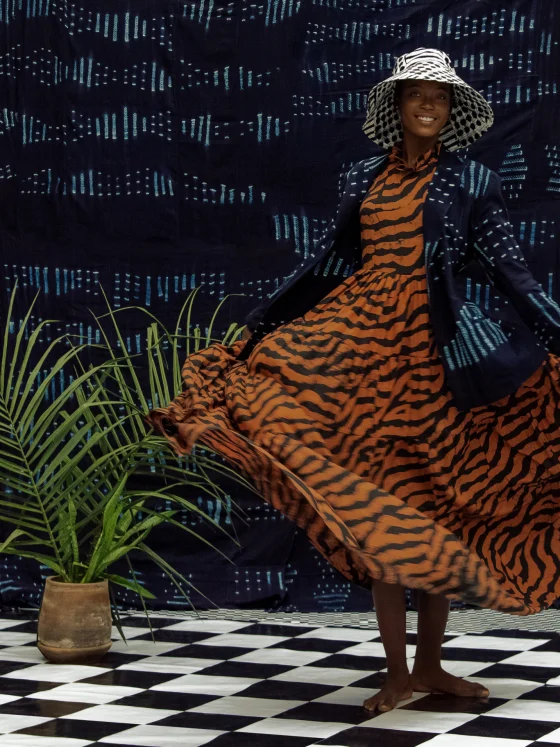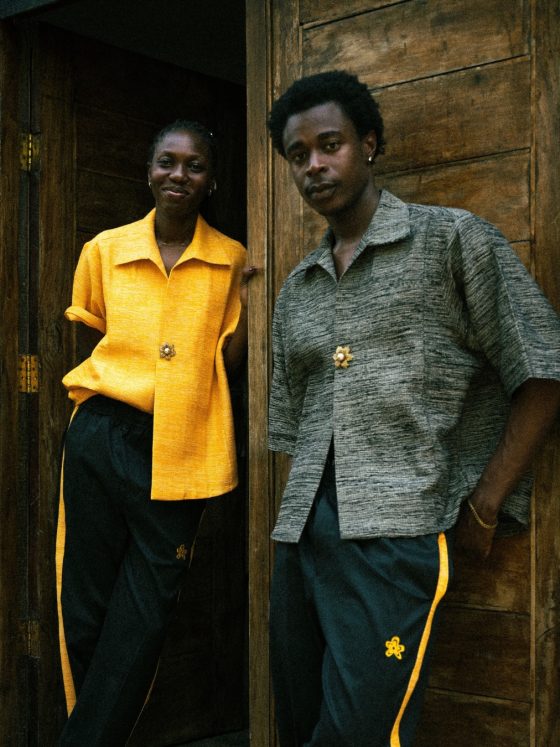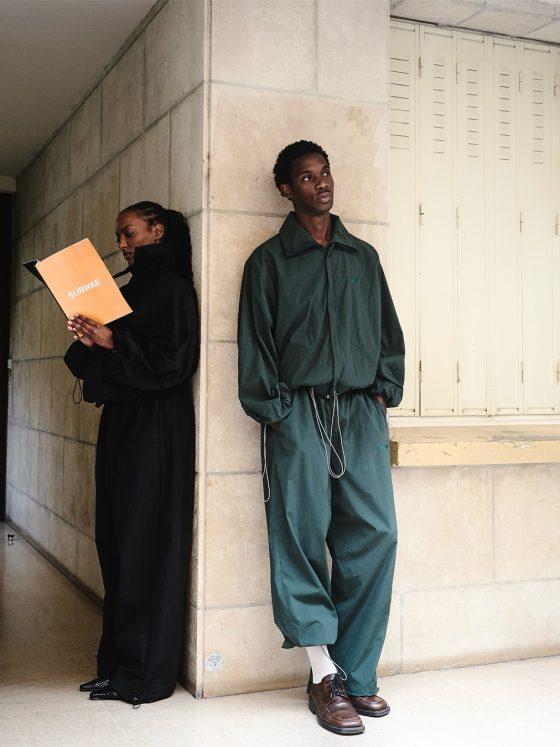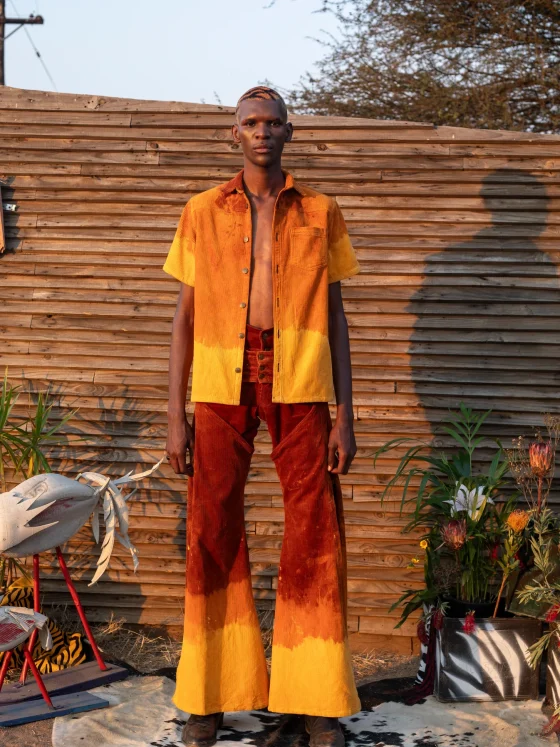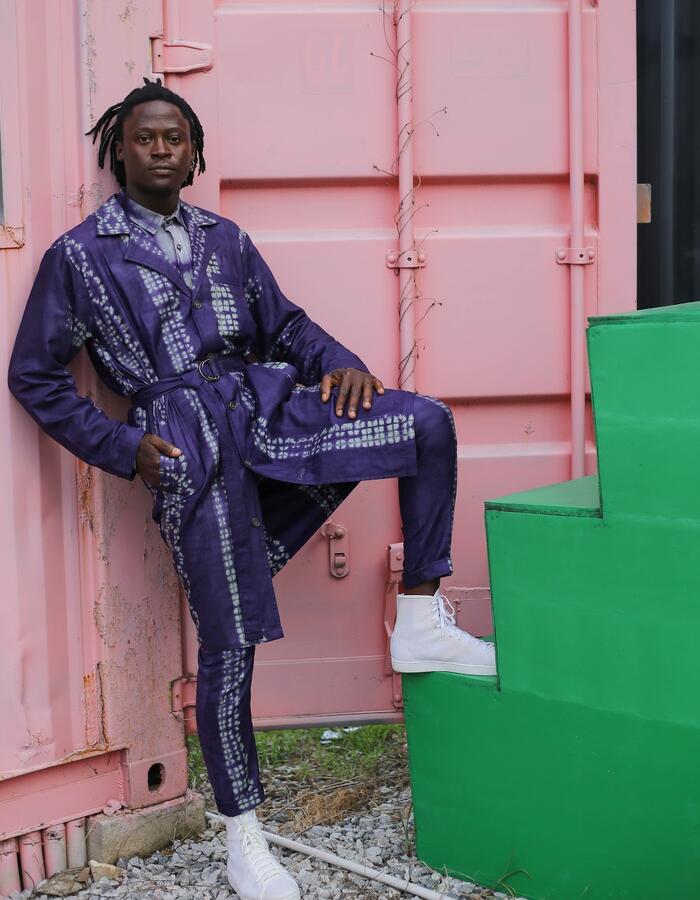
When Larry Jafaru Mohammed discussed his spring 2021 Nomad collection, he placed tie-dye within his family’s everyday experience of dressing. “Our parents used to get it for themselves and for us,” he told Christian Allaire in a November 2020 interview for Vogue. He had also photographed some pieces on his parents, whose pictures from the 1970s continued to influence him. The reference was close to home: clothing bought, worn and remembered before it became part of a collection.
That connection gives Nomad a particular place in the story of Larry Jay, the Ghanaian unisex label Mohammed launched in 2017. The collection brought together his preference for monochromatic dressing, his extensive use of purple, and his stated interest in tradition and comfort. Looking back, the most revealing thread is how those choices sit alongside his parents’ wardrobes. Family style was not simply a biographical detail behind the designer. By his account, it entered both the development of the clothes and the decision about who should wear them in photographs.
Explore how Larry Jafaru Mohammed connected tie-dye, purple and his parents’ style in Larry Jay’s spring 2021 Nomad collection, as he told Vogue.
Tie-Dye Before the Collection
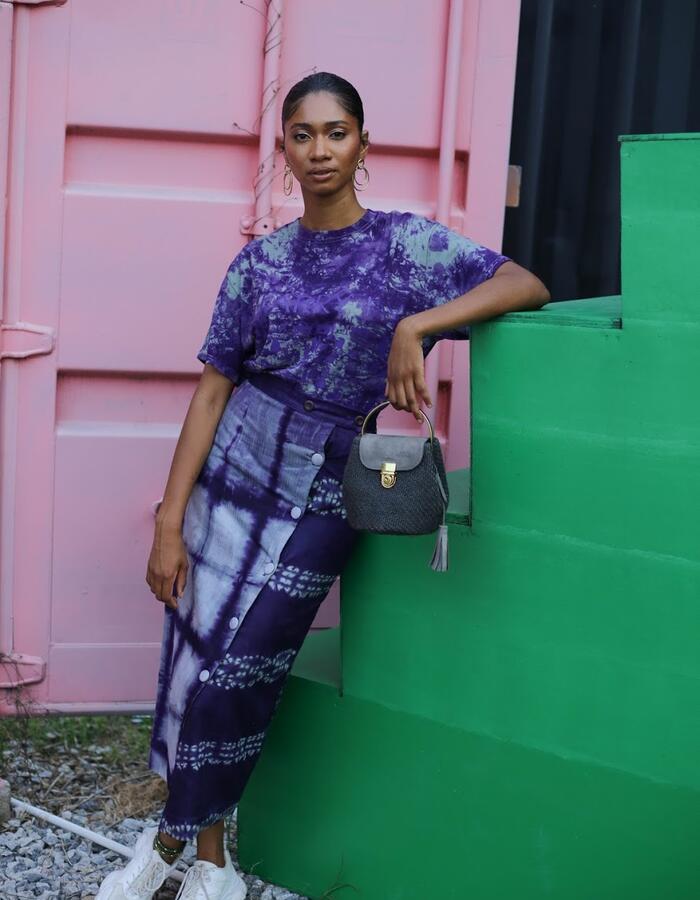
Mohammed described tie-dye as a familiar part of the clothing around him. “Tie-dye has been one of the most common fabrics here,” he said in the same interview. His next reference was not a museum collection or a distant historical period, but his parents buying it for themselves and their children. That sequence matters. It establishes the textile as something encountered through use, rather than an abstract cultural symbol selected to give a contemporary collection a sense of heritage. His account also changes how we understand continuity. There is no need to frame Nomad as the rescue of a forgotten practice when the designer describes it as part of a living wardrobe. The collection’s interest lies instead in the decisions he made within that familiarity: choosing tie-dye again, working it into his own collection and placing it alongside a preference for coordinated colour. The inherited reference gave him material to develop; it did not prescribe a complete design.
This is where the family connection becomes more useful than a broad claim about African inspiration. Mohammed said he looked to cultures in Accra and elsewhere on the continent. But his parents’ account provides a more precise point of entry. It tells us how a textile entered his experience and why its presence in Nomad was personal as well as visual. A continent-wide reference becomes legible through a particular household.
Why Purple Matters to Nomad
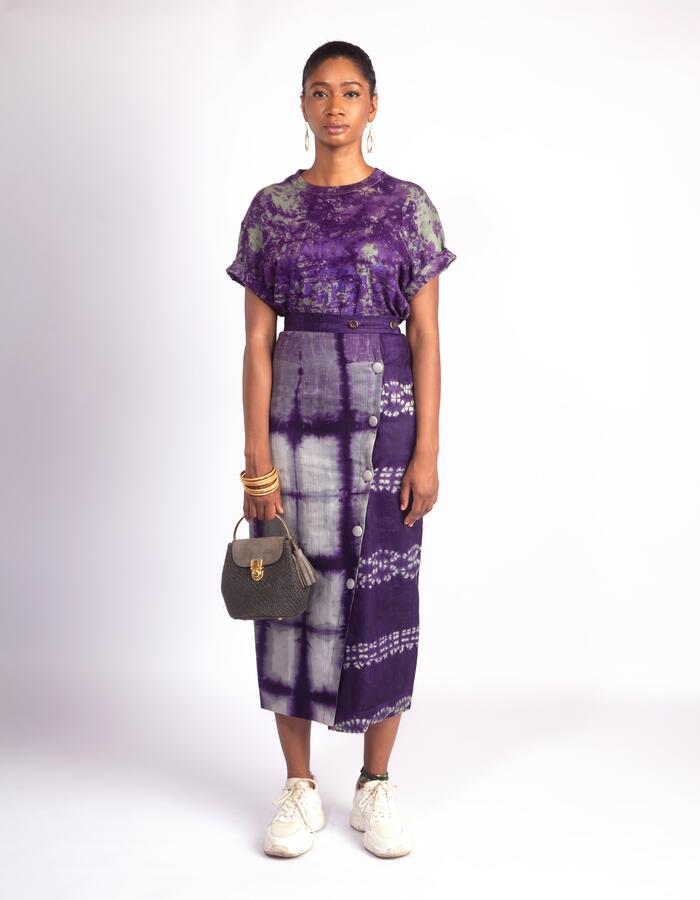
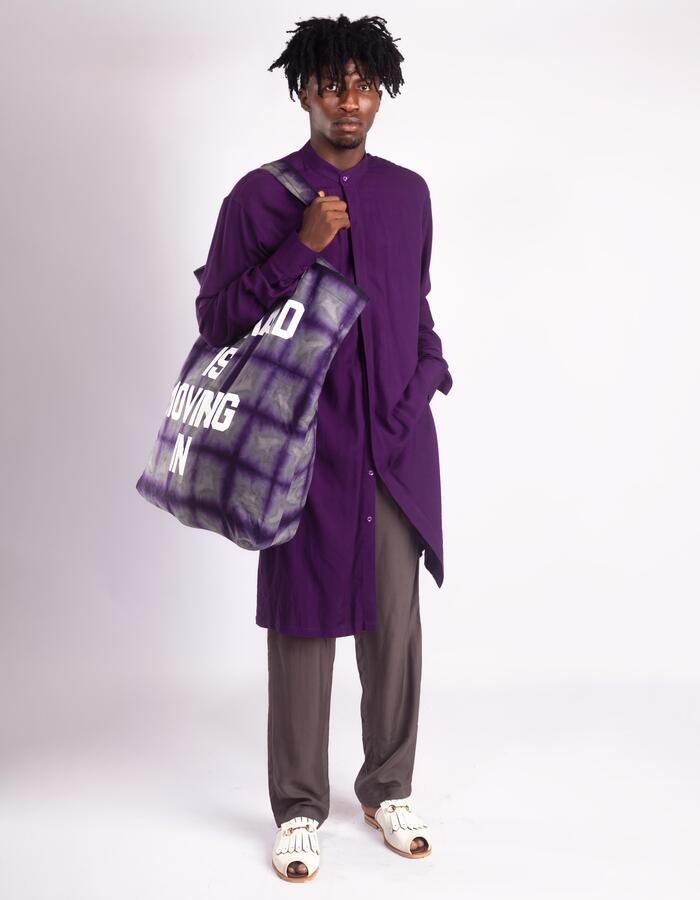
For Nomad, Mohammed linked his use of purple to an existing preference for monochromatic looks. “I like to do a lot of monochromatic looks, so for this collection, I used a lot of purple,” he told Vogue. It is a straightforward explanation, but an important one: the colour decision arose from how he wanted to organise an outfit. He did not offer a symbolic meaning for purple in that interview, and the collection does not need an invented one. The relationship between tie-dye and monochromatic dressing is the more productive subject. They describe different parts of a design: one concerns the treatment of the textile, while the other concerns the colour relationship across a look. Mohammed brought both into his explanation of the same collection. That allows Nomad to be read through coordination as well as pattern, rather than reducing its identity to a distinctive fabric surface.
Comfort was equally explicit. Mohammed described the collection as emphasising “tradition and comfort” and said it was inspired by travellers who wanted to learn about people, cultures and nature. In that account, the traveller is an interested participant, not merely a figure of escape. Read alongside the family references, the collection’s title holds two directions together: looking outward towards other people’s lives while carrying familiar ways of dressing into the work. That tension gives Nomad more substance than a general travel theme.
The Parents Were Part of the Image
Mohammed’s decision to photograph some pieces on his parents extends the family reference beyond inspiration. The people whose clothing had helped shape his eye also became wearers of his designs. He did not describe those photographs as a reconstruction of their 1970s pictures. He established a continuing exchange between how he remembered them dressing and how he wanted to present his own work. Their influence was active, not confined to an origin story. For a unisex label, that is a useful way to think about a garment’s life beyond a narrowly defined campaign customer. The designer’s account brings different generations into the presentation of the clothes. It does not tell us how every customer wore Nomad, but it does show whom Mohammed considered relevant to its image. His parents were not simply people to thank after the collection was finished; they helped explain its visual world.
The family photographs should also remain distinct from the editorial images that introduced the collection to Vogue readers. The magazine’s November 2020 feature accompanied a special series photographed by Carlos Idun-Tawiah for Mercedes-Benz, presenting work by five Accra-based designers after the pandemic disrupted live fashion-week programming. Mohammed’s account of photographing his parents and Idun-Tawiah’s editorial commission are separate credits. Both belong in the collection’s context, but they should not be collapsed into one shoot.
From Accessories to Ready-to-Wear
Mohammed’s path into clothing developed over several years. Born and raised in Accra, he began an accessories line in 2012, moved towards ready-to-wear around 2016 and launched Larry Jay in 2017, according to Allaire’s reporting. Those dates mark different stages of the practice. The later collection therefore followed an existing engagement with making rather than representing the designer’s first encounter with fashion. In that interview, Mohammed also explained that he wanted to work with people in his community and support local craftsmanship. He connected this ambition to recycling and upcycling things he found around him. Alongside the family wardrobe, this supplies another source for his design thinking: the materials and skills already within reach. His account of the label is grounded in relationships (with relatives, local makers and the things available to work with) rather than in a single inspirational theme.
The Hands Behind the Textile
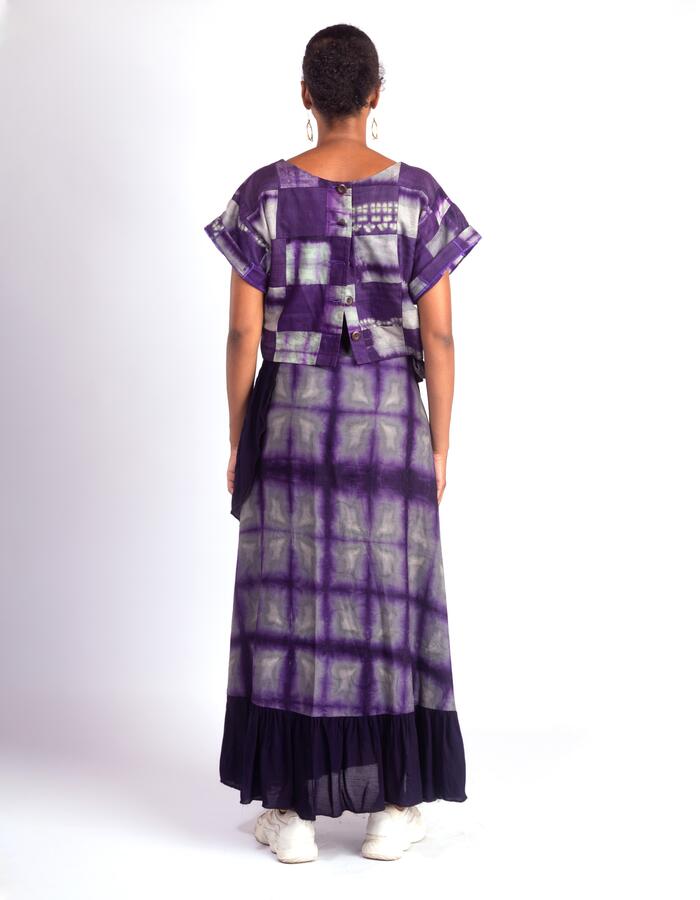
Larry Jay’s official production account gives those making relationships a more specific structure. The brand says it sources fabrics from local markets, works with Guinean and Burkinabè artisans who use hand tie-dye techniques, and has the resulting materials transformed into clothing and accessories by in-house or outsourced craftspeople. Sourcing, surface treatment and garment construction appear as distinct contributions. That account expands the way authorship should be discussed. Mohammed’s collection decisions include colour, references and presentation; the label separately credits artisans with executing the dyeing and craftspeople with making the finished products. Keeping those roles visible does not diminish the designer. It gives a fuller account of the work that sits behind a single brand name. Individual garment credits would make that account more precise still.
The production statement describes the brand’s broader practice, however, rather than providing a material history for every Nomad piece. It should not be used retrospectively to declare that every garment in the spring 2021 collection was reconstructed from previously worn clothing. The collection interview establishes the importance of tie-dye, purple, comfort, and family references. The official page adds the label’s stated making network. Together they provide context without becoming interchangeable evidence.
The Omiren Argument
Nomad is most revealing when it is read as a collection about clothing already present in the designer’s life. Tie-dye was familiar through family use. His parents’ photographs remained a source of style, and his parents themselves became wearers of the work. Purple and monochromatic dressing became deliberate choices within that frame of reference. In Mohammed’s account, the result was neither an untouched inheritance nor a complete break from it. It was a continuation shaped by his own decisions.
That is the stronger reason to revisit the collection. Larry Jay does not need a vague claim of cultural authenticity to make this story meaningful. The specificity is already there: a textile bought across generations, a designer looking closely at family photographs and a making practice that credits work beyond his own. Reading those relationships carefully lets the clothes carry memory without reducing them to nostalgia, and lets craft remain a contribution by people, not simply an adjective attached to a product.
Also Read:
- Hertunba: Florentina Agu Is Dressing Women to Conquer
- What It Actually Means to Dress “Back Home” When You’ve Never Lived There
- African Textile Glossary: 20 Terms Fashion Keeps Getting Wrong
- Traditional Clothing in Ghana: Kente, Batakari, Fugu & Adinkra
Frequently Asked Questions
Who is Larry Jafaru Mohammed?
Larry Jafaru Mohammed is the Accra-born designer behind Larry Jay, a Ghanaian unisex fashion label. He began working on accessories in 2012, moved towards ready-to-wear around 2016 and launched the label in 2017. He was born and raised in Accra, and he has said he wants to work with people in his community and support local craftsmanship.
What is Larry Jay’s Nomad collection?
Nomad is Larry Jay’s spring 2021 collection, discussed by Mohammed in a November 2020 Vogue interview. He connected it to tradition, comfort and travellers interested in people, cultures and nature. He also identified purple and tie-dye as important choices. The magazine’s feature accompanied a series photographed by Carlos Idun-Tawiah for Mercedes-Benz.
How did Mohammed’s parents influence the collection?
Mohammed recalled his parents buying tie-dye for themselves and their children. He said photographs of them from the 1970s influenced his brand, and that he photographed some of his own pieces on them. Those photographs are separate from the editorial images by Carlos Idun-Tawiah, and the two should not be treated as one shoot.
Is every Nomad garment made from repurposed clothing?
The cited sources do not establish that. Larry Jay describes a broader practice involving market-sourced fabrics, hand tie-dye and garment-making, but that statement is not a piece-by-piece material record for Nomad. The official page describes fabrics sourced from local markets, hand-dyed by artisans and made into clothing, but it does not catalogue the materials of each Nomad piece.