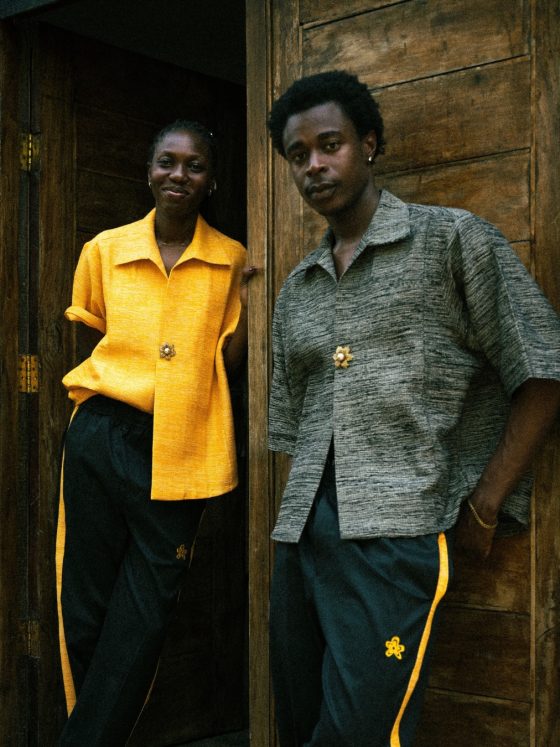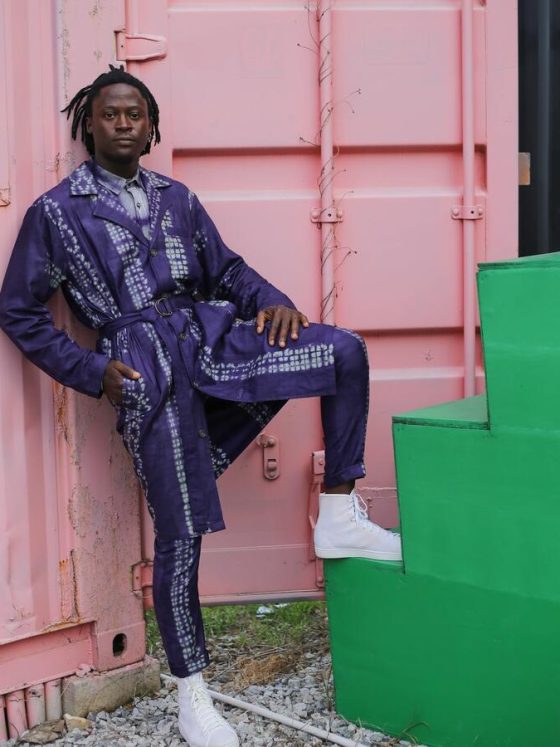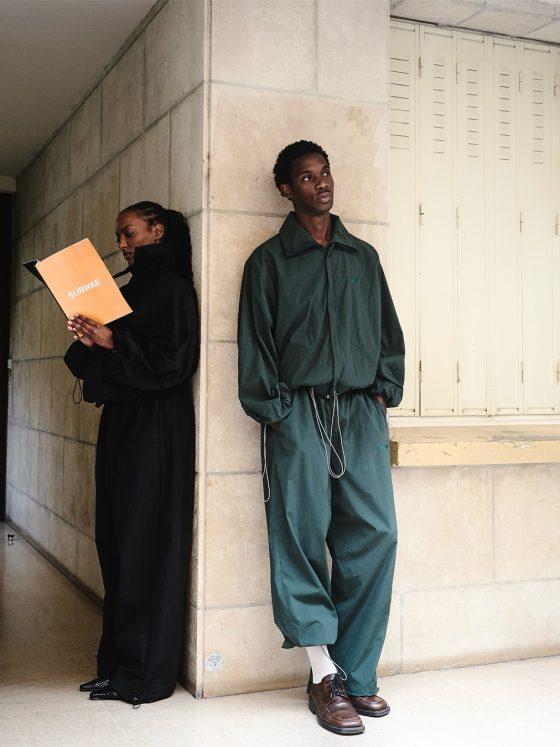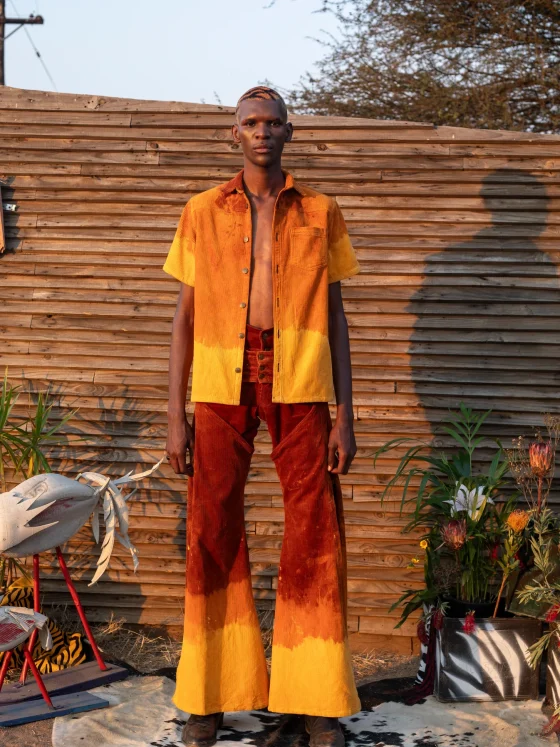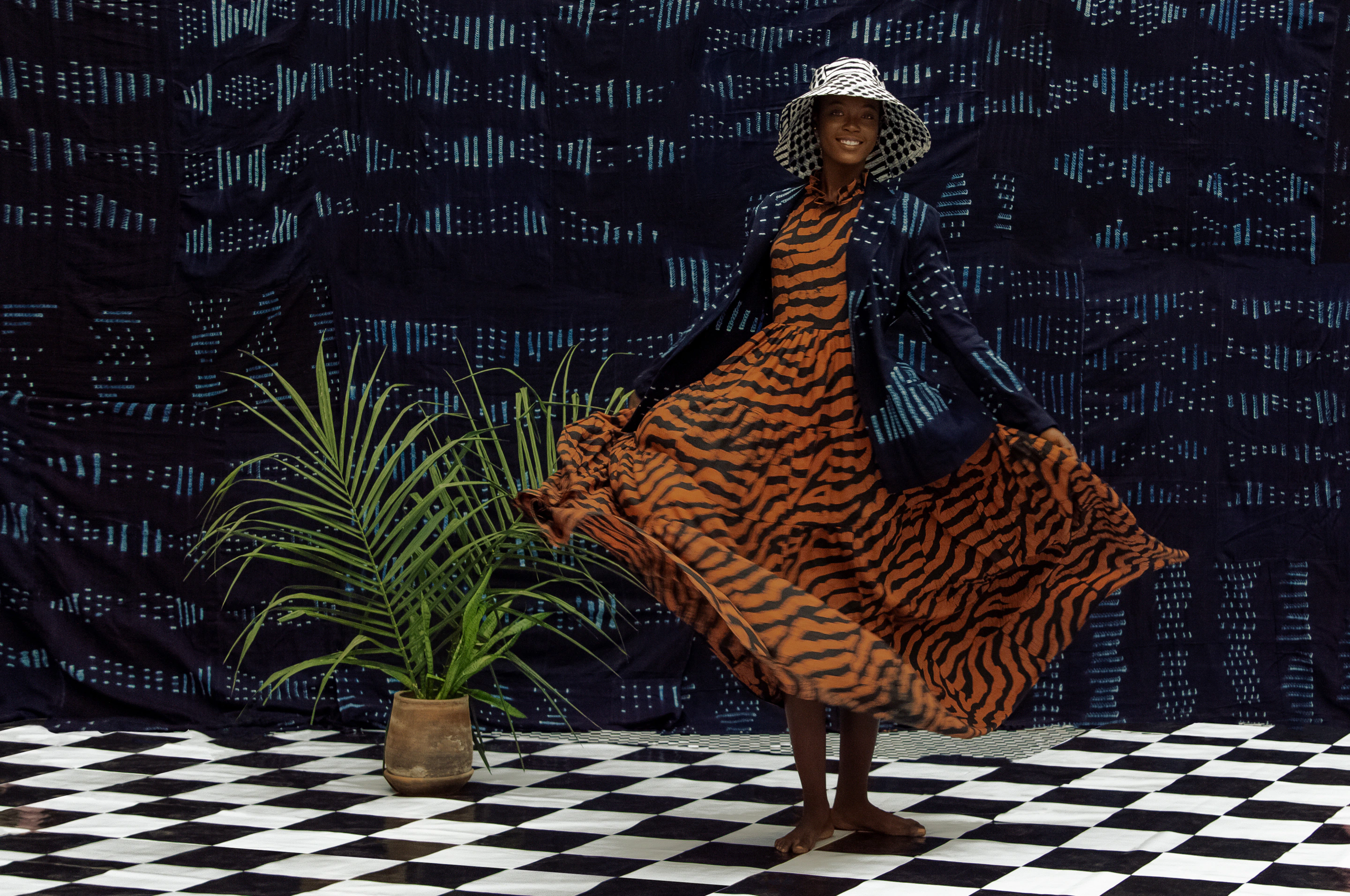
A palm print connects a shirtdress, maxi skirt and bucket hat in the Studio 189 × J.Crew collaboration. Elsewhere in the edit, blue indigo shibori print links a double-breasted blazer with trousers. These repeated descriptions establish relationships across the range: different garments participate in the same visual idea, giving the collection points of connection beyond the names attached to it. Studio 189 co-founder Abrima Erwiah explained the design proposition directly. “This collection features some of our best-selling items in new colourwayss and prints that are reinterpretations of J.Crew’s fabrics,” she said in the retailer’s accompanying interview. Her account identifies existing products, existing fabrics and the work of reconsidering both. It is a useful starting point because it describes a contribution rather than simply announcing a partnership.
The collection can therefore be read through two kinds of continuity. Studio 189 brought products already associated with its practice; J.Crew’s fabrics supplied material for reinterpretation. The new proposition lay in their relationship. The published account does not assign every design decision, but it gives a more informative explanation than the familiar claim that a collaboration combines two brands’ identities.
Explore how Studio 189’s J.Crew collaboration combined established designs, reinterpreted fabrics and hand-batik production, from palm prints to makers.
Familiar Products, Reconsidered Surfaces
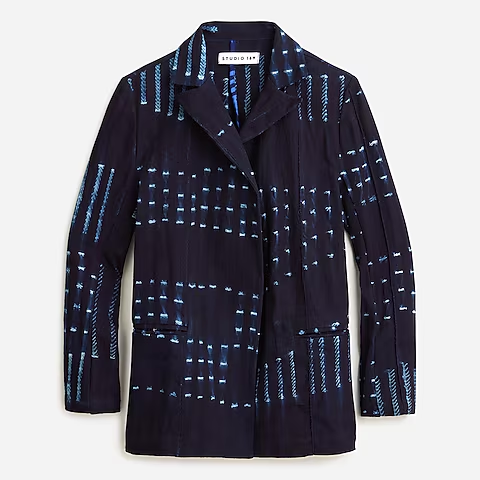
Erwiah’s reference to best-selling items matters. It places Studio 189’s existing product knowledge inside the collaboration rather than presenting the label solely as a source of textile techniques. The clothes were not described as an entirely new wardrobe built from nothing. Recognisable products became a basis for changes in colour and print. The product edit spans several ways of dressing: a halter bra top, printed maxi skirts, dresses, tailoring and bucket hats. The palm-print shirtdress sits within that wider range rather than carrying the collection’s full identity alone. A fringed wrap dress in dot and a ruffle midi dress in animal print introduce other surfaces and garment types. The result is a range organised through several print relationships, not one motif applied to every item.
That breadth also supports Erwiah’s explanation of how the pieces were intended to be worn. “They are meant for layering and mixing and matching,” she said. The comment directs attention towards combinations rather than a single prescribed look. A customer could encounter the palm print through a dress, a separate or an accessory; the collection did not require all three to be worn together for the connection to remain recognisable. Versatility, in this account, is a design intention rather than a demonstrated finding about every garment’s performance. What the product range does establish is choice between clothing categories. The same visual reference can enter a wardrobe at different scales (from an accessory to a complete dress) without requiring the wearer to adopt an entire coordinated outfit.
What “Reinterpretation” Adds to the Story
The phrase “reinterpretations of J.Crew’s fabrics” unsettles an easy description of the partnership as African design arriving to enliven an American retailer. According to Erwiah, the reference material also moved in the other direction: J.Crew fabrics became something for Studio 189 to reconsider. That makes the exchange a design process, not simply a distribution arrangement. It does not tell us which original J. Crew fabric corresponds to each finished print. Nor does it establish who chose every motif or colour. But it does identify the source relationship. Studio 189’s contribution cannot be reduced to supplying an already completed aesthetic that the retailer then presented unchanged. The published explanation describes transformation within the partnership.
That distinction is especially important in coverage of African fashion collaborations. “Inspired by Africa” would be both broader and less accurate than the partners’ own account here. It would obscure the existing Studio 189 products, the J.Crew fabric references and the stated handwork involved in producing the textiles. Specific contributions explain more than a geographic label can.
Hand-Batik Is Part of the Production Account
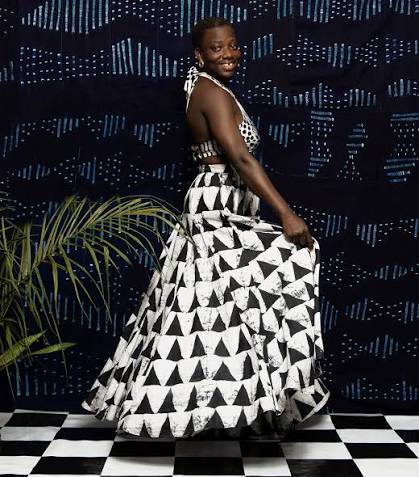
J.Crew’s feature states that each yard of fabric is batik-dyed by hand. This is a claim about making, not merely a description of a pattern’s appearance. It should remain attributed to the collaboration, but it belongs in the main design story: the partners present the textile surface as the result of work carried out on cloth. The distinction between motif and process is useful here. “Palm print” identifies an image; “batiked and dyed by hand” describes how the partners say they produced the textile. One does not explain the other. A reader can recognise a motif without knowing how it was made, just as knowing a technique does not reveal every decision about scale, colour, or placement. The collaboration’s presentation asks us to consider both.
The product names also require care. The edit uses “batik palm print” for several pieces and “blue indigo shibori print” for the blazer and trousers. Those descriptions should not be compressed into a single account of interchangeable craft techniques. They identify different textile references within the range, even though the feature does not supply a technical production record for each item. The most responsible reading stays close to that evidence. Handwork is part of the partnership’s stated proposition. It does not, by itself, establish the fibre, manufacturing location or complete production sequence of a particular dress.
From One Printer to a Wider Making Network
Erwiah’s account of Studio 189’s beginnings makes the relationship between textile and garment work more concrete. While visiting family in Ghana, she met craftworkers who struggled to access markets. She wanted to work with them through an organisation that functioned like a studio. “I moved to Ghana in 2013 and started very small with a few tailors and one batik printer,” she recalled. The sentence names separate capabilities at the outset. Tailoring and printing were not one undifferentiated activity described as craft. They were different contributions brought into a shared enterprise. That division remains useful when considering the collaboration: developing a textile surface and making a finished garment are related, but distinct, forms of work.
Erwiah and Rosario Dawson co-founded Studio 189. Its official account identifies a manufacturing facility in Accra and relationships with artisanal communities specialising in hand-batik, natural indigo dyeing, kente weaving and other techniques. Ghana is therefore central to the company’s stated production structure, while the wider network prevents the business from being understood as a single workshop performing every task. The facility’s existence does not establish the manufacturing location of every collaboration product. Its relevance is organisational: Studio 189 describes a practice combining garment production with relationships across different textile specialisms. The label’s role includes bringing those capabilities into a product range, not simply attaching a cultural story to finished clothing.
Interdependence as a Working Principle
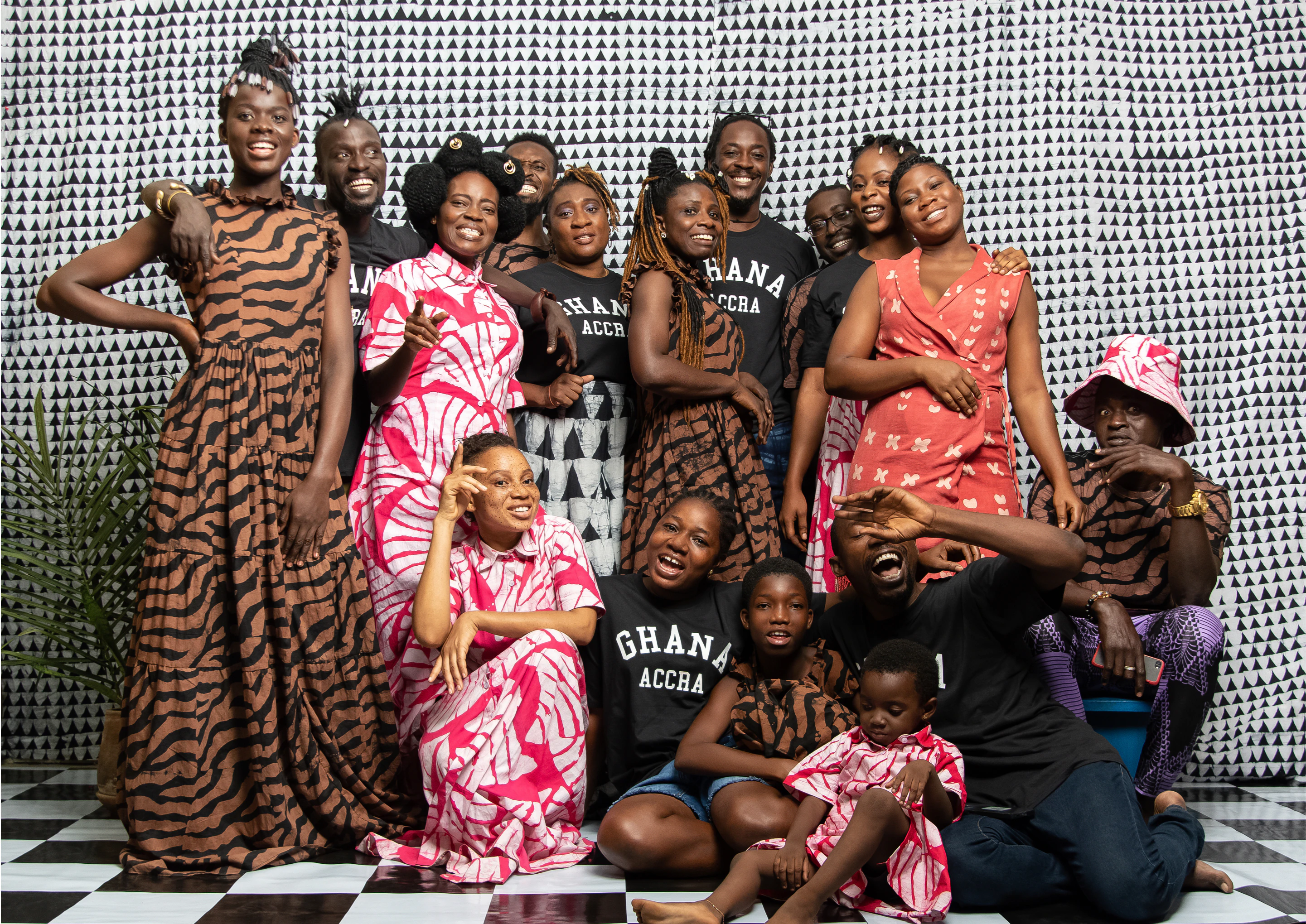
Erwiah connected the company’s approach to boa me na me mmoa wo, an adinkra symbol she translated as “help me and let me help you.” She described interdependence as a founding principle, explaining that the company needed to listen rather than arrive with a top-down prescription for how communities should work. Her emphasis was on building “a value chain that recognises the people making our products.” That statement places makers within the organisation’s understanding of value, rather than positioning them only as recipients of support. It also gives the collaboration’s account a standard of specificity to work towards: recognition becomes more informative when readers can understand who contributed which skills.
The feature does not provide individual printing or garment-making credits for the palm-print shirtdress. That is a limit of this particular public presentation, not evidence that contributors were unrecognised elsewhere or inadequately compensated. A fuller making record would add to the design story by connecting named people to the work already described. The same distinction applies to the interview’s sustainability language. Erwiah discusses traceability, efficient resource use, wages, benefits and career development as priorities. Those statements explain the areas the company says it considers; they are not product-specific measurements of environmental or labour outcomes. The collaboration’s design contribution can be examined without turning those intentions into independently established results.
The Omiren Argument
The Studio 189 × J.Crew partnership is most informative when read through the contributions its own account identifies: established products, reinterpreted fabrics and hand-worked textiles. That framework gives Studio 189 a more substantial role than the vague description of an African influence on a retailer’s collection. It places product knowledge, interpretation and making within the collaboration’s design proposition.
It also offers a better standard for discussing partnerships more generally. The question is not simply whether both names are visible. It is what each participant brings, what changes through the exchange and how the work becomes legible in the finished range. Here, Erwiah’s explanation provides a clear beginning. More detailed textile and garment credits would deepen it, not by replacing the clothes with a production story, but by making the design contributions behind them easier to understand.
Explore Studio 189
Visit Studio 189’s official website for its current presentation and J.Crew’s collaboration feature for the interview and product edit discussed here. The retained feature should not be treated as confirmation of current stock.
Also Read:
- After the First Order: African Fashion’s Repeat-Production Test
- How African Sourcing is Rewriting Global Luxury
- How Gambian Fabrics and Craftsmanship Carry a Country’s Memory
- The World Has Discovered African Fashion. Africa Is Still Waiting for the Invoice.
Frequently Asked Questions
Who founded Studio 189?
Abrima Erwiah and Rosario Dawson co-founded Studio 189. Its official account identifies a manufacturing facility in Accra and relationships with artisanal communities working across several textile techniques. Erwiah has said she moved to Ghana in 2013 and started with a few tailors and one batik printer.
What did Studio 189 contribute to its J.Crew collaboration?
According to Erwiah, the collection included some of Studio 189’s best-selling items in new colours and prints that reinterpreted J.Crew fabrics. The feature also states that the fabric was batik-dyed and hand-dyed. The sources do not assign every design decision or say which J.Crew fabric corresponds to each finished print.
Which products featured the palm print?
The collaboration edit lists a shirtdress, maxi skirt and bucket hat in batik palm print. The same edit pairs a blue indigo shibori print across a double-breasted blazer and trousers, and includes a fringed wrap dress in dot, so the palm print is one of several print relationships.
Was every product made in Accra?
The sources establish that Studio 189 operates a manufacturing facility in Accra, but they do not provide a garment-by-garment manufacturing record for this collaboration. The facility’s existence does not establish where each collaboration product was made. Its relevance is organisational: Studio 189 describes a practice that combines garment production with relationships across different textile specialisms.