Every sourcing decision is a production decision. The fabric a designer selects determines not only the garment’s cost but its finish quality, construction behaviour, care requirements, and performance on the body over time.
Designers who understand this make sourcing decisions with full awareness of their downstream consequences. Designers who do not make choices that look like savings on paper and feel like compromises in the finished garment.
None of the consequences of a sourcing decision can be fundamentally improved after the fabric has been bought. They can be managed at cost in the atelier or discovered at a higher cost by the customer. The most efficient place to make a good sourcing decision is before the order is placed.
Discover how fabric sourcing decisions shape cost, finish quality, and garment performance in African fashion production, and why sourcing intelligence starts before the atelier.
Sourcing as a Production Decision

The conventional framing of fabric sourcing is aesthetic and financial: find the fabric that delivers the required look at an acceptable price. That framing is incomplete.
The fabric that delivers the required look at an acceptable price may also be the fabric that makes the garment difficult to construct, produces a finish that undermines the label’s quality signal, and performs poorly on the body after the first wash.
Understanding sourcing as a production decision means asking three additional questions of every fabric under consideration, alongside the aesthetic and price questions that are already part of most sourcing processes:
- How will this fabric behave in construction?
- What finish quality will this fabric produce?
- How will this fabric perform on the body over the garment’s useful life?
The answers are available before the order is placed. They require either material knowledge, the ability to assess a fabric’s properties from a sample, or material testing, sending a sample through key construction and care processes to observe its behaviour. Both are significantly less expensive than discovering the answers in a production run.
The sourcing decision is made before the atelier begins. Every downstream production consequence of that decision is already locked in.
The Three-Consequence Model of Fabric Choice
Every fabric sourcing decision has three downstream consequence sets, determined at the point of sourcing and not substantially changed afterwards.
Cost consequences: the fabric’s properties determine construction time, the level of finishing skill required, interfacing or lining needs, and likely defect rates during construction. All of these translate into production cost.
Finish consequences: the fabric’s surface properties, drape, and edge behaviour determine how the finished garment will present. A fabric that frays heavily at the cut edge requires different seam finishing from one that does not. A fabric that does not press flat limits the precision of the silhouette that the atelier can achieve.
Performance consequences: the fabric’s fibre content, construction, and finishing determine how the garment will hold its shape, how it will respond to washing or dry cleaning, and how it will age on the body over the customer’s use.
A sourcing decision that considers only aesthetics and price while ignoring these three consequences is incomplete by definition.
How Sourcing Affects Cost
Construction time as a cost variable
The cost of a fabric is not the same as the cost of using that fabric. The price per metre is visible. The construction time it demands is often not.
A fabric that frays heavily requires more time for seam finishing than a tightly woven fabric. A fabric that stretches or shifts during cutting requires more time and control to cut accurately. A sheer fabric that requires underlining adds construction time to every garment.
The atelier’s rate is a fixed cost per hour. The fabric’s construction requirements are a variable cost determined by the sourcing decision.
A fabric that is 10% cheaper per metre but requires 30% more construction time is not cheaper. It is a more expensive garment.
Skill requirements as a cost variable
Some fabrics require specialist construction skills that standard atelier rates do not reflect. Silk and silk-equivalent fabrics require particular handling to prevent slippage and damage. Fabrics with large directional pattern repeats require pattern matching that adds significant cutting time and increases fabric waste. Fabrics with unstable finishes require specific pressing approaches to avoid shine or distortion.
If the atelier lacks the relevant specialist skills, sourcing a fabric that requires them either results in quality failures in the finished garment or forces the label to find a more specialised and more expensive production partner. The sourcing decision created the problem. The cost of solving it is part of the sourcing decision.
Material yield as a cost variable
Fabric yield is the proportion of the fabric ordered that ends up in finished garments. A fabric with a large directional pattern repeat can reduce yield by 15-30% compared to a plain fabric in the same weight, because pattern matching at seams requires additional fabric.
For a label producing at modest volumes, this yield difference translates directly into a higher cost per garment that a simple price-per-metre comparison does not capture.
How Sourcing Affects Finish
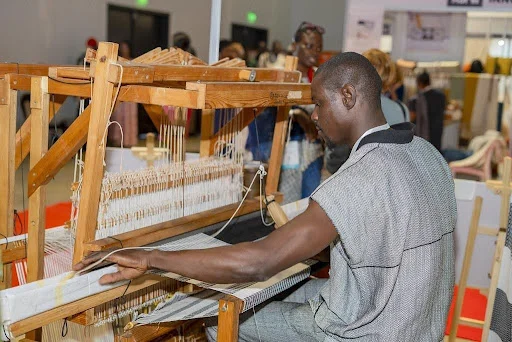
A garment with strong finish quality appears professionally made, regardless of price point. A garment with weak finish quality undermines the design and the label’s quality signal, no matter how strong the concept is.
The fabric’s properties substantially determine the finish quality a garment can achieve. Some fabrics readily support an excellent finish. Others require significant atelier skill and time to achieve a presentable finish, and some cannot be made to present well regardless of the atelier’s skill level.
Seam finish and fabric edge behaviour
A fabric’s behaviour at the cut edge determines which seam finishing approaches are viable. A fabric that frays significantly requires seam allowances to be finished, either by overlocking, binding, or turning and stitching, before the garment can be worn and washed without the internal structure degrading.
The seam finishing approach adds construction time and, in some cases, bulk to the seam allowance that affects how the seam sits inside the garment. Buyers and the press examine this closely at a showcase or launch. A sourcing decision that did not account for edge behaviour becomes visible at exactly that moment.
Drape and silhouette precision
This is one of the most common sourcing mistakes in emerging African fashion label production: a pattern is developed and approved for one fabric type, then produced in a different fabric weight or drape category because the second fabric is cheaper or more readily available. The finished garment looks different from the approved sample. The difference is entirely attributable to the sourcing decision.
The silhouette a garment presents is a function of the fabric’s weight and drape properties in relation to the construction method used. A pattern designed for a medium-weight woven will not produce the same silhouette in a lightweight chiffon or a heavy structured fabric.
For labels working with African textiles, the drape and weight variation between textiles in the same broad category can be significant. The variation between different Kente weave structures, for example, produces different drape and construction behaviour even within the same general textile type. A pattern developed and approved for one weave density will behave differently when produced in a different density of the same cloth. The sourcing decision needs to account for this before production fabric is ordered.
Surface presentation and pressing behaviour
A fabric that presses flat and holds its shape after pressing produces a clean, precise surface. A fabric that resists pressing, or that distorts under the heat required to press it, limits the precision of the finished surface regardless of construction quality.
Pressing behaviour can be assessed from a sample before the order is placed. Press a corner of the sample fabric at the temperature required for the garment construction. A fabric that distorts, develops a shine, or refuses to hold a pressed edge at the required temperature will compromise surface presentation in production.
ALSO READ
- How African Designers Should Compare Fabric Suppliers Before Placing an Order
- What Makes a Textile or Trim Supplier Reliable for Fashion Production
- What the World Lost When Hand-Weaving Gave Way to Mass Production
- The Intimacy of Tailoring: How Clothes Learn the Language of Your Life
How Sourcing Affects Garment Performance

Garment performance is what happens after the customer takes the garment home: how it holds shape over repeated wear, how it responds to washing or dry cleaning, and how it ages.
A dress that twists after three washes, a wrap skirt that grows three centimetres at the waist tie, a jacket that loses its shoulder line after a season of wear: these are performance failures the customer experiences long after the runway or pop-up is over. They are also, almost invariably, sourcing failures.
Fibre content and care performance
Fibre content is the primary determinant of care performance. Natural fibres generally breathe better and often improve with careful washing, but may shrink, felt, or fade if care requirements are not met. Synthetic fibres tend to be more dimensionally stable and easier to care for, but may pill and feel less comfortable in wear. Blended fibres balance properties from both categories, but the blend ratio significantly affects which properties dominate.
The care requirements that follow from the fabric’s fibre content are the label’s responsibility to communicate through accurate care labelling. A label that sources fabric with exacting care requirements but does not communicate them accurately on the care label creates a customer service problem that will manifest as damaged garments and complaints.
Construction stability and shape retention
The fabric’s weave or knit structure, combined with its fibre content and finishing, determines how well the garment holds its shape over time. A loosely woven fabric in a high-tension construction will distort at stress points where the tension is sustained. A tightly woven fabric in the same construction will hold its shape significantly longer.
Shape retention is one of the quality signals that distinguishes a label whose products build buyer and customer loyalty from one whose products produce only a single purchase. A garment that looks excellent in the shop and loses its shape after ten wears has not delivered value to the customer.
African textiles and performance expectations
For labels working with traditional African textiles, performance expectations need to be calibrated against the textile’s specific properties rather than generic fabric conventions. Natural dye systems used in traditional African textile production behave differently from synthetic dyes under the same care conditions: they may fade more quickly in direct sunlight, bleed in hot water, or deepen in colour over time when treated correctly.
These are not performance failures. They are performance characteristics that need to be communicated to the customer and accounted for in the care labelling. The intimacy between a garment and the body that wears it is often most powerfully expressed over time in traditional textiles that develop character with wear and proper care. Communicating this correctly is part of the label’s responsibility to both the customer and the textile tradition.
The garment’s performance is determined at the sourcing stage. The customer discovers it over the course of the garment’s life. The label’s reputation is what connects the two.
What Sourcing Intelligence Produces
A designer who makes sourcing decisions with full awareness of their downstream consequences on cost, finish, and performance produces garments that match the design intention, are produced at the expected cost, and deliver the expected performance to the customer.
This is the difference between a label that controls its production outcomes and one that is perpetually surprised by them: by atelier costs exceeding the estimate, by finish quality requiring corrections, by customer complaints about garments that did not perform as expected.
For African fashion labels whose reputations depend on consistent product quality, sourcing intelligence is not a specialist skill reserved for large labels with dedicated sourcing teams. It is the practical knowledge of how fabric properties translate into production and performance consequences. The labels that build durable commercial reputations are almost invariably the ones whose founders and production managers understand their materials well enough to make sourcing decisions that serve the garment’s entire journey from atelier to customer, not just the aesthetic decision and the price negotiation.
Combined with the supplier comparison discipline from the first article in this series and the reliability assessment from the second, sourcing intelligence gives the three-part foundation its production quality requires: the right material, from a reliable source, selected with a full understanding of what it will do in production and on the body.
The sourcing decision is made before the atelier begins. Make it with the whole garment in mind.
FAQs
How does fabric choice affect garment construction cost?
Fabric choice affects construction cost across three variables: construction time, skill requirements, and material yield. A fabric that frays heavily takes longer to finish internally. One with a large directional pattern repeat wastes more fabric in cutting and matching. A fabric that demands specialist handling increases the effective atelier rate because it can only be entrusted to more experienced machinists. A sourcing comparison that looks only at price per metre and ignores construction time, skill, and yield is not comparing true cost.
What fabric properties most affect finish quality in the finished garment?
Within the three-consequence model, finish quality is most affected by edge behaviour, drape, and pressing response. A fabric that frays significantly limits seam-finishing options and increases the time required to achieve a clean internal structure. A fabric whose weight or drape does not match the pattern specification produces a silhouette that differs from the approved sample, even when the construction is technically correct. A pressing response completes the set: a fabric that distorts under heat or refuses to press flat will always compromise the surface finish, regardless of atelier skill. All three properties can be assessed from a sample before the order is placed.
How should African fashion labels communicate care requirements for traditional textiles?
Care requirements for traditional textiles should be communicated accurately and specifically on the garment’s care label, based on the fibre content, dye system, and construction of the actual cloth used. Natural dye systems and handwoven structures common in African textiles often require cooler water, gentler detergents, avoidance of prolonged direct sunlight, and hand washing rather than machine washing. When communicated clearly, they set appropriate performance expectations and invite the customer into the correct care practices for a textile designed to develop character over time.
How can a designer test a fabric’s performance before committing to a production order?
Performance can be tested prospectively through targeted sample work covering all three consequence sets. For cost, sew a small test piece and note how long seam finishing, pressing, and handling actually take. To finish, test different seam finishes, observe edge behaviour, and press the fabric at the temperature required for construction. For performance testing, wash or dry-clean the sample according to the intended care label, then check for shrinkage, colour bleeding, distortion, pilling, and shape retention at stress points. These tests use minimal fabric and take hours rather than days.
What is the most common sourcing mistake that affects garment finish in African fashion production?
The most common mistake is substituting a different fabric weight or drape category from the one for which the pattern was developed and approved, usually because the substituted fabric is cheaper or more readily available. The finished garment presents a different silhouette, hang, and surface behaviour from the sample, even when the pattern and construction are unchanged. In many emerging labels, this substitution occurs at the sourcing stage without being retested against the pattern before production is committed. The result is a finish problem that appears to be a construction issue, but is entirely due to a sourcing decision that did not adhere to the original fabric specification.
CONTINUE READING