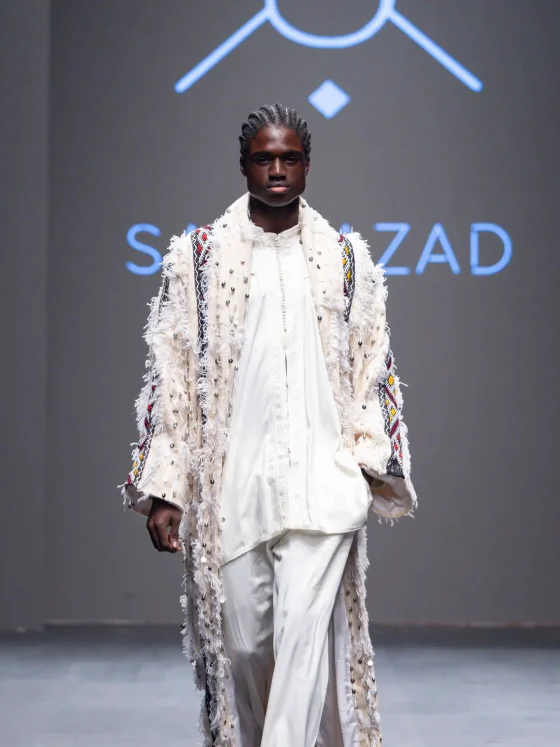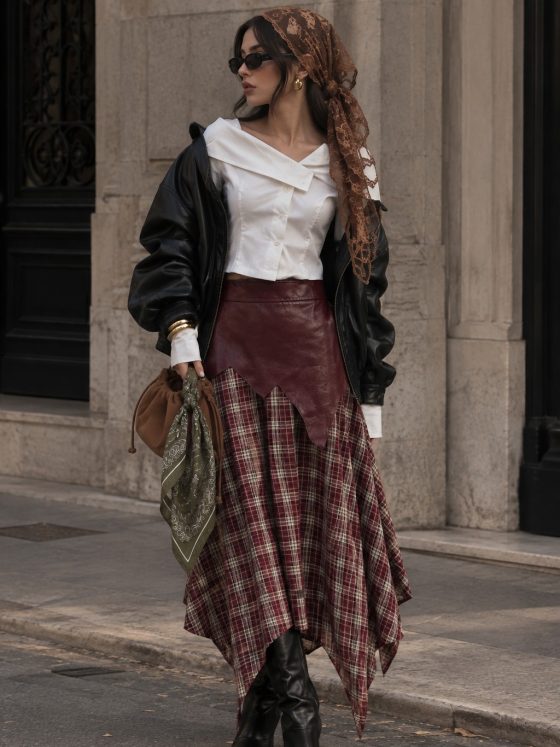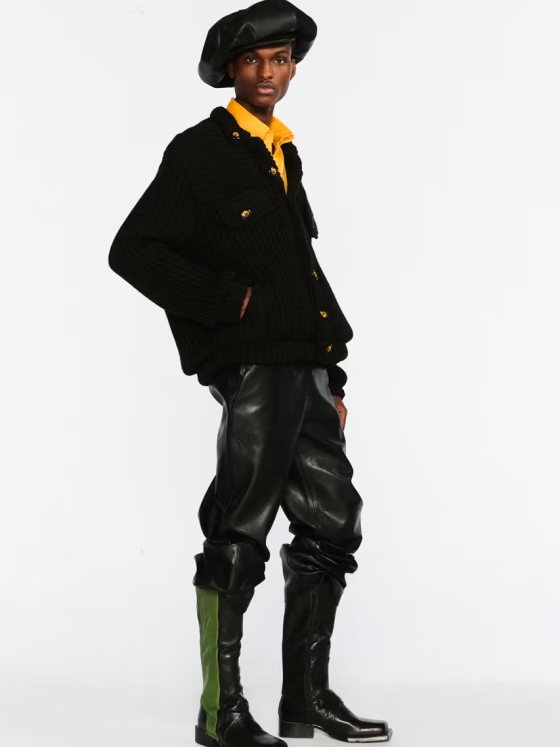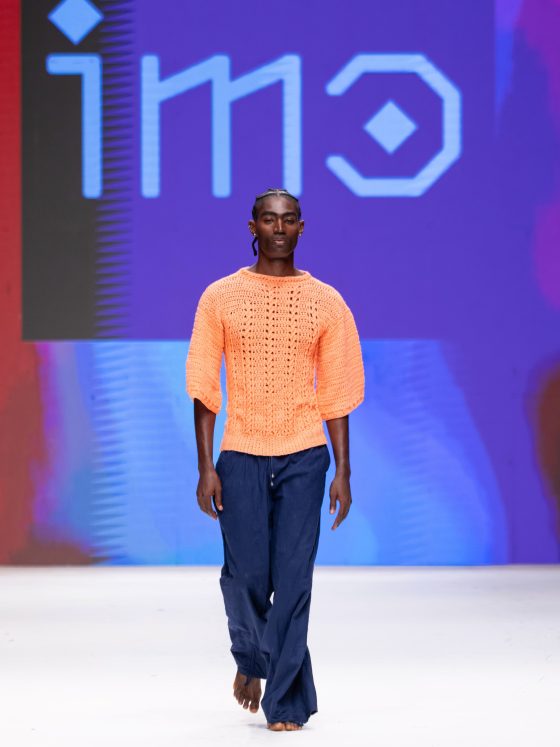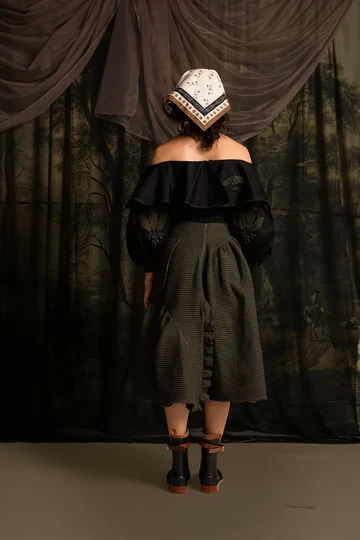
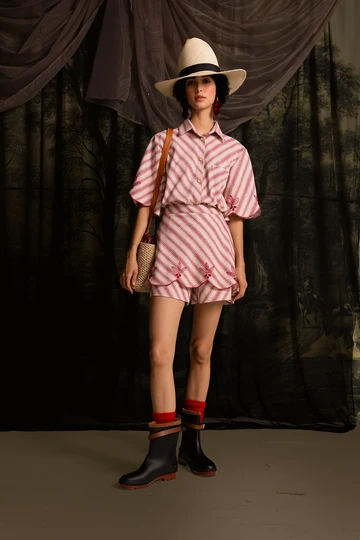
Coffee enters Alado’s La Aurora through several different doors. The recognisable references include flowers, fruit, rural stripes, and patterns drawn from household linens.
Clothing references include ponchos, ruanas, and work aprons. Then there are the less immediately visible interventions: coffee-ground-derived colour used for printing and buttons developed from coffee-tree wood residues.
These are connected ideas, but they are not interchangeable design achievements.
The collection’s interest lies in the distance between them. A floral image can describe a place, a reworked apron can give a clothing practice a new silhouette, and a wooden button can create a physical connection to the agricultural process.
La Aurora is most compelling when you consider those relationships separately, rather than grouping them under the broad promise of a coffee-inspired collection.
Presented with Kia at Colombiamoda 2026, the collection brought together the work of Alado’s creative directors, Andrés Restrepo and Alejandro González. El Colombiano places the show at Plaza Mayor in Medellín on 28 July, and the Alado team’s starting point was an eight-month investigation into Colombian coffee-growing landscapes and the people working within them.
The resulting proposition is more specific than “nature inspires fashion”. Alado looks at an inhabited landscape: cultivated land, inherited clothes, domestic textiles, tools, working routines and the material left behind by production.
The question is how much of that world survives the journey into the clothes, and in what form.
How Alado’s La Aurora translates Colombian coffee landscapes into clothing through rural dress references, embroidery and documented material experiments.
A landscape made of work and objects
In their interview with Revista Diners, Restrepo and González describe travelling through coffee-growing areas, including Armenia, southwestern Antioquia and El Retiro. They identify conversations and time spent with women coffee growers as part of the research.
Their account highlights small observations: hands selecting beans, worn sacks, crop geometry, morning mist, and inherited garments.
Those details establish several possible routes into design. Some are visual, such as a flower’s shape or the geometry of planted land. In contrast, others concern use, such as an apron’s relationship to work or a poncho’s relationship to the body. Still others concern material transformation.
This breadth gives the collection more to work with than a single emblem. It also creates a critical risk: when a collection can absorb almost any rural detail, the explanation can become more comprehensive than the clothes themselves.
“A landscape does not become a garment by being named. It becomes one by being decided, cut and sewn.” Omiren Styles Editorial Intelligence
Alado’s own account offers a useful way to resist that looseness. The designers distinguish between transforming a poncho, translating a work apron’s logic into tailoring, and reinterpreting a ruana.
These are stated design intentions, not merely references to scenery. They direct attention towards the construction and organisation of clothing.
The distinction matters. A landscape does not become a garment simply because its name appears in a show note; the translation requires an intermediate operation: a change in proportion, a placement of pattern, a material substitution, or a decision about how the piece sits on the body.
For readers who want the dress traditions behind these references, our guide to Colombian traditional clothing, regional dress and fabrics is a helpful companion.
Material: coffee as colour and component
The most concrete account of materials comes from the designers’ discussion of their work with Artextil. They describe developing a natural dye from spent coffee grounds for application through prints.
They also distinguish between exploring coffee grounds for buttons and using buttons developed from coffee-tree wood residues.
That wording is important. Exploration is not the same as confirmed use, and a printing colour is not a textile fibre.
Some reporting describes the collection more broadly as involving textiles made from coffee-industry residues; La República says so in its Colombiamoda roundup. The interview provides a narrower, more usable explanation of the processes: ground-derived dye applied in printing, alongside wood-residue components.
It does not justify describing the entire collection as fabric made from coffee. We make the same point about material claims in our guide to verifying a fashion brand’s fabric claims.
El Colombiano adds that wood from pruning coffee plants was used for buttons and other applications, while spent grounds supplied a textile dye for some of the collection’s graphics. The report ties the wood to soqueo, the practice of cutting the main coffee stem every seven years.
This corroborates the distinction between an applied colour process and a solid garment component.
These interventions operate at different scales. A printed image can contribute directly to an outfit’s visual reading, while a button may be less conspicuous; still, its material origin creates another kind of connection: the agricultural reference becomes part of the object rather than remaining exclusively an image.
The reports do not supply a complete garment-by-garment material map. Therefore, it would be inaccurate to assign a coffee-derived dye or wooden button to a named dress without further documentation.
The finding is collection-level but specific: Alado documents particular uses of coffee-related residues, not a universal composition.
Surface: from farmhouse linens to embroidery
The collection’s surface language reaches beyond the coffee plant itself. El Tiempo identifies stripes drawn from older rural textiles, embroidery recalling coffee flowers and fruit, and prints based on tablecloths and coverings found in coffee-growing homes.
This domestic reference is significant. It shifts attention from an export crop to the spaces surrounding its production, and table linen belongs to a household, introducing a different register than the plant, bean, or cultivated hillside.
In editorial terms, that is one of La Aurora’s strongest ideas. The collection does not need every reference to announce “coffee” immediately, since its account of place can also emerge through the textiles associated with living there.
Embroidery and printing nevertheless perform different work, and their techniques should not disappear beneath the general label of decoration. The published accounts establish both, but provide insufficient information to compare stitch density, internal finishing, or the execution of particular embroidered garments.
We can assess the range of references. Flowers and fruit make the agricultural connection recognisable, and stripes and household patterns broaden it into a material culture.
Together, they support a more layered proposition than a collection covered only in botanical illustrations.
In their Diners interview, the designers defend recognisable imagery, arguing that a literal image can provide an entrance into a story. That is a position worth taking seriously without treating it as a verdict, because recognition can begin the encounter but does not, by itself, establish the quality of the garment carrying the image.
Silhouette: between rural clothing and fashion form
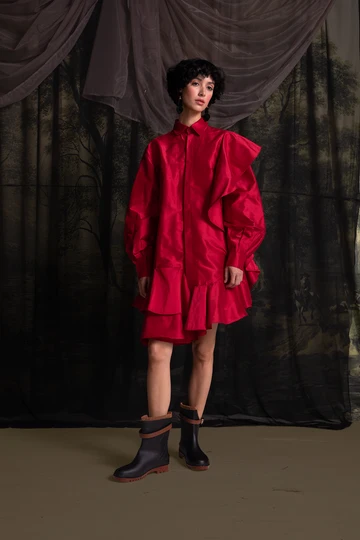
Published descriptions identify tailoring and corsetry within La Aurora, alongside reinterpretations of rural garments. Post-show coverage in Harper’s Bazaar Colombia also describes long, fluid dresses and skirts with ruffles.
El Colombiano adds that the designers reworked traditional campesino dress, keeping bare shoulders, boleros and wide skirts, in fabrics woven on the kind of horizontal loom used for ponchos and ruanas.
These categories introduce a productive contrast. Tailoring and corsetry suggest an interest in structuring the body. At the same time, fluid dresses and ruffled skirts introduce another relationship to volume, so this reporting can’t reduce the collection to a single uniform silhouette.
The more consequential question is how the rural references affect those forms. For more on a Colombian silhouette built through tradition, see our piece on the cumbia dress.
The designers’ explanation of translating a work apron into tailoring suggests more than a quotation. It proposes taking an existing garment’s logic and placing it within a different clothing system. Their references to the poncho and ruana similarly identify clothing, not simply landscape, as research material.
However, the available accounts do not identify a particular runway look and demonstrate every stage of that transformation. The strongest supported claim is that rural garment references are part of Alado’s stated formal method.
A more precise judgement of individual pattern-cutting decisions would require a reliably attributed sequence and more detailed documentation.
This is not a reason to dismiss the silhouette work. It is a reason to distinguish a promising design operation from an inspected technical result.
Styling: the field enters the presentation
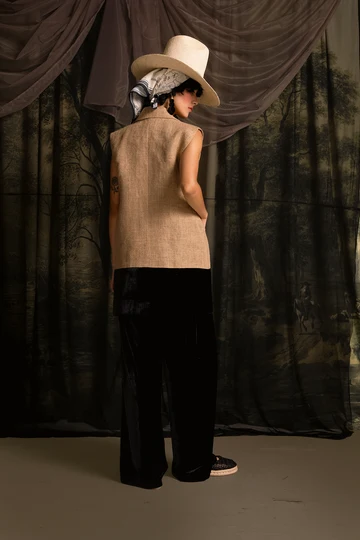
Harper’s Bazaar Colombia describes boots recalling agricultural work, reinterpreted hats and gloves within the collection’s presentation. Those elements surround the dresses, skirts, prints and textures with a more explicit reference to the field.
Their contribution should remain distinct from the clothes.
A boot can alter how a fluid dress is read, and a hat can make a rural association more immediate. But neither establishes that the dress itself has been structurally derived from agricultural clothing.
That distinction gives the presentation a more useful critical reading. Styling may reinforce a connection already present in the garment, or it may carry more of the narrative, and the two outcomes are not equivalent.
Sound also shaped the intended experience. In Diners, the designers discuss birds, wind and música carrilera as elements of a unified landscape rather than incidental accompaniment, and El Colombiano notes a soundscape of recordings made on the farms.
They aimed to place the garments within the environment that informed them.
That explains the presentation strategy. It should not replace the garment analysis, since an immersive setting can make an argument more legible, but the clothes still need to sustain attention outside it.
The women behind the research
The collection’s research account names women rather than presenting an entirely anonymous idea of rural labour. The accompanying documentary is described in four chapters featuring Rosalinda, María Eugenia, Marta Dolly, Sandra, and Rosa Elena.
The designers connect these encounters with memory, land, working practices and quality. Autocosmos reports that the documentary, titled Chapoleras, centres on women who cultivate coffee, and that the collection came from a Kia Colombia partnership with Alado.
The distinction between representation and participation matters here.
According to the interview, the Kia–Alado stand also provided space for the associated speciality coffee brands, Café La Naviera, El Mirador, Rosa Linda and El Recuerdo, to be presented directly. This is a documented activity beyond using the women’s experiences as a runway reference.
It does not, on its own, establish the financial terms of the relationships, revenue distribution, or a measurable long-term benefit. Those outcomes should not be presumed.
It does establish a broader presentation framework: garments, documentary accounts, and a setting in which the growers’ coffee could be offered. The clothing belongs within that framework but should not receive automatic design approval because the surrounding initiative has an articulated social purpose.
Beyond the wardrobe
Alado extended La Aurora into ceramics and home textiles. In their interview, the designers explain this through an interest in the territory’s material culture: identity expressed not only through clothing but also through objects and inhabited spaces.
The extension aligns with the collection’s focus on household linens. It suggests that the domestic reference was not merely a convenient source of prints but part of a wider design proposition.
Still, coherence across categories is different from proving each object’s success. A shared narrative does not remove the need to assess a ceramic piece as a ceramic piece or a coat as a coat.
Alado’s online collection listings identify products including Vestido Amanecer, Vestido Azahar, Vestido Aurora and Gabán Aurora. Those listings establish a retail continuation under the collection name, but the names alone do not establish which materials or techniques belong to each piece.
What the material experiments do not prove
The coffee-residue developments are a substantive part of the collection’s account. They should neither be ignored nor inflated.
The reviewed reporting does not provide comparative lifecycle evidence, complete processing information or a collection-wide environmental assessment. No conclusion about La Aurora’s overall environmental performance follows solely from the documented use of grounds-derived colour or wood-residue buttons.
That limit need not weaken the design discussion. The experiments remain relevant as material choices, and their value here is the specific relationship they establish between the source landscape and parts of the finished clothing.
Likewise, the designers’ account of making selected pieces available at presentation time describes production planning, not verified sales performance.
They say they coordinated immediate availability around work already developed rather than artificially accelerating hand processes. The interview does not document order volumes or sell-through.
The Omiren Argument
La Aurora makes its strongest case through translation rather than symbolism alone.
Coffee flowers and fruit provide recognisable images. Rural textiles and household linens widen the collection’s vocabulary; ponchos, ruanas and aprons enter the designers’ account of silhouette, and grounds-derived printing colour and wood-residue components establish specific physical connections to the coffee chain.
These are different operations, and keeping them distinct makes the collection more interesting, not less.
The evidence is strongest on material processes and documented references. It is less complete at the level of individual garment construction, and that imbalance should shape the verdict rather than be concealed by promotional language.
Alado’s achievement is not that every part of the collection has been proven to embody a landscape. Instead, the project identifies several credible routes by which a lived environment can enter clothing: through what people wear, what they keep in their homes, what they cultivate, and what production leaves behind.
The most persuasive reading of the approved title is therefore not literal. A coffee landscape does not simply become a dress; it passes through research, selection and transformation.
La Aurora gives those intermediate decisions enough substance to be examined and makes them the proper centre of the design conversation. More of our fashion coverage is at Omiren Styles.
Also Read:
- J Balvin x Vélez: Colombian Leather Craft at Colombiamoda 2026
- Latin America’s $87.9 Billion Fashion Economy: Where Afro-Descendant Brands Fit, and Where They Are Invisible
- What Quibdo Wears: The Afro-Colombian Dress Culture That Colombian Fashion Never Documented
- Colombian Traditional Dress: Mola, Pollera & Palenquera Guide
Frequently Asked Questions
Who designed La Aurora?
Andrés Restrepo and Alejandro González, Alado’s creative directors, developed the collection presented with Kia at Colombiamoda 2026.
Was the entire collection made from coffee waste?
The reviewed sources do not establish that. The designers specifically describe spent coffee grounds used for printing dye and buttons made from coffee-tree wood residues, alongside other materials and techniques.
How many runway looks were presented?
Published accounts differ: Diners reports 28 looks, while Semana and El Colombiano report 34. No definitive total is asserted here because an authoritative reconciled sequence was not established.
Is this a first-hand construction review?
No. It is a reported collection analysis based on published interviews, presentation coverage and collection listings. It does not claim physical inspection of the garments or independent testing of their materials.