The woman on the postcard is unnamed. Her head is turned to one side, showing the outline of a tied madras headscarf. A patterned shawl lies over her shoulders and matches the garment beneath it. A pendant hangs at her chest. The Smithsonian’s National Museum of African American History and Culture identifies the ensemble in this Fort-de-France portrait, dated around 1910, as a douillette, a formal style of French Caribbean dress. The madras sits above the matching fabrics. It completes the outfit without being the material from which the whole outfit is made.
The postcard shows madras already established as part of a particular way of dressing. It does not show when the cloth first entered that tradition. A dress-history exhibit from Dominica provides a different kind of evidence: it describes madras replacing a white head handkerchief as the jupe ensemble developed. Put the two accounts together and the question changes. It is not simply how an imported fabric became popular. It is how people gave that fabric a place among garments they already knew how to make, arrange and wear.
How South Indian madras became part of Creole dress, from a formal headwrap in Martinique to changing traditions of women’s dress in Dominica.
From traded handkerchiefs to Creole headwrap
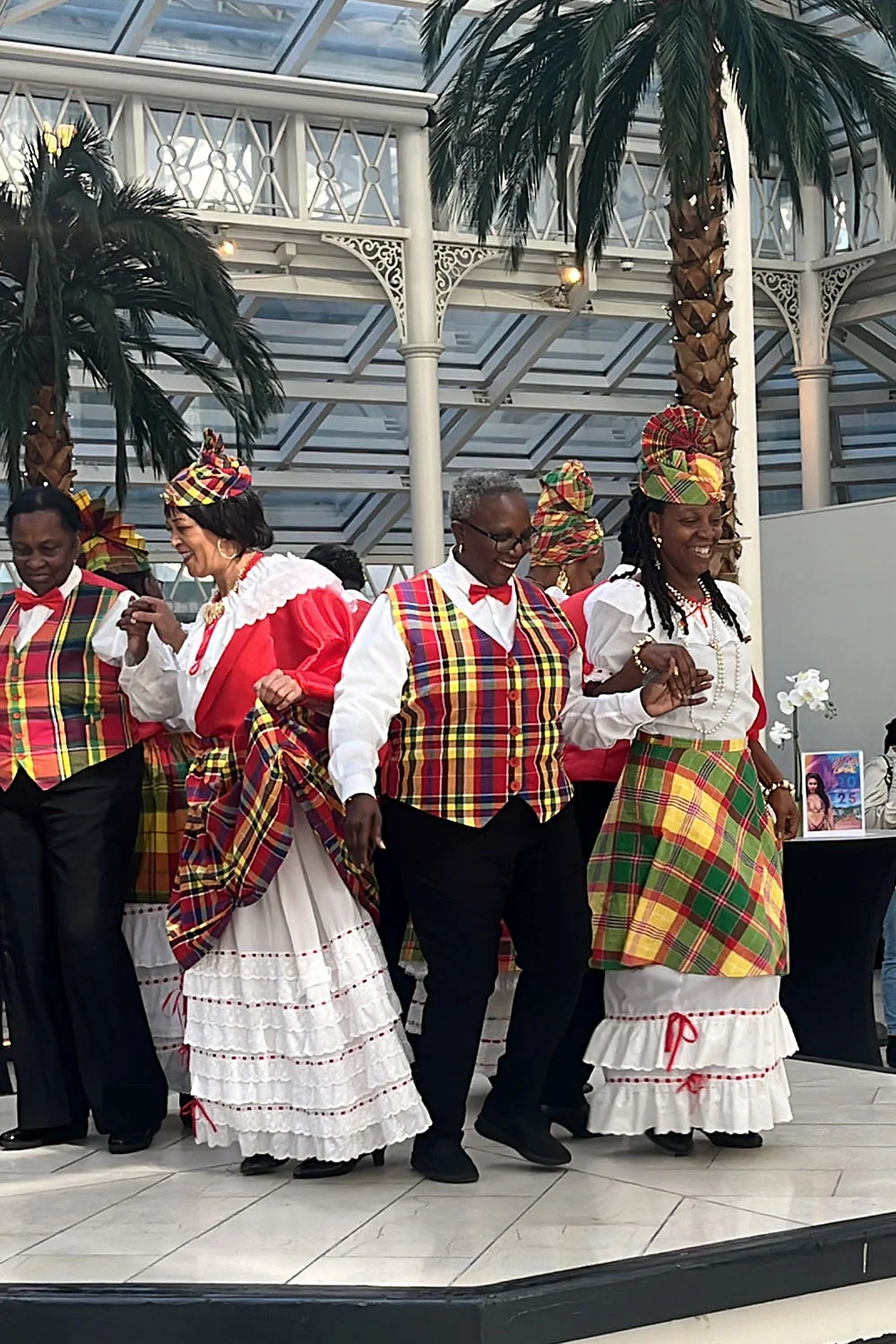
Madras takes its name from Madras, now Chennai, in South India. The textile, often woven in checks, circulated through colonial trade networks, including as handkerchiefs. South Indian weavers made the cloth; those networks made it available to buyers far from where it was woven. Neither fact explains how the headwrap in the Martinique postcard got its shape. The weave supplies the checked surface, but folding and tying determine which edges show, where the pattern changes direction and how the cloth stands away from the head.
Evidence suggests Caribbean madras styling travelled well before the postcard was made. The Connecting Threads exhibition on the appropriation of madras documents a European vogue for the Creole dress in the late eighteenth and early nineteenth centuries. It traces how white women raised in the Greater Caribbean brought headwrap styles associated with African Caribbean women into fashion in Paris and London, without openly crediting the women whose dress they drew on. An 1816 Paris fashion plate, Fichu-Madras Robe de Perkale, records Madras in that European fashion context.
The plate does not date the first use of madras in Martinique or Dominica. It does establish a useful sequence: South Indian cloth circulated through colonial trade; Caribbean ways of wearing madras were visible in European fashion by the early nineteenth century; and the later Fort-de-France postcard records the textile in a specific formal ensemble. The cloth’s route and the headwrap’s route are related histories, but they are not the same. The first follows a traded textile. The second follows a way of dressing that other people could adopt and circulate.
Martinique: What the headwrap adds to the douillette
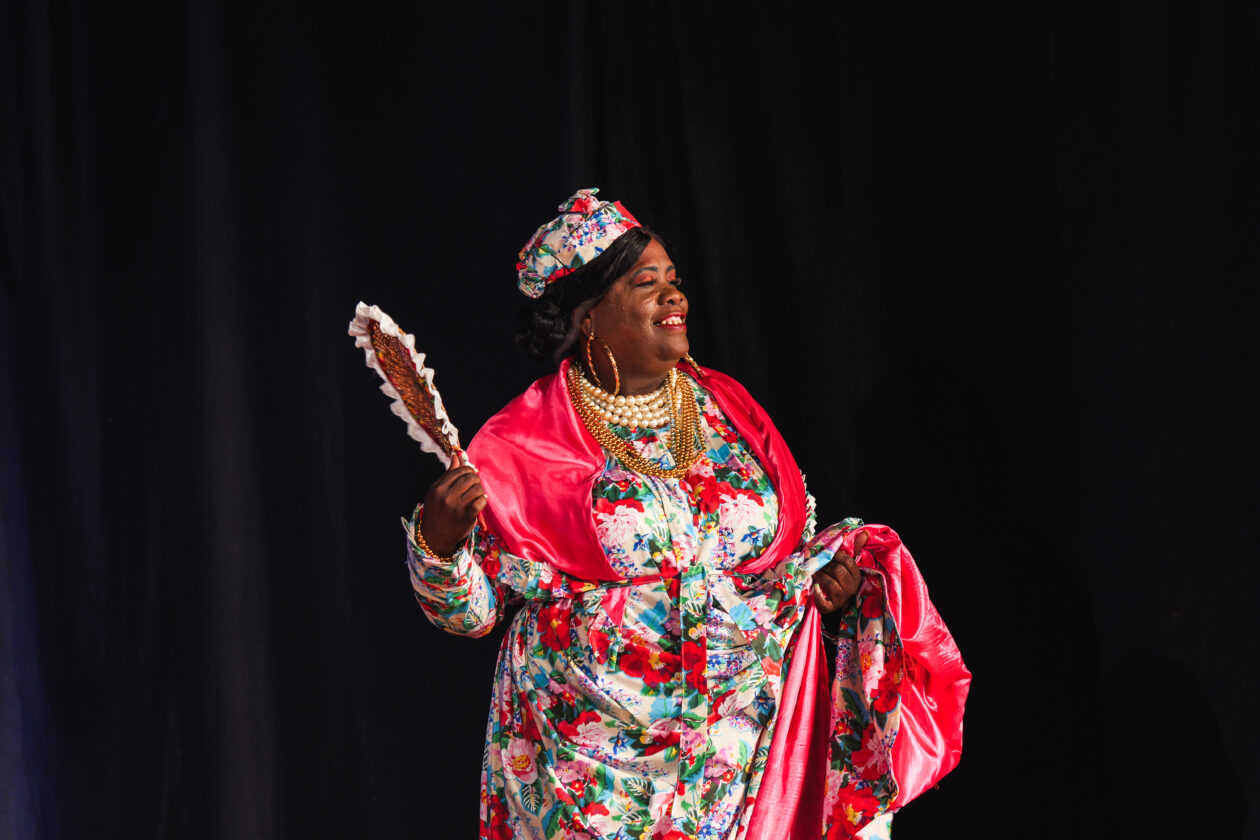
The postcard is especially useful because the museum identifies the outfit and describes how its elements relate. The shoulder shawl matches the garment beneath it, while the madras headscarf provides a separate pattern and shape. Looking at the headwrap alone would tell us something about the textile. Looking at it with the rest of the outfit tells us how it was used: the headwrap finishes an ensemble whose visual coherence does not depend on every piece being made from the same cloth.
The Smithsonian places the douillette in a history of dress under slavery and after emancipation. Its account distinguishes the formal ensemble from the chemise jupe, a bodice-and-skirt combination it associates with dress restrictions imposed on enslaved women. It describes Black women wearing elaborate douillettes after emancipation and identifies madras headscarves as adornments worn with both kinds of outfit. That last detail matters: the same kind of headcloth could appear with garments the museum distinguishes by form and historical context. Madras alone cannot identify which ensemble a woman is wearing.
The museum also describes conventions linking some ways of tying a headwrap to courtship and notes ceremonial tying. Those accounts show that tying could carry meaning beyond the fabric’s arrangement. They do not give us a universal key to Caribbean headwear or a basis for assigning a marital status to the unnamed woman. The postcard’s printed title, Type et Costume Créole, identifies her as a “type” rather than by name. It preserves details of her dress without preserving her explanation of it. That gap matters when reading a colonial image as evidence: a publisher’s label and a wearer’s account are not interchangeable.
Dominica: A change in headwear, not a rule for the whole outfit
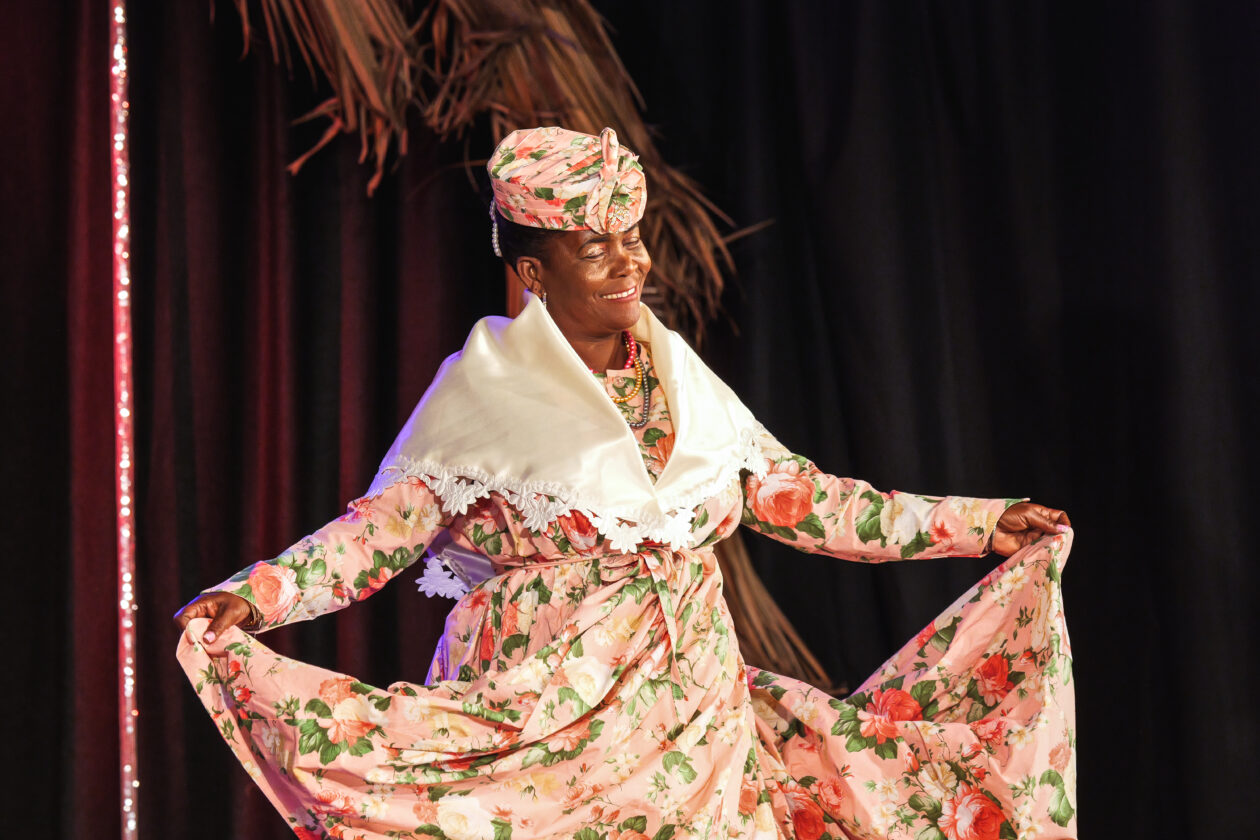
The Jupe and the Wob Dwiyet, a Dominican dress-history exhibit produced by Create Caribbean with Dominica’s Division of Culture, describes an earlier jupe ensemble with a brightly coloured skirt, a white chemise, lace trim and a white head handkerchief or bonnet. In the exhibit’s account, madras began to replace the white handkerchief as dress styles developed. The exhibit also describes changes to other parts of the outfit, including the use of a material known as imite for shoulder cloths and skirts. These are changes to particular pieces of clothing, not a shift to making the entire ensemble in madras.
Aileen Burton made a related distinction in a 2016 interview with The Sun in Dominica. In her account, adding madras, lace and gold jewellery does not automatically make an outfit national dress. She describes the wob dwiyet as an ensemble centred on a long dress, accompanied by a lining, petticoat, scarf, headpiece and jewellery. She distinguishes it from the jip, which she describes as a patterned skirt worn with a blouse and lace-trimmed petticoat. She also notes that a wob dwiyet could be made in madras, floral, dotted or plain fabric. The checks may be part of the outfit, but they don’t make it a wob dwiyet.
Burton’s recollection of stiffly starched, pleated petticoats rustling as women walked makes the distinction tangible. You could recognise the checks in a photograph or on a fabric counter. You could not know from the cloth alone how the layers would sit, move or sound. Those qualities depended on how the pieces were prepared and worn together. Where the exhibit describes a change in headwear over time, Burton’s testimony explains why recognising a textile still isn’t the same as recognising the dress.
The Omiren Argument
Trade explains how Madras reached the Caribbean. Dress history explains what people did with it. In the Martinique postcard, a tied Madras headwrap completes a douillette without defining the whole ensemble. In Dominica, a dress-history exhibit records madras replacing a white head handkerchief, while Burton’s account shows why the check pattern alone cannot identify a wob dwiyet. One source preserves a particular outfit; the others describe change over time and explain distinctions between ensembles. None needs to stand in for the whole Caribbean.
That distinction also changes where credit belongs. South Indian weavers made the textile. Trade brought it into Caribbean markets. Caribbean wearers gave it forms and uses that could travel independently of the cloth itself, as the European vogue for Madras headwraps shows. Calling the fabric imported explains its origin. It does not make the way it was folded, arranged and worn an imported idea. To understand how Madras became part of Creole dress, look at the finished outfit and ask which details the cloth supplied and which the people wearing it made.
Also Read:
- The Niger Delta Dress Tradition: What Ijaw, Urhobo, and Itsekiri People Have Always Known
- The Iria Wardrobe Is a Social Record: How Kalabari Dress Makes Womanhood Visible
- Maasai Shuka: The Cloth, the Community and the Politics of Cultural Value
- Gullah Geechee Women’s Headwrap Traditions, Still Practised Today
Frequently Asked Questions
What is Caribbean madras?
Madras is a textile associated with South India, often woven in checks. “Caribbean madras” refers to its use in Caribbean settings, where it has been worn as headcloths and used in garments and accessories. It is not the name of one Creole dress ensemble shared across the region.
How did Madras become part of the Creole dress?
Colonial trade brought South Indian Madras into Caribbean markets, including as handkerchiefs. Wearers incorporated it into ensembles in different ways. The Fort-de-France postcard documents an established use as a formal headwrap, while the Dominican dress-history exhibit records madras replacing a white head handkerchief. Neither source establishes a single adoption date for the Caribbean.
How was the Madras worn in Martinique and Dominica?
In the Martinique postcard, the madras is tied as a headwrap and worn with a formal douillette. In Dominica, the dress-history exhibit describes madras as replacing a white head handkerchief, and Aileen Burton identifies it as one of several fabrics that could be used for the wob dwiyet. These are documented examples, not fixed rules for either island.
Is Madras the same as the Wob Dwiyet?
No. Madras is a textile; the wob dwiyet is a dress ensemble. Burton describes versions made in madras as well as floral, dotted or plain fabrics. To identify the ensemble, look at how the dress and its accompanying pieces are put together rather than looking for checks alone.