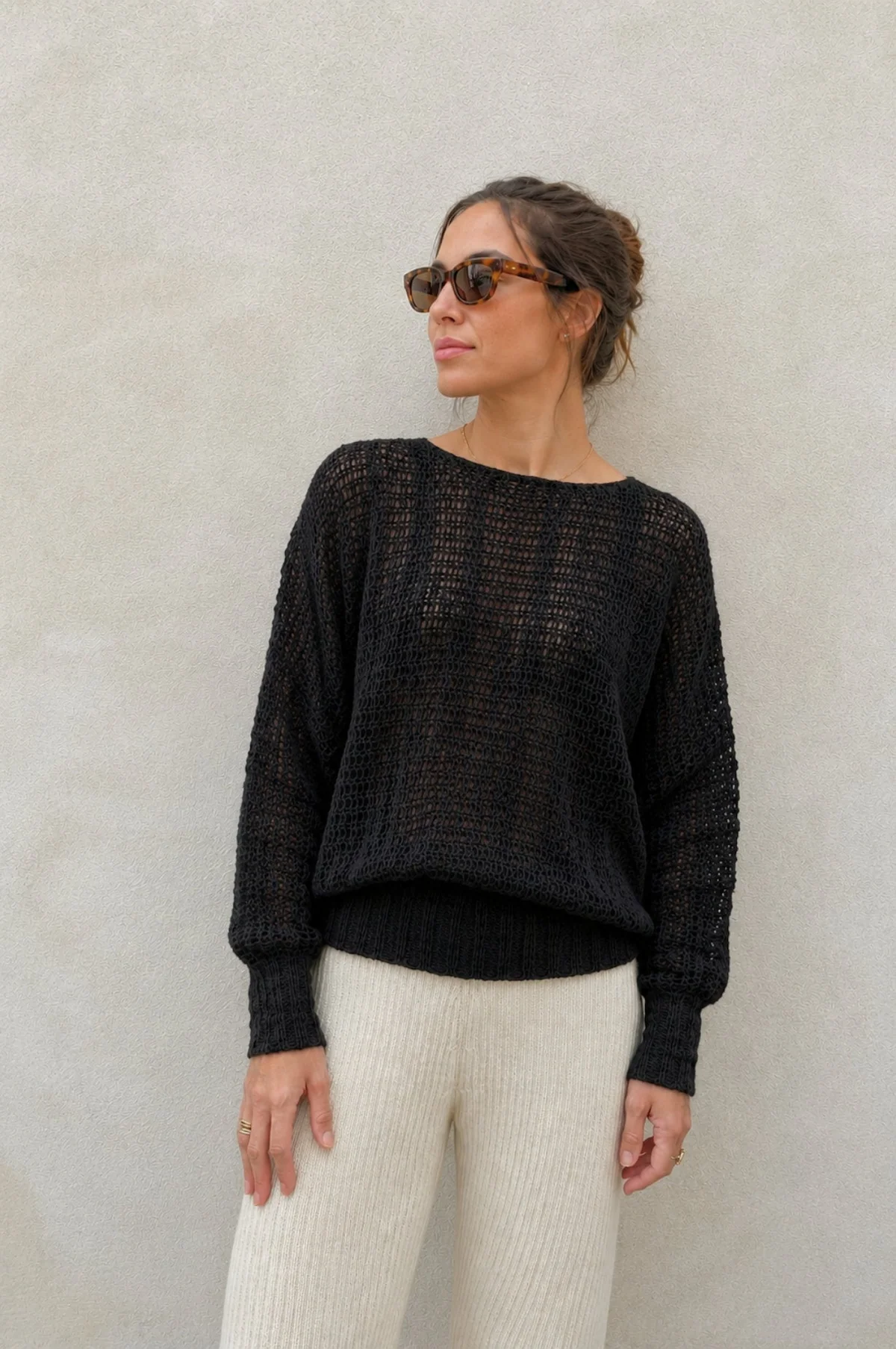
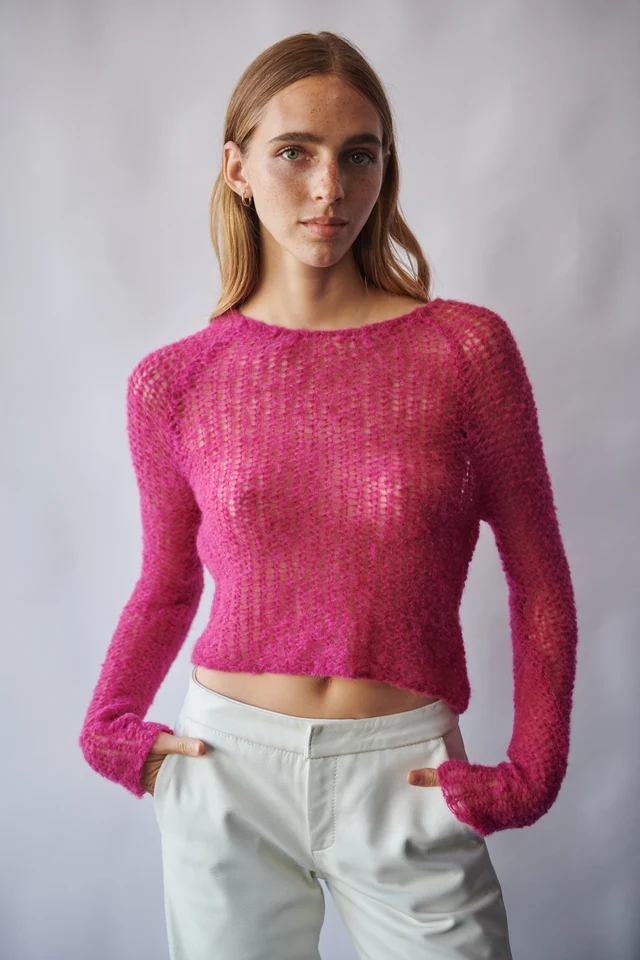
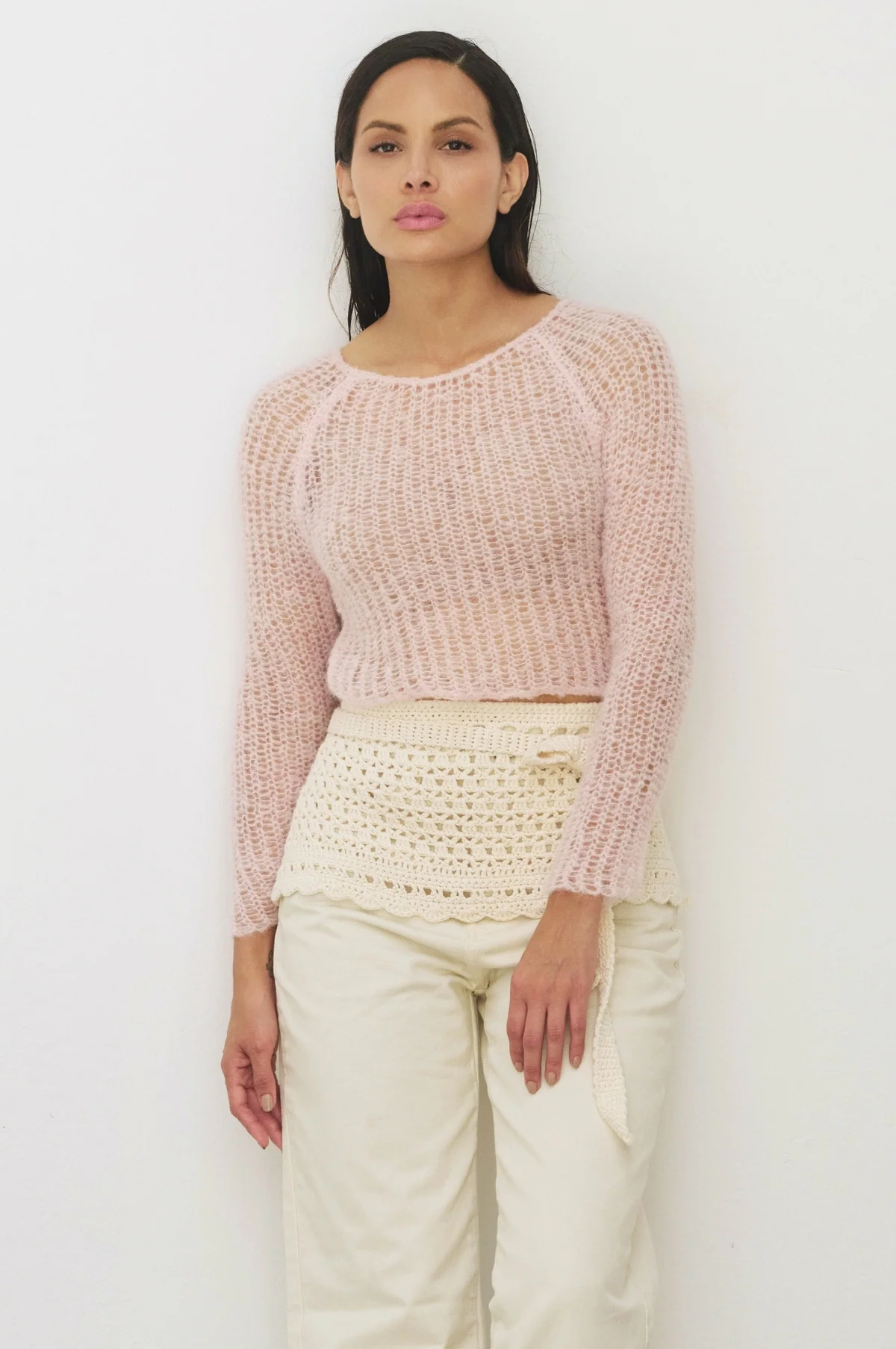
The most useful introduction to AYNI’s LIMA sweater is its specification: 89% alpaca, 11% polyamide, machine-knitted and made in Peru. The label describes it as a “cropped light openknit sweater”, lists Baby Pink as its colour, and offers XS, S, and M as size options.
These details establish a particular garment rather than an abstract idea of Peruvian knitwear.
They also set the boundaries of what we can say about it. The product record identifies the declared fibre blend, knitting method and country of manufacture, but it does not provide a complete route from fibre source to finished sweater.
It does not identify the workshop, and the retrieved text does not establish fit through finished-garment measurements.
LIMA is therefore a useful case for examining the difference between product disclosure and complete traceability. Its page provides meaningful information, and the task is to explain it without letting it stand for more than it documents.
If you want the broader habit of mind, our guide to checking a fashion brand’s fabric claims sets out the questions we bring to every product page like this one.
AYNI’s LIMA sweater is listed as 89% alpaca, 11% polyamide, and machine-knitted in Peru. Here is what its product record establishes about making and fit.
Read the product before the brand story
AYNI’s broader presentation links its collections to Peruvian artisans, traditional methods, and responsible production. Those statements describe the brand’s stated approach, but they don’t automatically establish the production history of each garment.
Bloomberg’s 2017 profile describes the label as a Peruvian alpaca brand founded by Laerke Skyum and Adriana Cachay, focused on preserving Peru’s weaving heritage. That is useful background on the brand, and it is still a statement about the company rather than about this sweater.
The LIMA sweater’s product page gives a more specific answer: it lists the technique as “Machine Knit”. That wording should guide its description, rather than assuming everything sold under a craft-focused label must be hand-knitted.
Machine knitting and skilled work are not opposing categories. The relevant distinction is between a named production method and an identified production team, and LIMA’s record provides the former, not the latter.
This is why item-specific information matters. A general account of craftsmanship may explain what a business values, while a garment record should explain what happened in the making of the object a reader is considering.
“A brand story tells you what a business believes. A product page tells you what it is willing to put its name on.” Omiren Styles Editorial Intelligence
For LIMA, the machine-knit disclosure is useful precisely because it narrows the description. It prevents the sweater from becoming a generic illustration of hand production and directs attention towards the method AYNI actually lists.
Keep both fibres in the description.

AYNI declares LIMA’s composition as 89% alpaca and 11% polyamide. The blend should remain visible whenever materials are central to the discussion, because describing the garment simply as an alpaca sweater may work as shorthand but does not replace the complete specification.
The product page does not identify the alpaca as baby alpaca or another named grade. Nor does it describe the polyamide as recycled.
Those details should not be supplied from expectations about the brand or from the composition of a different AYNI garment.
The percentages answer one question: what fibres does the seller declare in this sweater? They do not answer why the blend was selected, where its components originated or how the finished garment performs.
It would therefore be premature to assign the polyamide a specific function without an attributable explanation. The record does not state that it was added for strength, shape retention or another particular benefit.
A careful material account preserves the distinction between composition and purpose. The first is published, and the second has not been explained for this item.
What “Machine Knit” tells us
The listed technique establishes that LIMA should not be described as hand-knitted. It does not provide a technical account of the equipment, knitting programme, yarn preparation, assembly or finishing.
That is a limitation in the documentation, not a finding against the garment.
Production labels often describe one part of a process, and they do not necessarily identify every person or stage involved. In this case, the page does not name a knitter, production workshop or individual responsible for finishing.
AYNI’s homepage separately introduces Gladys Flor as a workshop leader. However, it does not connect her to LIMA, and attaching her name to this sweater would turn a general introduction into an unsupported item-specific credit.
The more accurate account is straightforward: AYNI identifies the knitting method, but the reviewed product record does not identify the people who carried it out.
That distinction protects the meaning of maker credit. A person’s name should be linked to a garment through evidence, not borrowed from elsewhere on a website to make the production story feel more complete, and we apply the same test in our note on how heritage fashion pages should credit makers.
Peru is a country-of-manufacture statement.
LIMA is explicitly listed as made in Peru. That is a concrete disclosure and an appropriate basis for describing it as Peruvian-made knitwear.
It is not a complete account of material origin. The page does not identify where the alpaca fibre was sourced, where the polyamide was produced or where the yarn was spun and dyed.
The Lima office address in the site footer should not be treated as the production location either. A business contact address does not establish where a particular garment was knitted.
This distinction matters especially when a product is discussed through national craft identity. “Made in Peru” can accurately describe the stated manufacturing country while leaving several earlier stages undocumented.
That does not make the phrase meaningless; it defines its scope. The evidence supports a country-level manufacturing statement, not a fully mapped domestic supply chain.
A stronger tracing record would connect the garment to its yarn and production sources. Until those connections are documented, the article should stop where the product record stops, a principle we explore in protecting the cloth makers behind provenance claims.
Cropped is a shape description, not a measurement
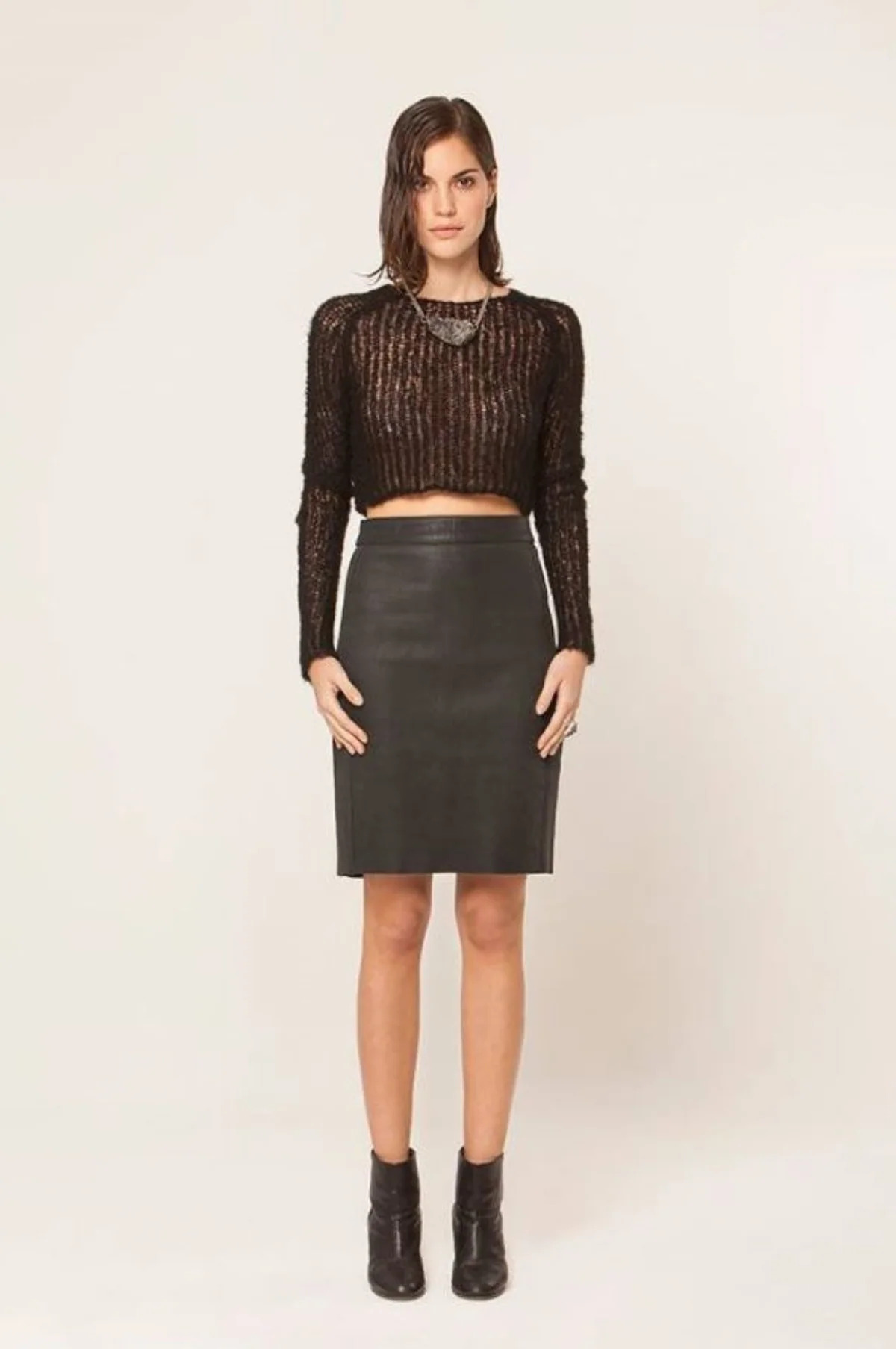
AYNI’s description gives LIMA three immediate characteristics: cropped, light and open-knit. Together, they communicate the seller’s intended presentation of the sweater.
“Cropped” identifies a length category, but it does not establish the garment’s body length. Without that measurement, a reader cannot determine where the hem would sit on a particular torso.
The same applies to the listed sizes. XS, S and M indicate the selections offered on the page. Still, they do not independently explain chest width, sleeve length, shoulder position, or intended ease, and the retrieved product text did not include those finished-garment details.
The page includes a “Size guide & garment care” link. Its presence suggests a path to further guidance, but this review has not verified the linked information, so it should not be treated as though it has already resolved the fit question.
The supported description remains useful: LIMA is marketed as a cropped open-knit sweater in three listed sizes. A confident individual fit recommendation would require more.
Do not turn appearance into a performance claim.
“Light” and “open-knit” describe the product’s intended character. They do not establish a measured garment weight, a temperature range or comfort on a particular wearer.
This article has not tested warmth, skin feel, pilling, shape retention or behaviour after cleaning. The product information reviewed does not provide results for those qualities.
That absence should not be taken as a negative judgement, because no poor performance has been established. The point is that performance remains outside the evidence examined here.
A familiar fibre name can invite assumptions based on other clothing, but another alpaca-blend sweater is not this sweater. Composition alone does not demonstrate how the complete garment behaves.
For a reader, the practical distinction is between information that helps form questions and evidence that answers them. LIMA’s specification provides a starting point, but it does not replace a fitting, a detailed measurement record or a relevant wear assessment
Brand commitments are not product-level environmental findings.
AYNI’s homepage associates the brand with sustainable and responsible production. The LIMA page does not provide an environmental assessment specific to the sweater.
Neither its alpaca content nor its Peruvian manufacture independently establishes lower environmental impact. The polyamide percentage does not settle that question in the opposite direction.
An environmental comparison requires a defined basis and supporting information. The reviewed listing does not provide the data needed to compare LIMA with another garment across production, use or disposal.
The appropriate treatment is therefore to attribute AYNI’s wider commitments while avoiding an independent sustainability verdict on this item.
This separation improves the article rather than weakening it. It lets AYNI’s disclosed information, blend, technique, and manufacturing country be assessed on its own terms, without presenting it as certification of every environmental claim.
The Omiren Argument
LIMA demonstrates why a product page deserves closer reading than a brand slogan.
AYNI publishes a full fibre blend, names the knitting method and states a manufacturing country. Those disclosures provide a firmer basis for discussing the sweater than a general narrative about alpaca, artisanship or Peruvian heritage.
The record does not complete the chain. It leaves material sourcing, production participants and measured fit insufficiently established for a fully traced account.
For Omiren, traceability must match the evidence. A country is not a supply chain, a technique is not a maker credit, and a size label is not a finished measurement.
The strongest supported description of LIMA is specific: a cropped open-knit sweater declared as 89% alpaca and 11% polyamide, machine-knitted and made in Peru. To understand more, we need records attached to this garment, not assumptions based on its materials or brand.
Readers can find more of our work on textiles and provenance at Omiren Styles.
Also Read:
- From Cocoon to Catwalk: Tracing a Single Strand of Rare Silk from Farm to Atelier
- Cloth, Craft, and Community: The Textile Traditions of Afro-Peruvian Coastal Culture
- Africa Grows Cotton. Asia Spins the Yarn. Who Profits?
- Afro-Peruvian Chincha Influences in Contemporary Peruvian Fashion
Frequently Asked Questions
What is AYNI’s LIMA sweater made from?
AYNI lists 89% alpaca and 11% polyamide. The page does not specify a named alpaca grade or describe the polyamide as recycled.
Is the LIMA sweater hand-knitted?
No. The published technique is “Machine Knit”. The listing does not provide a complete breakdown of assembly and finishing.
Where is it made?
AYNI states that LIMA is made in Peru. The reviewed page does not identify every material source or name the production workshop.
What is established about its fit?
The seller describes it as cropped, light and open-knit, with XS, S and M listed. Finished-garment measurements were not available in the retrieved product text.