A dress appears to carry polka dots. According to Thebe Magugu, those marks are scanned fingerprints supplied by Olivia Forsyth, a former spy for South Africa’s apartheid government. In a Tagwalk interview, the designer identified the pleated dress as his favourite look from the Spring/Summer 2021 collection, explaining that it represented the collection’s intention.
The discovery changes the garment’s interpretation without changing its physical form. A familiar pattern becomes connected to a particular person and history.
“The best prints reward a second look. The question is what the second look finds.” Omiren Styles Editorial Intelligence
That makes the dress a useful starting point for examining print. Its significance is not simply that the motif carries a story. It is that the motif initially resembles something else. Recognition arrives in stages: first pattern, then fingerprint, then a documented connection to espionage.
Magugu titled the collection Counter Intelligence. Across the fingerprint dress, confession-print blouse, and patterned parka, the relationship between appearance and information becomes more specific, and more complicated than a general claim that print tells stories.
Fingerprints, a confession, and a polygraph scan become textile imagery in Thebe Magugu’s Counter Intelligence. What do these prints contribute to the clothes?
A Collection Built Around Information
The official collection statement connects Counter Intelligence to Magugu’s research into female spies associated with apartheid-era South Africa. In his Tagwalk interview, he described reading Jonathan Ancer’s Betrayal: The Secret Lives of Apartheid Spies, contacting the author and speaking with former spies discussed in the book. These are the designer’s accounts of his research process, not interviews conducted for this article.
The presentation extended the subject beyond the textiles. The official credits name Kristin-Lee Moolman as director and Ibrahim Kamara as stylist on a film that uses surveillance scenarios. WWD’s contemporary review described its grainy CCTV- and VHS-like treatment and spoken extracts from Ancer’s book.
The distinction matters. Print contributed information to the garments, while film, styling and explanation helped audiences recognise the collection’s framework. The textile did not carry the entire narrative alone.
The three examples below consequently ask different questions: what does the surface show, what does its source establish, and how much of its meaning depends on explanation? Keeping those questions apart is the whole method of this piece.
The Fingerprint Dress: Pattern Before Identification

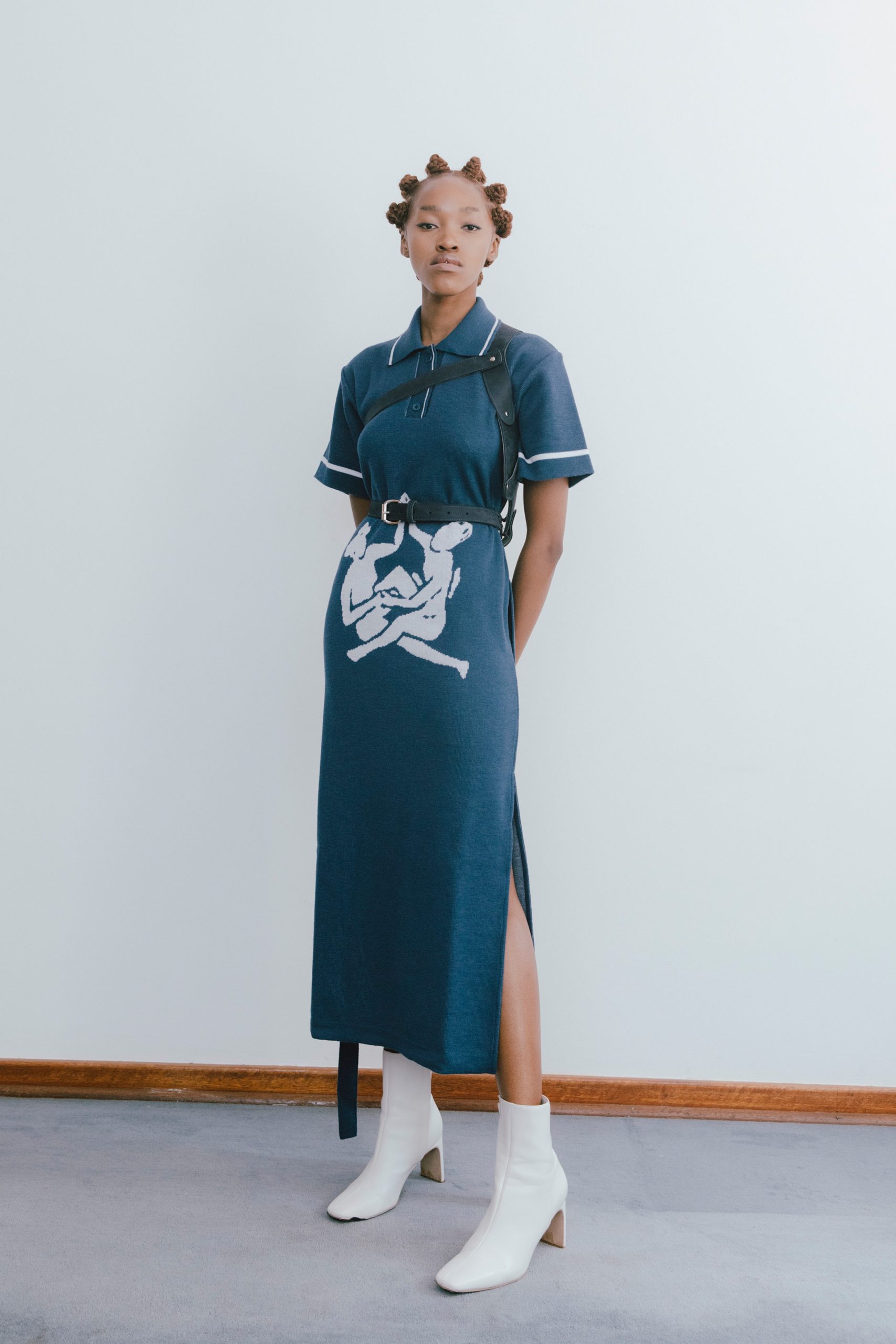
The official statement describes a dress that appears spotted with polka dots until closer inspection reveals Forsyth’s scanned fingerprints. Magugu’s Tagwalk interview identifies the garment as a pleated, bohemian-style dress and explains that she supplied the scans for his use.
The design proposition lies in that double reading. The marks can function as repeated decoration before their source becomes known. Once explained, they acquire a different significance: they are not anonymous dots but impressions associated with an identified person.
The dress therefore does not require the viewer to recognise the reference immediately. Partial recognition is part of the documented concept. Magugu described the collection to Tagwalk as “Hidden-In-Plain-Sight”.
That is a defensible connection between motif and collection premise. It does not establish every aspect of the garment’s visual success. Whether the print’s scale works consistently across the pleats, or how the pattern changes as the wearer moves, would require closer visual or physical examination.
The narrower finding is still substantial: the print operates through resemblance and delayed identification, rather than through an openly declared symbol.
The Confession Blouse: A Document Becomes a Surface
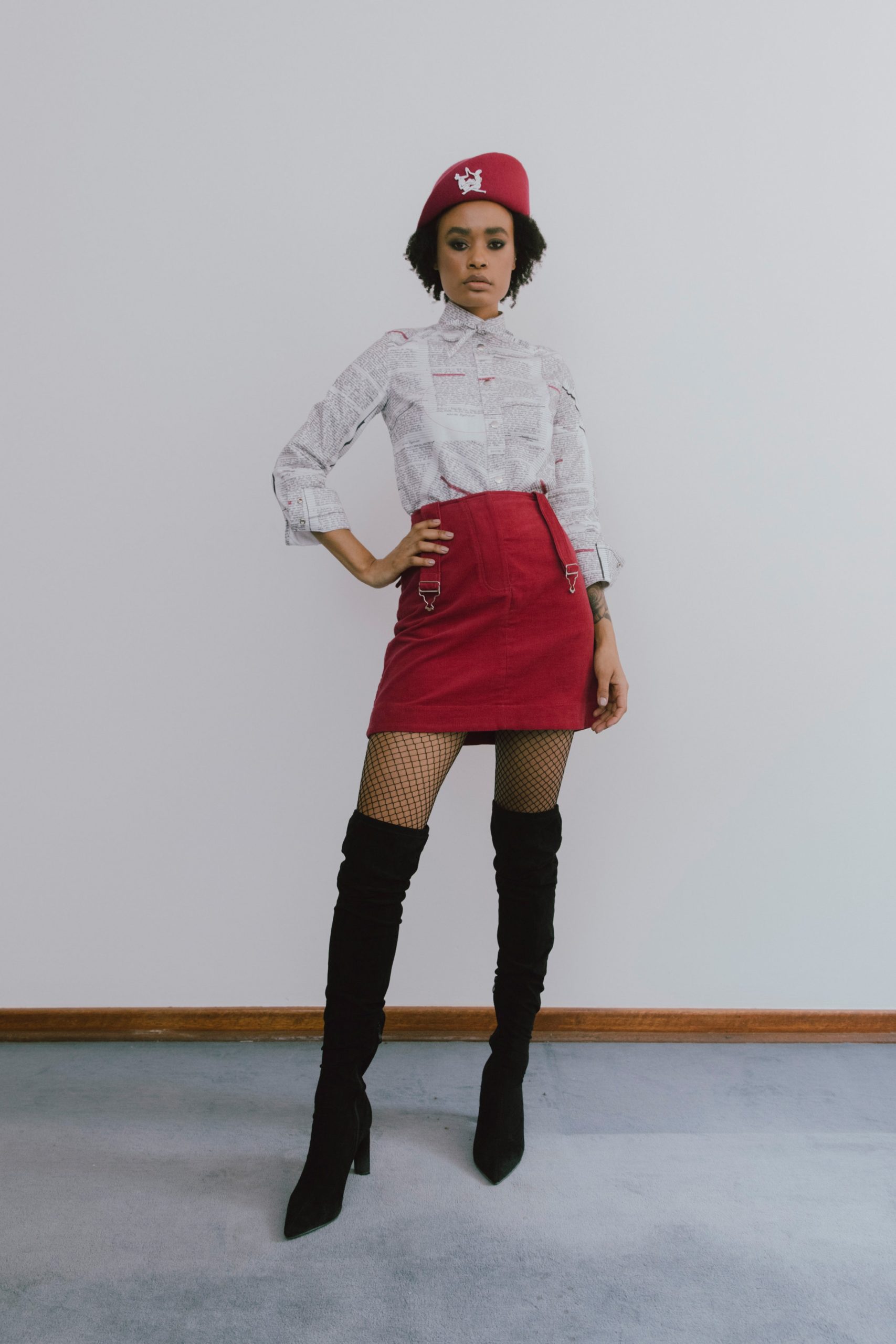
The cotton blouse takes a different approach. The brand states that its print reproduces an official in-camera confession supplied through South Africa’s judicial authorities. WWD describes a shirt featuring a redacted transcript of a spy’s confession. The claimed origin remains attributed to those accounts; the underlying document has not been authenticated for this article. Checking a claim at source is a skill in its own right, and we outline it in our guide to verifying a fashion brand’s fabric claims.
Here, the print’s source is language rather than a bodily impression. A document associated with testimony becomes clothing.
That shift raises a question the fingerprint dress does not: how much of the text must remain readable for the garment’s proposition to work?
The available sources establish the use of a confession transcript, but not whether an audience can read it in ordinary viewing conditions. It would therefore be premature to describe the blouse as allowing its wearer, or an observer, to access the full testimony.
Its more securely supported effect is the relocation of documentary material. The blouse brings the appearance and stated origin of a confession into a wardrobe. Whether the text functions as readable information, graphic texture or both remains a question for direct examination.
Unlike the fingerprint motif, the transcript does not depend on resembling a conventional dot. Its documented relationship to secrecy lies in the type of material used and, in WWD’s description, the presence of redaction.
The Parka: Several Sources, One Printed Field
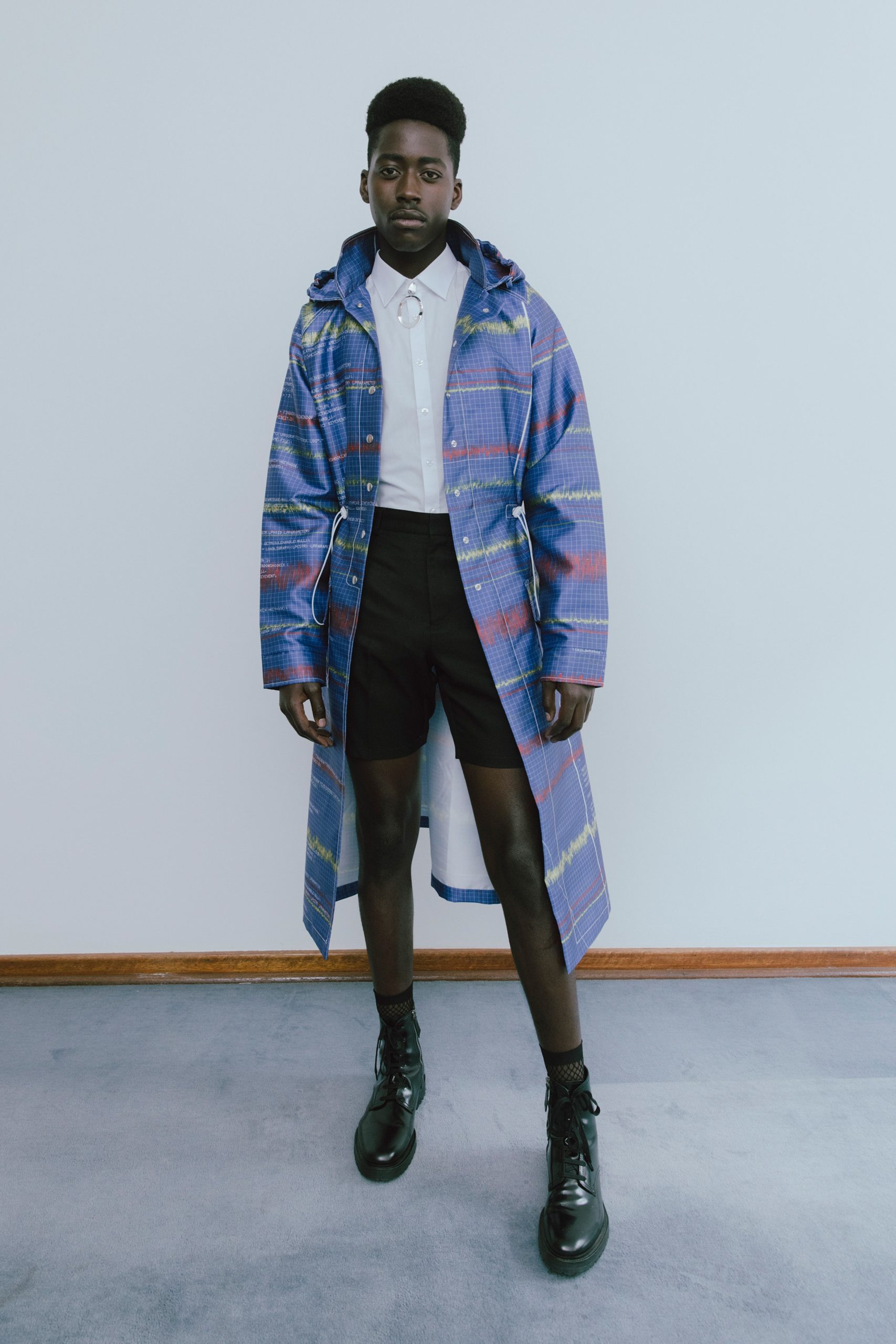
For the menswear parka, the brand describes high-twist satin carrying a mixed-media print that combines a polygraph-test scan with an internet phishing virus created for the collection by musician and coder Una Rams. WWD also identifies that combination and credits Rams’s contribution.
This treatment differs from both preceding examples. It is not a single identifying mark or one reproduced document. It combines material associated with testing truth and material associated with digital deception.
That contrast gives the print an intelligible conceptual structure. It also creates an attribution requirement: describing the surface solely as “Magugu’s espionage print” would omit the named contribution behind part of its content. Naming contributors properly is a recurring theme for us, and we consider it when deciding what a heritage fashion product page should clarify.
Yet the explanation does more work here than the sources establish the image can do on its own. Without knowing the ingredients, a viewer might not distinguish the polygraph scan from the digital material. The account supports an interpretation of their relationship, not a claim that either is immediately recognisable.
The parka consequently shows why we should assess the complexity of reference and the clarity of visual communication separately. A print can have several documented sources without making all of them legible at first encounter.
The Omiren Argument
Our argument is that print criticism should distinguish between what a surface does visually and what its documented source adds to the reading. The fingerprint dress offers the clearest example: its resemblance to polka dots is part of the stated design proposition, while knowledge of whose fingerprints were used changes its interpretation. Those are connected effects, but they are not the same effect.
The blouse and parka complicate that relationship. Their references are more specific than a general espionage mood, yet specificity does not guarantee that the source material remains recognisable on the body. A confession can become texture; combined technical material can become an abstract field. Criticism should examine those possibilities rather than assume that an informative collection statement proves successful visual communication.
Attribution is equally important. The collection’s account identifies a contributor of fingerprints, a stated documentary source and Una Rams’s work. Preserving those distinctions explains how the prints were assembled without suggesting that every historical claim has been independently checked. It also prevents “storytelling” from becoming a vague label that conceals the people and materials involved.
Finally, these examples do not support a rule that print must clarify a silhouette or remain fully legible. Concealment and misrecognition can be deliberate propositions. The more useful standard is whether criticism can identify the proposed relationship, explain the evidence for it and distinguish that finding from questions the available record cannot answer.
What These Prints Establish
Counter Intelligence offers three different relationships between textile imagery and information: a familiar pattern with a concealed identity, documentary text transferred to a blouse, and a composite print combining contrasting sources. Their connection lies in the collection’s treatment of disclosure and concealment, not in an assumption that every patterned garment performs the same task.
A fuller assessment of print against cut would require detailed comparison of placement, seams, folds and multiple views. This source-led reading establishes something more bounded: the prints are not interchangeable illustrations of a theme. Each introduces a different way for clothing to hold information and a different question about how much of that information the viewer can recover.
Also Read:
- Textile Provenance: How to Protect the Cloth Makers Behind the Fabric
- After Africa Fashion Week London 2026: What Converted Into Orders, Stockists, Press or Partnerships?
- What Happens After a Fashion Showcase? The Measures That Prove Market Access
- The Beauty Retail File: What Is Required by Law, and What Is Required by a Buyer?
FAQs
Which collection does this article examine?
It examines Thebe Magugu’s Counter Intelligence, his Spring/Summer 2021 collection, which included womenswear and menswear.
What are the apparent polka dots on the dress?
According to Magugu and the official collection statement, they are scanned fingerprints supplied by Olivia Forsyth. The designer identified the pleated dress as a particularly representative look in his Tagwalk interview.
Who contributed to the parka’s print?
The official statement credits musician and coder Una Rams with creating the phishing-virus material combined with a polygraph-test scan. WWD’s contemporary review also identifies his contribution.
Does a meaningful source automatically make a print successful?
No. A documented source establishes context, not a complete aesthetic verdict. In this collection, the sources explain the origins and intended relationships of the motifs; judging their placement, scale and interaction with each garment would require additional visual assessment.