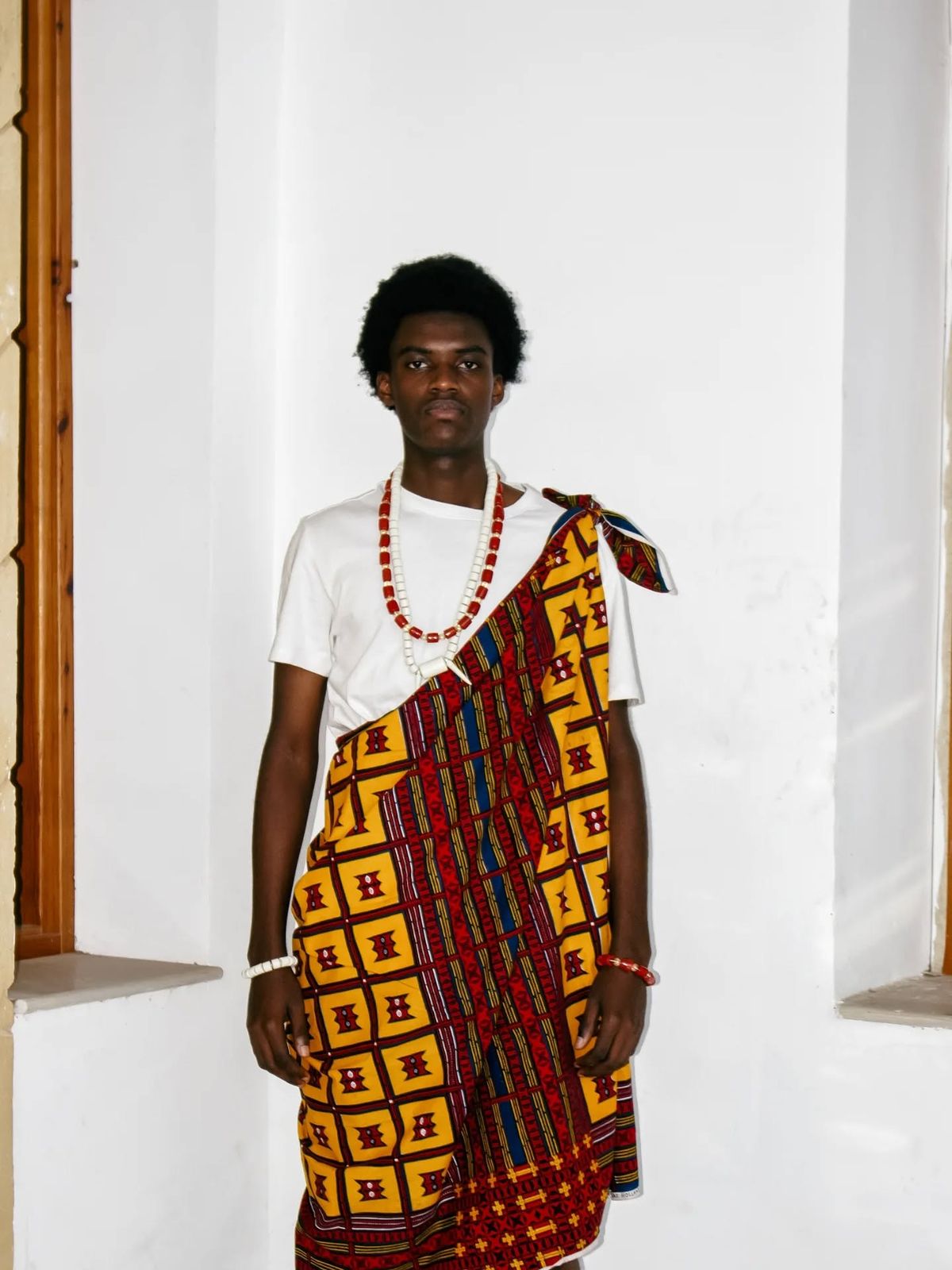
The African fashion market is worth 31 billion dollars. Among the most precisely encoded dress systems within that market’s cultural heritage sits the textile tradition of the Suriname Maroon communities: six groups of people who escaped Dutch plantation slavery, built autonomous nations in the Surinamese rainforest, and encoded their entire social and spiritual world in cloth. The pangi cloth that crosses the Atlantic in cultural memory from Akan kente is not only women’s dress. The men’s tradition is equally specific, equally loaded with readable meaning, and considerably less documented in global fashion writing than its female counterpart.
The kamisa is the men’s primary ceremonial garment. It is a piece of cloth worn as a loincloth or draped over the shoulder, and the way it is worn is a public declaration that everyone in the community can read. When a Maroon man wears his kamisa over his left shoulder, covering his heart, he is declaring that his heart is taken, that he is married or committed. When he wears it over his right shoulder, his heart is open, and he is available. That is not styling. That is a public announcement, encoded in the drape of a single piece of cloth, readable by every person present without a word being spoken.
The kamisa is not a loincloth. It is a communication system. Suriname Maroon men’s ceremonial dress encodes marital status, life stage, and cultural memory in cloth.
Suriname Maroon Men’s Ceremonial Dress: What the Garments Are
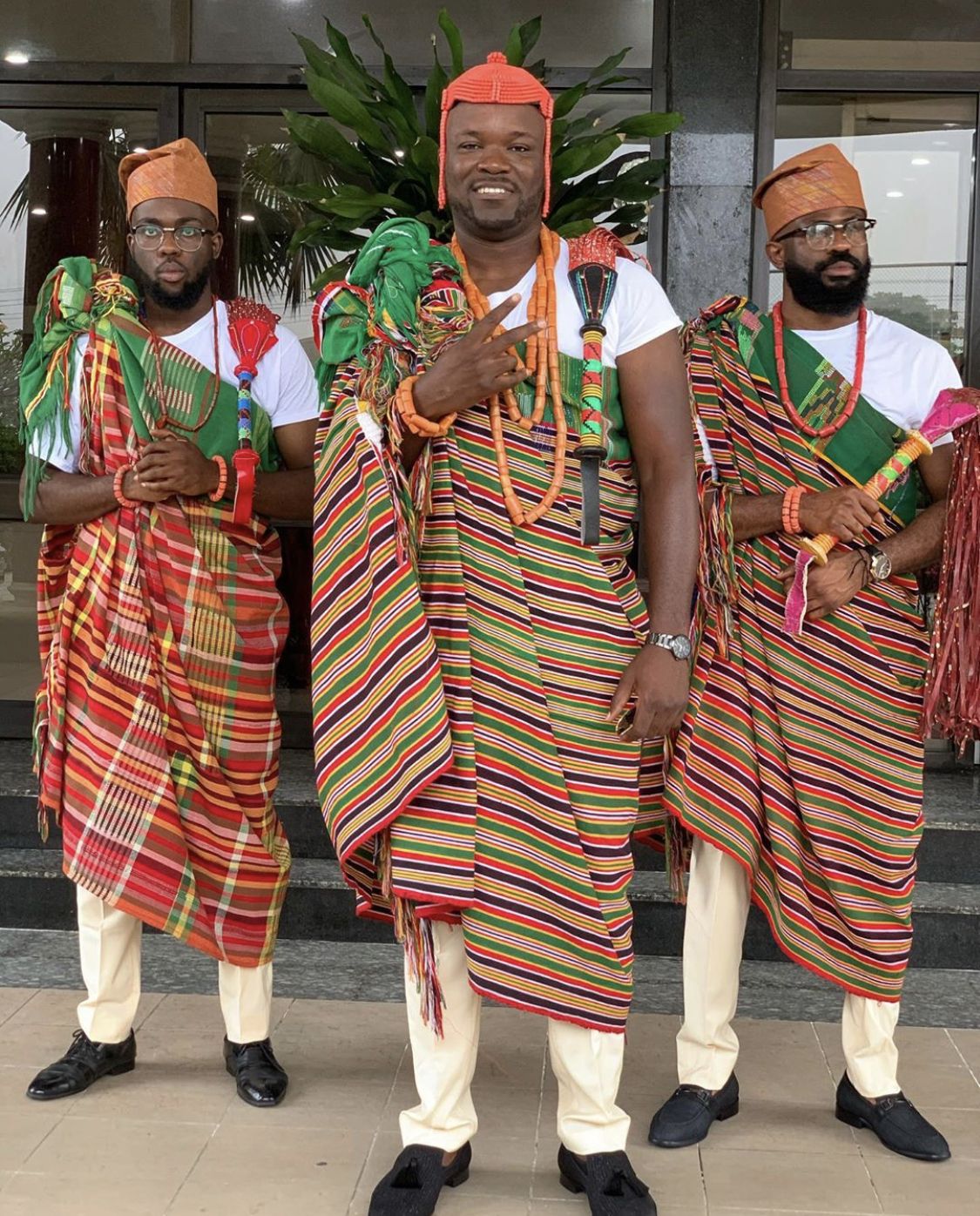
The Maroon textile vocabulary for men consists of several distinct garments, each with specific functions. As the Nieuwe Instituut’s documentation of the aseisente-pangi exhibition confirms, the pangi is a rectangular piece of fabric that functions differently depending on who wears it and how. For women, the pangi is worn as a wrap skirt. For men, the equivalent garment worn in the same family of cloth is the kamisa, worn as a loincloth or knotted on one shoulder over the chest. The bandja-koosoe is another male mode of wear: a length of cloth tied diagonally over the shoulder as a cape. Until the 1960s, the aseisente, a garment made of elongated strips of fabric, was primarily worn by men. It has since become a collective term for all garments of that construction type.
The Saramaka word for cloth is koosu, and it carries the weight of that meaning beyond simple fabric. In the non-monetised economy of the Maroon interior, cloth was treated rhetorically as currency. In the 1960s, when men returned from wage-labour trips on the coast, the price of coastal goods was cited in koosu rather than in guilders. The cloth itself was value. The kamisa, made from that cloth, carried the social weight of what the cloth represented: accumulated wealth, relationship, and standing in the community.
When a Maroon man wears his kamisa over his left shoulder, covering his heart, he is declaring that his heart is taken. When he wears it over his right shoulder, his heart is open. That is not styling. That is a public announcement, readable by everyone present, encoded in how a piece of cloth is draped over the body.
The Gi Kamisa Ceremony: Cloth and the Threshold of Manhood
The most significant ceremonial function of men’s cloth in Maroon culture is the gi kamisa, the giving of adult clothes to a boy at the threshold of manhood. It is the male equivalent of the gi pangi ceremony for girls, in which a woman receives her first pangi cloth as a marker of her transition to adulthood. As the cultural resources survey conducted for the Sabajo ESIA documents, gi pangi is the ritual performed to determine the transition from girl to adolescent, and the gi kamisa is its male counterpart. Both ceremonies mark the moment at which the community acknowledges that a young person has crossed a threshold, and both use cloth as the instrument of that acknowledgement.
The gi kamisa is not a private event. It is a community declaration. The cloth given is chosen with care, and the manner of the giving, who gives it, at what occasion, in the presence of which community members, is as significant as the cloth itself. The young man who receives his kamisa in this ceremony is not simply receiving clothing. He is receiving a social identity: the right to wear the garment that declares his status as an adult member of the community, capable of entering into the social relationships that the kamisa’s drape will now publicly communicate.
This is the point at which men’s dress in Maroon culture becomes most legible as a complete communication system rather than as clothing. The gi kamisa does not dress a boy in the conventional sense. It writes him into the social text of the community: he now wears a garment that others can read, and his wearing of it correctly, with the appropriate drape for his social situation, is his ongoing participation in that text.
The Pangi as Exchange: Men’s Ceremonial Roles
Men participate in the pangi exchange system as both givers and recipients, even though the pangi is primarily a women’s garment in terms of daily wear. As the Suriname African Heritage documentation of pangi and kamisa traditions confirms, pangis are exchanged on special occasions including births, weddings, and deaths. Men who return from wage-labour on the coast bring back quantities of fabric, including pangi cloth and trade cotton, for their wives and female relatives. The gift of cloth is simultaneously a practical provision, a declaration of the relationship, and an economic transaction encoded as social gesture.
At funerals, specific types of pangi and cloth are required for the ceremonies that mark death and facilitate the transition of the spirit. The community’s understanding of which cloth is appropriate for which moment is part of the cultural knowledge that both men and women are expected to carry. A man who does not know which cloth is appropriate at a funeral has not fully participated in the transmission of the community’s knowledge. The cloth at a Maroon ceremony is not incidental to the occasion. It is part of the ceremony’s structure.
The banyakrosi appliqué patterns that appear on the most elaborate pangis are associated with specific Winti spirits, families, and proverbs. Men who are skilled in the Winti spiritual tradition understand the communicative content of these patterns and participate in their production and exchange as part of the broader spiritual life of the community. The cloth is not separate from the spiritual practice. It is the form in which the spiritual practice is made visible.
The Aseisente: A History of Male Textile Innovation
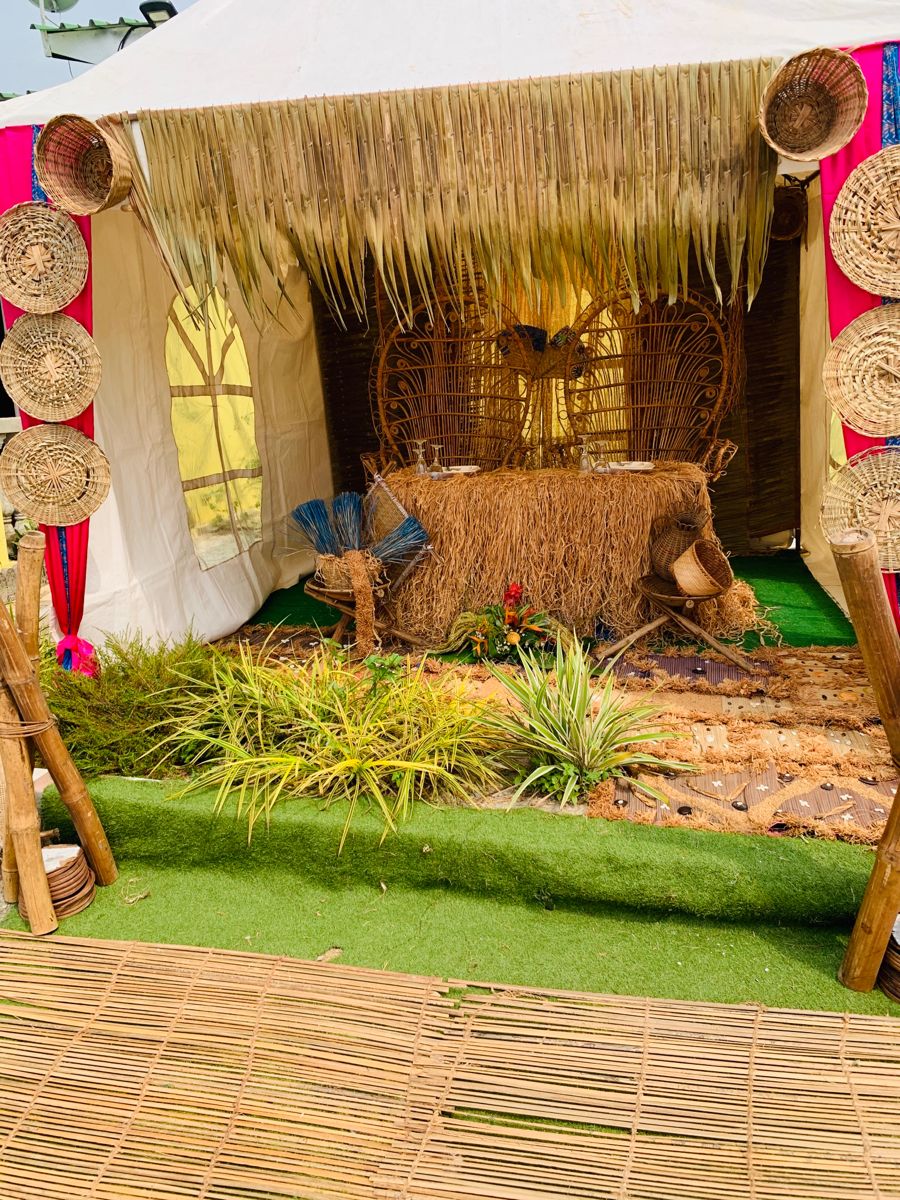
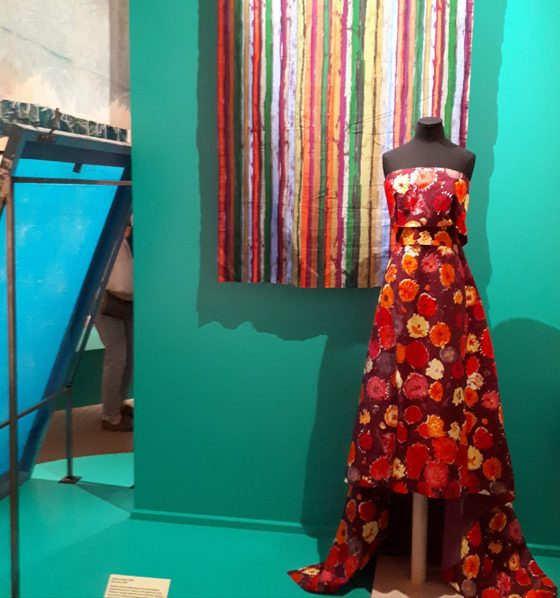
The aseisente is one of the most historically revealing garments in the Suriname Maroon men’s textile tradition. The Nieuwe Instituut’s documentation of the Saamaka aseisente confirms that it is designed as a rectangular patchwork of elongated strips in different colours and patterns. Until the 1960s, the aseisente was primarily a male garment. It has since become a collective term for all garments of that construction type, worn by both men and women.
The patchwork construction of the aseisente connects directly to the history of Maroon textile production. Early Maroon clothing was made from cotton grown or stolen from plantation fields, woven by hand. As trade access expanded, strips of different coloured cloth from coastal markets were sewn together to create patchwork garments. This patchwork tradition became the aseisente. The garment carries the record of its own making history in its form: the strips are the evidence of the available materials, the ingenuity with which they were assembled, and the aesthetic choices made in combining them. The patchwork is the autobiography of the community that produced it.
Connection to West African Textile Traditions
The pangi cloth used in Suriname Maroon men’s dress is multicoloured cotton with vertical and horizontal stripes, similar in its construction logic to West African kente cloth. This similarity is documented and not coincidental. As Richard Price’s peer-reviewed research in the Brill journal New West Indian Guide confirms, the connections between the Surinamese Maroons and Akan-speaking peoples resulted from the Akan origins of many of the African captives taken to Surinam. The striped, multi-coloured construction of pangi cloth reflects that inheritance across the Atlantic crossing. The cloth does not only wrap the body. It carries the memory of the culture that produced it.
The gi kamisa ceremony’s structure, in which the community acknowledges an individual’s life-stage transition through the giving of cloth, is consistent with West African textile practices that use cloth as an instrument of social acknowledgement. The Akan gold-weight system, the Yoruba aso-ebi, the Kente colour grammar, and the Maroon pangi exchange system all operate on the same foundational understanding: cloth communicates social meaning, and the act of giving, wearing, or exchanging cloth is an act of social inscription. The Maroon communities carried that understanding across the Atlantic and sustained it in the Surinamese rainforest for three centuries.
The Omiren Argument
Suriname Maroon men’s ceremonial dress is one of the most precisely documented examples of West African textile knowledge surviving the Atlantic crossing and developing into a fully autonomous tradition in a new geography. The African fashion market is worth 31 billion dollars. The kamisa that a Maroon man drapes over his left shoulder to declare that his heart is taken, the gi kamisa ceremony that writes a boy into the social text of the community as an adult, the aseisente patchwork that carries the record of how the community assembled cloth from available materials and made it beautiful: none of these is a preservation of African tradition in amber. They are active, evolving, community-specific practices that have been in continuous development since the peace treaties of 1760 and 1762 gave the Maroon communities the legal right to sustain them. Omiren Styles documents the men’s tradition specifically because fashion writing consistently underrepresents it. The gi pangi gets more attention than the gi kamisa. The women’s pangi is better documented than the men’s kamisa. The correction is not difficult. It requires only looking at what is there, naming it precisely, and refusing to treat men’s cloth culture as an afterthought in a tradition that made cloth the foundation of everything.
ALSO
- Dress and Identity in Jamaica: Rastafarian, Maroon, and Kumina Dress as Distinct Cultural Systems
- Afro-Mexican Veracruz Dress Traditions: The Jarocha Costume, Yanga, and What Distinguishes It From the Costa Chica Region
Frequently Asked Questions
What is the kamisa in Suriname Maroon culture?
The kamisa is the primary men’s garment in the Suriname Maroon textile tradition. It is made from pangi cloth, a multicoloured cotton with vertical and horizontal stripes, and is worn as a loincloth or knotted on one shoulder over the chest. The manner of wearing communicates social status: worn over the left shoulder covering the heart, it declares the wearer is married or taken. Worn over the right shoulder, it declares the wearer is available. The kamisa is the male equivalent of the women’s pangi wrap skirt.
What is the gi kamisa ceremony?
The gi kamisa is the Suriname Maroon male rite of passage in which a boy receives his first adult clothes, marking his transition from boyhood to adulthood. It is the male equivalent of the gi pangi ceremony for girls, in which a woman receives her first pangi cloth. Both ceremonies use cloth as the instrument of social acknowledgement, and both are community events rather than private family occasions. The gi kamisa writes the young man into the social text of the community: he now wears a garment that others can read, and his wearing of it correctly is his ongoing participation in the community’s shared visual language.
What does the aseisente garment signify?
The aseisente is a garment made of elongated strips of fabric sewn together in a patchwork construction. Until the 1960s, it was primarily a male garment. It has since become a collective term for all garments of that construction type, worn by both men and women. The aseisente’s patchwork construction reflects the history of Maroon textile production: strips of different coloured cloth from coastal markets sewn together with cotton grown or obtained in the Surinamese interior. The garment carries the record of the community’s material history in its form.
How does Suriname Maroon men’s dress connect to West African textile traditions?
Pangi cloth, the fabric from which the kamisa is made, has multicoloured vertical and horizontal stripes similar in construction logic to West African kente cloth. This connection is documented and reflects the Akan origins of many of the Africans brought to Suriname as enslaved people. The gi kamisa ceremony’s structure, using cloth to acknowledge life stage transitions, is also consistent with West African textile practices. The Maroon communities carried West African textile knowledge across the Atlantic. They sustained it in the Surinamese rainforest for three centuries, developing it into an autonomous tradition while maintaining its foundational logic.
Why is the pangi exchanged at Maroon ceremonies?
Pangis are ceremonially exchanged at births, weddings, deaths, and other significant occasions because cloth in Maroon culture carries social weight beyond its material value. In the non-monetised Maroon interior economy, cloth was treated rhetorically as currency. Giving pangi at a ceremony is simultaneously a practical provision, a declaration of relationship, an economic transaction, and participation in the community’s shared visual language. Men participate in the exchange system as givers when they return from coastal wage labour, bringing back fabric for their wives and female relatives, and as part of the ceremonial structures around birth, marriage, and death.
Explore More
Read the full Culture > Heritage & Identity section for Omiren Styles’ documentation of African and diaspora dress traditions, textile histories, and the communities that encoded cultural memory in cloth across the Atlantic.