Between 1650 and 1830, slave traders brought more than a quarter of a million Africans to Suriname. A number of those people escaped. They disappeared into the moors and jungles behind the plantations, built villages along the rivers of the interior, and established six distinct autonomous communities that the Dutch colonial authority was eventually forced to recognise by treaty. As the Dutch Intangible Heritage database documents, on October 10th 1760 the colonial authority concluded the first peace treaty with the Ndyuka people, granting them legal freedom and territorial rights in the interior. That date and that first treaty are engraved in the memory of the Maroons. Peace treaties with the Saramaka and Matawai followed in 1762 and 1767.
The African fashion market is worth 31 billion dollars. The Suriname Maroon dress traditions that emerged from those communities over the following three centuries represent some of the most documentedly African textile practices surviving anywhere in the diaspora. Their dress is not regional costume. It is material memory: the record of escape, autonomy, and cultural survival encoded in cloth by people who understood that when you cannot write your history, you wear it.
Suriname’s six Maroon communities encoded freedom in cloth. The pangi is not fabric. It is the material record of escape, autonomy, and 300 years of cultural survival.
Suriname Maroon Dress Traditions: Who the Six Communities Are
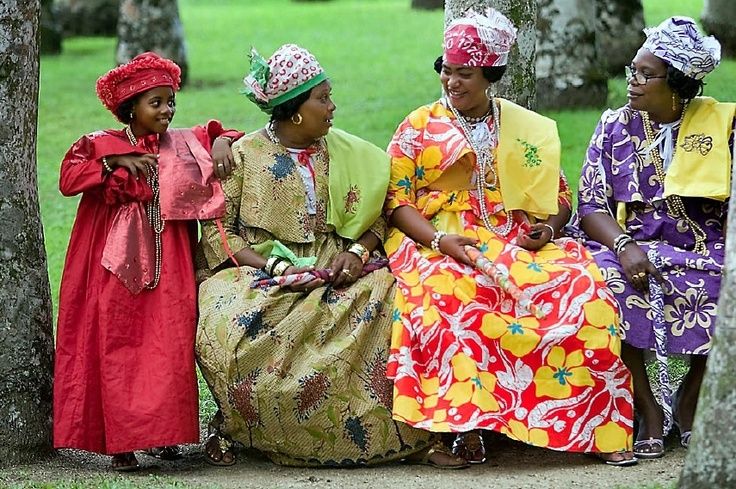
The six Maroon peoples of Suriname and French Guiana are the Saamaka, Ndyuka, Matawai, Pamaka, Aluku, and Kwinti, each with its own political leadership, language, dress tradition, and cultural practice. As Minority Rights Group’s documentation of the communities confirms, the communities divide into two branches: an Eastern branch comprising the Ndyuka, Aluku, and Pamaka, who speak variants of the Ndyuka language; and a Central branch comprising the Saamaka, Matawai, and Kwinti, who speak variants of Saramaccan. The Saamaka and Ndyuka are the largest, with populations of approximately 115,500 each according to 2018 estimates by the leading anthropologist of Maroon culture, Richard Price. The communities vary in everything from language and diet to dress, patterns of marriage, and residence.
The Saamaka are among the most extensively studied of the six groups. Their society is matrilineal, with clans called lo tracing descent through the female line. As Cultural Survival Quarterly’s documentation of Maroon rights confirms, in 2007, after a decade of legal struggle, the Saamaka people won a signal victory before the Inter-American Court of Human Rights, which ruled that they are entitled to the same protections as Indigenous Peoples under international law. Their rebel ancestors had fought for nearly a century before the 1762 peace treaty. The legal recognition of 2007 was built on top of that foundational act of refusal.
The Pangi: A Garment That Reads Like a Calendar
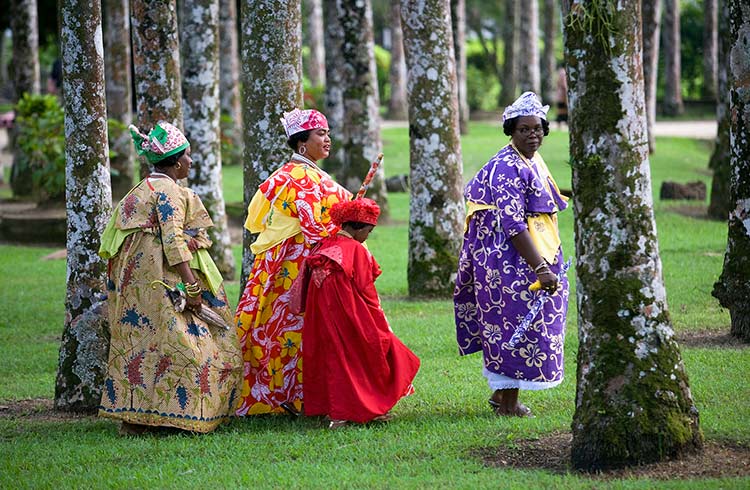
The most significant garment in Suriname Maroon dress traditions is the pangi, a long rectangular cloth worn by women around the waist. As the Textile Research Centre Leiden’s documentation of the Great Suriname Exhibition confirms, a woman’s first pangi traditionally marked her passage from girl to adult. The ceremony in which a girl receives her first pangi is called gi pangi, literally the giving of cloth, and sits alongside the gi kamisa ceremony for boys, who receive adult clothes at an equivalent threshold. The pangi is the dress of adulthood, of womanhood, of belonging to the community.
The pangi can be read like a calendar. Originally made from cotton grown or stolen from plantation fields, spun by hand using a spindle at foot height and woven on simple looms, the garment’s styles changed as Maroon communities changed: patchwork pangi were the language of the late 19th century; sewing narrow stripes of differently coloured cloth together became fashionable in the 1920s; in the 1970s, younger women who had learned cross-stitch in mission schools began decorating their pangi with non-linear cross-stitched designs. Each generation reinvented the garment without abandoning it. The pangi survived because it kept moving.
The pangi can be read like a calendar. Patchwork was the language of the 19th century. Coloured stripes were the language of the 1920s. Cross-stitch was the language of the 1970s. Each generation reinvented the garment and kept the tradition alive.
The most elaborate pangi carry appliqué patterns called banyakrosi, identified with specific families, with proverbs, or with Winti spirits. As the Duke University Sacred Arts of the Black Atlantic documentation confirms, one pangi is dedicated to the Fodu Winti (also known as Papa Winti), a specific spirit in the Winti religious tradition. Secular pangi carry proverbs embedded in their patterns: Teeka wan wani di pasisai di (There is always a way) and Lobi abi pasensie (Love is patient). The proverbs connect the textile tradition of the pangi to that of Akan kente cloth, in which strip-woven patterns also carry proverbial meanings. This is not coincidence: many of the African captives taken to Suriname were Akan-speaking people, and their aesthetic inheritance is visible in the Maroon textile tradition three centuries later.
Women, Textile Knowledge, and the Work That Kept Culture Alive
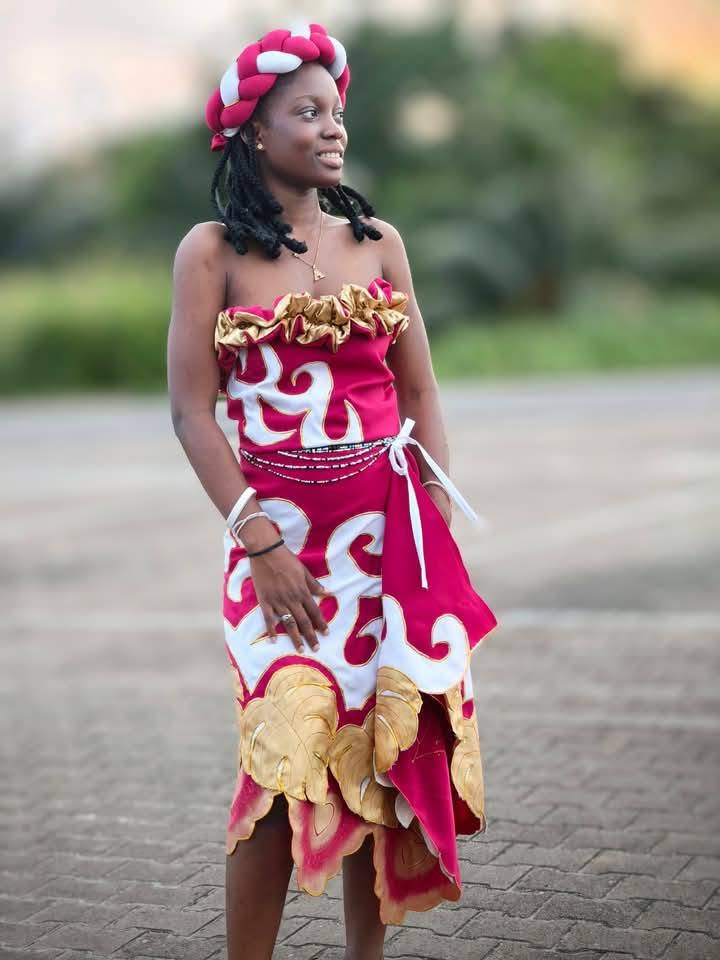
Richard Price, who has studied the Saamaka for more than fifty years and is the foremost scholarly authority on Maroon textile history, documents in his 2020 essay ‘Maroon Fashion History’ in the Brill journal New West Indian Guide that Maroon women’s textile arts were consistently overlooked by early colonial observers who celebrated men’s woodcarving while ignoring women’s clothing creativity. That imbalance in the historical record has obscured the central truth about how Suriname Maroon dress traditions survived: they survived because women kept making, wearing, and teaching them across generations, adapting to new materials and new social conditions without losing the cultural grammar underneath.
In the 1960s, men returning from wage-labour trips on the coast would give each wife as many as a hundred lengths of trade cotton cloth, treating cloth rhetorically as money in what Price calls a non-monetised society: the Saamaka word for cloth, koosu, was also used to cite coastal goods prices rather than the word for guilder. Cloth was value. Cloth was currency. And the women who turned that cloth into pangi, applying embroidery, patchwork, and later cross-stitch, were doing something more than decorative work. They were the active holders of the community’s visual and material culture.
The Pangi as Political Object: Moiwana and the Civil War
The pangi’s function as a carrier of historical memory was demonstrated most precisely by artist Marcel Pinas, whose installation Moiwana 86 Tafas placed 38 specially designed black-and-white pangi draped over chairs at a long dinner table to commemorate the 38 Maroon villagers murdered during the Suriname Civil War of 1986 to 1992. The installation referenced Judy Chicago’s The Dinner Party in its structure. Still, its content was specific Maroon grief: thirty-eight people who had been killed, commemorated in the garment that had marked their community’s life passages since childhood. The pangi that had been given to mark a girl’s adulthood became the garment in which the community grieved the adults who were taken. The textile tradition carried both.
The political history of the Maroon communities has never been fully separated from their material culture. As Cultural Survival Quarterly’s analysis of Maroons under assault in Suriname and French Guiana documents, the six communities have faced sustained threats to their territorial rights and cultural autonomy from mining operations, dam construction, and displacement. The dress traditions that preserve the memory of the original escape are also, in this context, an argument for continued existence: we are still here, we still govern ourselves, we still wear what our ancestors wore when they refused to be enslaved.
How the Dress Has Changed and Why That Is Not Loss
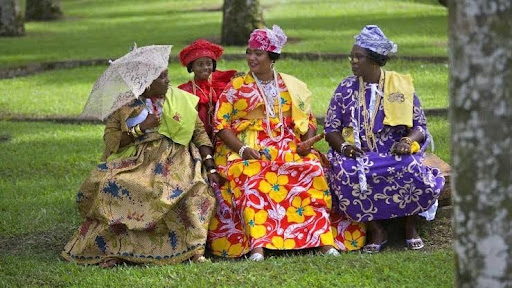
Suriname Maroon dress traditions have changed as communities have interacted more with urban and coastal life. In some groups, traditional garments such as the pangi remain the central daily garment; in others, outside influences have introduced new layers of clothing and different ideas of modesty and form. Men, who historically wore loincloths and shoulder capes in the interior, stopped wearing these on an everyday basis as more Maroons moved to coastal settings, retaining the traditional forms mainly at home and in ritual settings such as political gatherings and wakes.
This is not cultural loss by default. The pangi’s history of evolution makes that clear. A tradition that adopted mission school cross-stitch in the 1970s and made it its own has always been in motion. The pangi that Markus Balkenhol, as documented by the Duke University Sacred Arts project, describes as being increasingly worn by Black youth in the Netherlands who have no Maroon ancestry, as part of a search for cultural identity, is evidence not of dilution but of reach. The garment has moved beyond the community that created it and into a broader conversation about African diaspora identity. That is what living textile cultures do.
The Omiren Argument
Suriname Maroon dress traditions are not regional styles. They are material testimony: the record of six communities that refused enslavement, built independent nations in the rainforest, fought for a century before the Dutch were forced to recognise them by treaty in 1760 and 1762, and encoded that entire history into cloth. The pangi is the African fashion market’s 31 billion dollars at its most specific: a garment with documented African origins in the Akan kente tradition, adapted across three centuries by Maroon women who used it to mark adulthood, to carry proverbs, to invoke Winti spirits, to record patchwork in the 19th century and cross-stitch in the 20th, and to commemorate the thirty-eight people lost in the Civil War of 1986. Every generation reinvented the pangi and kept it. Omiren Styles documents these traditions as the diaspora fashion record they are: African textile intelligence that crossed the Atlantic and survived everything colonial power sent against it.
Also Read
- The Pollera, the Wob Dwiyet, and the Baiana: The African Women Who Dressed the Americas
- Cornrows Were a Map: The African Intelligence Behind Diaspora Braiding
- The African Origins of Carnival Costume: Feathers, Beads, and the Masquerade Tradition
- Santeria, Candomble, and Vodou: When African Spirituality Became a Fashion System
Frequently Asked Questions
Who are the Maroon communities of Suriname?
The Maroons of Suriname are descendants of enslaved Africans who escaped Dutch plantation slavery between the mid-1600s and 1830 and established autonomous communities in the forested interior. There are six distinct groups: the Saamaka and Ndyuka (each approximately 115,500 people as of 2018), the Matawai, Pamaka, Aluku, and Kwinti. Each group has its own language, political leadership, and cultural practices. The Dutch colonial authority was forced to recognise them by peace treaty: first with the Ndyuka in 1760, then with the Saramaka and Matawai in 1762 and 1767.
What is a pangi and why is it important?
The pangi is a long rectangular cloth worn around the waist by Maroon women in Suriname. A woman’s first pangi traditionally marked her passage from girl to adult in a ceremony called gi pangi, the giving of cloth. Pangi styles changed across generations: patchwork in the 19th century, coloured stripes in the 1920s, cross-stitch in the 1970s after women learned the technique in mission schools. The most elaborate pangi carry banyakrosi appliqué patterns associated with families, proverbs, or Winti spirits. The pangi connects directly to the Akan kente tradition, reflecting the Akan origins of many Africans brought to Suriname.
What is the gi pangi ceremony?
The gi pangi ceremony is the Maroon rite of passage in which a girl receives her first pangi cloth on reaching adulthood. It is the female equivalent of the gi kamisa ceremony, in which a boy receives adult clothes. Both mark significant thresholds in the life cycle and are among the cultural ceremonies that Maroon communities have documented as part of the intangible heritage they seek to preserve.
How did Suriname Maroon dress traditions preserve African heritage?
Maroon textile traditions preserved African heritage through several documented connections. The pangi cloth carries banyakrosi appliqué patterns linked to the Winti spiritual tradition, which combines African Vodun beliefs with Caribbean adaptations. The strip-woven structure of traditional pangi cloth resembles West African kente cloth, reflecting the Akan origins of many Maroon ancestors. The pangi’s role as a rite-of-passage garment and as a vehicle for proverbs and spiritual references mirrors the use of cloth as a text in West African dress traditions from the Akan to the Fon.
Is Suriname Maroon dress tradition still practised today?
Yes, though it has evolved. The pangi remains the central women’s garment in many Maroon communities in Suriname’s interior and is worn by diaspora Maroon communities in the Netherlands. The garment has been documented as increasingly worn by Black youth in the Netherlands who have no direct Maroon ancestry, as part of a search for African diaspora cultural identity. Artist Marcel Pinas used the pangi in his installation Moiwana 86 Tafas to commemorate the 38 Maroon villagers killed during Suriname’s Civil War of 1986-1992, demonstrating that the garment continues to carry contemporary political and memorial meaning alongside its historical one.
Explore More
Read the full Culture > Heritage & Identity series at omirenstyles.com for Omiren Styles’ documentation of African and diaspora dress traditions, textile histories, and the communities that built cultural continuity out of the materials available to them.