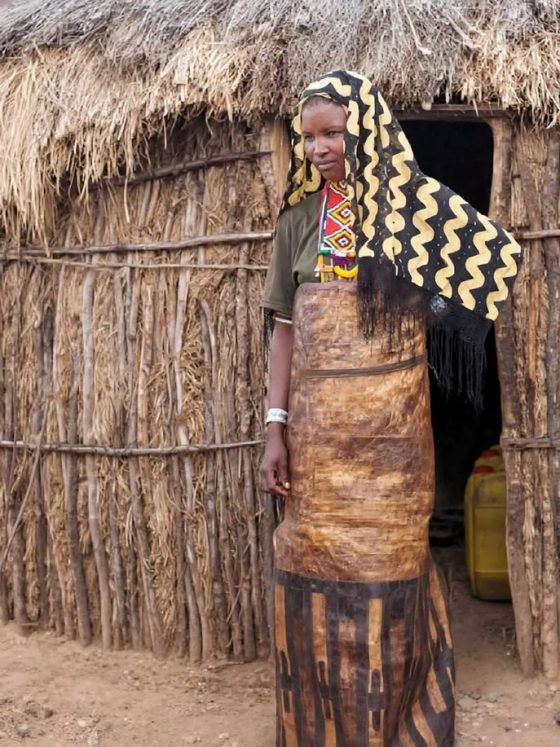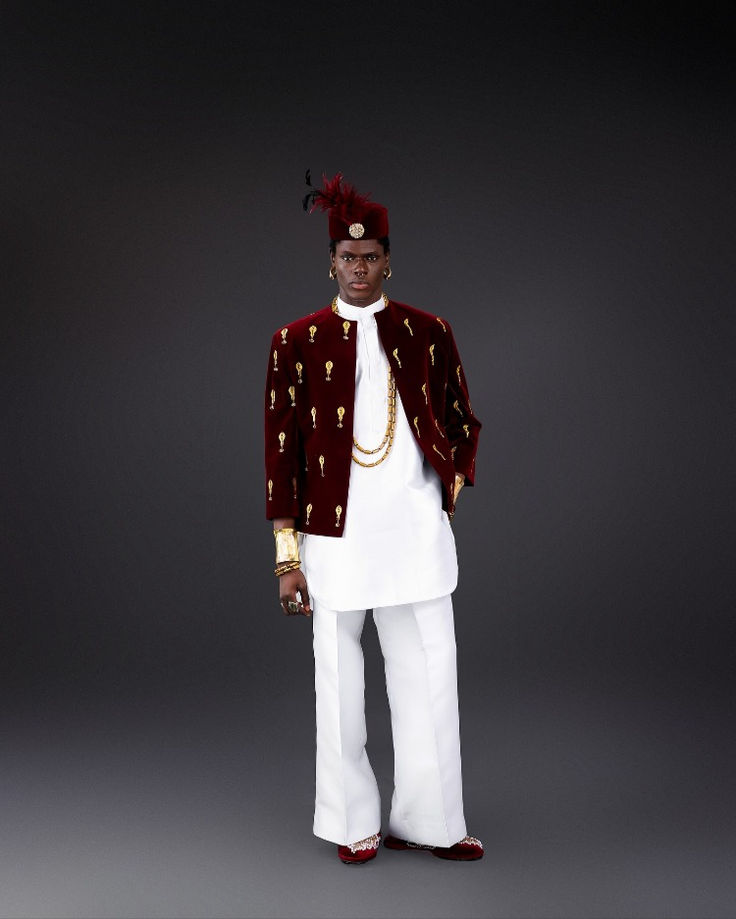
The most honest answer to “what do people wear in Benin Republic” is: it depends on which of the more than 42 ethnic groups you are asking about, which region of the country, which occasion, and whether you mean Monday morning in Cotonou or a wedding ceremony in Kandi. There is no single Beninese garment, no national dress that unifies the country’s visual culture across its coastal south, its interior plateau, and its northern savanna. There is a layered and specific set of dress systems, each rooted in a particular ethnic identity and geographic context, that coexist, overlap, and increasingly inform each other in the country’s cities.
This article is a factual guide to those systems. It covers everyday urban dress, regional traditional dress by ethnic group, the role of wax print and kanvô, ceremonial and occasion wear, the Vodun colour codes that influence dress choices in the south, and the contemporary fusion that Beninese designers and wearers are producing. It is not a guide to what tourists should wear. It is a record of what Beninese people actually wear.
The Omiren Argument: there is no single Beninese dress culture because there was never a single Beninese people. What exists instead is a set of specific, deeply developed dress systems, each with its own logic, that the country’s history brought into proximity with one another. That proximity has produced creative exchange for centuries.
From boubou to pagne, wax print to embroidered agbada, a complete guide to what Beninese people actually wear, across regions, occasions, and ethnic groups.
Urban Benin: What the Cities Actually Look Like

In Cotonou and Porto-Novo, the weekday dress code is predominantly Western. In offices, men wear trousers and shirts; senior professionals and executives wear suits. Women wear jeans, shirts, t-shirts, and office-appropriate Western dress. This is the dress of daily economic life in a country where French administrative culture shaped workplace norms during the colonial period and where those norms have largely persisted into the post-independence era.
Traditional dress is not absent from urban weekday life, but it is situational. A senior civil servant might wear an embroidered boubou to an important meeting. A market trader in Dantokpa will likely wear a wax pagne in a combination specific to her preference and the season. A young professional in the Haie Vive neighbourhood might wear a contemporary kanvô-blend shirt from a Cotonou designer alongside standard trousers. The city does not enforce a single code. It supports multiple codes simultaneously and allows wearers to switch between them depending on context.
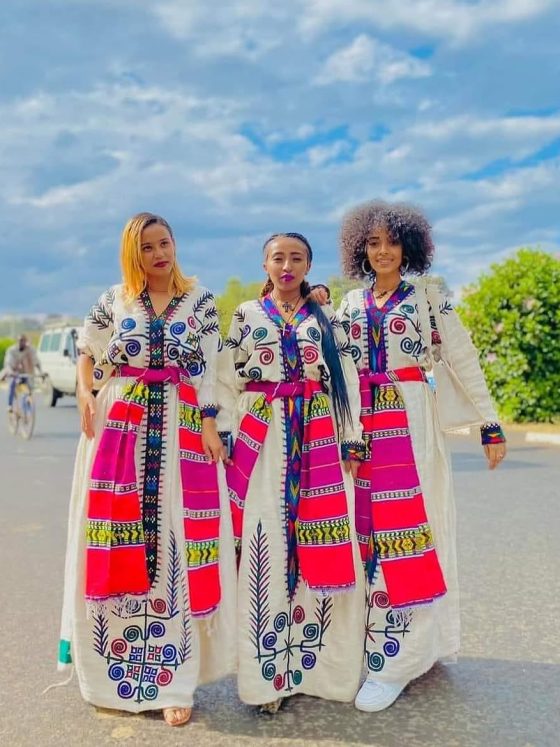
Weekends and ceremonies look different. The embroidered boubou, a long, flowing robe with hand- or machine-embroidered details at the collar, cuffs, and chest, is formal-occasion wear across Benin’s southern communities regardless of ethnic affiliation. It appears at weddings, funerals, religious ceremonies, and significant family gatherings, worn by both men and women. Its formality is legible to everyone present, which is part of its social function.
The Bomba and the Pagne: The Foundational Garment System
The Bomba is the base layer of Beninese traditional dress across most of the country’s southern communities. For men, it takes the form of a loose tunic shirt worn over loose trousers. For women, it is a loincloth with a coordinated top. In its basic form, it is the most commonly worn traditional garment at ceremonies, community events, and formal family occasions across Benin’s southern ethnic groups. The material, cut, and ornamentation of the Bomba adapt to the occasion: a simple cotton version for daily wear, a more elaborate interpretation in wax pagne or kanvô for ceremonies.
Wax print pagne is central to women’s dress across the country, particularly in the coastal south. Sold in six-yard lengths and typically worn as a wrapper around the hips and waist, paired with a matching blouse and headscarf, the pagne is the most versatile item in a Beninese woman’s wardrobe. It moves between daily wear, market visits, family gatherings, and ceremonies by changing in combination, colour choice, and print selection rather than in fundamental construction. The print itself carries meaning: specific prints are associated with specific occasions, social positions, and messages, a system of material communication that has been developed and refined by Beninese women over generations.
The matching headscarf, called a coiffure in local parlance, is not an accessory. It is a component. Wearing a pagne without a corresponding headscarf in a ceremonial context is equivalent to wearing formal dress without its final element. The combination is the complete statement.
Yoruba Dress in Southern Benin: Iro, Buba, Agbada, and Gele
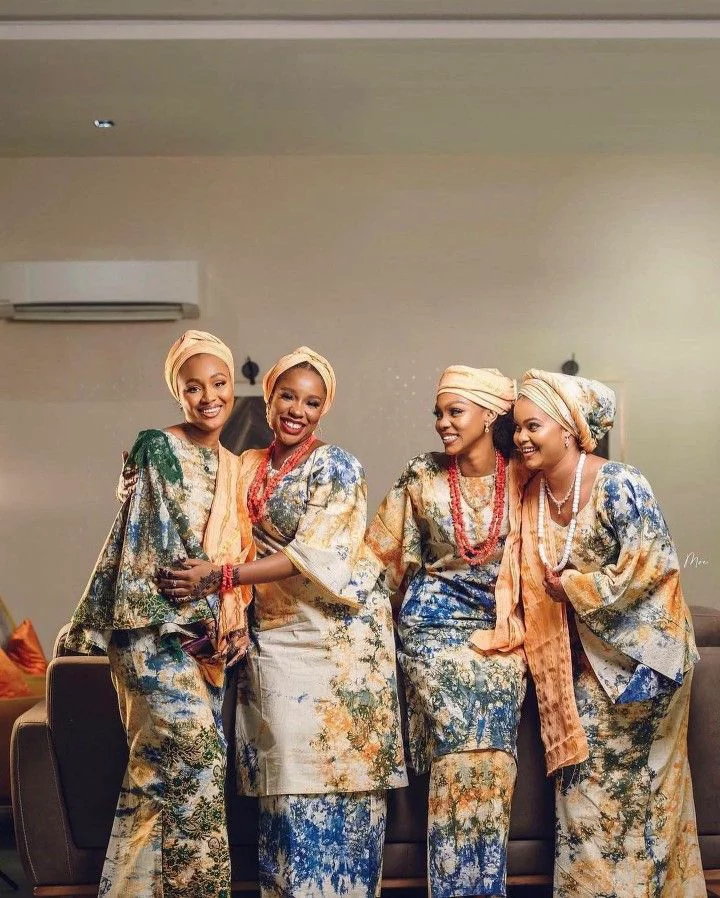
The Yoruba communities of southern Benin, concentrated in Porto-Novo, the Ketu region, and the country’s southeastern corridor, maintain a distinct and elaborate dress tradition. For women, the central ensemble is the iro and buba: a wrap skirt (iro) paired with a loose blouse (buba), made from the same or complementary fabrics and completed with the gele, a structured head-wrap tied in configurations that communicate the formality of the occasion. The ipele, a matching shoulder sash, completes the formal ensemble. For very important occasions, aso-oke, the prestigious handwoven cloth of the Yoruba tradition, is used in place of wax pagne.
For Yoruba men in Benin, the agbada is the primary formal garment: a full-length flowing robe worn over a buba (loose shirt) and sokoto (trousers), in rich fabrics including damask, brocade, and lace, with embroidery at the collar, chest, and sleeves that communicates the wearer’s status. The fila, a traditional cap in various configurations, completes the formal male ensemble. The abeti aja (dog-ear cap) and the gobi are two common fila styles for different levels of formality.
The gele deserves specific attention because it is not simply a headwrap. It is a skill, a practice, and a social signal. The technique for tying a gele to specific configurations is knowledge that is transmitted and maintained, and the resulting structure communicates the occasion’s formality with a precision that words cannot match—a loosely tied gele signals everyday dress. A towering, architecturally structured gele signals the highest formal occasion.
Bariba Dress in Northern Benin: Turu, Dansigi, Tako
The Bariba people of northern Benin, whose communities are concentrated in the Borgou and Alibori regions, maintain a dress tradition that is materially distinct from the country’s southern systems. The daily dress for Bariba men is the Turu: a large, ankle-length, generally sleeveless tunic made from thick ecru cotton. The knee-length Dansigi shirt is sometimes worn underneath or as a standalone. The Sokoto, large-waisted tapered trousers with a matching fabric belt, completes the basic ensemble.
For luxury occasions, Bariba men wear the Tako, the northern name for kanvô, the handwoven fabric produced by Baatonu weavers in the north. The tako in its finest form, a guinea fowl–coloured weave, was historically valued at up to three oxen, a measure of prestige that confirms its function as a statement of status rather than simply a garment. The Bermuda-style demberu, made from fabric for the Wasangari warrior class and from animal skin for hunters and farmers, encodes social position through material choice rather than cut.
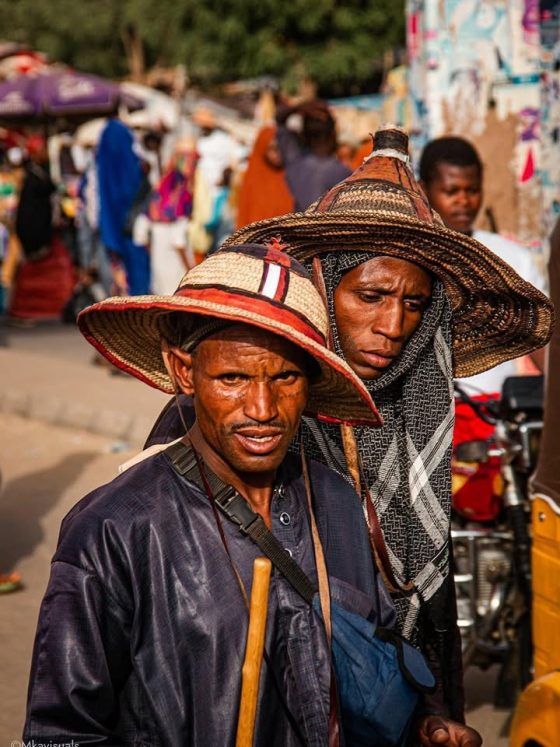
Fabric hats are essential to Bariba men’s formal dress. The historical record confirms that wearing a hat in public was once compulsory in Bariba communities. The type of hat, its colour, and its configuration communicate the wearer’s social position within the community hierarchy. Removing this layer of the dress system strips away a layer of social communication that the garment was designed to convey.
The Dashiki, the Boubou, and the Borrowed Vocabularies
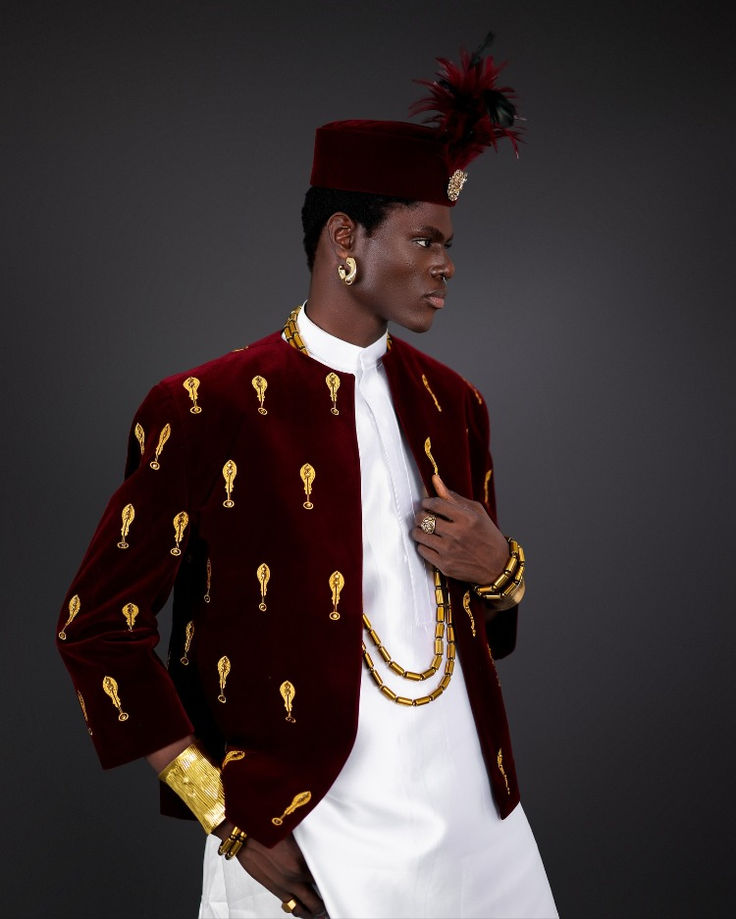
The dashiki, a colourful, loose-fitting garment that covers the upper body and originates in West African tailoring traditions, is worn throughout Benin as both an everyday and a formal garment. It has formal and informal versions: simple draped cloth for daily wear, fully tailored suits for ceremonies. Most Beninese grooms wear white dashiki suits at wedding ceremonies. Lace dashiki suits paired with bowler hats are a specifically Beninese formal combination, visible at weddings and ceremonies across the country’s southern communities.
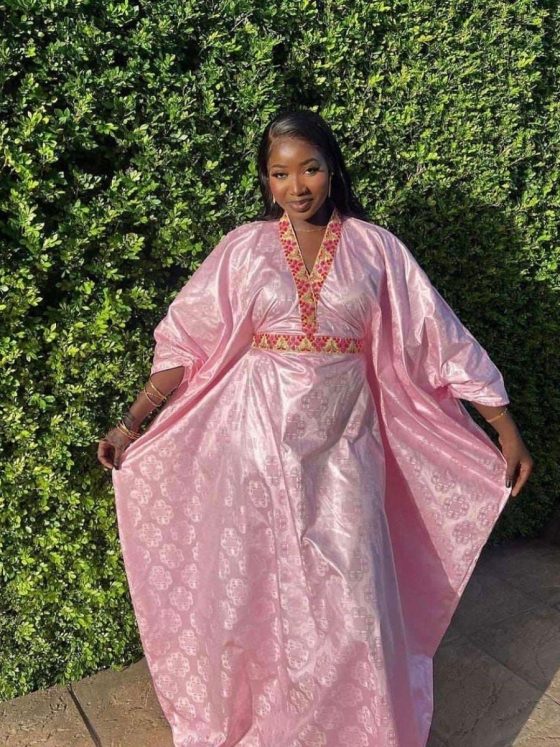
The embroidered boubou, distinct from the Bomba in its formal weight and level of ornamentation, is the prestige garment for both men and women across Benin’s ethnic groups at the highest formal occasions. Made in rich fabrics including damask, brocade, and high-quality cotton, with hand-embroidery or machine embroidery at the collar, cuffs, and chest, the embroidered boubou signals the occasion’s seriousness and the wearer’s intention to be seen as formally dressed. Its growing popularity across both genders reflects a Beninese dress culture that maintains multiple formal vocabularies simultaneously rather than collapsing into a single national standard.
Black and red are the traditional colours of mourning across southern Beninese communities. This is not a universal rule, and specific communities have their own mourning dress protocols. Still, the combination is widely understood as a signal of grief and is avoided at celebratory occasions by those who know the code.
Vodun Colour Codes and the Spiritual Dimension of Dress
In the Vodun-practising communities of southern Benin, which constitute a significant proportion of the country’s population, particularly in the regions around Ouidah, Abomey, and Porto-Novo, colour is a dimension of dress that communicates spiritual affiliation and ceremonial function. White clothing is worn for spiritual purification and is preferred for certain ceremonies, including initiation rites and offerings to specific deities. Red carries associations of authority and sacrifice. Indigo, the deep blue produced from natural dye, is worn by priests and carries associations of ceremonial dignity and prestige.
These colour associations are not confined to ceremonial contexts. They inform everyday dress choices for practitioners and their families in ways that are not always visible to outside observers. A Vodun practitioner selecting fabric for a new outfit is making choices within a colour system that carries spiritual meaning, not only aesthetic preference. The pagne’s print and colour combination communicates to those who know the system what the wearer’s spiritual affiliations and current ceremonial status are.
The annual Vodun Days festival in Ouidah, held on 10 January, is the most publicly visible expression of this dress culture. Priests and priestesses dress in colourful ceremonial robes, with high priests conducting rituals in red, white, or indigo depending on the specific deity they serve. The festival’s visual language is a compressed expression of the colour system that operates more quietly throughout the year in Beninese daily life.
ALSO READ
- Kanvô: Benin’s Royal Handwoven Fabric, Fully Explained
- Beninese Bridal Fashion: Fabric, Ceremony, Identity
- Benin Textiles and Symbolism
Muslim Dress in Northern Benin
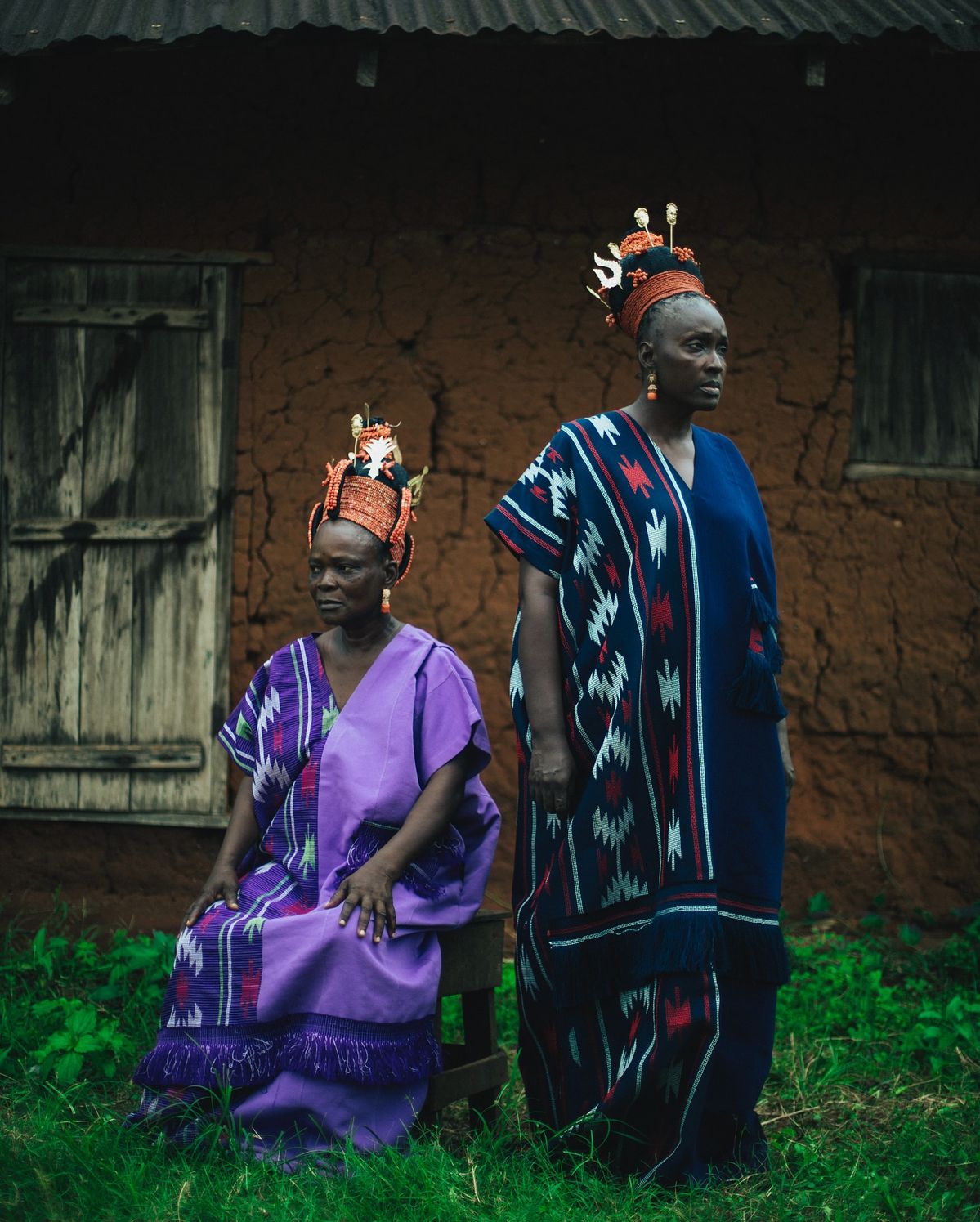
The Muslim communities of northern Benin, including the Bariba, Dendi, and Fulani peoples, follow dress traditions shaped by Islamic conventions of modesty alongside northern Beninese material culture. Women wear three-piece cloth arrangements: one wrapper around the waist, one around the chest, and one covering the head. Veils and headscarves are common. The colour palette for formal occasions tends toward white, gold, and rich earth tones.
Fulani women are particularly known for their long, colourful, flowing robes, worn with elaborate jewellery, including earrings, necklaces, and bracelets, which carry social and cultural significance within the community. Fulani hair traditions, including braids decorated with coins, amber, and coral, are a distinct visual marker that travels across national borders with the Fulani pastoral communities, who maintain their own dress traditions regardless of the country they are in.
For northern Muslim men, the boubou, in its northern interpretation, is the primary formal garment: longer and more flowing than the southern version, worn in lighter cotton and linen fabrics suited to the drier northern climate, and embroidered at the collar and cuffs with patterns specific to northern Beninese tailoring traditions. The kaftan, a simpler robe style, is worn for less formal occasions.
Kanvô and the Contemporary Turn
Kanvô, the royal handwoven fabric of the Dahomey Kingdom, woven from cotton, linen, and hemp by Fon and Baatonu weavers, is experiencing a documented revival in Beninese dress culture. Designers, including Elvira Akplogan of LOAN-H, and labels including FARE are producing contemporary garments from kanvô that sit comfortably in both ceremonial and everyday urban contexts. The Beninese government’s official labelling of kanvô in 2020 and its inclusion in the annual Tu consommes local campaign have contributed to renewed consumer interest in the fabric among urban Beninese buyers.
The contemporary Beninese dress scene is producing a generation of designers who treat traditional fabrics, kanvô, wax pagne, northern woven cloth, as materials to be reinterpreted rather than preserved. The silhouettes change. The construction techniques incorporate contemporary tailoring. The fabrics remain rooted in Beninese material identity. This is not a departure from tradition. It is the latest iteration of a dress culture that has incorporated new materials and aesthetics for as long as there have been trade, colonialism, and contact with the wider world.
What does not change, across all of these dress registers, is the underlying logic: in Benin, what you wear communicates who you are, where you come from, what occasion you are observing, and what values you hold. That is not a feature of traditional dress that modernity has eroded. It is the purpose that dress has always served, and it continues to serve it, in every region of the country, in every layer of the wardrobe.
“There is no single Beninese dress culture because there was never a single Beninese people. What exists instead is a set of specific, deeply developed dress systems, each with its own logic, that the country’s history brought into proximity. That proximity has been producing creative exchange for centuries.”
Frequently Asked Questions
What do people wear in Benin?
Benin Republic has over 42 ethnic groups and no single national dress. In urban centres like Cotonou and Porto-Novo, Western clothing dominates daily life. Traditional dress is worn at ceremonies, weddings, and formal occasions. The Bomba, a loose tunic over trousers for men and a loincloth with a top for women, is the base garment across southern communities. Wax print pagne with matching headscarves is central to women’s dress across the country. In northern Benin, Bariba men wear the Turu, a long-sleeved cotton tunic. Muslim communities in the north wear flowing boubous and three-piece cloth arrangements.
What is the traditional dress of the Benin Republic?
Traditional dress varies by ethnic group and region. Key garments include: the Bomba (loose tunic and trousers, worn across southern communities), the embroidered boubou (formal flowing robe for both men and women), the dashiki (colourful loose upper-body garment, with lace dashiki suits and bowler hats as a distinctly Beninese formal combination), the Turu (ankle-length sleeveless cotton tunic worn by Bariba men in the north), and kanvô (the royal handwoven fabric woven from cotton, linen, and hemp, worn for formal and ceremonial occasions). Wax print pagne with matching headscarves is the most widely worn item across the country.
What do Beninese women wear?
In cities, Beninese women wear Western clothing for daily work and errands: jeans, shirts, dresses, and office wear. For ceremonies and formal occasions, a wax-print pagne in a six-yard wrapper, with a coordinated blouse and matching headscarf, is the central ensemble. Yoruba women in southern Benin wear the iro and buba (wrap skirt and loose blouse) with a structured gele headwrap and ipele shoulder sash. Muslim women in northern communities wear three-piece cloth garments that cover the waist, chest, and head. Kanvô-based contemporary garments are increasingly worn for urban formal occasions.
What colours have special significance in Beninese dress?
In Vodun-practising communities of southern Benin, white signals spiritual purification and is worn for certain ceremonies. Red conveys authority and sacrifice. Indigo carries ceremonial dignity and prestige and is associated with priests and notable figures. Black and red together are the traditional colours of mourning across southern communities and are avoided at celebratory occasions. In Bariba communities of northern Benin, red cloth was historically reserved for crowned heads at the annual Gaani festival in Nikki.
What is the Bomba in Beninese dress?
The Bomba is the standard traditional garment in southern Beninese communities. For men, it is a loose tunic shirt worn over loose trousers. For women,n it is a loincloth with a coordinated top. It is adapted in material and ornamentation according to the occasion: plain cotton for everyday wear, wax pagne or kanvô versions for ceremonies and formal events. It is not specific to one ethnic group but is widely recognised as the foundational traditional garment form across the country’s south.
What is kanvô, and when is it worn?
Kanvô is Benin Republic’s royal handwoven fabric, introduced to the Dahomey court by King Agonglo in the late 18th century. It is woven from cotton, linen, and hemp by Fon weavers in the south and Baatonu weavers in the north (where it is called Tako). Traditionally reserved for royalty and formal occasions, it is worn today at weddings, ceremonies, and formal events by both men and women. Contemporary designers, including Elvira Akplogan of LOAN-H and FARE, are producing everyday kanvô garments. The Beninese government officially labelled kanvô in 2020.
Explore more from our Culture section, where African dress is documented with the specificity it has always had and the coverage it has always deserved.