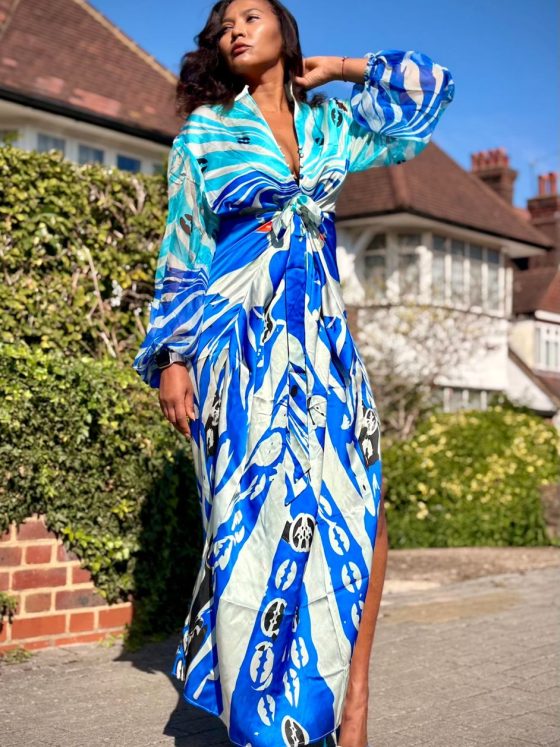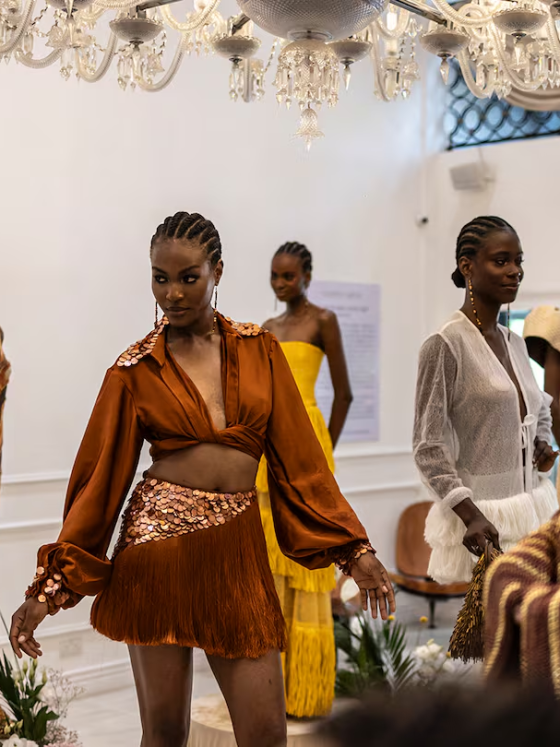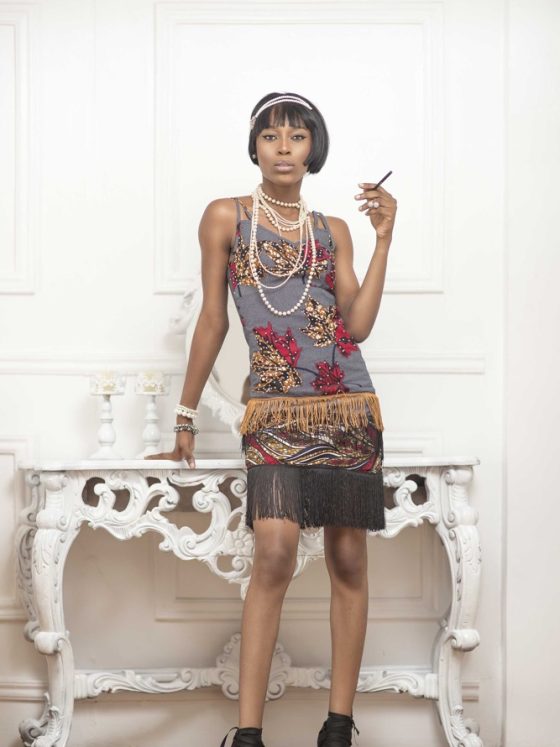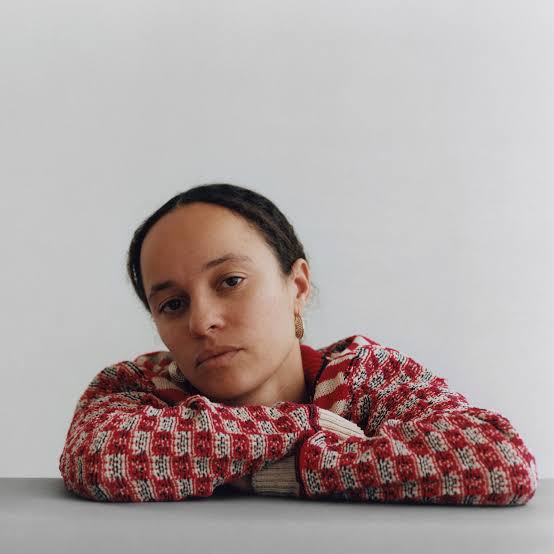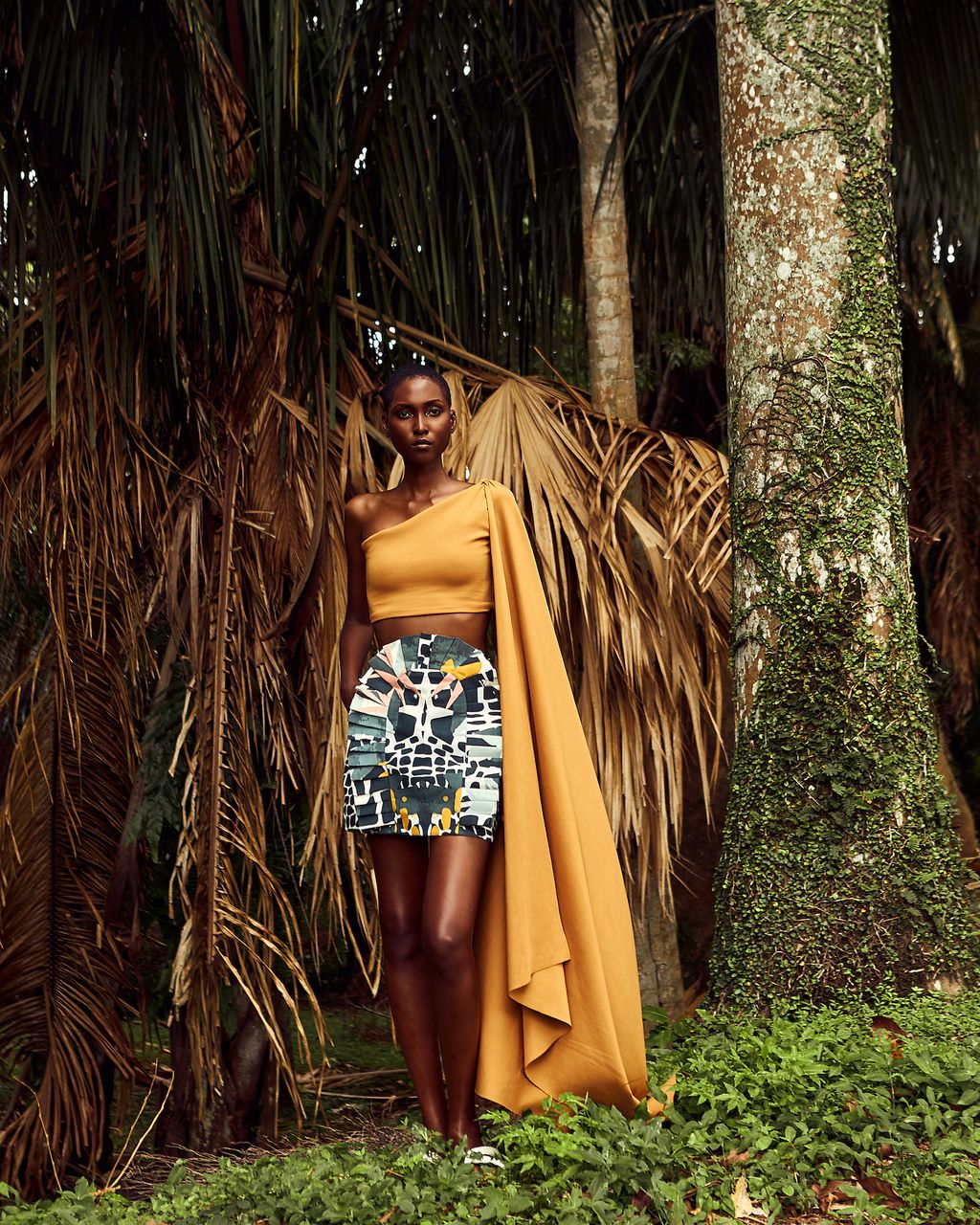
A gathered neckline, a sheer column, and a structured bustier produce different kinds of dresses, even before you consider their prints. Through Avani, Anvaya and Aarya, Shoma the Label offers a way to examine Caribbean fashion beyond the familiar language of colour, tropical imagery and cultural celebration.
Explore Shoma the Label through three dresses that reveal different approaches to print, silhouette and drape within Shoma Persad’s Trinidad-based practice.
Three dresses, three ways of organising fabric
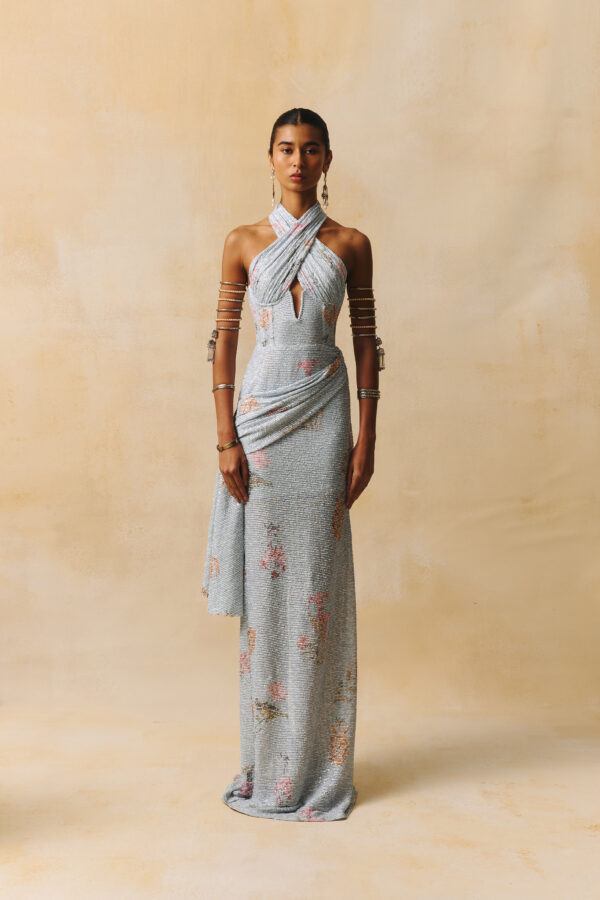
At Shoma the Label, the Avani Wrap Dress concentrates fabric around the neck and waist. Its high halter neckline gathers into soft pleats, while a wrap tie defines the waist.
The back opens, and elongated panels extend the draped treatment. These details create a dress whose identity depends on how the fabric is gathered, secured, and released, not simply on the image printed across it.
“A print tells you what a dress looks like; the cut tells you how it lives.” Omiren Styles Editorial Intelligence
Anvaya takes another route. Its published specification describes an elongated, sheer column with a high neckline, soft sleeve volume, and a tiered hem, plus a detachable tassel belt that further adjusts the shape.
Aarya, meanwhile, combines a strapless, boned bustier with a draped skirt and extended scarf panels. Its lace-up back and structured bodice introduce a more explicit framework than the other two designs.
The comparison is revealing because these are not minor variations on one printed dress. They make different propositions about the body: where it is defined, where fabric moves away from it and where the garment introduces volume.
Print enters those arrangements rather than replacing them. That distinction provides a more precise starting point for understanding Shoma Persad’s label than describing its clothes through colour or cultural references alone.
A Trinidadian label with a particular family story
Founded in 2020, Shoma the Label draws on Indian and Caribbean influences in its practice. The Trinidad Guardian reports that Shoma Persad launched it that year, and Brown Girl Magazine profiles her as the founder and creative director of a Trinidad-based luxury label.
The label’s published account places print alongside structure, fluidity, and drape, presenting them as part of the same design vocabulary. The statement sets up an intention worth examining: the printed surface and the shape it carries should be understood together.
For spring/summer 2026, Persad gave that intention a personal historical context. In the statement for “A Thread Across the Water”, she connected the collection to her great-grandfather’s departure from Agra in the late nineteenth century as an Indian indentured labourer.
She framed the work through ancestry, migration and endurance, associating flowing lines, sheer layers and tailoring with that account. These are the designer’s stated links between family history and clothing, and the Guardian’s report confirms the Agra connection and the late-nineteenth-century departure.
The specificity matters. It offers more than an indistinct claim of heritage, naming a family connection and a history that shaped the collection’s explanation.
Yet the narrative should not be asked to do all the critical work. A draped panel does not communicate that history to every viewer, so the story explains what Persad intended, while the garment’s proportions and construction show what she made of the idea.
Avani: the waist as a point of control
Avani’s design is organised around two distinct areas of concentration. At the top, gathered pleats draw fabric toward the halter neckline, and at the waist, the wrap tie defines the silhouette.
Between these points, the dress is defined by drape rather than an uninterrupted flat surface. The open back and extended panels add another contrast, setting an exposed area beside lengths of fabric.
That configuration gives the print a demanding role. Gathering can compress an image, while wrapping introduces overlap and changes its direction.
These are consequences of the garment’s specified operations, not proof that any particular motif has been precisely positioned. The relevant design question is how the artwork accommodates those changes: whether folds enrich its rhythm or obscure the relationships on which it depends.
The label’s product description makes clear that Avani is not conceived merely as a loose dress cinched afterwards. Gathering, wrapping and extension are central to its identity.
The waist does more than mark a size; it helps organise the relationship between the upper body and the longer draped elements. This gives the dress a distinct proposition before colour or motif is interpreted.
Anvaya: length before definition
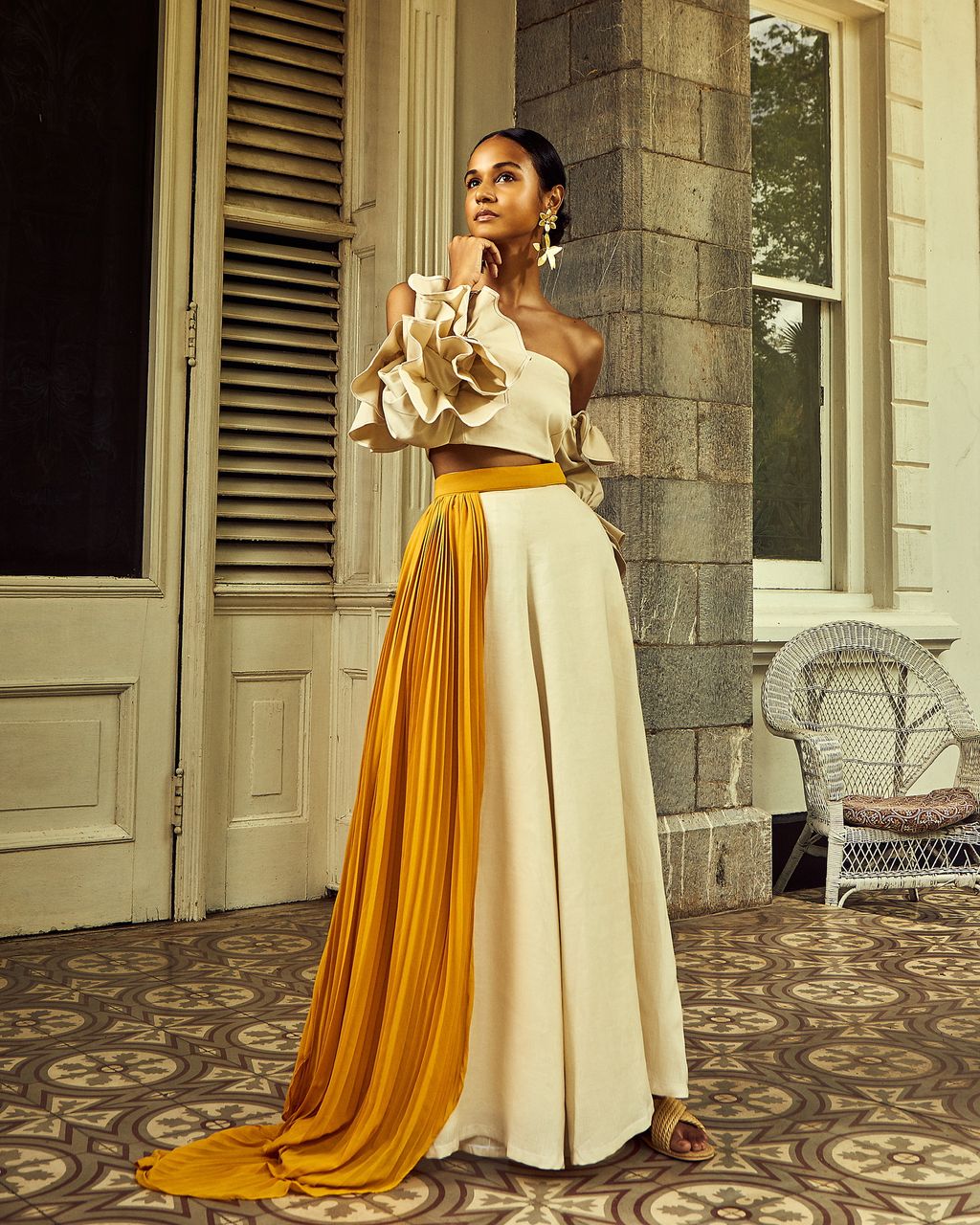
Anvaya offers the clearest contrast to that approach. Its specification begins with an elongated column, then introduces sheer construction, softly voluminous sleeves and a tiered hem.
Unlike Avani, its waist is not presented as a permanently fixed organising point. The detachable tassel belt allows cinching while keeping the column as the underlying form.
This changes how the design is read. Avani emphasises a succession of concentrated points; Anvaya prioritises length and continuity.
Its sleeves and tiered finish complicate that continuity without reproducing the wrap dress’s arrangement. Both may be described as fluid, but the word alone is insufficient, because one controls fabric through gathering and tying. At the same time, the other starts with an extended shape and allows further adjustment.
Sheerness introduces a further distinction. It is part of the specified construction rather than simply a styling description, affecting the relationship between fabric, coverage and whatever is worn beneath.
The precise visual result would depend on a particular version and styling. The comparison is nevertheless clear: Anvaya brings together an elongated outline, transparency, sleeve volume, and an optional belt, creating a different setting for print than Avani’s gathered halter and open back.
Aarya: a framework for drape
Aarya makes the relationship between control and release more explicit. The product page describes a strapless mini dress with a boned bustier and structured bodice, plus a draped skirt and extended scarf panels.
A lace-up back with metal eyelets adds another stated construction detail. The design therefore combines a defined upper framework with elements that continue beyond it.
The distinction is more useful than describing the dress simply as strong and soft. Boning, lacing, and a structured bodice are deliberate choices, as are a draped skirt and extended panels.
Their coexistence creates the design’s central problem: how to connect a controlled form to lengths of fabric that behave differently. Compared with Anvaya’s column, Aarya places more emphasis on the transition between a defined section and its extensions.
These specifications do not guarantee comfort, support, or a successful fit for every wearer. They establish the proposed method.
Within the selected group, Aarya shows that Shoma’s interest in drape doesn’t depend exclusively on loose or flowing silhouettes. Draping can also be attached to a more structured base, changing the relationship between the printed material and the body beneath it.
Print placement is part of the design question.
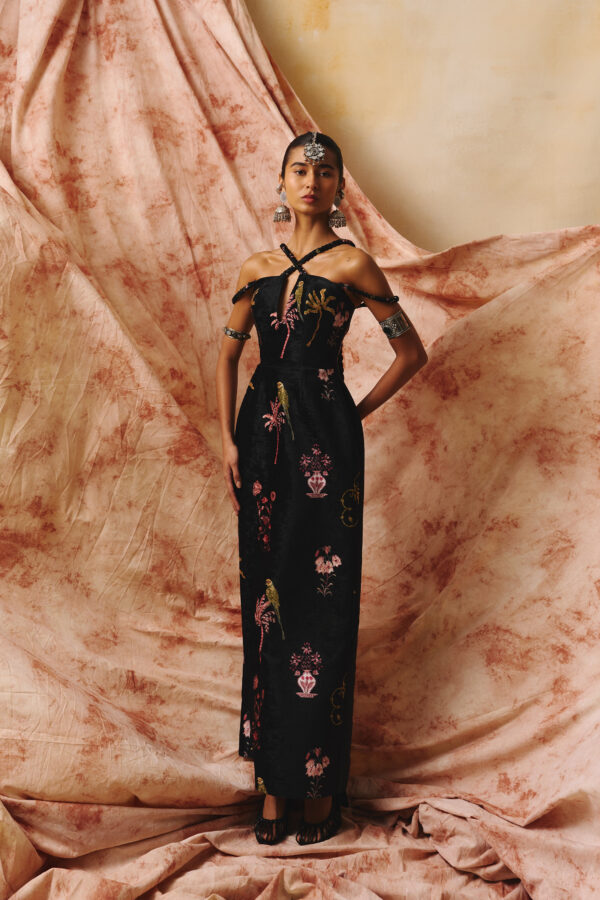
Shoma’s product pages state that printed pieces are hand-cut, and that exact print positioning may vary between garments. This is a consequential qualification for a label whose visual identity includes print.
A catalogue image shows a particular arrangement, not necessarily the same placement on every finished piece. Do not interpret the advisory as automatically a virtue of individuality or a flaw in consistency.
The significance of variation depends on the artwork and the cut. A dispersed motif may accommodate changes differently from an image whose effect relies on a particular area appearing at the neckline or waist.
Without a verified account of the artwork and cutting plan, those distinctions remain questions for further examination. The advisory does establish that precise visual claims should be tied to an identified example.
It would be misleading to describe one motif’s apparent relationship to a seam as a guaranteed feature across every version. Equally, “hand-cut” alone does not explain the judgement involved in placing pattern pieces on printed fabric, and the process deserves its own reporting rather than a romantic assumption about making.
Origin, authorship and production
The selected product pages describe made-to-order production in the label’s Trinidad atelier, and Brown Girl Magazine likewise describes the pieces as handmade and made to order. That gives the garments a stated production location and a specific ordering model.
It is more informative than a general appeal to Caribbean craftsmanship, but it does not identify every contributor involved in creating the artwork, developing patterns, cutting or assembling the dresses. The Guardian reports that Persad designs and hand-develops the prints herself, which answers part of that question for the artwork.
Those roles matter because a printed garment brings several forms of authorship together. The artwork must be credited separately from the silhouette design. At the same time, developing and making the piece involves further decisions, a point we make in what a heritage fashion product page should clarify.
A fuller account would establish those contributions rather than folding them all into the founder’s biography. For a wider view of how cloth and costume carry meaning in Trinidad, see our piece on the textile and costume traditions behind Trinidad’s Carnival.
Persad’s family narrative and the stated Trinidad production context consequently provide different kinds of information. One explains the collection’s personal and historical frame; the other locates the brand’s described making, and neither independently proves how well the garments resolve their design problems.
What sits behind the image
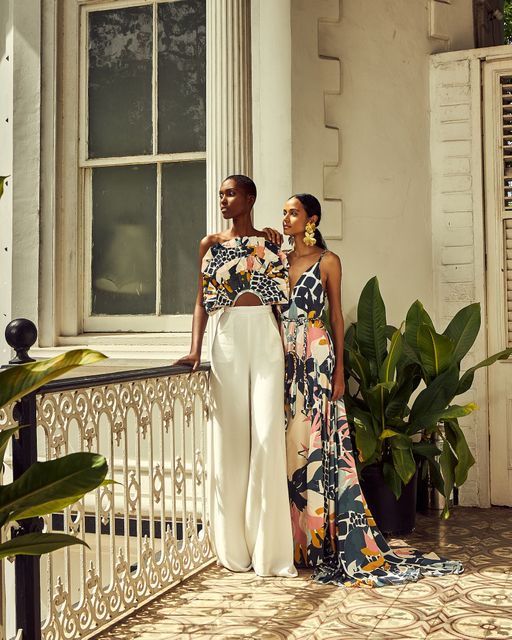
Avani, Anvaya and Aarya establish three different approaches within Shoma’s published offering. Avani concentrates fabric at the neckline and waist before extending it through draped panels; Anvaya begins with a sheer column and allows an optional change in waist definition; and Aarya anchors the drape to a structured, boned bodice.
Their differences make it difficult to reduce the label to an attractive printed surface.
The next level of assessment concerns how those shapes integrate with particular artworks. A compelling print cannot guarantee a resolved dress, just as a persuasive collection statement cannot substitute for proportion.
The strongest finding the product record supports is that silhouette is an active part of Shoma’s proposition. Its dresses ask print to work across different forms rather than giving every image the same unchanging frame.
Omiren Argument
The defining issue is integration: how artwork, cut and drape contribute to one another. The selected Shoma dresses demonstrate distinct structural approaches, making shape central to the label’s proposition rather than incidental to its printed identity.
That provides a more substantive basis for discussing the work than a general celebration of colour or heritage. Persad’s narrative gives the collection context, but the clothes must still be examined on their own terms: where fabric is controlled, where it is released, and how the printed surface responds.
Also Read:
- Meiling: The Trinidad Designer Who Built a Minimalist Language From Caribbean Sensibility
- Afro-Caribbean Fashion in Trinidad and Tobago: Carnival, Community, and Cultural Identity
- Jamaican Designers Building a Fashion Identity on Their Own Terms
- Priya Ahluwalia and the Design Intelligence of Double Diaspora
Frequently Asked Questions
Who founded Shoma the Label?
Creative director Shoma Persad founded the label in 2020. Its published account identifies Indian and Caribbean influences within its design practice.
How do Avani, Anvaya and Aarya differ?
Avani combines a gathered halter neckline, wrap waist and draped back panels. Anvaya is described as a sheer column with sleeve volume and a detachable belt. Aarya pairs a structured bustier with a draped skirt and extended scarf panels.
Where does Shoma say these garments are made?
The selected product pages describe made-to-order production in its Trinidad atelier. This is the brand’s published production statement rather than an independently audited finding.
Is print placement identical on every garment?
The brand says printed pieces are hand-cut, so exact positioning may vary. Customers with specific placement requirements should confirm them directly before ordering.