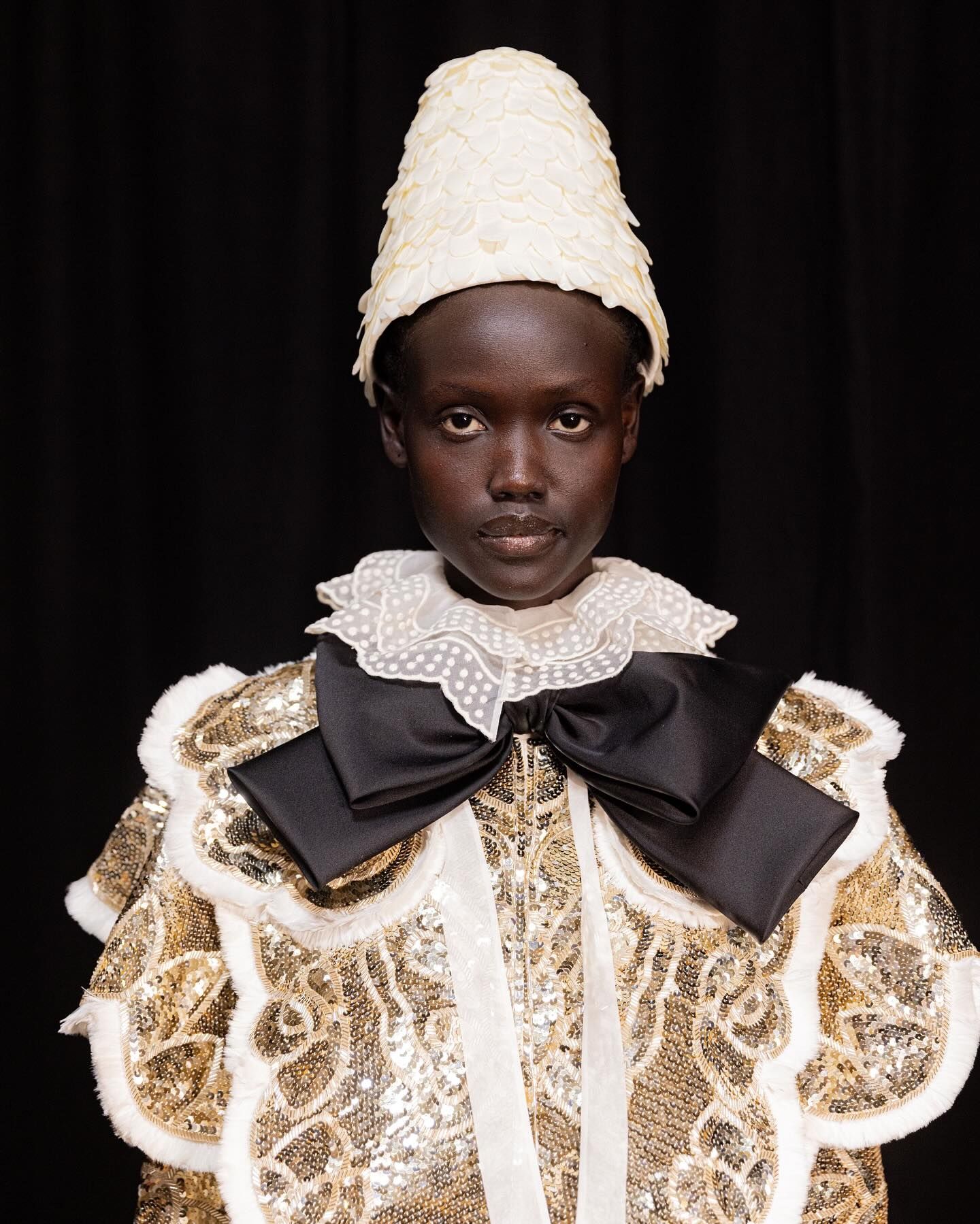
The jacket supplies the colour. The collar decides where the eye stops.
In the Kenneth Ize Autumn/Winter 2026 look examined here, a white collar draws attention towards the face above a vertically striped jacket. White cuffs repeat that contrast at the wrists, while purple neckwear adds a concentrated accent at the throat.
These details don’t replace the jacket’s visual structure. They change how we encounter it. The patterned torso remains the largest area of activity, but the neckline becomes a distinct focal point rather than simply the place where the stripes end.
The look belongs to ‘JOY’, Ize’s Autumn/Winter 2026 collection, presented during Intervention at Berlin Fashion Week. Here, the focus is narrower than the collection’s theme: how visible portions of an underlayer shape how an outfit is read.
The shirt becomes a frame, not because it surrounds the jacket, but because its exposed edges establish points of emphasis.
This is a question that runway styling raises regularly, but that fashion writing does not always address directly. The jacket is the designed object; the shirt is the context in which the jacket appears. When that context is handled well, the result looks inevitable. When it isn’t, even the most carefully designed jacket can feel incomplete. Understanding what the visible shirt is doing in a look is part of understanding whether the look works.
A close reading of how a white collar, white cuffs and purple neckwear organise the upper body in a Kenneth Ize Autumn/Winter 2026 look. This article examines what happens when the shirt becomes a frame for the jacket rather than a background.
The Collar and Cuffs Work Together
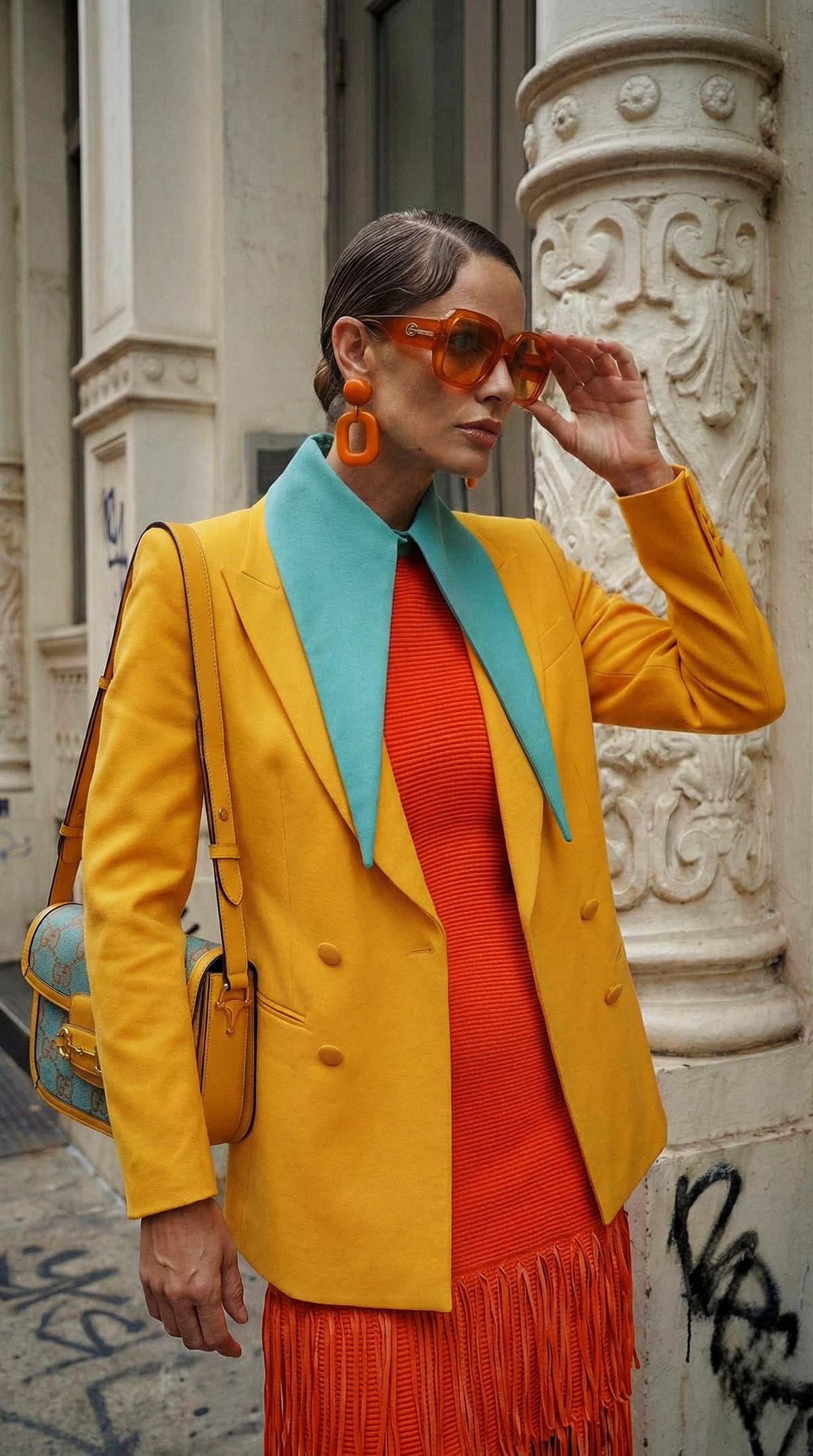
The white collar introduces a relatively simple shape above a busy surface. Against the multicoloured stripes, its brightness is immediately legible.
Placement gives that contrast its purpose. At the neckline, white separates the patterned torso from the face. The eye has somewhere to arrive after travelling through the jacket’s colours and vertical lines.
The collar also brings a sharper visual character to the outfit. Its defined edges contrast with the jacket’s textured-looking surface. That difference is productive: neither element disappears into the other.
On its own, however, the collar could feel detached, a conspicuous formal detail sitting above the jacket rather than belonging to the whole look.
The cuffs resolve that risk.
White reappears at the ends of the brown sleeves, connecting the neckline to two other points on the silhouette. The repetition makes the collar feel less isolated without spreading brightness across another large area.
The cuffs also prevent the quieter sleeves from becoming visually inert. They punctuate the brown, marking where the sleeves end while leaving the patterned torso dominant.
What matters is the relationship, not simply the presence of white. The collar establishes the main contrast; the cuffs make that contrast feel integrated.
Their limited exposure is important. More visible white would change the balance, making the shirt a larger competing surface. As shown, its role remains precise: it defines edges rather than taking over the outfit.
This principle isn’t exclusive to contemporary tailoring. The question of how to establish a focal point in an outfit that contains several strong elements has been central to textile design and dress for much longer. White collar and cuff details have served this function in European formal dress for centuries. What changes in this look is the surface it borders: a handwoven textile with a strong vertical pattern that carries its own assertive visual logic. The collar doesn’t make the outfit more formal. It is giving the eye a place to rest.
Purple Makes the Neckline Less Predictable
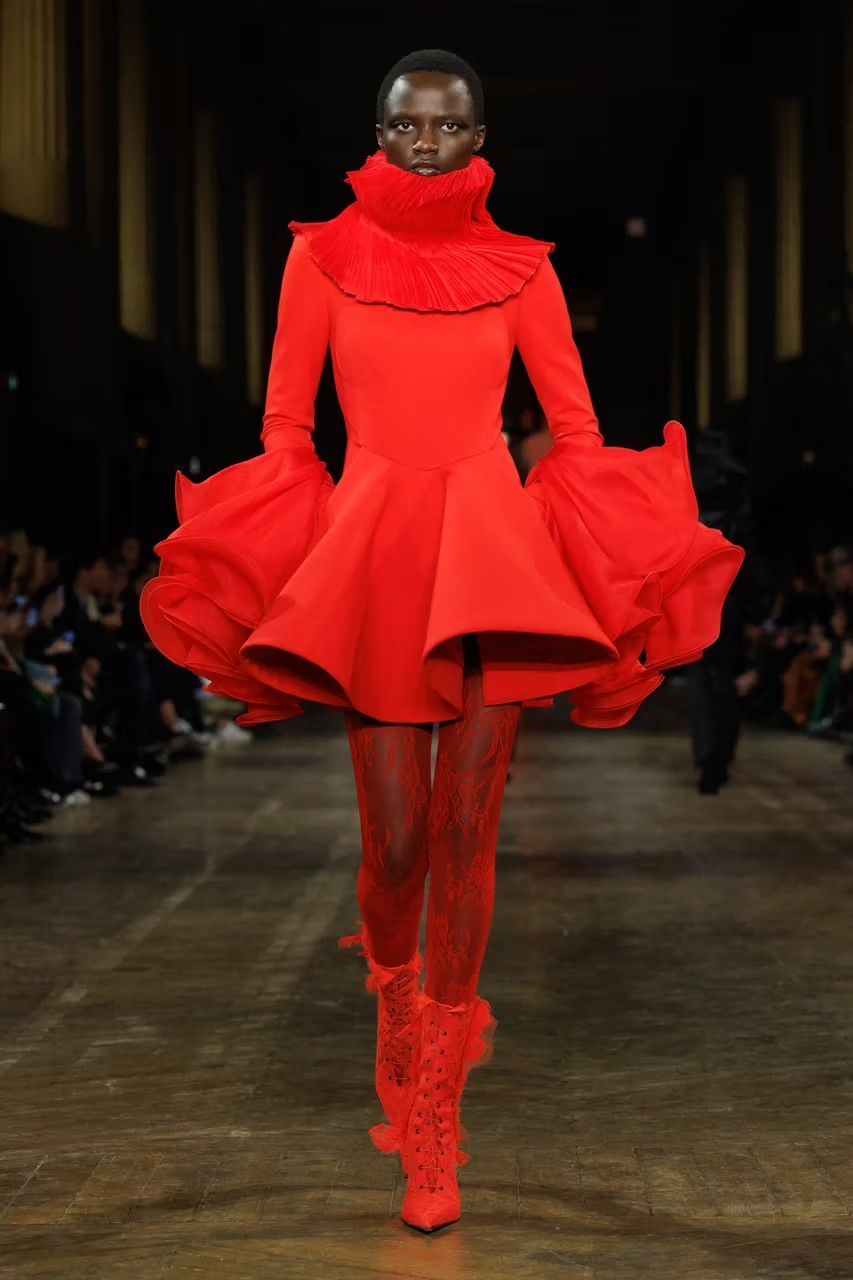
The purple neckwear performs a different job.
Where the cuffs repeat an existing contrast, the neckwear introduces another colour. It occupies an already active junction between face, white collar and striped jacket, making it the styling choice most likely to complicate the look.
Its scale keeps that complication manageable.
The purple is conspicuous against white, but it covers a small enough area to remain an accent. It adds emphasis near the face without becoming a second dominant colour field.
It also changes the collar’s function. White no longer acts only as a separation between skin and pattern; it becomes a clear setting for the neckwear. The collar makes the purple easier to read, and the purple makes the neckline less severe.
There is a trade-off. Without the neckwear, the outfit would have a simpler upper section: white above stripes, with fewer competing points of interest. But simplicity is not automatically the stronger choice.
Here, the purple adds character. It keeps the collar from reading as only a crisp boundary and gives the neckline a more assertive presence.
The choice works because its size remains subordinate to its colour. The accent is vivid but contained.
The relationship between the three elements at the neckline is worth mapping precisely. The white collar creates separation. The purple neckwear creates emphasis. Both sit against the jacket’s stripes, which provide the general pattern. Each of the three occupies a different scale: the stripes are large and repetitive; the collar is medium and simple; the neckwear is small and singular. Scale prevents the three from competing equally. The smallest element is the most vivid, and that arrangement lets the larger elements do their work without being overwhelmed.
What the Styling Changes
The jacket already has its own structure. Its patterned front, plain sleeves, fastening and pockets organise the garment before the shirt enters the discussion.
The styling adds another hierarchy.
The collar pulls attention upwards. The cuffs carry that contrast to the wrists. The neckwear concentrates colour near the face. Together, they make the upper body and sleeve endings more distinct within the complete look.
This is the difference between examining a garment and examining how it is worn. The jacket’s design determines much of the silhouette; the visible underlayer changes which parts receive emphasis.
Calling these details ‘finishing touches’ understates their contribution. They are small, but their placement affects the outfit’s balance.
The most convincing decision is repeating white. It makes the collar belong to the whole silhouette rather than leaving it as a solitary accent. The purple neckwear is the more debatable intervention, exchanging a little clarity for greater individuality.
That distinction looks at its interest. The cuffs stabilise the collar; the neckwear unsettles its neatness. One choice integrates. The other adds character.
Fashion criticism that attends to how garments are worn rather than only what they are made of makes visible the decisions that separate a look from a garment. The credit block of a fashion image names the stylist alongside the designer for exactly this reason. The styling is a distinct layer of decision-making with its own argument. In this look, the visible shirt makes that argument directly: it says the jacket needs context, and that context should do more than simply not compete with it.
The Underlayer as a Compositional Tool
In most runway presentations, the shirt or underlayer disappears. It fills the collar opening and cuff ends, and the expectation is that it will be as quiet as possible. When a shirt is visible only at the edges of a jacket, its default role is to be unobtrusive.
This look inverts that expectation.
The white collar and cuffs are not trying to be invisible. They are positioned as deliberate contrasts, chosen for what they add to the jacket’s reading rather than for their neutrality. The collar is where the outfit becomes a face-adjacent object rather than a textile surface. The cuffs are where the sleeves acquire endings rather than fading out.
The underlayer becomes a compositional tool when its visible portions are treated as design decisions rather than practical necessities. The question the stylist answers is not ‘What will cover the collar opening?’ but ‘What should the collar opening communicate?’. In this look, the answer is sharpness, followed by colour.
The question of what a garment communicates versus what it simply does is one that dress history has returned to repeatedly. An archival analysis of a garment asks what it was designed to say in its moment and what it reveals about the body it dressed. A styling analysis asks the same question at the level of the complete outfit: what does each element communicate, and does the whole say something that the parts alone could not? In this look, the white and purple details at the neckline say that the wearer’s face is the destination. The jacket provides the journey.
The Limits of What Can Be Confirmed
This article’s visual analysis is based on photographs supplied by AnOther’s Kenneth Ize Autumn/Winter 2026 gallery. The observations about collar placement, cuff visibility and neckwear scale are drawn from what those photographs show.
The photographs alone cannot confirm the shirt’s specific construction, the fabric of the neckwear, or whether the collar and cuffs were designed as part of the shirt or attached separately. The analysis treats the visible elements as styling decisions without claiming to understand how they were produced.
Published coverage of the JOY collection describes aso oke, velvet, wool, lining and denim as part of the collection’s material vocabulary. That information applies to the collection as a whole and does not establish the composition of the shirt or neckwear visible in this particular look. The shirt is white, and it has a defined collar and cuffs. The neckwear is purple. The photographs support these observations.
ALSO READ:
- Kenneth Ize’s Autumn/Winter 2026: How One Jacket Organises Pattern
- Who Made This Fashion Image? Reading Adut Akech’s Vogue Australia Cover Credits
- What a Museum Record Can – and Cannot – Tell Us About Dress
- The Global South Made Fashion. It Just Never Got Credit.
Frequently Asked Questions
Which runway look does this article examine?
It examines the previously discussed Kenneth Ize Autumn/Winter 2026 look with a vertically striped jacket, brown sleeves and trousers, a white collar and cuffs, and purple neckwear. The collection, titled JOY, was presented during Intervention at Berlin Fashion Week.
What does it mean for a shirt to become a frame?
Here, the shirt’s visible edges establish points of emphasis around a more visually active garment. The collar defines the neckline, while the cuffs repeat that contrast at the wrists. Most of the underlayer remains concealed, but its exposed portions influence the whole silhouette.
Why do the cuffs matter as much as the collar?
The cuffs connect the white collar to the outfit rather than isolating it above it. Their repetition creates a relationship between neckline and sleeve endings without introducing another large surface that competes with the jacket.
Does the purple neckwear compete with the jacket?
It adds activity to an already busy neckline, but its small scale keeps it secondary to the patterned torso. The result is less minimal than it would be without the accent, yet more distinctive: purple gives the collar character without displacing the jacket as the principal garment.
Is the shirt made from a specific fabric?
That has not been confirmed. The photographs show a white shirt with a defined collar and cuffs. The supplied images alone do not identify the fabric composition, and published collection-level information about Aso Oke, velvet, wool, and denim does not establish the composition of this specific underlayer.
Where did the photographs come from?
The photographs came from AnOther’s Kenneth Ize Autumn/Winter 2026 gallery. Photographer attribution and reproduction permission remain to be confirmed before publication. The page reference in the URL should not be treated as an official runway look number.