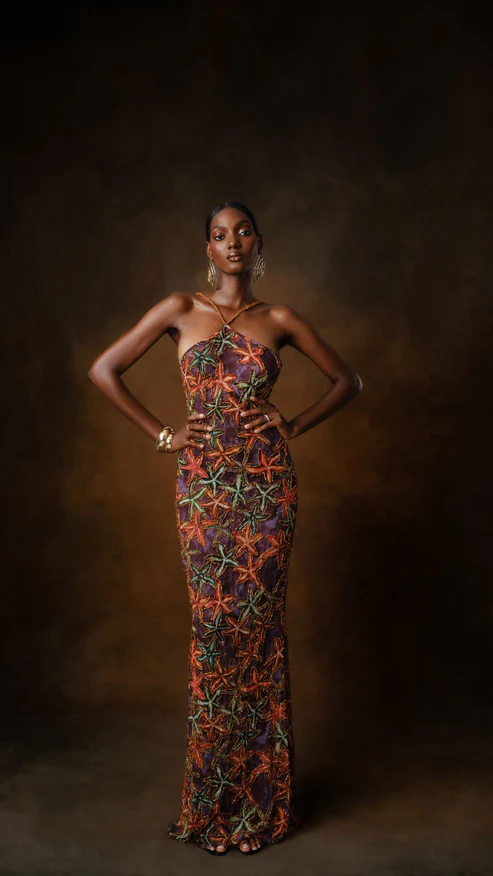
In London, designers reduce mythology to mood boards. They extract a name, soften a symbol, and smooth the edges until the reference becomes decorative rather than structural. Michelle Adepoju refuses the practice entirely.
Through her label Kìléntár, Adepoju engineers Yoruba cosmology into a silhouette. She cuts folklore into precise fabric weights. She builds the sacred feminine through drapes that hold their position and proportions that do not apologise. The result raises a question that every designer working at the intersection of African heritage and contemporary fashion must eventually face: what emerges when African spirituality functions as the structural system rather than the decorative reference?
Adepoju’s answer is Kìléntár. This is currently one of the most rigorous arguments in global womenswear.
Michelle Adepoju does not borrow from Yoruba cosmology. She builds with it. Every silhouette in Kìléntár carries the weight of a design system that is centuries older than the fashion industry it now occupies.
The Cosmology That Grounds the Work

Yoruba cosmology originates from the Yoruba people of West Africa, primarily in present-day Nigeria, Benin, and Togo, with roots extending across centuries of oral tradition and spiritual practice. The system, known as Ifa, centres on Olodumare as the Supreme Being and a pantheon of Orishas, each embodying a distinct natural and spiritual force: Yemoja governs water; Oya governs transformations and storms; Oshun governs sensuality and abundance; and Ogun governs iron, labour, and war.
Colonialism and the transatlantic slave trade fractured but did not erase this system. It travelled with enslaved Yoruba people into the Americas, where it reformed into Candomblé in Brazil, Santería in Cuba, and Vodou in Haiti, each a living adaptation that kept the Orishas’ intelligence intact across centuries of suppression. This system is not mythology in the archive. sense. It is a knowledge system that proved durable enough to survive forced displacement and still operates across three continents.
Adepoju draws upon this resilience deliberately. Kìléntár does not treat the Orishas as visual references. It treats them as design briefs.
Research Before Aesthetic
The Cosmology That Grounds the Work
Yoruba cosmology originates from the Yoruba people of West Africa, primarily in present-day Nigeria, Benin, and Togo, with roots extending across centuries of oral tradition and spiritual practice. The system, known as Ifa, centres on Olodumare as the Supreme Being and a pantheon of Orishas, each embodying a distinct natural and spiritual force: Yemoja governs water; Oya commands transformations and storms; Oshun holds sensuality and abundance; and Ogun asserts iron, labour, and war.
Colonialism and the transatlantic slave trade fractured but did not erase this system. It travelled with enslaved Yoruba people into the Americas, where it reformed into Candomblé in Brazil, Santería in Cuba, and Vodou in Haiti, each a living adaptation that kept the Orishas’ intelligence intact across centuries of suppression. This structure is not mythology in the archival sense. It is a knowledge system that proved durable enough to survive forced displacement and still operates across three continents.
Adepoju draws upon this resilience deliberately. Kìléntár does not treat the Orishas as visual references. It treats them as design briefs.
The Sacred Feminine, Without Fragility
Kìléntár’s womenswear occupies a deliberate tension: softness anchored by command.
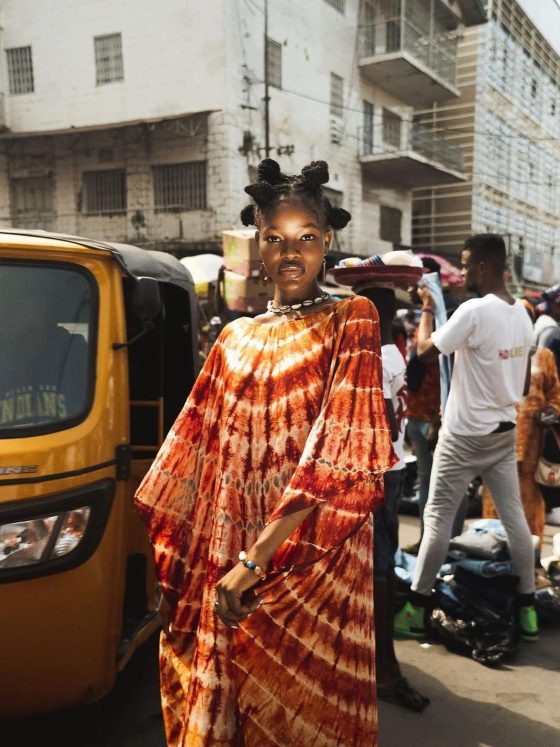
Structured shoulders balance flowing fabrics. Bias cuts are stabilised with intentional waist definition. Prints are bold but disciplined.
The result is not fragility masquerading as femininity. It is present.
In Yoruba cosmology, the feminine divine is expansive — nurturing but formidable, fluid but sovereign. Adepoju mirrors that through proportion.
A gown may ripple at the hem, but the torso holds shape. A sleeve may billow, but the neckline asserts geometry.
Nothing collapses.
This is how mythology becomes architecture.
READ ALSO: Ajabeng and the Architecture of Afro-Minimalism
Diaspora Without Performance
Based in London, Adepoju operates within a global fashion ecosystem that often commodifies African references. The danger of diaspora design is that it flattens, turning complex heritage into aesthetic shorthand.
Kìléntár avoids such danger by refusing spectacle.
There are no exaggerated costume cues. No overplayed symbolism. The collections are refined, contemporary, and globally legible but grounded.
The prints don’t overtly proclaim their identity. They assume it.
Diaspora fashion is most powerful when it does not seek validation. Adepoju does not frame Yoruba cosmology as an exotic narrative for Western consumption. She frames it as an intellectual foundation.
London is the base. Yoruba cosmology is the spine.
Colour as Theology
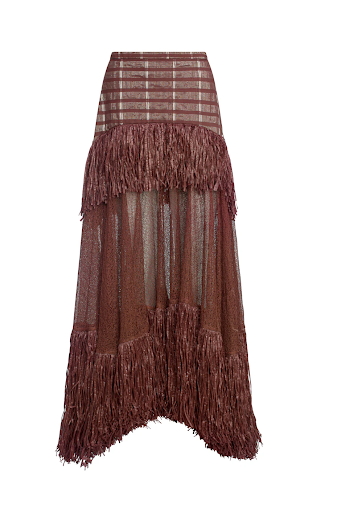
In Out of This World, blue is not trend alignment. It is theology.
Deep indigos suggest spiritual depth. Lighter aquatics imply fluidity and transformation. Saturated tones evoke the visual drama of water under light.
The choice is deliberate.
In Yoruba symbolism, water carries dual meaning — creation and destruction, allure and danger, rebirth and sovereignty. Adepoju translates that duality into garment logic.
Soft chiffon overlays conceal structured bodices. Flowing skirts contrast with angular seam work. The fabric language mirrors cosmological complexity.
This is how storytelling survives modernity.
Elegance as Cultural Strategy
There is discipline in Kìléntár’s refinement.
Rather than leaning into maximalist print layering often expected of African-influenced fashion, Adepoju exercises control. Patterns are placed strategically. Silhouettes breathe. Negative space is respected.
This restraint does two things.
First, it challenges the stereotype that African artistry must be loud to be legible.
The garments belong in London showrooms. They photograph cleanly. They sit comfortably in global retail spaces.
But remove the Yoruba research, and the work loses its thesis.
That is the mark of structural influence.
ALSO READ: Chief Robinson Olafisoye’s Beaded Spiritual Art: Modern Craft, Deep Roots in Yoruba Culture
Beyond Inspiration: Building a Visual Canon

What Adepoju is doing extends beyond one collection.
By consistently grounding her work in Yoruba narrative, she contributes to a growing visual canon—one in which African spiritual systems are interpreted with nuance rather than novelty.
Fashion has long drawn from Greco-Roman mythology without apology. European houses reference gods, goddesses, and classical lore as intellectual capital.
Why should Yoruba cosmology be treated differently?
Kìléntár answers that question by refusing hierarchy.
If mythology can anchor European couture, it can anchor African diaspora fashion with equal authority.
The Woman Who Wears Kìléntár
The imagined wearer is not passive.
She is culturally literate. She understands symbolism even if she does not articulate it publicly. She is at ease in London, Lagos, or New York. She moves between global spaces without dissolving into them.
The garments support that mobility.
Flowing dresses allow movement but maintain composure. Structured elements ensure presence. Prints carry narratives without being overwhelming.
Empowerment here is not slogan-driven. It is engineered.
The woman is not wearing “African-inspired fashion.”
She is wearing cosmology that is refined for contemporary life.
Why This Matters Now
African design narratives are expanding globally. But expansion often risks dilution. The market rewards aesthetics that travel easily — not always those that carry intellectual weight.
Adepoju’s work resists flattening.
By grounding collections in research and executing them with precision, she demonstrates that African spiritual systems can exist within high-fashion frameworks without compromise.
African knowledge must be the primary lens, not a footnote.
Kìléntár does not append Yoruba mythology to global fashion. It builds from it outward.
Designing Continuity

Michelle Adepoju is not merely designing dresses.
She is designing continuity.
Through disciplined drape, symbolic colour, and intentional structure, she translates Yoruba cosmology into garments that belong to the present—not as relics or costumes, but as living systems.
In an industry that often consumes African references as trends, Kìléntár asserts something steadier.
Mythology is not archived.
It is architecture.
And in Adepoju’s hands, it is tailored for the future.
Celebrate innovative design rooted in culture — browse African Fashion Designers on OmirenStyles.
FAQs
- Who is Michelle Adepoju?
Michelle Adepoju is a British-Nigerian designer who founded Kléntár.
- What inspires Kìléntár?
Kléntár draws inspiration from Yoruba cosmology, feminine sovereignty, and West African artistry.
- What was S/S24 about?
Out of This World honoured Mami Wata with fluid blue silhouettes.
- Is Kìléntár diaspora fashion?
Yes. It bridges Yoruba heritage with London-based contemporary design.
- What defines her aesthetic?
Her aesthetic is characterised by structured femininity, symbolic colour, refined drapery, and research-driven storytelling.