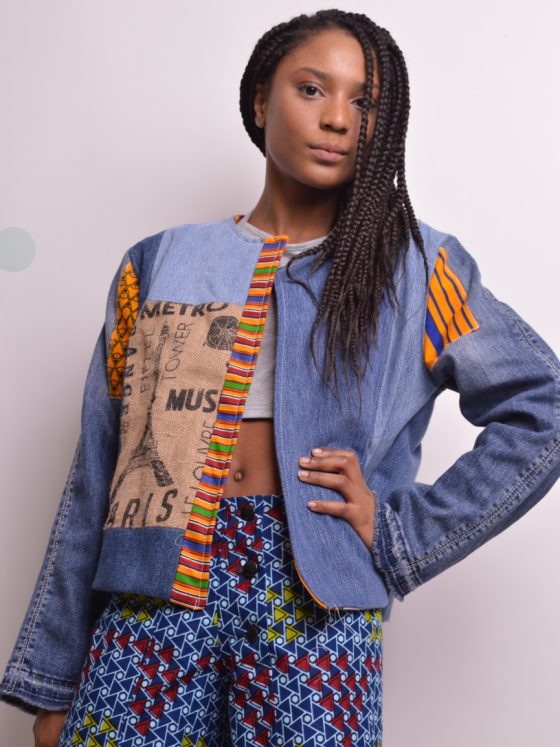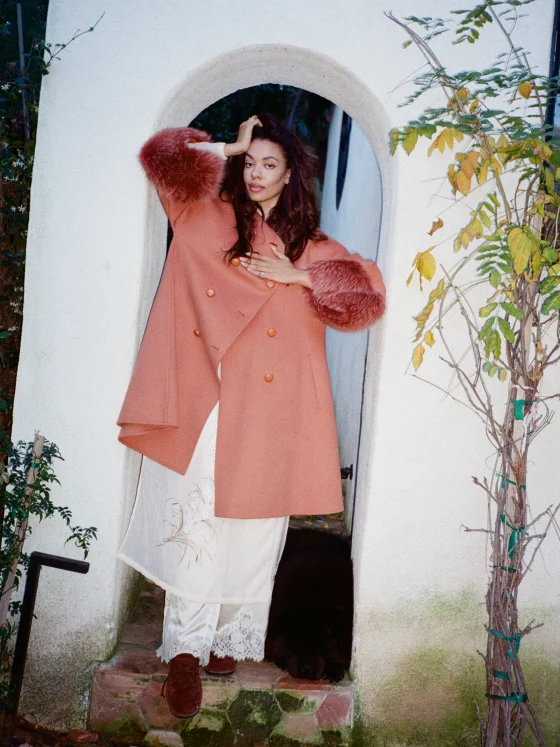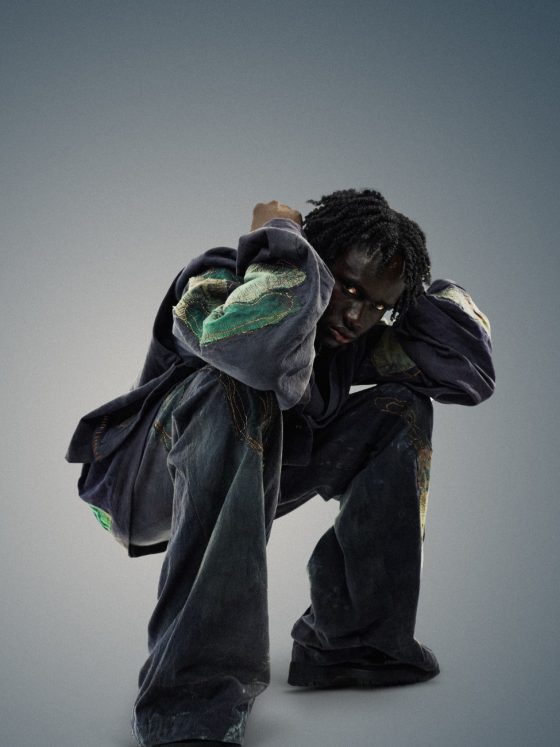
A full circle skirt supplies one of LABRUM London’s most revealing Spring/Summer 2027 examples. Its hand-embroidered scenes refer to the market stall once run by founder Foday Dumbuya’s grandmother in Sierra Leone. The garment brings two scales of attention together: the skirt’s expansive shape and the smaller incidents represented across its surface. WWD identifies the skirt and family reference; Vogue describes the collection’s grandmother-inspired embroidery as unusually rich and detailed. That combination points towards LABRUM’s distinctive proposition. The label brings narrative textiles into clothing whose broader forms remain comparatively direct. Its strongest devices do more than explain where an idea originated: they give the garment an identifiable surface. In SS27, embroidery, passport-derived pattern and textured tailoring establish different routes towards that identity. They also expose the challenge of a storytelling-led brand: a compelling source must become a convincing design, not merely an explanation attached to it.
Explore how Foday Dumbuya’s LABRUM London turns family history, passport motifs and expressive textiles into tailoring in its SS27 collection.
LABRUM in Brief
Founder and creative director Foday Dumbuya conceived LABRUM in 2014, according to the brand’s official account. His formative years span Sierra Leone, Cyprus and London. He identifies his family’s approach to dress (traditional tailoring combined with an African touch) as an early influence, alongside professional experience at companies including DKNY and Nike. LABRUM describes its purpose through diaspora stories, freedom of expression and the possibility of a borderless society. Its positioning is condensed into “Designed by an Immigrant”, but the official statement also makes a more practical promise: clothing rooted in simplicity, fit and attention to detail. That matters because it gives the work a standard beyond representation. The garments must offer something through their shape, textile and finish, whether or not a viewer knows the designer’s biography. The story provides context; the clothing must sustain the encounter.
LABRUM is an established independent practice, not a newly arrived discovery. Dumbuya received the Queen Elizabeth II Award for British Design in 2023, and the label won the 2026 BFC/GQ Designer Fashion Fund. Those milestones establish institutional recognition. They do not resolve the quality of a particular collection, but they make a closer examination of the design language more useful than another introductory celebration of the founder.
A Family Story Made Visible
The grandmother reference succeeds as a starting point because it names an activity, not simply an abstract idea of ancestry. A produce seller and her market stall supply the embroidery’s subject. The memory becomes scenes, then thread. On the circle skirt identified by WWD, the full garment provides a substantial surface for that treatment without requiring an equally complicated silhouette. The relationship between a direct shape and detailed imagery is central to the example. The skirt establishes an immediately legible garment category; the embroidery offers a second, closer level of attention. Its narrative is not dependent on an accompanying slogan. At the same time, the published descriptions do not establish every figure’s placement or identify the people who executed the stitching. Inspiration, design and making credit remain separate parts of the account.
This is a more precise use of family history than treating a founder’s background as a guarantee of authenticity. The grandmother’s work becomes a particular visual subject. The garment’s interest lies in what that translation produces: a surface that asks to be examined rather than a story that substitutes for looking. LABRUM’s broader identity becomes strongest when the specific reference gives the clothing something recognisable to do.
The Passport as a Signature
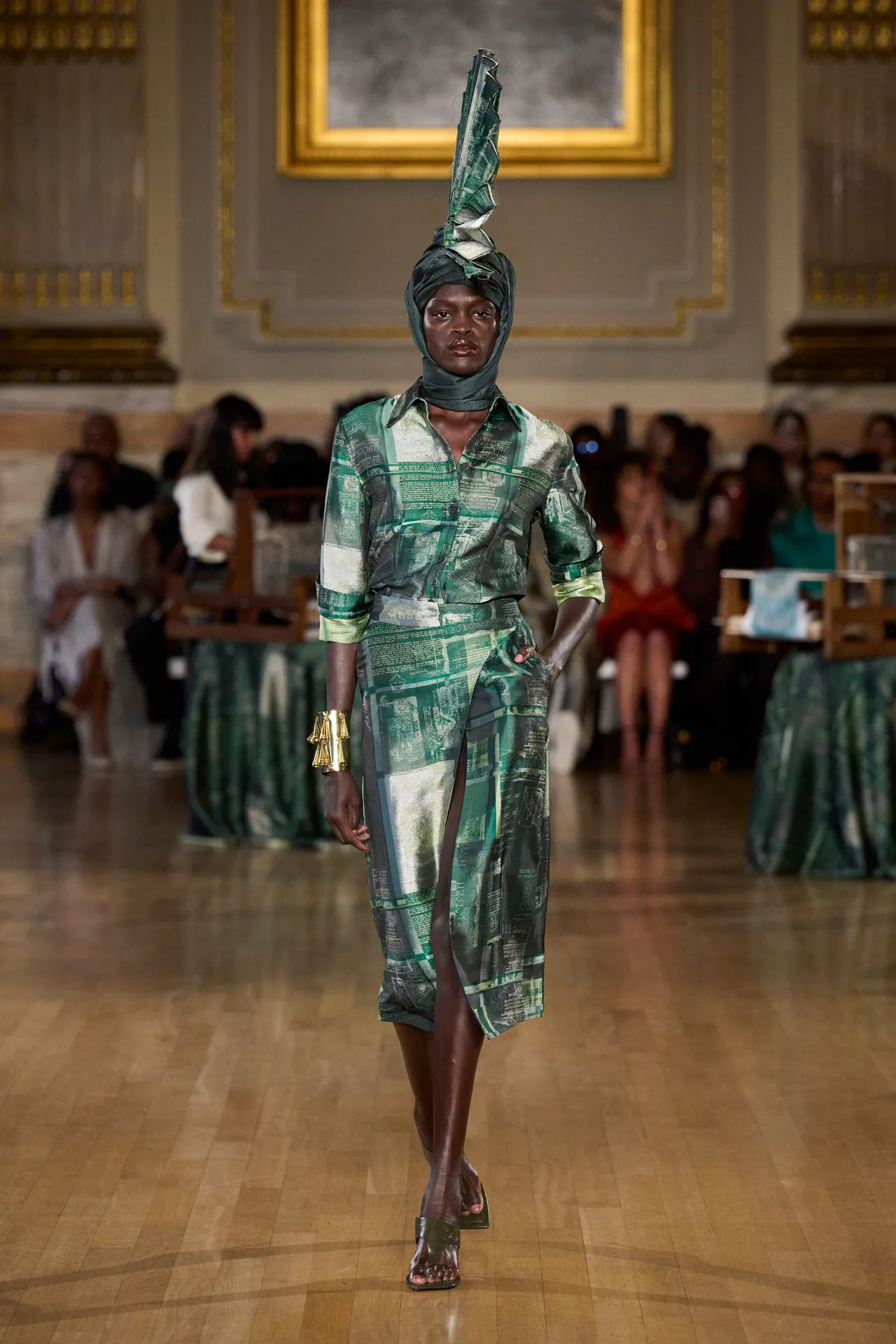
The passport motif works differently. WWD reports that destinations and dates from Dumbuya’s family passports feed the label’s now-signature jacquard. Unlike the embroidered market scenes, this device begins with records rather than an illustrated activity. Information associated with movement is reorganised as pattern, allowing it to recur across the brand’s clothing rather than remain tied to one narrative garment. Jacquard describes patterned fabric produced through controlled weaving; it is not simply another word for a printed graphic. The distinction matters to the article’s account of translation: the reported passport information enters a textile structure rather than remaining a document reproduced unchanged. The exact garment carrying the motif in the SS27 gallery still requires confirmation, so it should not be assigned to an individual runway image on appearance alone.
As a brand device, the motif has an advantage over a collection-specific illustration. It can build recognition through repetition. Its limitation is the same: recognition can become familiar without becoming more interesting. The useful question is how the pattern relates to the garment carrying it (its scale, placement and visual density), not simply whether its family source remains meaningful. The passport supplies the information; design determines what that information becomes.
Tailoring That Holds the Story Together
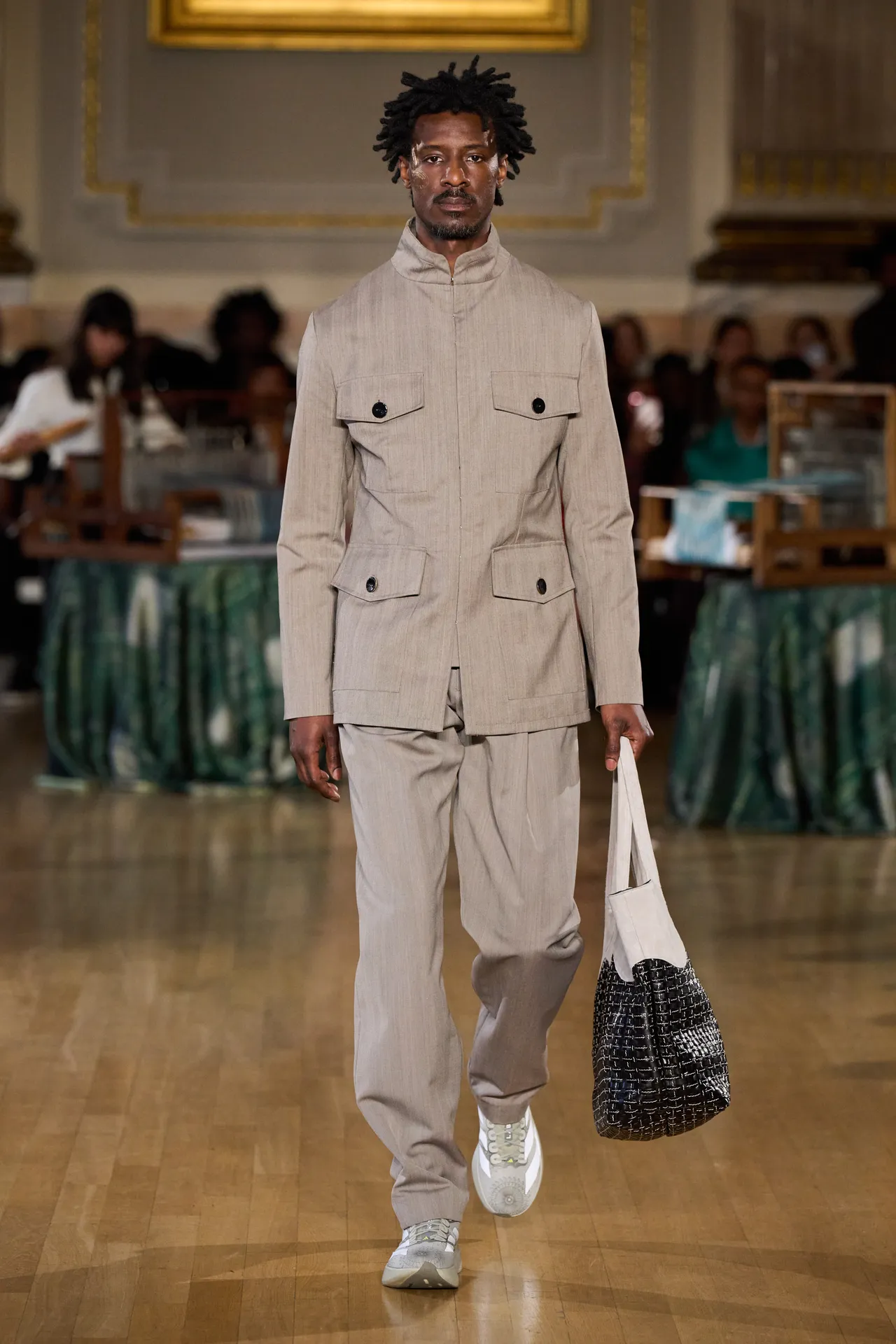
SS27’s tailoring offers a less literal route into the brand. WWD identifies a white suit in fil coupé with an oblong geometric motif. Vogue describes ample tailoring in a custom-developed ochre fil coupé and a pale, spongy bouclé. These accounts establish a collection whose identity is carried by textile structure as well as representational imagery. The fabrics are not interchangeable decorations: they offer different kinds of surfaces against which the cut is read. Fil coupé means “cut thread”. In the technique described by textile specialist James Dunlop, additional threads are woven into a pattern and subsequently cut, producing a textured edge or fringe. It can resemble embroidery, but it is woven. That distinction helps explain why the collection’s materials should not all be grouped under “embellishment”. A stitched scene and a patterned weave can both enrich a surface, but through different processes.
The tailoring’s contribution is to give those active surfaces an intelligible framework. WWD’s favourable assessment emphasises lightweight construction, easy proportions and an unfussy approach to dressier clothing. That is the most useful counterweight to LABRUM’s extensive references. A viewer should encounter a suit first as clothing, then discover the textile and its account. If understanding the source becomes the only reason to value the garment, the relationship has become unbalanced.
Colour Connects the Collection
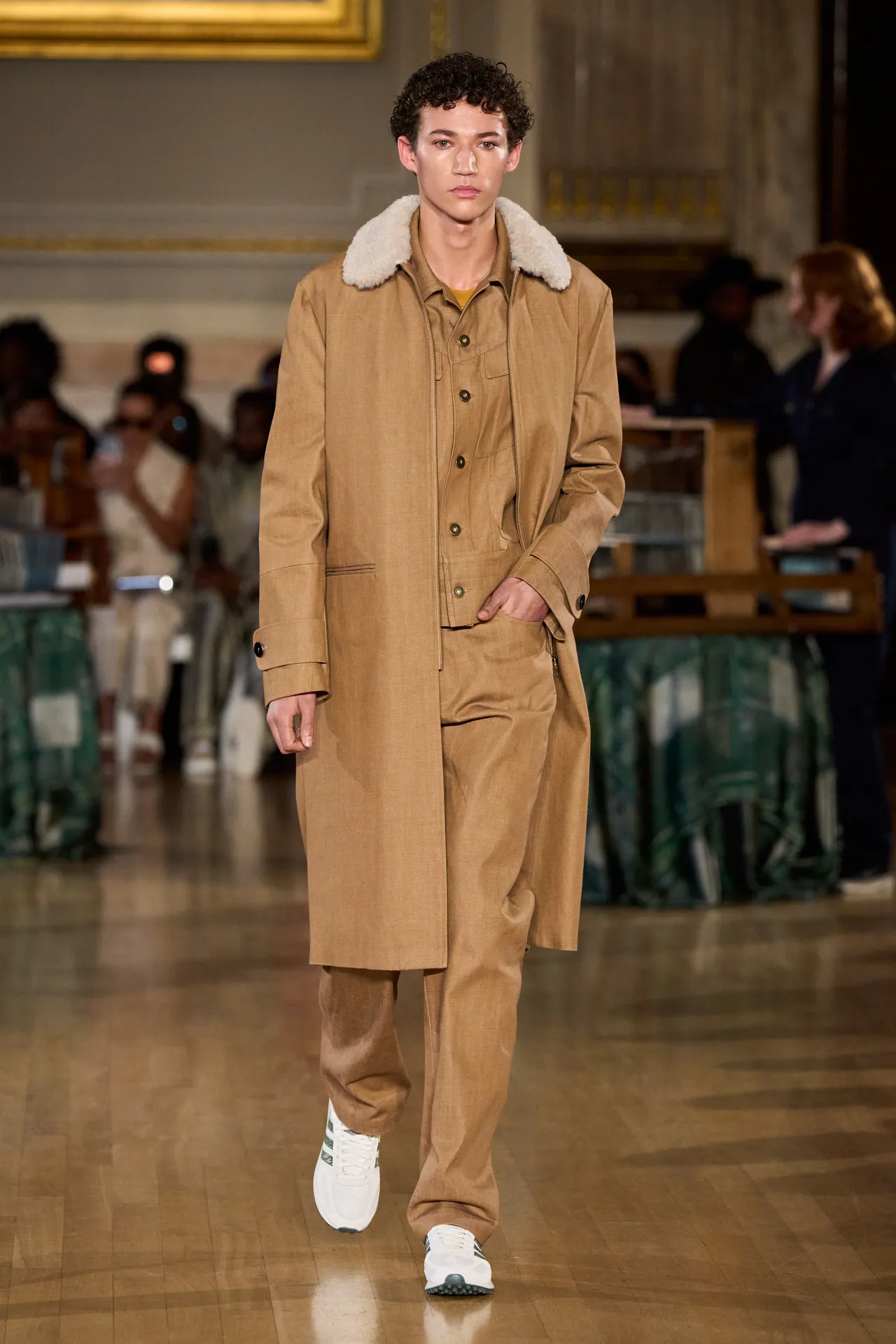
Colour supplies another form of continuity. Both reviews identify Jacob Lawrence as a source, with WWD naming The Shoemaker and The Seamstress. Its account describes saturated blues, yellows and wine tones; Vogue adds mossy greens and ochres punctuated by cobalt. The paintings’ subjects connect the palette with work and making, while the colours give the collection a visual relationship that does not depend on repeating the same motif. This is a quieter method of storytelling than the embroidered scenes. A colour need not depict a person or reproduce a document to contribute to the collection’s character. The source account adds another layer, but the palette can operate before the viewer learns it. That distinction is important to LABRUM’s range: not every reference needs to announce itself with equal explicitness.
Taken together, the examples make “heritage-inspired” an insufficient description. The collection draws from family testimony, documentary records, painting and textile development. What connects them is not a single decorative vocabulary but a repeated movement from source to surface. The tailoring then provides a comparatively stable structure around those changes.
What Makes LABRUM Recognisable?
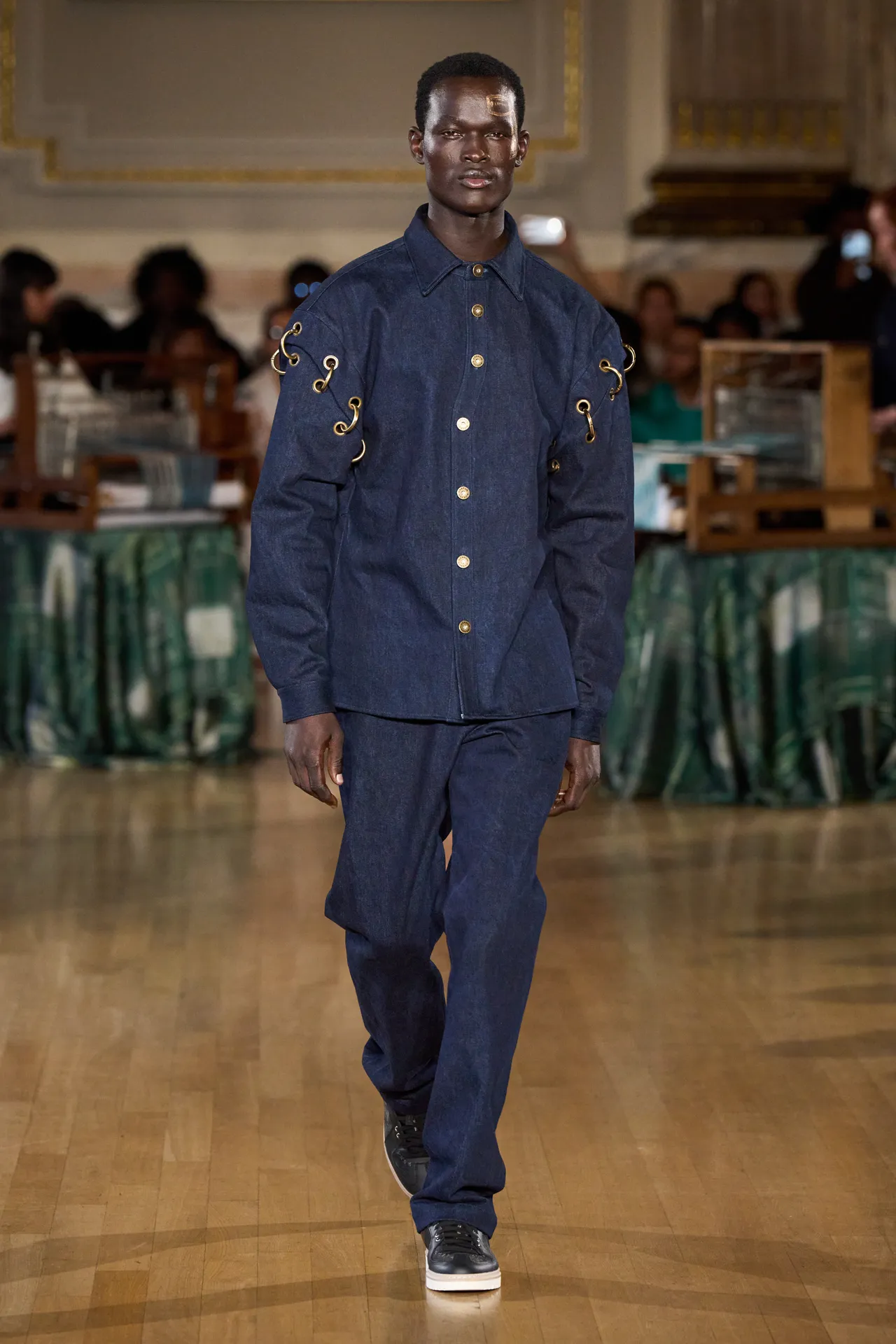
LABRUM’s most distinctive proposition is the relationship between narrative density and relatively straightforward clothing forms. The circle skirt carries scenes; the passport motif makes information repeatable; the tailoring gives textured cloth room to register. The brand does not need every garment to perform the same kind of storytelling. Its coherence lies in how consistently it treats the surface as a place where a reference can become material. That is also where the spotlight’s critical distinction belongs. The grandmother embroidery has the clearest reported connection between subject, technique and garment. The passport jacquard has the strongest stated claim to an established signature. The tailoring offers the broadest route into the collection for someone who does not know either story. These are different strengths, not interchangeable proof that the collection is meaningful.
SS27 is persuasive as an account of LABRUM’s design language, but the available evidence supports a more limited judgement about its progression. Vogue’s Mahoro Seward praises the collection’s technical accomplishment while questioning whether it advances the preceding season’s momentum; WWD responds more positively to its ease and elegance. Omiren need not settle that disagreement through borrowed conclusions. The firmer assessment is that LABRUM has an identifiable vocabulary whose next development must happen in the garments, not simply in the explanation of their references.
The Omiren Argument
The principle is translation. LABRUM becomes distinctive when a source changes form: work remembered as an embroidered scene, travel records reorganised as pattern, a painter’s palette brought into tailoring. Naming the reference matters, but the design contribution lies in what happens to it.
The label’s strongest proposition is not that its stories deserve attention before the clothes are judged. It is that those stories can produce clothes with an identity of their own. The standard remains specific: a recognisable textile, a convincing relationship between surface and shape, and enough design substance to reward looking before (and after) the explanation.
Also Read:
- Madam Wokie and LABRUM: Following the Textile Credits
- Afro-modernism in Fashion: The African Designers Defining a New Design Language
- African and Diaspora Fashion in London: Designers, Institutions and Community Style
- Sierra Leonean Designers Shaping the Future of African Fashion
Frequently Asked Questions
Who founded LABRUM London?
Foday Dumbuya founded it and serves as creative director. LABRUM’s official account dates the brand’s conception to 2014 and links its development to his formative years in Sierra Leone, Cyprus, and London. He also worked at companies including DKNY and Nike, and received the Queen Elizabeth II Award for British Design in 2023.
Which collection does this spotlight examine?
It focuses on Spring/Summer 2027 and was reviewed in September 2026. The collection concludes a three-part exploration of “osmosis”, which Dumbuya uses as an analogy for cultural exchange through the movement of people. The article reads the circle skirt embroidery, the passport jacquard, the fil coupé tailoring and the Jacob Lawrence-derived palette as different routes from source to surface.
What does “Designed by an Immigrant” express?
LABRUM uses the phrase within its stated commitment to diaspora stories, inclusion and freedom of expression. It identifies the brand’s position; it does not replace the need to examine the design and production information attached to individual garments. The official statement pairs it with a promise of simplicity, fit and attention to detail.
Are the runway pieces available to purchase?
This article does not establish that. Runway presentation does not confirm retail availability. Check current products, release dates, compositions and purchasing conditions on LABRUM’s official website and the relevant individual listings, rather than inferring from runway coverage or image galleries.