A pageant gown has to work with a person, not simply occupy a stage. That sounds straightforward until you consider everything it requires: the right colour for a specific skin tone, a silhouette that moves with the wearer, surface decoration that catches stage light without overwhelming the person beneath it, and a personality match that makes the whole thing feel like a natural extension of the woman wearing it. For the Jamaican designers behind Uzuri International, those are not abstract design values. They are the practical starting points for every commission they undertake.
“The factors that influence the design of the evening gown for the delegate include the skin tone and what colours will mesh, blend, or contrast with the skin tone. How the gown will perform on stage, how it will move, sparkle – all of those things. The personality of the delegate is also important.” ― Mark McDermoth, Jamaica Observer, 2022
That testimony, from the Jamaica Observer’s September 24, 2022 interview, gives the design practice a framework before a specific garment is considered. McDermoth is describing colour as relational, movement as a design variable and personality as part of the brief. Two documented looks from the house, Yendi Phillipps’s gown at Miss World 2007 and Davina Bennett’s yellow gown at Miss Universe 2017, offer two different points of reference for those principles. Neither case summarises the house’s entire output. Together they show how formal clothing acquires a public identity through design, wearing and subsequent commentary.
Explore Uzuri International through Yendi Phillipps’s 2007 gown, Davina Bennett’s 2017 yellow dress and verified testimony from its Jamaican designers.
The Designers Behind the House
Uzuri International is the umbrella company behind the house’s work. In the 2022 Observer interview, Karl Williams dates its incorporation to 1998. “It was in 1998 that we officially incorporated the Uzuri International company, which is the umbrella company,” he says. “More so now, we are trying to distinguish the fact that Karl Williams and Mark McDermoth are the designers.” That distinction matters when assigning credit across the house’s history. A company, a label, and the individual designers who created a specific garment are related but not interchangeable, and the sources for this spotlight credit selected gowns for the house rather than assigning undocumented responsibility to either partner individually.
The same report identifies Williams and McDermoth’s involvement in Miss Universe Jamaica. That organisational relationship helps explain the setting in which several of their designs have appeared, but it should be kept separate from questions of individual garment quality. Design attribution and pageant organisational responsibility are different, even when the same people hold both roles. Conflating them would not serve the garment credit or the historical account.
The 2022 interview adds to the picture by letting the designers articulate their practice. McDermoth’s testimony about colour, movement and personality is a design statement, not a promotional claim. It describes how they approach the brief before construction begins, the same starting point House of Clay’s Keisha Allen emphasises in her own account of Jamaican bridal work: understanding the person is the first design task. For Uzuri International, that principle has been tested before international audiences over two decades.
Yendi Phillipps, 2007: A Look Preserved Through Attribution

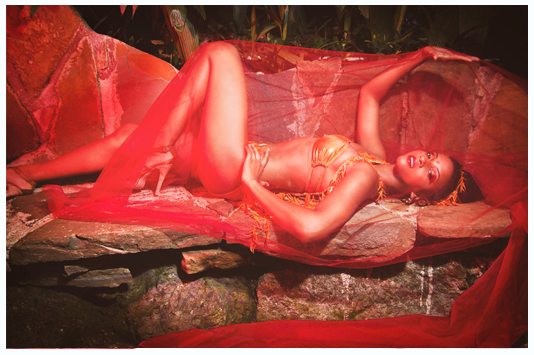
A Spartan Health Club retrospective identifies Phillipps’s 2007 Miss World gown as an Uzuri International design. Its caption explicitly links the pictured garment to that competition year, establishing a wearer, an occasion, and a house credit. That combination provides a historical anchor for the discussion rather than an unnamed example of Jamaican formalwear. The significance of documenting that attribution is easy to underestimate: many garments from Caribbean designers worn at international competitions remain uncredited in the public record, so verified credit is itself useful history.
A Jamaica Gleaner report dated June 8, 2008, describes the dress as covered in feathers and glitter. That account is available only as an indexed extract, not a fully retrieved article, so we can attribute the description but cannot reconstruct the silhouette, the placement of embellishment, or the construction method. The reading here is therefore a modest one: surface and decoration feature in the contemporary description, and the later retrospective preserves the design credit. Together those two pieces of evidence show how a gown’s public record can survive through different kinds of source material, each with its own limitations.
That limitation is also an editorial opportunity. A dress described in a 2008 newspaper report as covered in feathers and glitter tells you something about how it was received and what registered visually. It does not tell you everything about how it was constructed, how it moved, or what decisions went into placing decoration where it appeared. Keeping those gaps visible is more honest than filling them with garment specifications the available sources simply don’t provide.
Recognition Is Not the Same as a Pageant Award
The Spartan retrospective records that Global Beauties named the gown its most beautiful evening gown across international pageants for 2007. An indexed December 2008 Gleaner report adds an important precision: the recognition came through a public vote, not a best-gown award at Miss World itself. That distinction matters. A reader vote and a judging panel verdict are different things, and the historical account is stronger for keeping them separate.
The recognition belongs to the gown’s reception history rather than its competition result. It tells you that, across international pageants that year, many people found the Phillipps gown the most compelling evening dress they had seen. It does not explain why individual voters preferred it or what qualities they responded to. It does confirm, however, that the gown made an impression beyond the competition in which it was worn. That is a meaningful fact about a piece of Jamaican design, and it stands on its own without needing embellishment.
Davina Bennett, 2017: Colour and Multiple Points of Emphasis

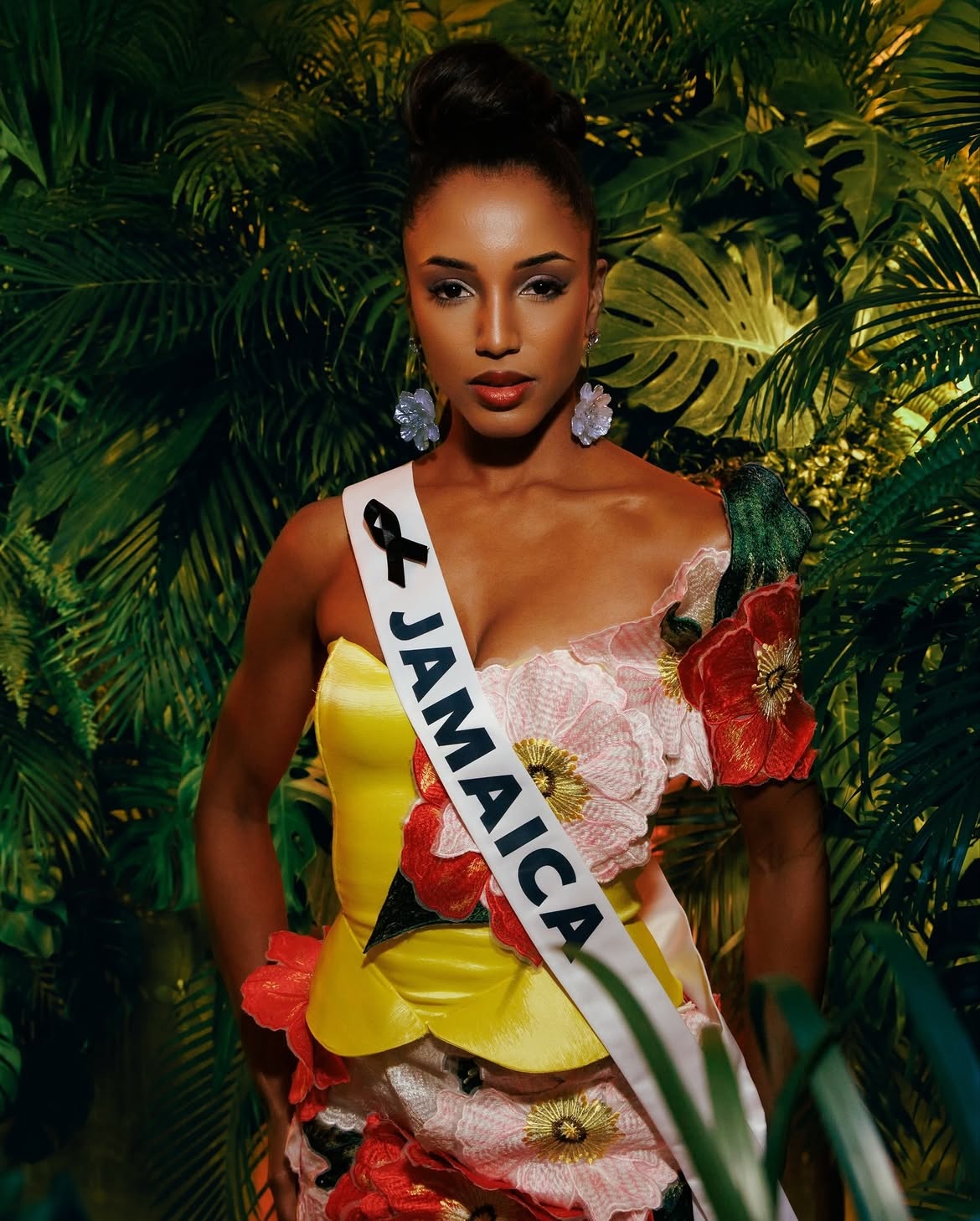
Bennett’s yellow gown at Miss Universe 2017 offers more descriptive evidence. In his November 28, 2017 review of the finals, designer and commentator Nick Verreos credits the dress to Uzuri International and describes sheer, iridescent fabric; oversized appliqués; back capes; and a bright yellow colour. Those are his observed features, not a manufacturer’s specification of fibre content or construction method, but they give the discussion considerably more to examine than the Phillipps account allows.
The yellow is worth pausing on before moving to the other elements. McDermoth’s 2022 testimony describes colour as something that must mesh, blend or contrast with the wearer’s skin tone. In that account, colour is relational and specific to the individual, not a general aesthetic preference. Bennett’s yellow, worn on an international stage and described by a working designer as the garment’s first point of visual impact, reflects the kind of colour choice McDermoth’s design philosophy describes as requiring careful thought. The available sources do not document that specific conversation, but they record the outcome.
The oversized appliqués and back capes add further points of emphasis. A gown with bright colour, surface decoration, and structural cape elements works in three different registers at once. Whether those elements reinforce each other or compete visually is exactly the question Verreos’s review addresses, and his answer is instructive without being simple.
Verreos also notes that Bennett retained the gown from the preliminary competition for the finals. That detail identifies the garment being discussed and gives the look continuity across two stages of the same event. It serves the historical record rather than evidence of a strategic calculation on the designers’ part.
A Critic’s Response, Not a Universal Verdict
Verreos’s assessment is notably mixed before it becomes approving. He considers the gown visually busy, then revises that reading when he accounts for how Bennett presents it. His account matters for this spotlight because it does not separate the garment from the person wearing it. The look is assessed as a combination, not as a dress photographed on a stand. At the same time, it remains one critic’s response during a live competition broadcast, and it should be understood in those terms.
A gown can have several assertive features without eliciting the same response from every viewer. Verreos’s revision of his initial impression illustrates how the relationship between garment and wearer changes the reading. His substantive observation that presentation shapes how a design is received connects directly to McDermoth’s point that personality is a design consideration. The designer builds it in; the wearer activates it.
What the Comparison Reveals

The two cases offer different depths of reading, and a useful comparison acknowledges that asymmetry rather than treating the archive as equally complete for both garments. Phillipps’s gown has a documented credit, a limited contemporary description and a recorded public response. Bennett’s has a critical account of several identifiable features and a designer’s revised assessment. Claiming the same level of detail for both would not accurately serve the history.
The two cases connect through the relationship between designed clothing and public presentation. In both cases, reception became part of the record: a reader vote in one case, a critic’s live commentary in the other. Neither replaces analysis of the garment itself, nor does either supply construction details that the available sources do not document. But both show how a garment’s life extends beyond the moment it is worn. It enters commentary, retrospective and attribution, and those layers become part of what we know about it.
The evidence most strongly supports the conclusion that presence matters more than guaranteed impact. McDermoth describes stage performance and the wearer’s personality as design considerations built into the process. The two selected records show how people discussed garments credited to Uzuri International in exactly those terms. That supports a focused spotlight on the house without claiming that two gowns define Jamaican fashion or that these two occasions exhaust what the designers have made over their careers.
Omiren Argument
Uzuri International’s work most usefully illustrates for Omiren’s coverage of Caribbean fashion and design that designing for a public occasion is a specific discipline, not just a more demanding version of designing for private wear. The stage, the audience, the body’s movement in a competition setting, and the relationship between colour and stage lighting are design variables that require deliberate thought. McDermoth names them explicitly, and the two gowns examined here are points at which those variables produced documented public responses.
For Omiren’s readers, Uzuri International also shows how a Jamaican design house can build a career across multiple decades, two international competitions, and an ongoing organisational role in national pageantry, while maintaining a coherent design philosophy the designers themselves articulate. The 2022 Jamaica Observer interview is the clearest public record of how Williams and McDermoth describe that philosophy. The two gowns are the best-documented examples of it in practice.
Omiren’s coverage of Jamaican fashion returns to one question: how Caribbean designers build and maintain a legible identity in international contexts. Uzuri International’s approach, designing from a specific understanding of the individual wearer and the stage she will occupy, answers that question. Its two decades of competition work show how consistently it has applied that approach.
Also Read:
- Jamaican Designers Building a Fashion Identity on Their Own Terms
- How House of Clay Structures a Bridal Consultation in Jamaica
- Caribbean Diaspora Designers on the Runway
FAQs
Who Are the Designers Behind Uzuri International?
The Jamaica Observer’s 2022 interview identifies Karl Williams and Mark McDermoth as the designers behind Uzuri International, the umbrella company Williams dates to its incorporation in 1998. The sources credit both selected gowns to the house rather than assigning documented responsibility for individual elements to either partner.
Which Gowns Are Examined Here?
The selection covers Yendi Phillipps’s gown from Miss World 2007 and Davina Bennett’s yellow gown from Miss Universe 2017. Published sources attribute both to Uzuri International. These are documented competition occasions. The article does not claim that both garments have equally detailed surviving specifications or that either exhausts what the house has produced.
Is this the same as Uzuri K&Y from Rwanda?
No. This article concerns Jamaica’s Uzuri International, founded and operated by Karl Williams and Mark McDermoth. It is a distinct business from Rwanda’s Uzuri K&Y. The shared name does not indicate a connection between the two houses.