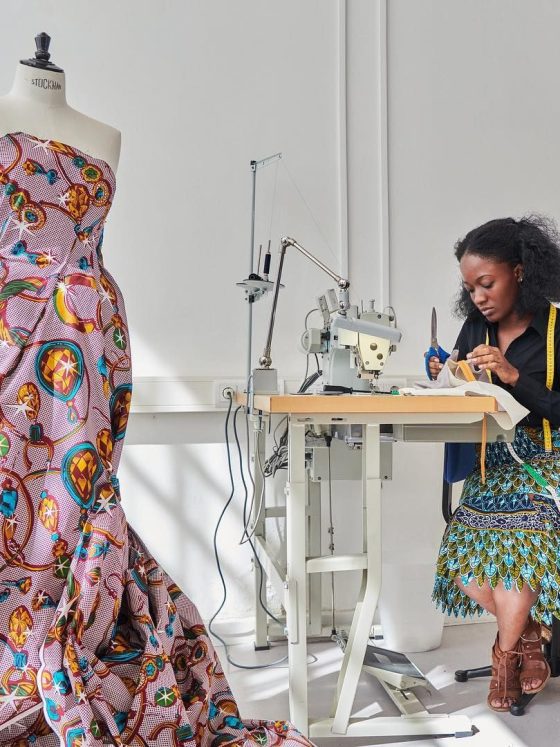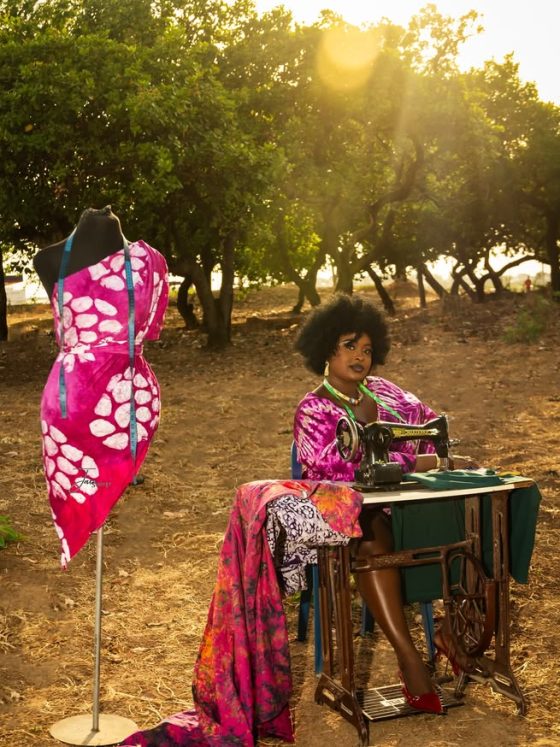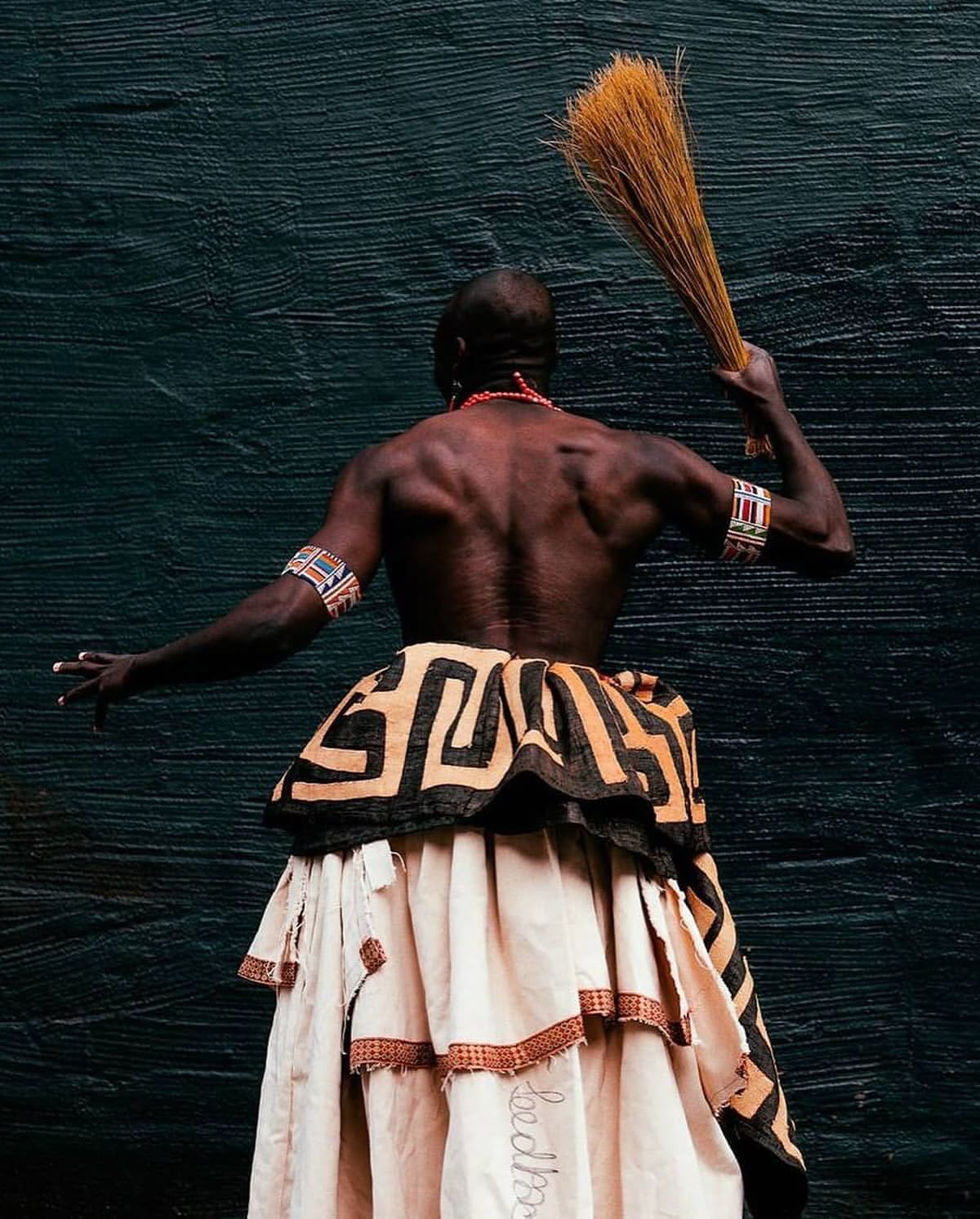
The mood board says Kuba-inspired print. The design brief says Kuba cloth pattern. The marketing copy says Kuba print fabric. Each of those phrases describes something that does not exist. Kuba cloth is not a print. It has never been a print. It is a woven raffia textile produced by the Kuba people of the Democratic Republic of Congo through a hand-weaving process in which men weave the base cloth, and women soften, dye, and embroider it with cut-pile and appliqué techniques developed over centuries. The geometric patterns that fashion treats as print motifs are not printed on the surface of Kuba cloth. They are built into its structure by hand, using a needle and cut raffia fibre, one loop and one cut at a time.
The African fashion market is worth 31 billion dollars. Kuba cloth is one of the most documented and most imitated African textiles in global design, and one of the most consistently misclassified. As Omiren Styles’ documentation of the global fashion industry’s engagement with African craft traditions confirms, the selection criterion that determines which African traditions global fashion returns to is the selection criterion that determines which traditions are most legible without deep cultural knowledge. Kuba cloth’s geometric vocabulary is visually striking and immediately translatable into print. That translatability is the source of both its global recognition and its systematic misrepresentation.
Fashion keeps calling Kuba cloth a print. It is not. Understanding what it actually is changes what designers are allowed to do with it and how they must credit it.
Kuba Cloth Is Not a Print: What the Textile Actually Is
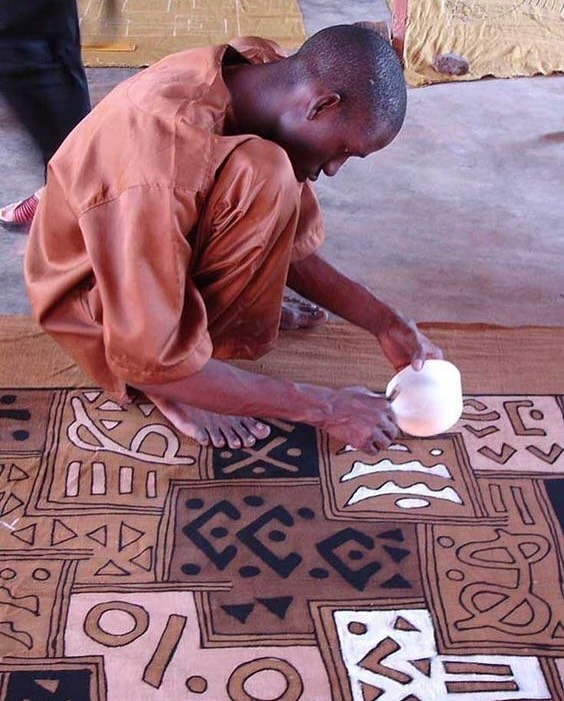
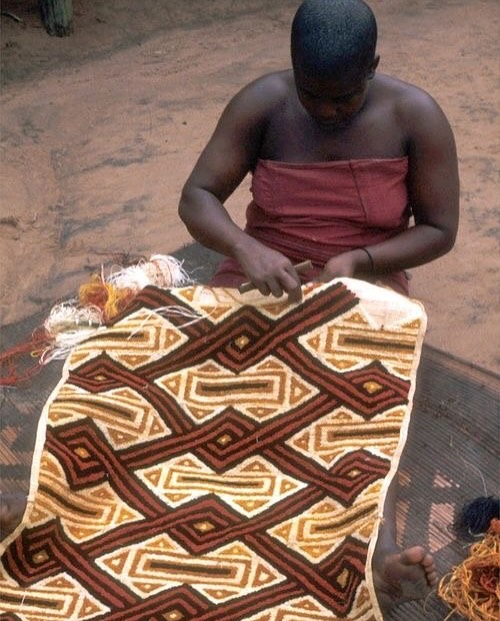
Kuba cloth is made from the leaf fibre of the Raphia vinifera palm tree. Unlike most natural textile fibres such as wool or cotton, raffia is not spun into thread. It must be softened and made flexible by hand before it can be woven. Men of the Kuba Confederation harvest and prepare the fibre, then weave it on a locally specific single-heddle loom set at a 45-degree angle. This position requires the weaver to work above head height throughout the weaving process. As the Victoria and Albert Museum’s documentation of the Kuba cloth collection confirms, Kuba is a cloth made from handwoven raffia palm fibres, often embroidered, dyed, appliquéd, or otherwise decorated with distinctive geometric patterns after weaving. The plain-weave raffia ground is typically filled with a complex pattern of interlocking angular motifs through a cut-pile technique: designs are first stitched onto the cloth before raffia fibre is drawn through with a needle and closely cut to create a dense pile, producing a plush, velvet-like effect.
The cut-pile process is the most consequential element for designers to understand. It is this technique, not printing, not dyeing, not screen application, that produces the visual surface most often referenced as a Kuba print. The geometric motifs exist in three dimensions. They are not flat. They are not applied to a substrate. They are raised above the base cloth by drawing raffia fibre through it with a needle and cutting the loops to create a velvet surface. The entire visual argument of Kuba cloth, its density of pattern, its textural contrast, its depth of field, is an artefact of this hand technique. A print of a Kuba pattern reproduces the geometry but strips away the craft dimension that gives it its authority.
Anything printed in a Kuba cloth fashion, digitally or otherwise, is not Kuba cloth. That sentence should end most design briefs that describe a fabric as Kuba-inspired print. The brief is describing something that does not exist. Kuba cloth is made. It is not printed.
The Three Techniques and Why Each Matters
Kuba textiles are produced through three major techniques, and designers who reference the tradition should be able to distinguish between them. As Craft Atlas’s documentation of Kuba textile techniques confirms, Kuba textiles are elaborate cloths made of raffia palm leaf fibre from the DRC, unique in their intricacy of design and surface decoration. Most textiles are variations on rectangular or square pieces of woven raffia enhanced by geometric designs executed in linear embroidery in flat-stitch and cut-pile stitching, the latter creating surfaces resembling velvet.
The cut-pile technique (Shoowa) produces the most widely recognised Kuba surface: the velvet-like geometric panels whose raised pile gives the cloth its depth and tactility. The appliqué technique attaches additional pieces of raffia cloth to the base to create pattern through layering. The embroidery technique creates flat-stitch geometric designs without the pile. Each technique produces a different visual and tactile result. Calling all of them a print conflates three distinct methods of making with the single most superficial way of reproducing the result of any of them.
Natural dyes complete the production. Black is produced from burnt banana plant leaves and mineral materials. Yellow comes from the Rubiaceae plant. Red comes from Camwood. These dyes are absorbed differently by the raffia fibre than by cotton or synthetic materials, which is one of the reasons that authentic Kuba cloth has a specific colour quality that industrially printed imitations cannot fully replicate. The colour is in the fibre, not on its surface.
What Matisse, Picasso, and Klee Understood That Fashion Has Forgotten
The modernist artists who engaged seriously with Kuba cloth understood it as a three-dimensional object. Henri Matisse kept pieces in his studio and described them as his velvets: a description that acknowledges the textile’s physical properties, the pile, the depth, the tactile density. Pablo Picasso and Paul Klee both engaged with Kuba geometry in ways that art historians have documented as influencing their approaches to abstraction. These artists recognised not a print to be reproduced. It was a visual system built through a specific material process, and the geometry derived its authority from that process.
Fashion has systematically forgotten what the modernists understood. When a design team references Kuba cloth through a digital print, it is doing something these artists would have recognised as a category error: reproducing the visual output of a process without engaging with the process itself. As Meekono’s documentation of Kuba cloth for design applications confirms, the beauty of Kuba cloth has long been a source of fascination worldwide, its influence visible even in the most avant-garde art of the 20th century. What made it worth engaging with was not the geometry in isolation but the geometry as an expression of a specific material intelligence. A print does not transmit material intelligence. It transmits appearance.
The Naming Problem
The textile is known by several overlapping names in the international market, each with varying degrees of precision. Kuba cloth broadly refers to textiles produced by the Kuba Confederation of ethnic groups, including the Bushoong, Shoowa, Ngongo, Kete, and Ngeende peoples of the DRC. Shoowa textiles refer specifically to the geometric cut-pile panels associated with the Shoowa ethnic group. Kasaï Velvet, or Kasaï Velours, refers to both the geographical region and the velvety texture. However, the name is technically imprecise as production extends beyond both the Kasaï region and the Shoowa sub-group. Raffia velvet is a descriptive term for the cut-pile variety.
None of these names is equivalent to a print. Yet the international market routinely sells printed cotton described as Kuba cloth, Kuba print, or Kuba-inspired fabric. These products are not Kuba cloth. They are imitations of the visual surface of Kuba cloth, produced through a process that has nothing to do with the Kuba Kingdom, raffia, or the hand techniques that created the geometry being reproduced. The ethical and commercial consequences of that substitution fall on the Kuba communities whose work is being reproduced without credit or compensation.
What Some Symbols Still Mean
The cultural stakes of misclassifying Kuba cloth are not only commercial. Some Kuba patterns are restricted in their cultural use. As Omiren Styles’ buyer’s guide to authentic Kuba cloth confirms, some Kuba cloth patterns are restricted in their use within Kuba society. Certain symbols are still permitted only on royal clothing, and violations of these restrictions within Kuba communities carry social and legal consequences. A designer who deploys a restricted-symbol Kuba pattern as a print motif on a commercially available garment or interior product is not subject to Kuba law, but they are making a cultural decision. Making it with knowledge of its significance is the minimum standard of respect.
The restricted-symbol dimension also illustrates why calling Kuba cloth a print is not merely technically incorrect. It is culturally illiterate. A print is a neutral reproduction of an image. A Kuba pattern may be a document of social hierarchy, a ceremonial marker, a record of political relationship, or a symbol restricted to royal use. Treating it as a decorative print removes the social system it encodes. The pattern remains. The meaning is stripped. The community whose cultural intelligence produced the pattern receives neither acknowledgement nor benefit.
What Designers Should Actually Do
The correct response to Kuba cloth is not to avoid it. It is to engage with it precisely. A designer who wants to reference Kuba textile tradition should understand the production process well enough to explain it. They should be able to distinguish among the Shoowa cut-pile, appliqué, and embroidery traditions. They should know that the geometry is three-dimensional and cannot be accurately reproduced in two-dimensional print without losing the material argument that makes the pattern significant.
They should credit the Kuba Kingdom and the DRC in any public presentation that references them. They should research whether their specific pattern reference has known cultural restrictions. They should consider whether their design creates any economic relationship with the Kuba communities whose visual intelligence they draw from, and, if not, they should explain why not. And they should stop writing mood boards and design briefs that describe Kuba cloth as a print, because that description tells anyone who reads it that the designer has not done the research their reference requires.
The Omiren Argument
Kuba cloth is not a print. The African fashion market is worth 31 billion dollars. The Kuba textile tradition of the Democratic Republic of Congo is one of the most technically sophisticated handcraft textile systems in the world: handwoven raffia palm fibre softened and made workable by hand, embroidered with cut-pile technique using a needle and natural dyes from burnt banana leaves, Rubiaceae plant, and Camwood, producing a three-dimensional geometric surface that no print process can replicate. Henri Matisse kept pieces in his studio and called them his velvets. Pablo Picasso and Paul Klee engaged with geometry in ways that have been documented as influencing twentieth-century abstraction. What these artists understood was not a print reference. It was a material intelligence that had to be engaged with on its own terms.
Fashion’s persistent misclassification of Kuba cloth as a print is not a minor terminological error. It is the mechanism through which a handcraft tradition is converted into a decorative resource without credit, without compensation, and without the cultural knowledge that would make the reference serious rather than superficial. Some Kuba patterns carry royal restrictions. All Kuba patterns carry the signature of a specific production process whose labour and knowledge belong to the Kuba communities of the DRC. Designers who reference Kuba cloth as a print are not referencing Kuba cloth. They are reproducing the appearance of its surface while discarding the material and cultural system that produced it. That is not inspiration. Omiren Styles names it correctly: it is extraction from a tradition that has no mechanism to stop the taking and receives no share of the commercial value generated by its reproduction.
Also Read:
- African Textile Museums: Preserving Memory in an Age of Fast Fashion
- Akwete, Kuba Cloth, Barkcloth, and Kete: The Sacred Textiles the World Is Finally Discovering
- African Textile Glossary: 20 Terms Fashion Keeps Getting Wrong
- Bogolan Is Not Mud Cloth: Why the Name Matters and Who Benefits From Getting It Wrong
Frequently Asked Questions
What is Kuba cloth?
Kuba cloth is a handwoven textile made from raffia palm fibre by the Kuba Confederation of ethnic groups in the Democratic Republic of Congo, including the Bushoong, Shoowa, Ngongo, Kete, and Ngeende peoples. The fibre is peeled from the leaves of the Raphia vinifera palm tree, softened by hand, and woven by men on a single-heddle loom set at a 45-degree angle. Women then decorate the woven base cloth through cut-pile embroidery, appliqué, or flat-stitch embroidery techniques to create geometric patterns. The cut-pile technique, which draws raffia fibre through the cloth with a needle and cuts it to create a plush, velvet-like surface, is the most widely recognised variety.
Why is Kuba cloth not a print?
Kuba cloth’s geometric patterns are not applied to a fabric surface through any printing process. They are built into the cloth’s structure through hand techniques: cut-pile embroidery draws raffia fibre through a woven base and cuts the loops to create raised geometric motifs in three dimensions. The pattern exists in the cloth’s physical structure. A print reproduces the visual appearance of that structure on a flat surface without the raised pile, without the raffia fibre, and without the hand process that produced the original. Anything described as a Kuba print or Kuba cloth pattern fabric is an imitation of Kuba cloth’s visual surface, not Kuba cloth.
How is Kuba cloth made?
Kuba cloth production begins with harvesting the leaf fibre of the Raphia vinifera palm tree. The fibre is softened and made flexible by hand or with tools before being woven by men on a locally specific single-heddle inclined loom. The woven base cloth panels typically measure 30x60cm to 50x100cm and are joined to create larger cloths. Women then soften the woven cloth further by dampening, kneading, and beating it. Natural dyes are prepared from local plant materials: black from burnt banana leaves and minerals, yellow from the Rubiaceae plant, red from Camwood. The cloth is then decorated with cut-pile embroidery, appliqué, or flat-stitch embroidery.
What should designers know before referencing Kuba cloth?
Designers should know that Kuba cloth is a three-dimensional woven and embroidered textile, not a print, and that reproducing its geometric patterns as a flat print misrepresents both the textile and the tradition. They should understand the three main production techniques: cut-pile (Shoowa), appliqué, and embroidery. They should know that some Kuba patterns carry cultural restrictions, with certain symbols restricted to royal use within Kuba society. They should credit the Kuba Kingdom and DRC in any public reference. They should source authentic pieces through specialist dealers rather than mass-market platforms, and they should consider whether their reference creates any economic relationship with the Kuba communities whose visual intelligence they are drawing from.
What is the difference between Shoowa cloth, Kasaï Velvet, and Kuba cloth?
Kuba cloth is the broad term for raffia textiles produced by the Kuba Confederation, an ethnic group in the DRC. Shoowa textiles refer specifically to geometric cut-pile panels associated with the Shoowa sub-group of the Kuba Confederation. Kasaï Velvet, or Kasaï Velours, is a descriptive term for the cut-pile variety, referencing the region and its velvet-like texture. However, it is technically imprecise, as production extends beyond both the Kasaï region and the Shoowa sub-group. All three terms refer to aspects of the same handcraft textile tradition. None of them describes a print.
Explore More
Read the full Fashion > Opinion section for Omiren Styles’ documented editorial positions on how fashion should engage with African textile traditions, with the cultural precision those traditions require and the communities that produced them deserve.