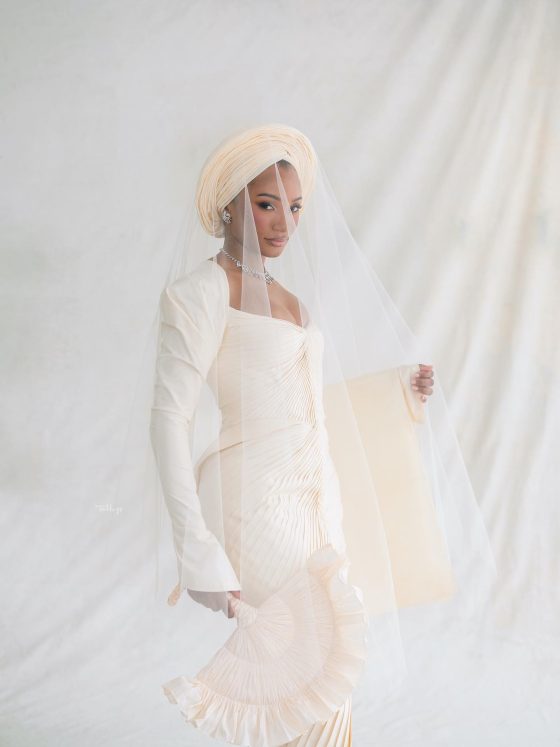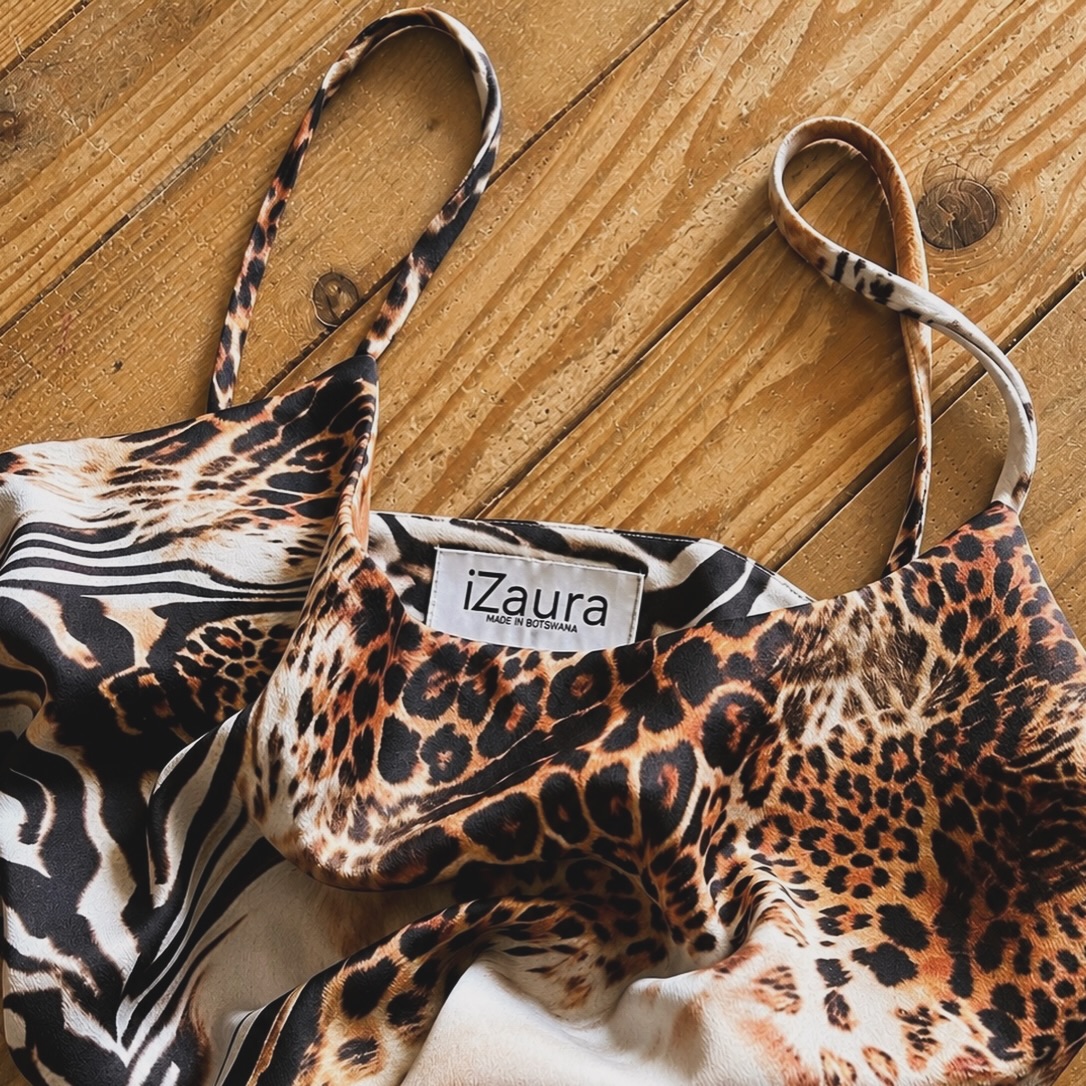
Mothusi Lesolle described the headgear as a queen’s crown, made with beads from Quazi Design. That detail gives the collaboration a more specific role than the broad description “dress and accessories” suggests. The beadwork was part of the element intended to complete the figure’s royal identity, while a shield-shaped corset supplied the corresponding reference at the torso. The look paired iZaura’s white linen gown with Quazi Design’s recycled-paper bead accessories for the Commonwealth Fashion Exchange. It was unveiled at Buckingham Palace on 19 February 2018; the exhibition record also identifies a final display at the Australian High Commission in London on 22 February. These dated appearances establish a completed historical look, distinct from the sketch and workshop material included in the same digital exhibition.
The design is most usefully approached through those relationships: garment and accessory, contained silhouette and added flare, protection and authority. Its published symbolism also contains a less comfortable relationship. Lesolle criticised unequal expectations placed on women while choosing white to signify purity. The look’s interest lies partly in that unresolved tension, not simply in declaring it an expression of empowerment.
A study of iZaura and Quazi Design’s 2018 Commonwealth Fashion Exchange look, connecting its linen gown, shield-shaped corset and paper-bead accessories.
Begin with the Garment’s Structure
In his pre-presentation interview, Lesolle described the gown as entirely linen and its silhouette as “a mermaid shape with a flared top skirt”. He also identified a structured corset shaped like a shield. These are three distinct parts of his explanation: an underlying silhouette, an additional area of flare and a structured treatment of the torso. The description proposes a contrast between containment and expansion rather than one uninterrupted volume. A mermaid form and an added flared skirt do not make the same contribution. Their relationship is the key design question, although the published interview does not specify where each volume change begins or how the layers are assembled.
Lesolle connected that silhouette with an ambition to celebrate both smaller and curvier women, particularly bodies he felt society did not readily celebrate. That explains his intention. It does not establish an inclusive size range or demonstrate how this single exhibition garment fitted different wearers. The distinction keeps the discussion attached to one object rather than turning a stated aspiration into a proven result.
The Shield and Crown Form a Pair
The corset’s meaning is unusually explicit in Lesolle’s account. He associated its shield shape with the protection a royal mother gives her kingdom. The headgear then completed the queen reference. His explanation therefore distributes the idea across the torso and head rather than attaching it to one isolated decorative motif. That is the most coherent relationship in the documented proposal. The corset and headgear are assigned complementary roles: protection and authority. It is more precise than describing the gown as powerful without identifying where that language enters the design. The reference nevertheless remains Lesolle’s interpretation. His interview makes a broad association between shields and African nations; the article need not extend that into a universal account of African symbolism. For this particular look, the defensible finding is narrower: the designer named a shield-shaped structure and a crown-like headpiece as connected parts of his concept.
What Quazi’s Contribution Changes

The Commonwealth Fashion Council identifies Lesolle with iZaura and describes Quazi Design as the artisan collaborator. Its account names Doron Shaltiel as Quazi’s managing director and explains the company’s transformation of discarded magazine pages into beads and jewellery. It concludes that Quazi’s accessories completed iZaura’s look. Lesolle’s interview provides a more particular connection: he describes creating the headgear with Quazi’s beads. That establishes a contribution within the crown concept without proving who assembled every part of the finished headpiece. The account credits Quazi’s beadwork while leaving individual operations undocumented and unassigned.
The collaboration consequently changes more than the list of names attached to the gown. It introduces a second material practice into a component central to the stated design. Paper beadwork is not merely placed beside the royal reference; it participates in making that reference possible.
Linen and Paper Have Different Responsibilities
The exhibition gives the white linen and coloured beads different symbolic tasks. White represents purity. Red recycled-paper beads are associated with HIV/AIDS awareness. Black beads are described as signifying cultural power and paying tribute to women’s power. These meanings belong to the exhibition’s explanation of this collaboration, not to every occurrence of white cloth or coloured beadwork. The materials also occupy different positions in the account. Linen supplies the gown; paper is transformed into the beads used for accessories. The contrast matters because the look does not rely on one surface treatment to communicate everything. Garment form, material and bead colour carry different parts of the proposal.
A complete visual judgement would still need to establish the accessories’ exact scale and placement in the final ensemble. The documentation supports their contribution and stated meanings, but it does not justify inventing how prominently every bead registers against the gown. The symbolic account is specific; the visual effect requires its own evidence.
Purity and Empowerment Do Not Resolve Neatly
The tension around purity appears in Lesolle’s own interview, not only between his account and the exhibition text. He identifies himself as a feminist concerned with women’s empowerment and education. He criticises body shaming and the unequal scrutiny of women’s sexual histories, including virginity testing. He also says he chose white to signify purity. The exhibition repeats the purity association and describes it as an expectation of young women in Swaziland, the country name used in the historical record. Neither source fully explains whether the look intends to affirm, reclaim or challenge that expectation.
That ambiguity should remain visible. It would be too easy to turn the gown into an uncomplicated declaration of liberation, just as it would be too simple to dismiss the whole collaboration as contradictory. The more productive reading is that its language of protection and authority sits beside a purity ideal whose relationship with the designer’s critique remains unresolved.
Recycled Paper Is a Material Fact
Quazi’s use of discarded magazines is documented through the exhibition’s account of bead-making and workshop activity. Printed pages become small objects that can be assembled into jewellery and incorporated into a larger dressed proposal. This is a material transformation with a defined contribution to the look. Its significance does not depend on a claim that the resulting accessory is environmentally superior in every respect. The available sources provide no comparative footprint, durability test or measured reduction in resource use for this ensemble. Nor does the historical account establish Quazi’s current staffing or employment arrangements.
The stronger design discussion stays with what the contribution makes possible. A material associated with printed information becomes beadwork; that beadwork enters accessories and headgear; those elements carry part of the look’s stated meaning. The origin is relevant, but it should not exempt the resulting design from assessment.
Read the Completed Look Without Erasing Its Development

The exhibition contains a sketch, workshop material and images explicitly labelled as final displays. These are different kinds of evidence. A sketch records a proposal; a workshop image records a stage or activity; an exhibition photograph records a particular presentation of the completed ensemble. Lesolle’s February interview belongs to that development history. It describes a gown already sent to England while also using future-facing language about adornment and presentation. The subsequent exhibition record confirms the collaboration’s appearance, but it should not be used to assume that every proposed detail survived unchanged without checking the final views.
Keeping those records distinct gives the object a clearer history. It avoids treating the designer’s description as a substitute for the finished work while also preserving the explanation of why particular choices mattered to him.
Where the Collaboration Is Most Convincing
The strongest documented connection is between the shield-shaped corset and the beadwork headgear. Both participate in the royal-mother concept, and the headgear places Quazi’s contribution within that concept rather than outside it. The accessory credit therefore has a substantive design consequence. The account is less resolved where several broad ambitions accumulate around one garment: body acceptance, education, public-health awareness, purity and women’s authority. Each has a place in the published explanation, but their presence does not prove that they become equally legible in the completed look. The most defensible judgement is therefore specific. This collaboration offers a connected proposition through garment structure and beadwork, with a particularly clear relationship between torso and headgear. Its symbolic language is more uneven: protection and authority reinforce one another, while purity remains in tension with the critique of unequal expectations placed on women.
The Omiren Argument
The principle is contribution. A collaboration is not fully explained by placing two names beneath a finished look. The account should establish what each contribution changes.
Here, Quazi’s beadwork participates in the headgear and carries colour-specific meanings within iZaura’s broader proposal. That is more substantial than decorative acknowledgement.
The same scrutiny applies to symbolism. A precise explanation establishes intention; it does not automatically establish visual success. The look deserves credit for its connected design proposition while leaving its unresolved meanings open to examination.
Also Read:
- Botswana Men’s Beadwork Accessories and What They Signal
- Botswana’s Tswana Beadwork Cooperatives and the Push Into Export Markets
- The High-End Bead Revolution: Redefining Luxury Accessories
- Maasai Beadwork: Meaning, Symbolism, and the Language of Identity
Frequently Asked Questions
When was the look presented?
The exhibition records its unveiling at Buckingham Palace on 19 February 2018 and a final display at the Australian High Commission in London on 22 February. These dated appearances establish a completed historical look, distinct from the sketch and workshop material included in the same digital exhibition.
What did each collaborator contribute?
The sources connect iZaura, through Mothusi Lesolle, with the gown’s design and Quazi Design with the recycled-paper bead accessories. Lesolle specifically identifies Quazi beads in the headgear. The records do not allocate every making operation to a named individual, so the credit stays with the two collaborators.
What materials are established?
White linen is documented for the gown, alongside recycled-paper beads in the accessories, which Quazi Design makes from discarded magazine pages. Lesolle describes the gown as entirely linen. The sources do not provide a complete specification for every internal component, so the corset’s construction is documented only as shield-shaped.
What do the colours in the look mean?
The exhibition assigns different symbolic roles to the materials. White linen represents purity, red recycled-paper beads are associated with HIV/AIDS awareness, and black beads signify cultural power and pay tribute to women’s power. These meanings belong to this collaboration’s explanation, not to every use of white cloth or coloured beadwork.