The African fashion market is worth 31 billion dollars. Within that market, many of the most culturally grounded adornment traditions remain underdocumented because the communities that produced them were not centred in colonial scholarship, museum acquisition, or international fashion coverage. Botswana men’s beadwork is one of those traditions. Its history is older than most fashion systems currently considered significant. As Brighton Museum’s documentation of its Botswana beadwork collection confirms, while ostrich eggshells have been made into beads for thousands of years in southern Africa, the specific styles, social functions, and cultural encoding of Botswana beadwork vary across the country’s Xhosa, Kalanga, Tswana, and San communities, with the mixing of cultural influences itself part of Botswana’s and Southern Africa’s material history.
What Botswana men’s beadwork accessories signal depends on context. The important point is not that there is one universal men’s beadwork code across this diverse country. It is that beadwork has long communicated identity, community membership, ceremonial participation, and social connection in community-specific ways, through necklaces, bracelets, wristbands, belts, and decorated leather garments and hunting equipment, and that this tradition deserves more sustained attention than it has received.
Botswana men’s beadwork is older than most fashion systems. It has been signalling identity, community, and life stage for tens of thousands of years. Here is what it says.
Botswana Men’s Beadwork Accessories: A History Older Than Writing
Botswana occupies a significant place in the history of personal adornment across southern Africa. As the peer-reviewed journal documentation of Botswana beadwork traditions confirms, ostrich eggshell beads have been produced and exchanged across southern Africa for tens of thousands of years, with the region containing numerous Later Stone Age and Iron Age sites where bead production has been archaeologically documented. The traditions are among the oldest known forms of personal ornamentation anywhere in the world, with evidence extending more than 40,000 years.
These beads were not purely decorative. They were part of broader material systems that linked people through exchange, social relationships, and shared cultural practice. San communities across what is now Botswana, Namibia, South Africa, and Zimbabwe maintained the hxaro gift-exchange network, in which ostrich eggshell beads functioned as vehicles of long-distance social relationships: given between communities to establish and maintain trust, sustain alliances, and navigate the challenges of semi-nomadic life in the Kalahari. The bead was both object and infrastructure.
Among San communities, beads were not only worn. They were given. The hxaro gift-exchange system used ostrich eggshell beads to establish and maintain long-distance social networks, turning adornment into a mechanism of relationship and trust that operated across the Kalahari for thousands of years.
What Botswana Men’s Beaded Accessories Historically Included
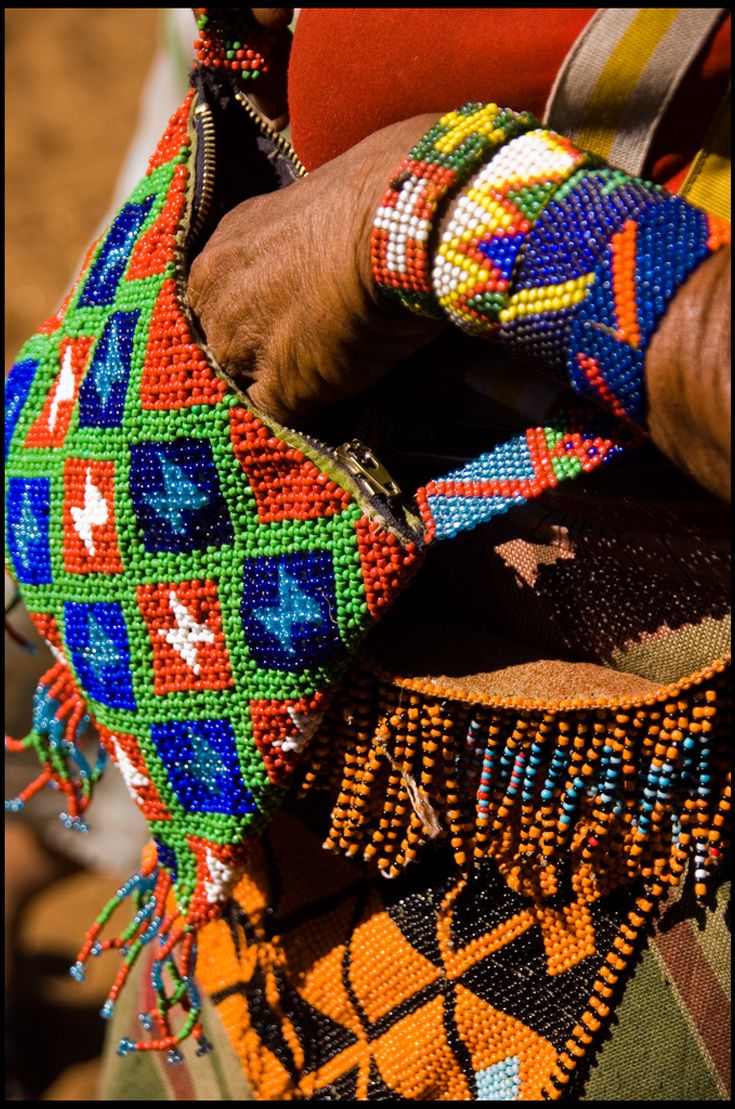
Documentation varies by community and period, but historical and ethnographic evidence points to several forms of male adornment across Botswana’s diverse peoples. The Tswana, San, Kalanga, and Kgalagadi communities each maintained distinct dress traditions, with men wearing beaded necklaces during ceremonies and cultural events, wristbands and bracelets as decorative and ceremonial accessories, and bead-decorated leather bags, straps, and equipment associated with hunting and daily life. Brighton Museum’s documentation of the Willoughby Botswana collection confirms that beadwork styles associated with different cultural groups circulated and mixed across Botswana, with objects showing Xhosa, Kalanga, and Tswana influence on the same piece, demonstrating that the historical record of Botswana beadwork is one of sustained cultural exchange.
Among the San, where documentation is most detailed, both men and women wore ostrich eggshell beads strung as necklaces or girdles, sewn into narrow fabrics for head-ornaments, or sewn onto clothing and bags. Leather bags used for gathering and hunting were highly decorated with ostrich eggshell beads, making the object an adornment as well as a functional tool. Men’s participation in this beaded material culture was as embedded as women’s, even when the specific forms differed.
Kgalagadi communities, who inhabit the Kalahari Desert region, wore beadwork, leatherwork, and ostrich eggshell jewellery as common decorative elements embellishing traditional attire adapted to their arid environment. The Tswana tshila, the traditional sleeveless top for men, was paired with accessories including ditlhake, brass or copper bracelets. The principle across these communities was consistent: adornment communicated social information, and that communication was expected of men as much as of women, though the specific objects differed.
What the Accessories Signal
Unlike contemporary fashion accessories, which often communicate aesthetic preference or brand affiliation, traditional Botswana beadwork communicated social information. Depending on community and context, men’s beaded accessories could signal cultural identity, participation in ceremonies, family relationships, social connections, community belonging, respect for tradition, and life stage. Researchers caution against assigning universal meanings to individual colours or patterns because symbolism differs between Botswana’s communities. What a particular combination of colours means among the San of the Kalahari is not necessarily what it means among the Tswana of the eastern districts. Reading these traditions accurately requires knowing which community’s grammar you are reading.
The parallel with other southern African adornment traditions is instructive. In Ndebele communities, the beaded apron, the beaded neck hoop, and the beaded blanket each encode specific life stage information that the community reads instantly. The iphephetu marks the coming-out ceremony. The ijogolo marks the birth of the first child. The isigolwani neck hoop communicates rank and marital status through its height and the bead colours it carries. Botswana beadwork operates by the same fundamental logic: the bead is a text, and the community is the reader. The difference is that the Botswana tradition has been less systematically documented in terms that outsiders can access.
Materials and Making: From Ostrich Eggshell to Glass
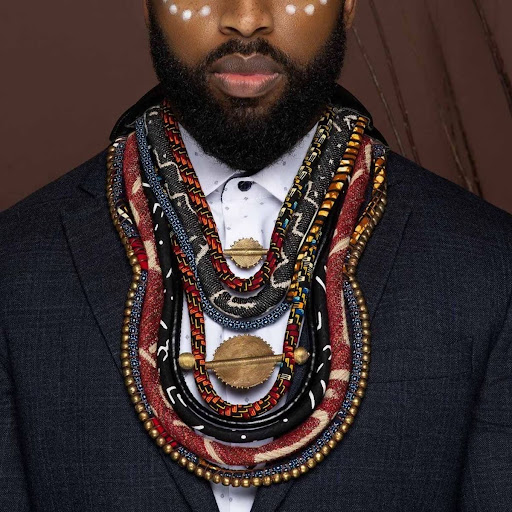
Before imported glass beads became widely available through Indian Ocean and later European trade routes, artisans across Botswana worked with locally sourced materials: ostrich eggshell, shells, seeds, bone, leather, sinew, and plant-based fibres. The production of ostrich eggshell beads was technically demanding: the shell was broken into small pieces, chipped into a disk shape, and then pierced with an arrow to drill the central hole. The resulting beads, creamy white and consistent in their disc form, were the most widely circulated adornment material in the southern African region for tens of thousands of years.
Glass beads entered the region through Arab and Portuguese traders via the East African coast from the seventh to eighteenth centuries, becoming more widely available after European settlement. Brighton Museum’s collection research confirms that this introduction expanded the visual range of beadwork without displacing the Indigenous tradition. Rather than treating imported glass beads as a break from heritage, Botswana’s artisans incorporated them into existing design systems, using their brightness and colour range to extend and elaborate patterns that older materials had established. The result is a craft language that has always been adaptive, absorbing new materials into older logics without losing those logics.
This dynamic is directly parallel to what happened with Maasai beadwork in East Africa. Omiren Styles’ documentation of Maasai beadwork meaning and symbolism confirms that during the 19th century, glass beads from Europe and Asia entered East Africa through colonial trade routes. Rather than displacing tradition, these materials were absorbed into it. The glass bead became central, valued for its brightness and durability. The system absorbed the external material without dissolving the internal logic that governed its use. Botswana’s beadwork followed the same pattern: the technical argument and the cultural one remained intact.
Why Men’s Beadwork Receives Less Attention
Botswana men’s beadwork is less widely discussed than women’s beadwork for several interconnected reasons. Museum collections assembled during the colonial period, including the Willoughby collection at Brighton Museum, often foregrounded women’s jewellery because it was more visually prominent as standalone adornment. Tourism has historically highlighted women’s craft traditions as the more commercially accessible representation of Botswana’s heritage. Academic research has concentrated on bead production, exchange networks, and ceremonial use rather than specifically on male fashion and dress.
Most significantly, men’s beaded objects were frequently integrated into clothing, hunting gear, and ceremonial items rather than existing as separate jewellery pieces. The beaded leather bag, the decorated hunting equipment, the bead-embellished ceremonial garment: these are harder to identify as men’s fashion in the conventional sense because the beadwork is embedded in a functional object rather than worn as an isolated piece of jewellery. Once you start reading beadwork as a system of adornment embedded in material culture rather than as isolated jewellery, men’s traditions become much easier to see.
Contemporary Relevance and Living Practice
Botswana beadwork continues as a living tradition rather than a preserved historical record. As Botswana Tourism’s documentation of the country’s arts and crafts sector confirms, contemporary artisan communities in Botswana continue to produce handcrafted beadwork using traditional and contemporary materials, with the craft sector contributing to both cultural preservation and economic development. The Brighton Museum’s 2019 purchase of a contemporary ostrich eggshell bead necklace and earring set made by Nairobi artisan Dikgwa Kaki Matlakola at the National Museum of Botswana’s annual Basket and Craft Exhibition confirms that the material tradition is active enough to sustain contemporary production at an internationally recognised museum standard.
For contemporary fashion, the lesson of Botswana’s beadwork tradition is the same lesson that emerges from every serious African adornment system: the object is never only decoration. The ostrich eggshell bead worn by a San man in the Kalahari as part of a hxaro gift-exchange relationship is carrying something that cannot be purchased separately from the social system that produced it. The beaded leather bag worn on a hunt is simultaneously a functional tool and a cultural statement. The bracelet worn at a ceremony is readable by the community in ways that are invisible to a casual observer but precise to those who know the grammar.
The Omiren Argument
Botswana men’s beadwork accessories belong to one of the oldest and most geographically significant adornment traditions in southern Africa. The African fashion market is worth 31 billion dollars. Botswana’s contribution to the cultural knowledge behind that market is older than the market by tens of thousands of years. Ostrich eggshell beads have been produced and exchanged across southern Africa for more than 40,000 years. San communities used them as vehicles of long-distance social relationships in the hxaro exchange network, turning adornment into infrastructure. Tswana, Kalanga, and Kgalagadi men wore beaded necklaces, bracelets, belts, and decorated leather accessories that communicated cultural identity, community belonging, ceremonial participation, and life stage in community-specific visual languages. These traditions are less widely known not because they were less important. Rather, museum collections, tourism, and fashion media have historically foregrounded women’s beadwork while treating men’s beadwork as incidental to clothing and functional objects, and therefore less visible as fashion. Omiren Styles documents Botswana men’s beadwork here as what it is: a coherent, historically deep, and culturally specific adornment tradition that fashion writing has consistently overlooked.
Also Read
- Top 5 Traditional Styles for Ndebele Women in 2026
- Maasai Beadwork: Meaning, Symbolism, and the Language of Identity
- The Dipo Ceremony and What Krobo Beadwork Communicates About Womanhood in Ghana
- What Is the Maasai Shuka and Who Profits When a Blanket Becomes a Global Fashion Staple
Frequently Asked Questions
What are traditional men’s beadwork accessories in Botswana?
Traditional men’s beadwork accessories in Botswana include beaded necklaces worn at ceremonies and cultural events; bracelets and wristbands used as decorative and ceremonial pieces; bead-decorated leather bags and hunting equipment; and bead-embellished garments and ceremonial attire. The exact forms vary between Botswana’s communities: San, Tswana, Kalanga, and Kgalagadi peoples each maintained distinct beadwork traditions, with ostrich eggshell beads being the most historically significant material across all groups.
What do Botswana men’s beadwork accessories symbolise?
Depending on community and context, Botswana men’s beaded accessories can signal cultural identity, community belonging, ceremonial participation, family heritage, social connections, and respect for tradition. Researchers consistently caution against assigning universal meanings to specific colours or patterns because symbolism differs between Botswana’s communities. A colour combination that carries one meaning among the San of the Kalahari may carry a different meaning in a Tswana context.
Why are ostrich eggshell beads important in Botswana’s cultural history?
Ostrich eggshell beads are among the oldest known forms of personal adornment in southern Africa, with evidence of production and exchange extending more than 40,000 years. In Botswana, they have been used for jewellery, clothing decoration, ceremonial accessories, and gift exchange. Among San communities, ostrich eggshell beads formed part of the hxaro gift-exchange system, through which long-distance social relationships and alliances were established and maintained across the Kalahari region.
How did European trade change Botswana beadwork?
European trade introduced colourful glass beads that expanded the range of materials available to Botswana’s artisans. Rather than replacing traditional bead-making techniques, imported glass beads were incorporated into existing design systems, extending the visual range of beadwork while preserving Indigenous methods and cultural grammar. This adaptive incorporation is consistent with how other southern and East African beadwork traditions responded to new materials: the external input was absorbed into the internal logic rather than replacing it.
Why is Botswana men’s beadwork less well known than women’s beadwork?
Botswana men’s beadwork is less visible for several reasons. Museum collections have historically foregrounded women’s jewellery as more visually prominent standalone adornment. Tourism narratives have centred women’s craft traditions. Most significantly, men’s beaded objects were frequently integrated into clothing, hunting gear, and ceremonial items rather than worn as separate jewellery pieces, making them harder to identify as fashion in the conventional sense. Once beadwork is read as a system of adornment embedded in material culture rather than as isolated jewellery, men’s traditions become clearly visible.
How is Botswana beadwork influencing contemporary fashion?
Traditional Botswana beadwork continues as a living practice through artisan communities, heritage festivals, and the Botswana Tourism craft sector. Contemporary jewellery designers and accessories makers draw on traditional techniques, materials, and cultural storytelling to produce pieces that carry the heritage forward into new markets. The National Museum of Botswana’s annual Basket and Craft Exhibition is one platform through which contemporary artisans, such as Dikgwa Kaki Matlakola whose work was acquired by Brighton Museum in 2019, reach international institutional collectors.
Explore More
Read the full Culture > Heritage & Identity section at omirenstyles.com for Omiren Styles’ documentation of African adornment traditions, beadwork histories, and the cultural systems through which communities across the continent have communicated identity, life stage, and social belonging for thousands of years.