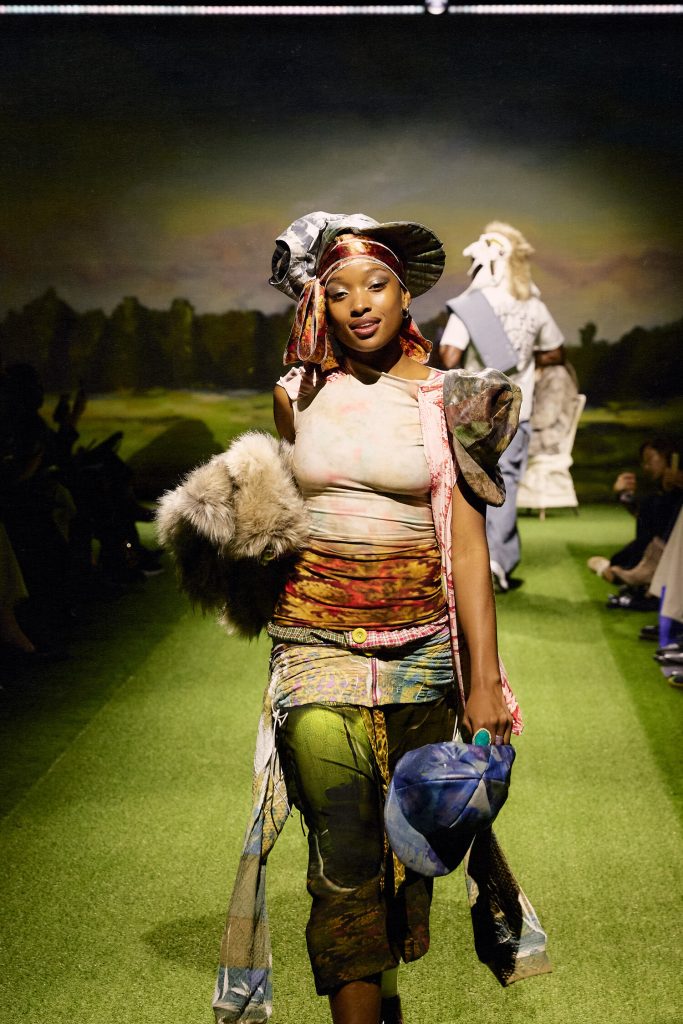
Before the barbecue becomes a spectacle, a grandfather asks when the family was last properly together. An older model enters in a distressed grey waxed-cotton outfit. The question is about reunion, but also about the lives relatives lived before younger generations knew them. That is a more interesting starting point than nostalgia alone. Family memory does not preserve everyone equally. Grandparents can become fixed in their later roles; parents’ earlier selves survive through photographs and occasionally surprising revelations. A familiar person turns out to have had another life. For spring/summer 2027, YAKU makes those partial accounts productive. Can’t Rush Cooked Food brings its continuing fictional family narrative into the setting of a barbecue, where recollection develops into folklore. Ordinary clothing categories share the scene with gaming references, exaggerated objects and invented surfaces.
The collection’s achievement is not that every garment tells a complete story. It is that the story is distributed: a silhouette establishes a presence, a photograph supplies a fragment of evidence, and a performance gives a character behaviour. The strongest moments let these elements contribute differently, rather than making each repeat the same explanation.
YAKU’s SS27 collection turns a family barbecue into clothing, photographic accessories and performance, exploring how memories become characters.
From a Relative to a Character
YAKU’s current biography names British-Caribbean designer Yaku Stapleton and his partner, Nas Kuzmich, as the studio’s founders. Its practice extends from menswear into sculpture, performance, set design and digital storytelling. Clothing is central, but it is not the studio’s only medium. That breadth begins in Stapleton’s process. Speaking to the Observer before the show, he described making collages around real relatives, amplifying their characteristics into figures that might be humanoid or monstrous. He calls this the “limitless version”. SS27 centres on characters based on his grandfather and two sisters, whose memories of a barbecue do not align.
The phrase describes an operation rather than a simple influence. The relative supplies a starting point; collage permits exaggeration; the resulting character creates possibilities for clothing and performance. It does not directly explain every seam or accessory. The documented method gives the collection its framework, while individual garments still need to be understood through their particular decisions. Crucially, the disagreement remains useful. A conventional family album might select the clearest image and settle on a caption. YAKU leaves room for competing versions. The collection can accommodate a recognisable person and a fantastical interpretation without deciding that only one is true.
The Grandfather Is More Than a Costume
The opening grey outfit establishes the grandfather through material and presence rather than a printed declaration of his role. Its distressed waxed-cotton surface looks like an identity beyond the narrative attached to it. The surface treatment is significant. An artificially aged finish does not prove a garment has a history, but it can introduce the appearance of wear into a newly made object. Here, that appearance sits beside a story concerned with what younger relatives know, and do not know, about an older person. The result need not be read as a reconstruction of something a grandfather actually owned. It is a proposed image of a character, made from a familiar clothing vocabulary and altered through treatment.
That distinction protects the work from an overly literal reading. Memory-led design does not have to reproduce the past accurately to engage with it meaningfully. It can reveal the act of imagining someone’s earlier life. The grey look is persuasive because it gives the character room beyond a single anecdote. Its interest does not depend entirely on the audience recognising a particular joke. Material, ageing and the wearer’s presence establish a quieter register within a collection that also enjoys excess.
Wearing the Family Photograph
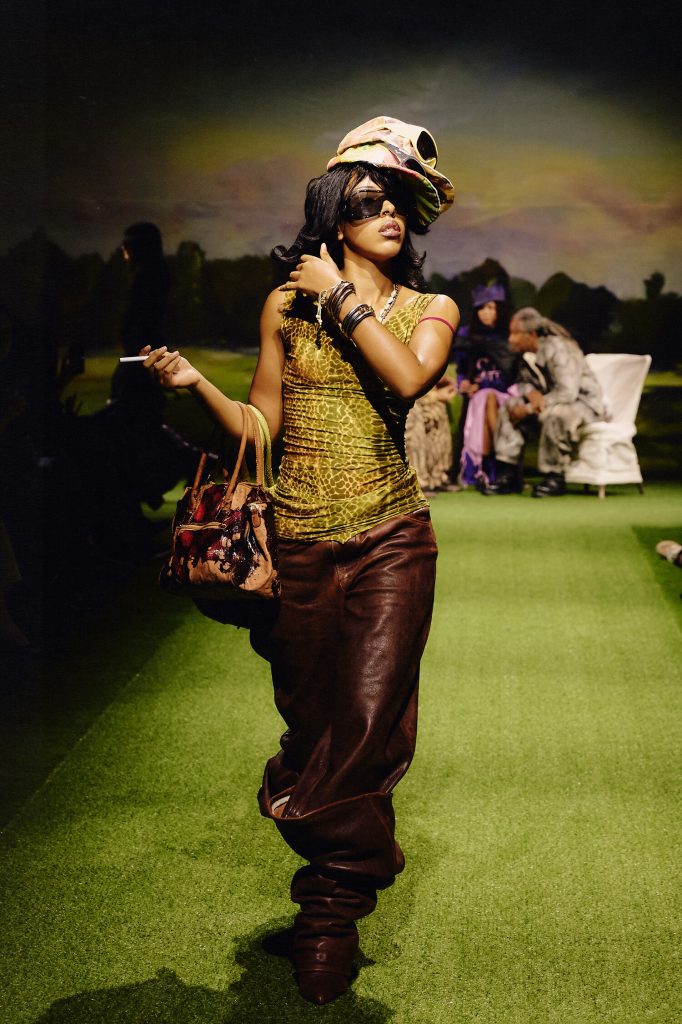
Another look combined brown leather trousers, full through the leg and sharply narrowed at the ankle, with stacked baseball caps carrying photographs from Stapleton’s childhood. The accessories and trousers work through different kinds of information. The caps carry images from an identifiable archive. The trousers alter the body’s outline. Stacking several caps changes the familiar object before the photographs are even read. Something normally worn singly becomes an accumulation. The headwear holds more than one image and more than one layer, making excess part of its form. That is an effective way to handle family photography. The images are neither isolated in a gallery-like presentation nor reduced to a discreet sentimental detail. They become conspicuous, mobile and slightly unruly.
The trousers produce a different effect. Their narrowing at the ankle concentrates the volume above, giving the silhouette a pronounced endpoint. This is character-building through proportion rather than documentation. Neither approach needs to defeat the other. The photographic accessory succeeds by making its source visible. The trousers work through shape. Together, they show how the same outfit can hold a record and an invention without forcing them into one technique. This is the collection’s clearest demonstration of memory as more than a source for prints. An archive can be worn literally while the body around it is imagined differently.
Humour Has a Place in the Wardrobe
A championship-belt graphic on a short-sleeved shirt replaces the expected lettering with “UNC”. The family role becomes a title, with the grandiosity of the sporting reference doing much of the comic work. The humour is not incidental to the collection’s account of remembering. Families often describe one another through exaggerated reputations. A person becomes the accomplished one, the difficult one or the one whose entrance changes the atmosphere. Such descriptions are affectionate in some circumstances and restrictive in others. The shirt participates in that inflation. It gives a familiar role the visual apparatus of an award.
Its immediate legibility serves a different purpose from the photographic caps. The caps invite attention to particular images; the graphic delivers its premise quickly. That speed can help establish a character within a busy show. The limitation is not that humour makes a garment less serious. It is that a joke and a silhouette sustain attention differently. The graphic offers recognition; the cut and styling must determine what remains after that recognition. YAKU’s collection benefits from containing both immediate and slower readings. Its world would be flatter if every object required explanation, or if every object announced its meaning at once.
Fantasy Belongs to the Memory
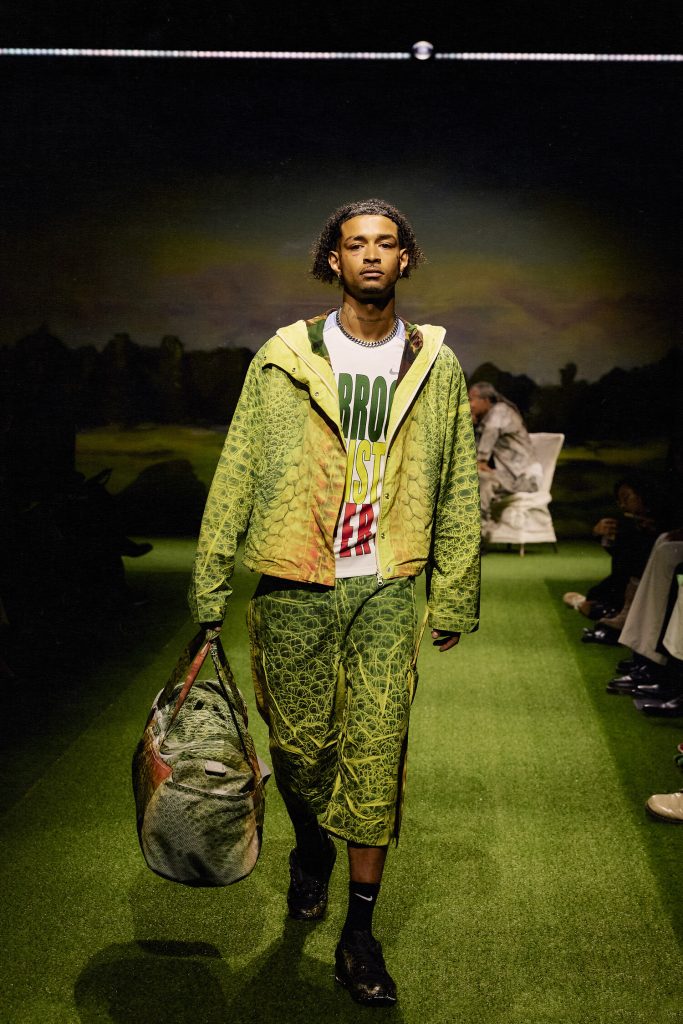
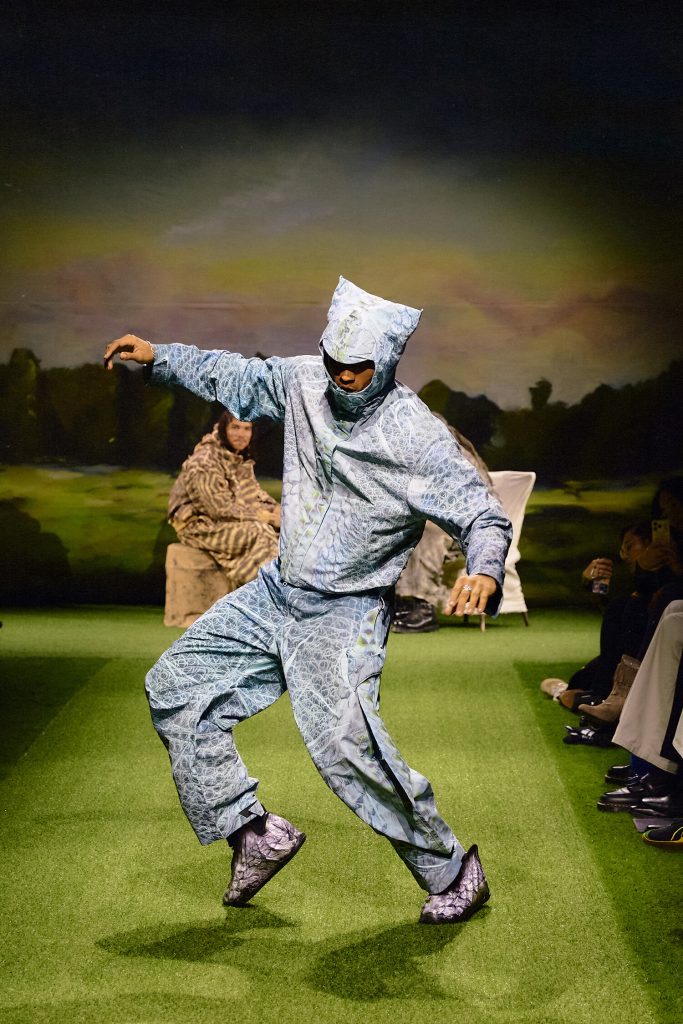
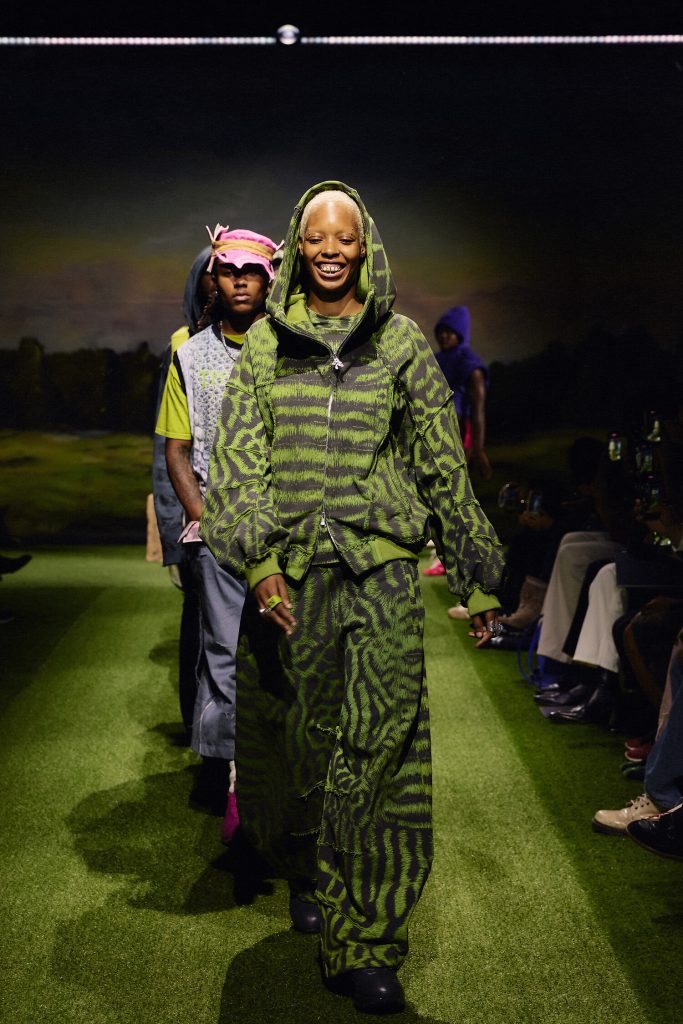
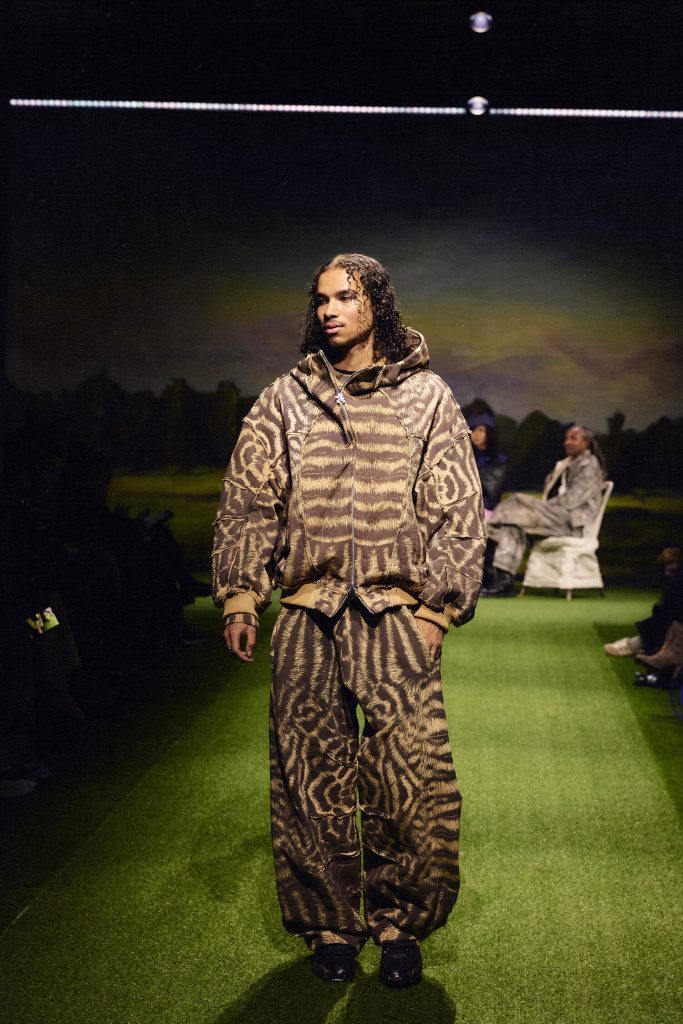
The barbecue does not displace YAKU’s established gaming vocabulary. Noctis documents “Zilla-skin” patterns and a dress referencing Varrock, the city in RuneScape, alongside the collection’s baggy tracksuits and shorts. The description “Zilla-skin” should not be mistaken for a verified material specification. The reporting establishes a named surface pattern, not its fibre content or production technique. Its role within the collection is to keep the familiar wardrobe open to an invented creature-world. The Varrock reference works differently. Text names an attachment that some viewers will recognise and others will not. It places a remembered digital environment inside the same scene as a family gathering.
There is no need to separate these into authentic memory and escapist fantasy. A game can belong to childhood as firmly as a house, an outfit or a relative’s voice. It becomes part of what a period felt like. YAKU’s particularity lies in allowing those registers to coexist. The family is not transported intact into a generic fantasy setting. Its memories help generate the setting.
The Runway Becomes a Social Space
SS27 was YAKU’s first runway show, according to Noctis, following earlier presentations built around interactive stations. Three characters took seats beside the runway, occupying a position between performers and spectators. That arrangement gives the audience a model for watching. The people in the story are also observers. Their presence makes the runway resemble a social situation rather than a sequence of isolated entrances. Elsewhere, flips, a kiss and a deliberately withdrawn handshake supplied behaviour that a conventional walk could not. These gestures do not explain construction, but they establish relationships, embarrassment, confidence and play. They make personality visible through action.
Stapleton had already articulated his dissatisfaction with a straight-line walk in the Observer interview: he felt the characters “deserved more”. The performance is therefore not an accessory added to an otherwise complete runway concept. It is part of the studio’s stated method. The distinction matters when assessing the show. A theatrical object need not justify itself as daily clothing. Its task may be to establish scale, humour or a character’s relationship to the world. The garments, accessories and actions should be judged for what each contributes, and for whether they support one another.
Where the Presentation Strains
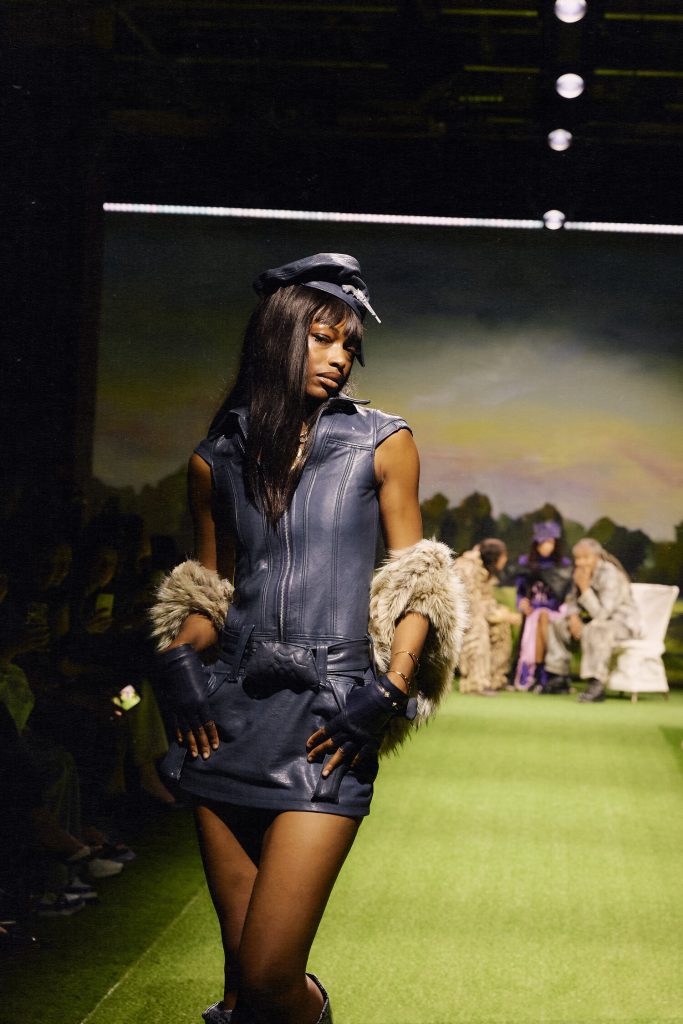
The move to a runway also introduces practical pressure. Vogue’s Elektra Kotsoni reported a five-minute delay before spectators furthest from backstage saw clothes. That is a specific observation about visibility, not a verdict on every audience member’s experience. It nevertheless identifies a real tension. A character can take time to establish, but a fashion presentation still needs to give viewers access to the objects under consideration. The answer is not necessarily a faster, quieter show. Removing the behaviour would remove part of YAKU’s subject. More precise choreography could preserve the social atmosphere while making the garments easier to follow.
The final bow offered another account of the production. Hypebae recorded the backstage team joining the models and designer in “Greatest Team” T-shirts. The fictional family temporarily gave way to the people who had made its appearance possible. That was an apt conclusion to a collection concerned with how groups remember themselves. It also made collective labour visible without requiring another invented character.
A Particular Family, Not a Universal Template
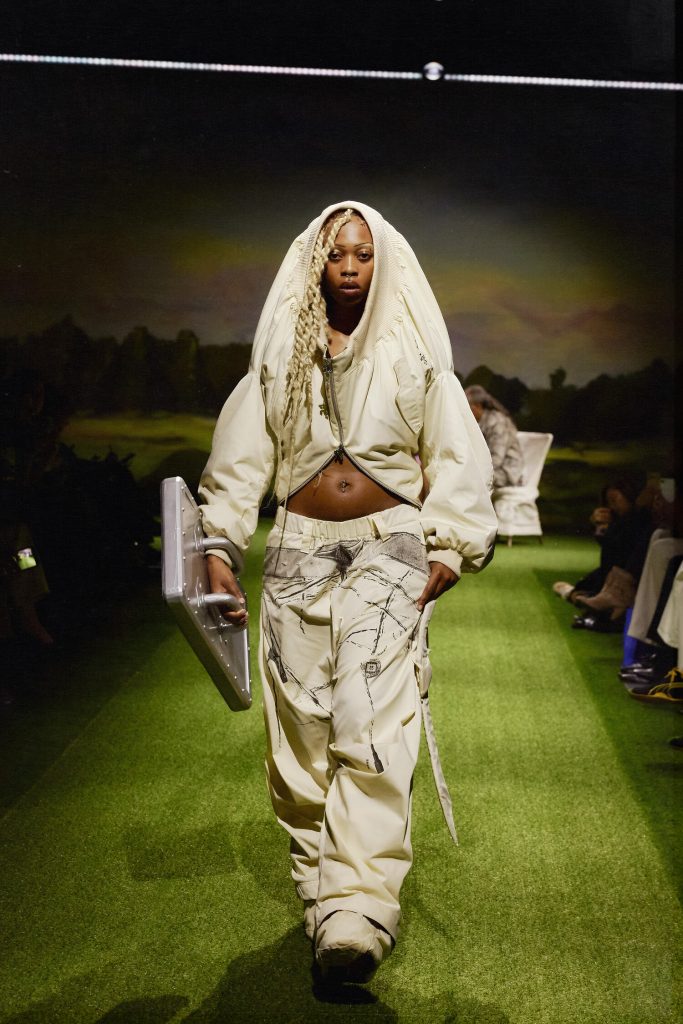
Noctis identifies British-Caribbean references within SS27 alongside early-2000s and gaming aesthetics. The significance lies in their arrangement, not in treating every barbecue or family joke as culturally exclusive. YAKU’s specificity does not require universal recognition. One viewer may recognise a gesture immediately; another may respond first to scale, colour or absurdity. The collection can support both encounters. Its most convincing contribution is the refusal to tidy those experiences into one authoritative memory. The photographs, characters and behaviour retain different relationships to the past. The limitation is equally clear: some of those relationships are easier to understand through the reporting than through the clothes alone. Yet complete independence from narrative is not the appropriate measure of success for a studio working across media.
The better judgement is whether the parts add something to one another. In SS27, the photographic caps, altered proportions and performed encounters do. They build a family world through different forms of evidence rather than repeatedly illustrating one anecdote.
The Omiren Argument
YAKU SS27 succeeds by distributing memory across several media. Photographs supply records, proportion invents bodies, and performance gives the characters relationships.
The collection does not make those operations equally clear at every moment. Its runway choreography sometimes complicates access to the clothes, and some references remain dependent on explanation.
But its central design proposition is convincing: a family archive need not become a fixed image. It can become a system for producing different objects, gestures and appearances. Can’t Rush Cooked Food gives recollection a form without pretending there was only one version of the gathering.
Also Read:
- West African Dress as a Living Record: What Oral History Reveals About Cloth
- From Style to Culture: How Fashion Brands Become Ecosystems
- When Style Becomes Language: Africa’s New Fashion Movements
- Copenhagen Fashion Week AW26/27: Beyond Runways, Into Insight
Frequently Asked Questions
Who founded YAKU?
YAKU’s official biography names British-Caribbean designer Yaku Stapleton and his partner, Nas Kuzmich, as the studio’s founders. The practice extends from menswear into sculpture, performance, set design and digital storytelling, so clothing is central to the studio but is not its only medium.
What is YAKU’s SS27 collection called?
The spring/summer 2027 collection is titled Can’t Rush Cooked Food. It places the label’s continuing fictional family narrative in the setting of a barbecue. According to Noctis, it was YAKU’s first runway show, following earlier presentations built around interactive stations.
How does family enter the design process?
Stapleton describes making collages around real relatives and amplifying their characteristics into figures that might be humanoid or monstrous, which he calls the “limitless version”. SS27 centres on characters based on his grandfather and two sisters, whose memories of a barbecue do not align.
How does the collection carry memory beyond the clothes?
Memory is distributed across several media. Stacked baseball caps carry photographs from Stapleton’s childhood, a distressed grey waxed-cotton outfit establishes the grandfather, and a shirt with a championship-belt graphic reading “UNC” turns a family role into a title. Flips, a kiss and a withdrawn handshake add behaviour to the runway.