Rosa Maria dos Santos distinguished difficulty from effort. In a 2012 interview in Sobral, Ceará, she explained that acarajé was not difficult to make, but involved a great deal of work. Her account moved between ingredients, preparation, transport, selling locations and the uncertainty of customer demand. Fourteen years later, Rita Santos, identified by Brazil’s Ministry of Culture as the national coordinator of the baianas’ association ABAM, discussed a different scale of responsibility: what heritage recognition should deliver for the people practising the occupation. She called for safeguarding, protection, income generation and better working conditions. These are separate accounts, not a continuous record of one business or a reconstruction of one working day. Together, they help explain why the work of a baiana de acarajé cannot be understood through the finished food alone.
Published accounts from Sobral and Brazil’s Ministry of Culture show the learning, preparation, dress and selling behind the work of baianas de acarajé.
Learning From Someone Who Knows the Work

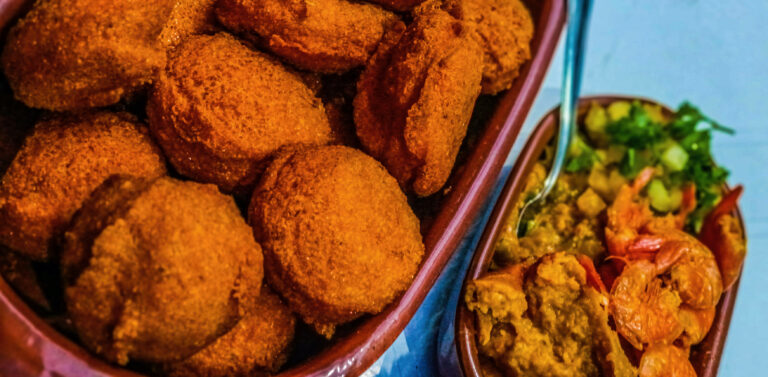
Acarajé is made from black-eyed peas and fried in dendê, or palm oil. The Ministry of Culture traces its origins to the Gulf of Benin in West Africa. It describes its preparation knowledge as having reached Brazil through enslaved Africans, subsequently sustained especially by Black women. The transmission of that knowledge has involved named teachers and a longer history. Rita Santos identifies Clarice Souza dos Anjos, founder of ABAM, the national association representing baianas de acarajé and related practitioners, as the person who taught her. She learned in 2001 through a course Clarice delivered via Sebrae, Brazil’s small-business support organisation.
Rosa Maria described another route. While living in Fortaleza, she worked with two women from Salvador who made and sold acarajé. Initially employed to help in the household and care for a baby, she began assisting with preparation. She later took on making and selling the food. She also corrected a geographical assumption: she was from Ceará, not Bahia. She entered the work by living and working with baianas. The two accounts show distinct forms of learning: organised instruction and an extended working relationship. Neither requires the teacher to disappear behind a general statement about tradition.
The Work Before and Around the Tabuleiro
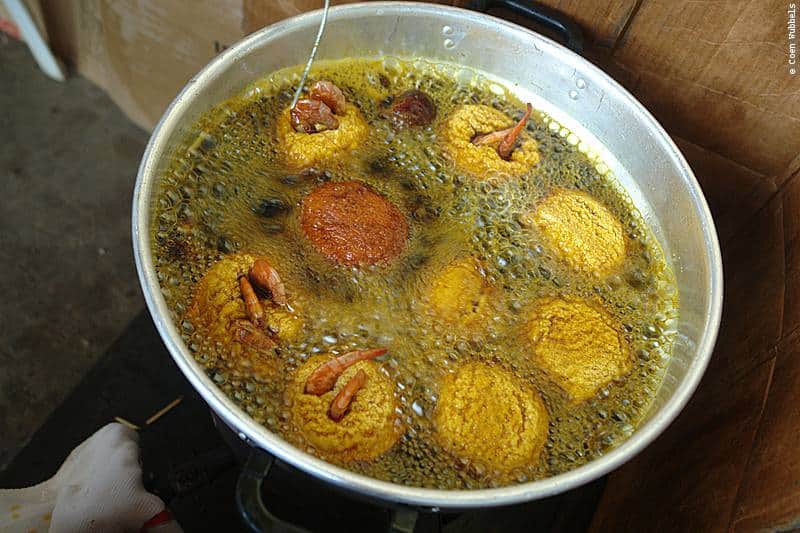
In Rosa Maria’s account, preparation began at home. She made batter there and took it to the selling point, where she prepared portions in response to demand. Her daughters helped with the preparatory work. Ingredients required their own arrangements. She said her husband bought dendê in Fortaleza because she could not obtain a suitable supply in Sobral. She identified the oil and shrimp as significant expenses. These details describe her circumstances in 2012, not current prices or availability. They nevertheless establish something a recipe cannot: obtaining an ingredient was part of the work.
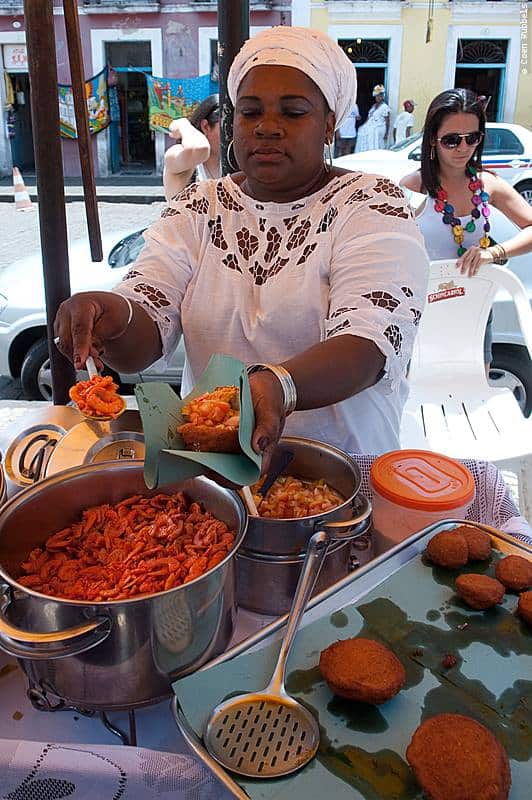
So was moving equipment. Rosa Maria recalled arrangements involving a cart, someone to push it and later other forms of transport. They also had to choose and reassess the selling place. In the interview, she compared the city park with the Praça São João fair and described events as another important source of business. Demand was not assured. She remembered early occasions when she returned without selling any acarajé. By the time of the interview, her assessment of the strongest location had changed: the fair was performing better for her than the park. The tabuleiro, the display and serving arrangement through which customers encounter the food, was therefore one part of a larger operation. Behind it were decisions about supplies, preparation, transport, timing and where to work. The Ministry of Culture’s description of the occupation explicitly includes choosing and preparing ingredients, organising the tabuleiro and maintaining relationships with the spaces in which the activity takes place.
“For Me, It’s a Uniform”
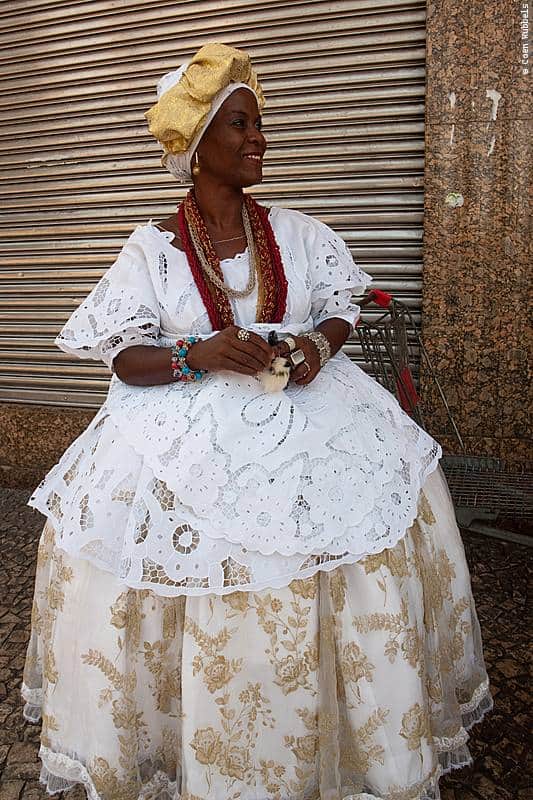
Rosa Maria’s interview also explains why we should not interpret clothing without listening to the wearer. She recognised religious relationships within the wider tradition. But when discussing her own clothing, she described it as a farda: a uniform for selling acarajé. Its appearance helped people identify what she offered. That was her interpretation of her commercial work. It should neither be overwritten by a general explanation of sacred dress nor applied to every other practitioner.
The Ministry of Culture describes religious knowledge as part of the occupation’s recognised heritage, including relationships with Candomblé and the orixás Xangô and Oyá. It also discusses food sold commercially at the tabuleiro. These sources address different questions. The institutional account explains relationships within the recognised practice. Rosa Maria explains what clothing meant in her own work. Neither permits a writer to infer every seller’s religious affiliation from an outfit, a food or an occupational title.
Sharing Skills Without Choosing a Successor
Rosa Maria said her daughters knew how to make acarajé. They could help with preparation for an event or take on the work when she was ill. When asked whether one would eventually take over, however, she did not identify a successor. She said she did not know and did not intend to stop working soon. The distinction is useful. Passing on skills is not the same as determining another person’s occupation.
Rita Santos’s experience also shows that continuity need not depend exclusively on family succession. Her named teacher and course identify a route through which someone outside a particular household could learn. The Ministry of Culture recognises transmission within families and through other baianas. The practice continues through people able to do the work, but their paths into it need not be identical.
What Heritage Recognition Covers
Brazil’s Instituto do Patrimônio Histórico e Artístico Nacional, Iphan, registered the Ofício das Baianas de Acarajé in its Book of Knowledge in 2005. Iphan describes its essential elements as including practices surrounding food production, clothing, the arrangement of the tabuleiro and preparation of the working space. The registered subject is therefore broader than a recipe. It concerns an occupation and its associated knowledge. Iphan’s own revalidation materials likewise identify the registration as recognition of African knowledge in Brazil and discuss safeguarding undertaken with practitioners and public bodies.
Rita Santos argues that understanding this scope is necessary before treating the occupation only as commerce or gastronomy. In the Ministry of Culture’s 2026 account, she describes it as living heritage connected with African ancestry, Black women’s resistance and the transmission of knowledge. Her practical demand is equally clear: recognition should not remain merely symbolic. It should lead to measures that support practitioners’ ability to continue working. That is an attributed position, not evidence that every requested outcome has been achieved. It offers a question for future reporting: what has recognition changed in practitioners’ working conditions?
What the Two Accounts Make Visible
Rosa Maria’s historical testimony supplies operational detail: who helped, where ingredients came from, how equipment moved and why one selling location might be preferable to another. Rita’s more recent account identifies teaching and safeguarding as responsibilities extending beyond an individual business. The difference between them is productive.
One makes a particular working experience legible. The other explains what a practitioner and association representative want cultural recognition to accomplish. Neither should stand in for all baianas. Their value lies in what they say specifically, and in the questions their accounts make possible.
The Omiren Argument
A tradition is not sustained by visibility alone. The accounts examined here identify teaching, supplies, preparation, selling and the ability to continue working as parts of its life. Heritage recognition names the practice’s significance; it does not remove the need to understand those conditions. For Omiren, the principle is livelihood: examine how cultural knowledge is practised without reducing its holders to either commercial operators or picturesque symbols.
That means preserving the distinction between a practitioner’s experience, an association representative’s demands and an institution’s description of heritage. Serious coverage should explain what is recognised, and listen to what the people doing the work say they need.
Also Read:
- The Rise of Afro-Brazilian Fashion Designers and Their African Roots
- The Pollera, the Wob Dwiyet, and the Baiana: The African Women Who Dressed the Americas
- How African Diaspora Communities Use Dress to Mourn, Celebrate, and Survive
- Afro-Brazilian Renaissance: Reclaiming Heritage, Shaping Today
Frequently Asked Questions
Who taught Rita Santos to make acarajé?
Rita Santos names Clarice Souza dos Anjos, founder of ABAM, the national association representing baianas de acarajé and related practitioners, as her teacher. She learned in 2001 through a course Clarice delivered via Sebrae, Brazil’s small-business support organisation. Her route shows that skills can pass through organised instruction, as well as through family or an extended working relationship with other baianas.
Why is the work of a baiana de acarajé more than cooking?
Rosa Maria dos Santos said acarajé was not difficult to make but involved a great deal of work. Her 2012 account covered obtaining dendê and shrimp, preparing batter at home, moving equipment, choosing a selling place and facing uncertain demand. The tabuleiro was one part of a larger operation that began long before the customer arrived.
What does Brazil’s heritage registration cover?
IPHAN registered the Ofício das Baianas de Acarajé in its Book of Knowledge in 2005. It describes the essential elements as including food production, clothing, the arrangement of the tabuleiro and preparation of the working space. The registered subject is therefore an occupation and its associated knowledge, not only a recipe.
Did Rosa Maria name a successor for her work?
No. She said her daughters knew how to make acarajé and could help at events or work when she was ill. Asked whether one would take over, she said she did not know and did not intend to stop working soon. Her account separates passing on skills from deciding another person’s occupation.