A printed cotton dress survives with its handstitching, gathered sleeves and carefully positioned pattern. Its neckband and waistband were cut to display selected portions of the textile. Piping defines the armholes and the lower edge of the waistband. Made in Staunton, Virginia, between 1845 and 1865, it records a sequence of skilled decisions. Its maker’s name has not survived in the published record.
The National Museum of African American History and Culture titles the object Dress made by an unidentified enslaved woman. Its creator field is more open: “Unidentified Woman or Women”. The distinction leaves room for one maker or several without diminishing the evidence of their work.
The dress belongs to the Black Fashion Museum Collection, alongside garments by named designers including Ann Lowe and Peter Davy. Read together, these three objects offer different routes into fashion history: construction without a recovered name, a recognised designer examined beyond a celebrated commission, and a Caribbean-born designer whose surviving work provides substance for further study.
Their preservation owes much to Lois K. Alexander-Lane. The museum she founded helped preserve clothing that documented Black participation in fashion materially, rather than acknowledging it only through familiar public figures. The collection’s significance begins with that act of recognition: deciding that the work was worth keeping.
Explore the Black Fashion Museum Collection through Ann Lowe, Peter Davy, an unidentified enslaved maker, and Lois Alexander-Lane’s preservation work.
Lois Alexander-Lane’s collecting project
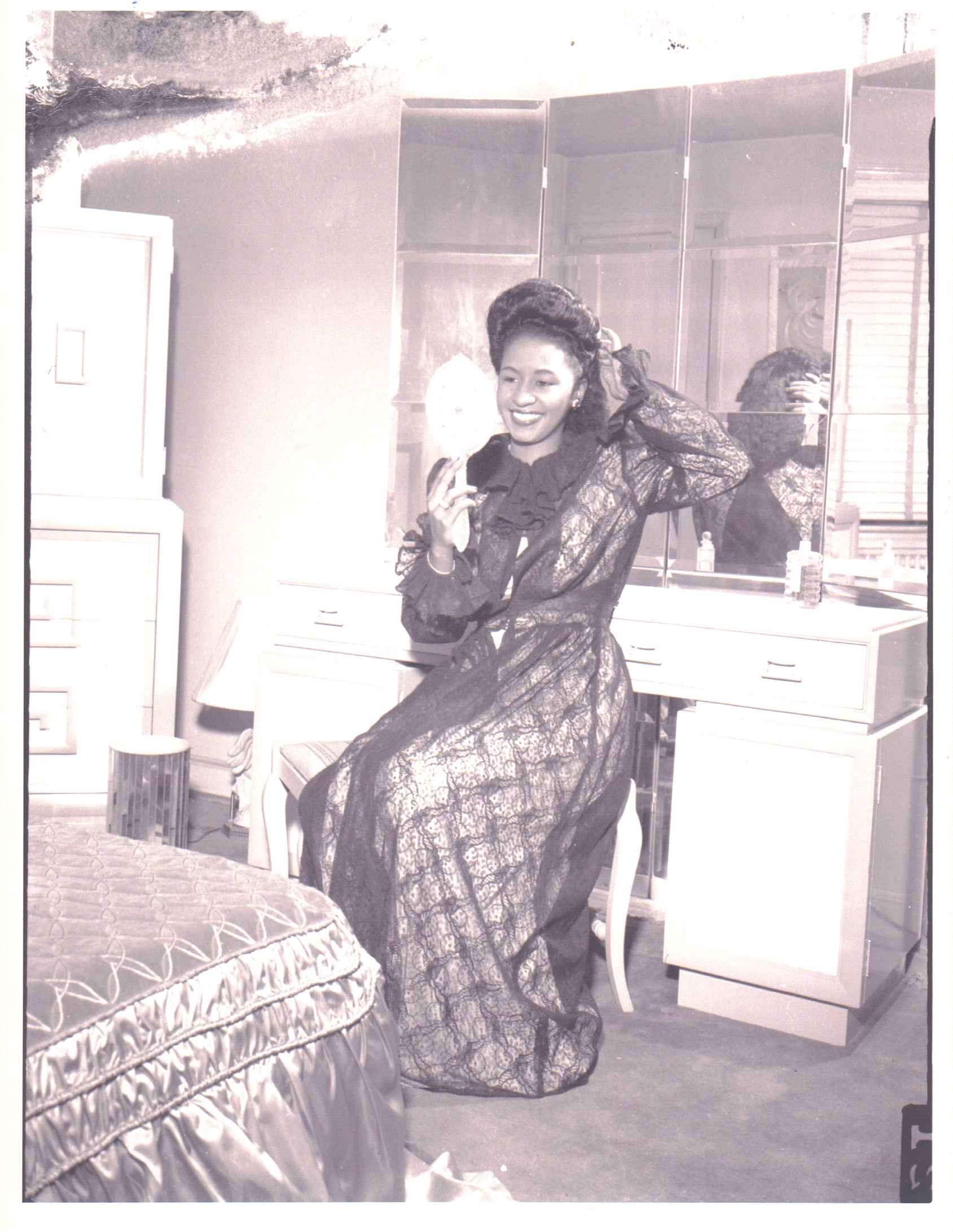
Alexander-Lane founded the Black Fashion Museum in 1979. It opened in Harlem and relocated to Washington, DC, in 1994. Her museum work formed part of a broader professional life encompassing fashion education and enterprise, including the Harlem Institute of Fashion, which she established in 1966.
Her collecting addressed a substantial documentary gap. A contemporary Washington Post account described her discovery of a largely undocumented history of Black contributions to American fashion. NMAAHC similarly characterises her lifelong work as an effort to document and preserve those contributions.
That purpose matters because the collection was not simply assembled around the ownership of valuable clothing. It brought attention to makers and forms of work that could otherwise remain difficult to identify within a public fashion history
The institution’s survival also required labour beyond acquiring objects. Reporting on the collection describes Alexander-Lane’s daughter, Joyce A. Bailey, seeking a permanent institutional home that would preserve the holdings together and make them available beyond a restricted research audience. In 2007, the Black Fashion Museum’s collection was donated to NMAAHC.
The donor credit attached to individual garments retains the earlier institution’s name: “Gift of the Black Fashion Museum founded by Lois K. Alexander-Lane”. That wording preserves a chain of custodianship. These objects did not simply arrive at the Smithsonian without a prior collecting history.
NMAAHC’s Black Fashion Museum collection guide provides an overview and helps you find published object records. This feature examines three of those records rather than attempting a survey of the entire collection.
A maker’s name is missing; the artistry is not.
The handstitched cotton dress, object number 2007.3.4, demonstrates why an unidentified maker need not become an indistinct historical presence.
Its construction is documented in detail. The long sleeves gather at the back shoulder seam, and the bodice gathers into the front waist. The full skirt combines gathers at the front hips and back with a flat central section at the front waist. The bodice and sleeves are lined in muslin; the skirt is unlined.
Those arrangements distribute fabric differently around the body. The record therefore preserves more than the broad description “a full-skirted dress”. It identifies where fullness was introduced and where the surface was kept flatter.
The printed cotton adds another layer of decision-making. A reddish-brown ground carries alternating columns of red roses and geometric motifs, with cream, black, orange and red contributing to the pattern. The neckband and waistband were “fussy cut”: cut selectively to display the printed design.
That phrase identifies an intentional relationship between textile and garment. The maker or makers did not merely use patterned cloth; they positioned parts of its design within specific structural elements.
Piping at the armholes and waistband further articulates the dress’s construction. Buttons and buttonholes survive at the back opening, while decorative buttons sit at the waist. The hem was turned up by three and a half inches. These details retain evidence of assembly and finish at a scale that a distant view of the silhouette could easily obscure.
The record does not recover the maker’s training, the garment’s wearer or the circumstances of every stage of production. Nor should technical accomplishment romanticise making under enslavement. What survives is a garment whose construction warrants precise attention alongside the documented condition of its maker or makers.
Anonymity limits one kind of knowledge: biography. It does not erase the material evidence.
Ann Lowe beyond a famous wedding dress
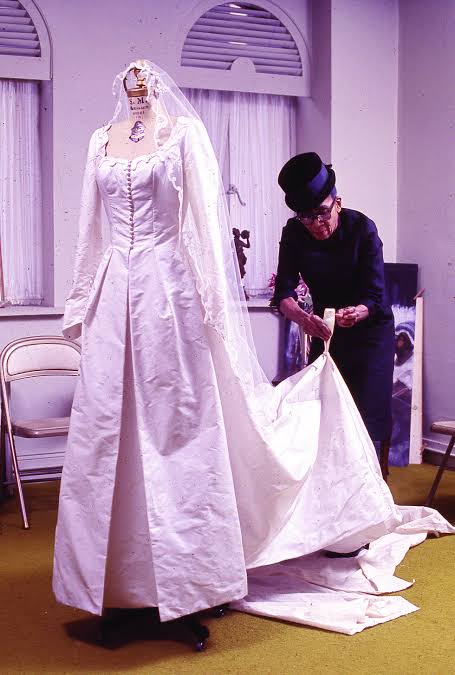
Ann Lowe’s association with Jacqueline Kennedy’s wedding dress offers a familiar entry point into her career. The Black Fashion Museum Collection also lets us examine other garments that make her practice more specific.
One is a pale green-teal silk sari gown dated 1966–1967, identified as designed by Lowe and worn by Barbara Baldwin Dowd. Made in New York City, it has a sleeveless bodice, scooped neckline, empire waist and floor-length skirt. Its object number is 2007.3.23.
The gown’s individual record shows how the design incorporated existing textile ornament. A sari border with heavy metallic geometric brocade forms part of the bodice. Embroidered leaves were cut from a border and sewn around the waist, with their lower edges left loose to create dimension.
The relationship between cloth and construction continues through the skirt. Additional brocaded leaves, cut from a larger sari fabric, were applied near larger leaves already present in the textile. A separate back panel extends from the upper bodice to the hem, its edges trimmed with border fabric. Bows at the shoulders use that border material too.
These decisions make the patterned textile active within the garment. Borders become framing devices; selected motifs become applied ornament; and flat embroidery acquires a dimensional edge.
The skirt combines a flat front with slight gathering at the back. Inside, boning, lining, elastic supports, an internal waist ribbon and a stiffened petticoat help establish and maintain the form. The catalogue records both the visible effects and some of the construction beneath them.
That is the historical value of this particular gown. It allows Lowe to be studied through the manipulation of material, the placement of ornament and the support of a silhouette. Her reputation directs attention towards the object, but it does not replace the analysis.
The named wearer also remains part of the record. Dowd’s identification establishes a relationship between garment and person without requiring an unsupported reconstruction of the occasion on which it was worn.
Peter Davy: a career made more visible through objects
Peter Davy’s presence introduces a different professional trajectory.
Born in Kingstown, St Vincent, Davy created Carnival costumes in St Vincent and Trinidad and Tobago before moving to New York City in the 1980s. NMAAHC describes him as a fashion designer, dressmaker and stylist. Its account also acknowledges that, despite his standing as a designer, relatively little is known about him.
The Black Fashion Museum held a retrospective of his work in 1994, four years after his death. When its holdings moved to NMAAHC in 2007, they included more than a dozen beaded gowns by Davy. His work was therefore not a marginal addition: the earlier museum had already devoted exhibition attention to his career.
The gold lamé strapless dress, object number 2007.3.84, offers one concrete point of study. The museum dates it to 1985–1990 and records New York City as its place of manufacture. Its materials include lamé, lace, net, sequins and beads.
The dress’s catalogue entry describes a fitted bodice with a sweetheart neckline. The skirt follows the hips before expanding above the knee through accordion-pleated godets: inserted sections that create additional fullness. Lace traces the neckline, the edges of the godets and the hem.
A metallic-gold net rosette sits at the front of the bodice, finished with a flower ornament of sequins and beads. Six pieces of boning support the upper bodice; the remainder of the dress is unlined.
The effect comes from a relationship between contour and expansion. The fitted upper portion establishes the body-following line, while the pleated inserts release the lower skirt. Ornament reinforces selected edges and concentrates attention at the bodice.
The museum attributes the unlabelled dress to Davy. That attribution, combined with its construction description and his documented career, makes the object available for discussion beyond a name in a list of overlooked designers.
His Carnival work provides professional context, but the catalogue does not identify this dress as a direct adaptation of a particular costume. The stronger connection is the documented career itself: a Caribbean-born maker whose work crossed costume, dressmaking and fashion, and whose garments were retained for study.
Three objects, different kinds of historical visibility
These dresses preserve unequal amounts of biographical information. That inequality does not establish a hierarchy of importance.
For the nineteenth-century dress, the maker or makers remain unidentified, while the construction is described in detail. For Lowe’s gown, both designer and wearer are named, and the record documents the treatment of an existing patterned textile. For Davy’s dress, attribution and professional context place a specific garment within a career that the museum continues to research.
Together, they show why a fashion collection needs more than recognisable ownership. A garment can document technical knowledge even when its maker’s name is absent. It can expand understanding of an established designer beyond a famous commission. It can also provide material substance for a career whose public record remains comparatively limited.
The first dress is not a preliminary stage on the way to named authorship. It asks a different question: what can skilled work retain when biography has been lost?
Alexander-Lane’s collecting helped preserve the possibility of asking that question alongside the others. The collection holds objects through which different forms of contribution can remain visible without being forced into the same kind of story.
Using the collection as a reference
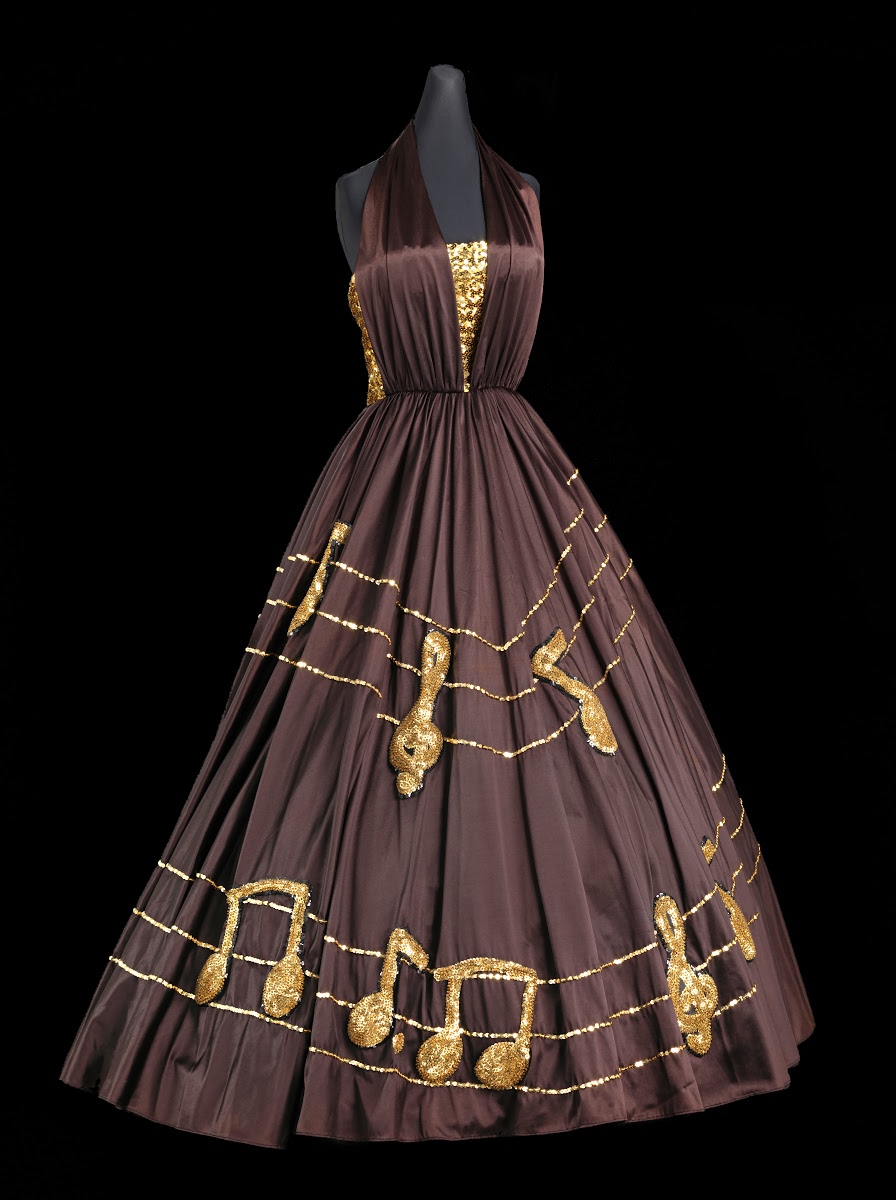
For readers, researchers and editors, the published records offer a practical starting point: an object number, a date or date range, materials, named people, places and a physical description.
Those fields should be read together. An object title may be concise while the creator field preserves uncertainty. A designer’s name may be familiar while the construction details supply less familiar evidence of practice.
Omiren’s What a Museum Record Can and Cannot Tell Us About Dress History examines that interpretive task in greater detail. Here, the essential point is that catalogue information becomes useful when it is attached to a specific garment and a specific question.
NMAAHC’s online guide facilitates that work without claiming to publish every holding. These selected records establish three examples, not the collection’s complete geographical, chronological or professional range.
Omiren Argument
The Black Fashion Museum Collection changes the questions we can ask of fashion history. A garment need not belong to a celebrity to document design, technical knowledge or working life. An unidentified maker does not become historically insignificant because a name was not preserved.
Alexander-Lane’s collecting work helped retain evidence that public recognition alone would not guarantee. Its value lies both in the garments and in the decision to preserve them as contributions to a larger history.
The task now is to make that evidence legible: identify makers where the record permits, explain construction precisely, and keep uncertainty visible without letting it eclipse the work. The collection is most powerful when its objects are not simply admired, but studied.
Also Read:
- African Textile Museums: Preserving Memory in an Age of Fast Fashion
- Fashion History Through African Women’s Wardrobes: Cabinets, Trunks and Family Archives
- West African Dress as a Living Record: What Oral History Reveals About Cloth
- Brixton’s Caribbean Dress Legacy: Tailoring, Fabric, Beauty and Cultural Memory
Frequently Asked Questions
What is the Black Fashion Museum Collection?
It comprises holdings from the Black Fashion Museum founded by Lois K. Alexander-Lane. The original museum opened in 1979; its collection was donated to NMAAHC in 2007. The Smithsonian now provides an online overview and individual object records, which this feature uses to examine three garments.
Why did Lois Alexander-Lane preserve fashion objects?
NMAAHC describes her lifelong work as documenting and preserving Black contributions to fashion. Contemporary reporting also identifies her attention to a substantial, previously undocumented history of that participation. Her museum retained clothing that materially documented Black participation in fashion.
What does the collection preserve about unidentified makers and named designers?
One documented example is a dress made by an unidentified enslaved woman or women, dated 1845 to 1865, whose record preserves detailed evidence of handstitching, gathering, pattern placement, piping and lining. This feature also examines a gown by Ann Lowe and a gold lamé dress by Peter Davy, as selected examples rather than a complete list of designers.
Do the online records cover the entire collection?
They should not be treated as an exhaustive inventory. The NMAAHC collection guide explains how to search published records and identifies people represented in the online collection. This feature examines three records, not the collection’s complete geographical, chronological or professional range.